Key Takeaways
- Programmatic Corporate Efficiency: Transitioning to a decentralized model eliminates intermediate bureaucratic layers, automating core governance and payroll to reduce operational overhead by up to 30%.
- Mitigating Plutocracy & Exploits: Implementing advanced mechanics like Quadratic Voting and strict multi-sig parameters protects institutional treasuries from whale dominance and governance exploits.
- Enterprise-Grade Compliance: Sustainable DAO development requires a bulletproof legal framework (such as Wyoming LLCs or Cayman Foundations) to prevent joint-and-several liability risks for token holders.
- Customizable Hybrid Architectures: Forward-thinking enterprises avoid pure decentralization, choosing instead to delegate specialized business operations to automated sub-DAOs while retaining macro-level accountability.
A decentralized autonomous organization is changing how businesses coordinate capital, governance, and operations. Instead of relying on centralized management layers, organizations can automate decision-making through transparent blockchain protocols and smart contracts.
The global DAO ecosystem manages billions of dollars in treasury assets, while enterprise adoption continues to grow across investment networks, supply chains, creator economies, and tokenized asset ecosystems.
Modern organizations use DAO development governance frameworks to improve transparency, reduce operational costs, and accelerate decision-making without sacrificing security.
Whether you want to understand how to create a DAO, evaluate a suitable DAO model, or explore enterprise-grade implementation strategies accordingly.
What is a DAO?
A DAO is a blockchain-powered governance structure where predefined rules are enforced through smart contracts instead of centralized management teams.
A modern DAO Model uses blockchain technology to automate organizational processes, treasury management, proposal execution, and voting activities.
Core components include:
- Governance framework
- Smart contracts
- Treasury system
- Voting mechanisms
- Community participation
- Token-based governance
The objective is to create transparent decision-making without relying on centralized intermediaries.
How Does DAO Model Work?
A Decentralized Autonomous Organization (DAO) operates through a combination of blockchain technology, smart contracts, governance tokens, and community participation. Unlike traditional organizations, where decisions are made by executives or boards, a DAO uses predefined rules encoded into smart contracts to manage operations transparently and automatically.
At its core, every governance action follows a structured workflow that ensures decisions are collectively reviewed, approved, and executed without relying on centralized authorities. This process creates a transparent and trustless environment where stakeholders have direct influence over organizational outcomes.
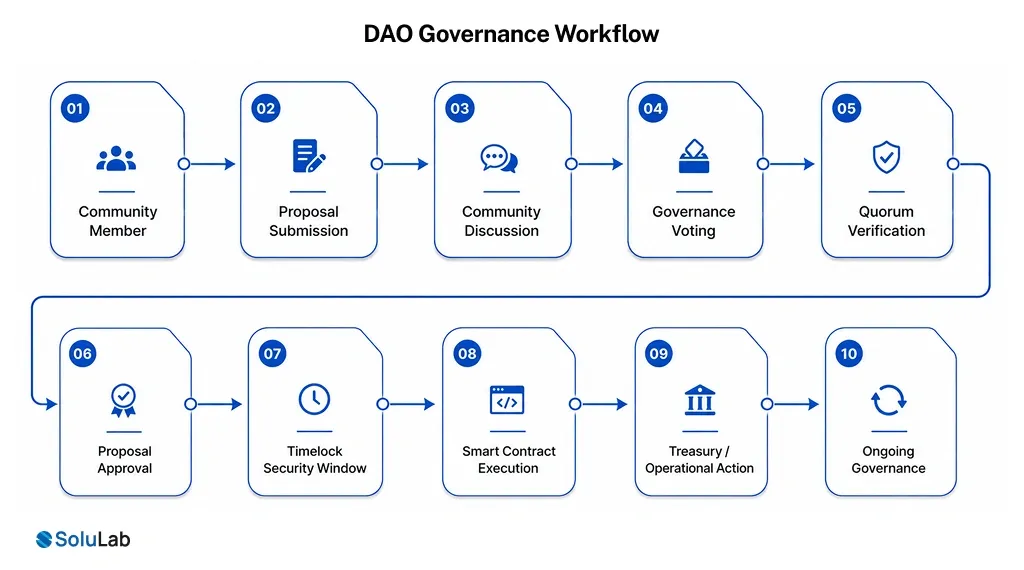
1. Proposal Creation
Every governance action within a DAO starts with a proposal. Members of the organization can submit proposals for initiatives such as treasury allocations, protocol upgrades, partnership approvals, operational changes, or community programs.
Depending on the governance framework, proposal creators may need to:
- Hold a minimum number of governance tokens.
- Pay a proposal submission fee.
- Receive support from other community members before formal voting begins.
- Meet predefined eligibility requirements established by the DAO.
A proposal typically includes the objective, implementation details, required budget, expected outcomes, and the specific smart contract actions that will be executed if approved.
2. Community Discussion and Review
Before voting begins, proposals enter a discussion phase where stakeholders analyze the potential impact of the recommendation. This stage helps improve decision quality by allowing contributors to identify risks, suggest modifications, and gather community feedback.
Discussion usually takes place through:
- Governance forums
- DAO community platforms
- Discord and Telegram channels
- Governance dashboards
- Social governance tools
This collaborative review process ensures that proposals are thoroughly evaluated before treasury funds or governance actions are committed.
3. Voting Period
Once community discussions conclude, the proposal enters the voting stage. Governance token holders cast votes based on the voting mechanism adopted by the organization.
Common voting models include:
Token-Based Voting: Voting power is proportional to the number of governance tokens held by a participant.
Quadratic Voting: Voting influence increases at a non-linear rate, reducing the ability of large token holders to dominate decisions.
Delegated Voting: Members can delegate their voting rights to trusted representatives or subject-matter experts.
Reputation-Based Voting: Voting power is linked to community contributions rather than token ownership alone.
During this phase, the DAO smart contract tracks participation levels, voting outcomes, and quorum requirements in real time.
4. Quorum Verification and Proposal Approval
For a proposal to pass, it must satisfy predefined governance conditions established during the DAO design phase.
These requirements often include:
- Minimum voter participation (quorum)
- Majority approval percentage
- Voting duration requirements
- Treasury authorization thresholds
- Multi-signature approvals for sensitive actions
For example, a DAO may require:
- At least 10% of all governance tokens to participate.
- More than 60% of the votes supported the proposal.
- A mandatory 72-hour voting period.
If these conditions are met, the proposal is approved and moves to execution.
5. Timelock and Security Review
Many enterprise-grade DAOs introduce a timelock period between proposal approval and execution.
A timelock acts as a security buffer by delaying execution for a predefined period, often between 24 and 72 hours.
This mechanism provides time for:
- Community review of approved actions.
- Identification of governance attacks.
- Emergency intervention if vulnerabilities are discovered.
- Treasury protection against malicious proposals.
Timelocks are widely used to strengthen DAO governance security and reduce operational risks.
6. Automated Smart Contract Execution
After approval and timelock completion, the DAO Smart Contract automatically executes the approved action.
No executive approval, administrator intervention, or manual processing is required.
Examples of automated execution include:
- Releasing treasury funds.
- Updating governance parameters.
- Deploying protocol upgrades.
- Modifying reward structures.
- Approving ecosystem grants.
- Adding new governance members.
Because execution is controlled by immutable blockchain code, all stakeholders can verify that the approved action is carried out exactly as voted.
7. Treasury and Asset Management
Most DAOs maintain an on-chain treasury that stores digital assets, stablecoins, governance tokens, or tokenized real-world assets.
Treasury activities are governed through community voting and often secured through:
- Multi-signature wallets
- Governance contracts
- Spending limits
- Treasury committees
- Automated budget allocation mechanisms
This structure ensures that organizational resources are managed transparently and according to community-approved rules.
8. Continuous Governance and Evolution
A DAO is not a one-time deployment. Governance remains active throughout the organization’s lifecycle.
Members continuously participate in:
- Strategic decision-making
- Budget approvals
- Ecosystem expansion
- Contributor onboarding
- Governance framework improvements
- Risk management initiatives
As the community grows, governance systems can evolve through new proposals, upgraded voting mechanisms, and specialized sub-DAOs that manage individual business functions.
How to Create a DAO: Step-by-Step Development Process
Building a successful DAO requires far more than deploying governance tokens and enabling voting. Enterprise-grade DAOs combine governance design, legal structuring, token economics, smart contract security, treasury management, and community participation into a unified framework.
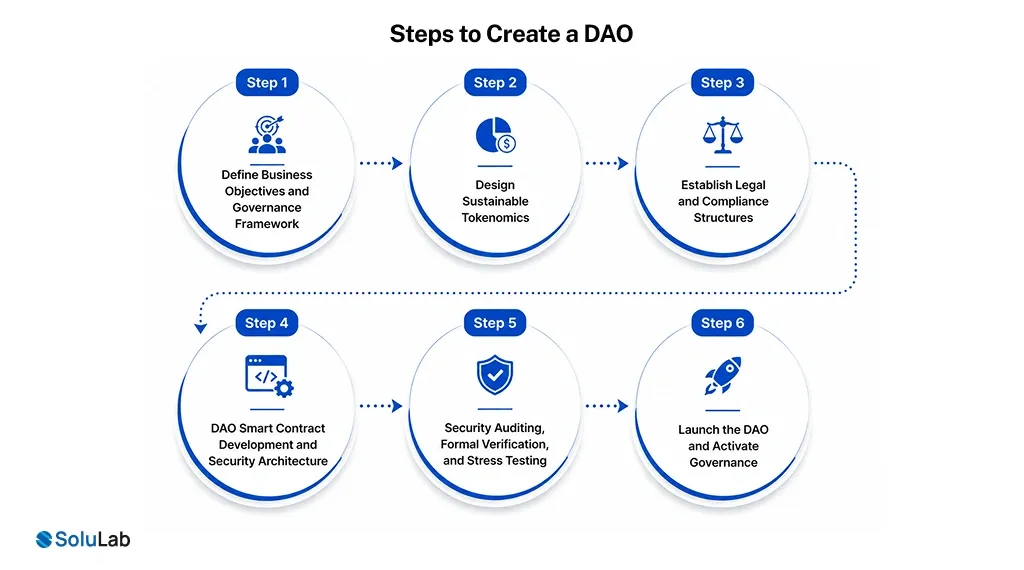
Organizations planning to Build DAO on Blockchain should follow a structured blockchain development lifecycle to ensure long-term sustainability, regulatory readiness, and operational security.
Step 1: Define Business Objectives and Governance Framework
Every successful DAO begins with a clear organizational purpose. Before any technical development starts, stakeholders must identify why the DAO is being created and how governance decisions will be managed.
Key planning areas include:
- Governance goals and decision-making scope
- Treasury management requirements
- Community participation models
- Revenue generation mechanisms
- Compliance and regulatory obligations
- Stakeholder roles and responsibilities
Organizations should also establish measurable governance metrics such as quorum requirements, voting participation targets, proposal approval thresholds, and treasury spending limits.
For example, many enterprise DAOs require:
- 5% to 15% quorum participation
- 51% to 67% approval thresholds
- Treasury spending caps for operational proposals
- Multi-signature approvals for high-value transactions
A poorly designed governance structure often becomes the primary reason DAO projects fail to scale.
Step 2: Design Sustainable Tokenomics
Effective DAO Token Development creates economic incentives that align community members, contributors, investors, and long-term stakeholders.
Tokenomics directly influences governance participation, treasury growth, and ecosystem sustainability.
Key considerations include:
- Total token supply
- Initial token distribution
- Vesting schedules
- Treasury allocation
- Governance rights
- Staking incentives
- Contributor rewards
- Liquidity provisioning
A common enterprise allocation model may include:
| Allocation Category | Percentage |
|---|---|
| Community Rewards | 30% |
| Treasury Reserve | 25% |
| Team & Contributors | 20% |
| Ecosystem Growth | 15% |
| Strategic Partners | 10% |
Security-focused tokenomics should also include:
- Vesting periods ranging from 12 to 48 months
- Lock-up schedules for founders and early investors
- Anti-whale voting protections
- Delegated governance mechanisms
Without proper incentive alignment, governance participation typically declines significantly within the first year of operation.
Step 3: Establish Legal and Compliance Structures
While DAOs operate on blockchain networks, legal protection remains essential for long-term sustainability.
A legal wrapper helps protect token holders from personal liability and provides regulatory clarity for treasury operations, taxation, and contractual relationships.
Popular DAO-friendly jurisdictions include:
- Wyoming DAO LLC
- Cayman Foundation Companies
- Marshall Islands DAO LLC
- Swiss Associations
- Singapore Foundation Structures
During this phase, organizations should define:
- Corporate governance policies
- Treasury ownership structures
- Tax reporting requirements
- Intellectual property ownership
- Regulatory compliance procedures
- KYC and AML obligations, if applicable
Industry experts increasingly recommend integrating legal governance directly into DAO operating agreements to ensure on-chain decisions have enforceable legal recognition.
Step 4: DAO Smart Contract Development and Security Architecture
Professional DAO smart contract development forms the foundation of the governance ecosystem.
The smart contract layer governs proposal creation, voting execution, treasury management, token distribution, and permission controls.
Core contracts typically include:
- Governance contracts
- Treasury contracts
- Voting contracts
- Token contracts
- Timelock contracts
- Multi-signature wallet integrations
- Staking contracts
- Reward distribution mechanisms
Enterprise-grade DAO infrastructure should also implement critical security controls such as:
Multi-Signature Treasury Protection
Treasury funds should never be controlled by a single wallet.
Most organizations adopt:
- 3-of-5 signatures
- 5-of-7 signatures
- 7-of-11 signatures
before treasury assets can be moved.
Timelock Security Mechanisms
All approved governance actions should pass through mandatory execution delays.
Industry-standard timelocks range from:
- 24 hours for operational actions
- 48 to 72 hours for treasury transactions
- Up to 7 days for protocol upgrades
This creates a security window to identify malicious proposals before execution.
Role-Based Access Control (RBAC)
Specialized operational teams may require limited permissions without receiving unrestricted governance authority.
RBAC frameworks help:
- Limit treasury access
- Restrict contract upgrades
- Separate operational functions
- Prevent internal misuse
Governance Attack Prevention
The architecture should protect against:
- Flash-loan attacks
- Vote manipulation
- Sybil attacks
- Treasury draining attempts
- Governance takeovers
Security-focused DAO smart contract development significantly reduces attack surfaces before deployment.
Step 5: Security Auditing, Formal Verification, and Stress Testing
Security auditing is one of the most critical phases of DAO development.
According to blockchain security reports, smart contract exploits have resulted in billions of dollars in losses across Web3 ecosystems over recent years. A single vulnerability can compromise treasury assets, governance integrity, and stakeholder trust.
Comprehensive auditing should include:
Automated Security Testing
Using tools such as:
- Foundry
- Hardhat
- Slither
- Mythril
to identify code vulnerabilities and logic flaws.
Manual Smart Contract Review
Independent smart contract audits are performed through line-by-line code analysis to identify:
- Reentrancy vulnerabilities
- Access control weaknesses
- Integer overflow risks
- Governance loopholes
- Treasury execution flaws
Governance Simulation Testing
Organizations should simulate:
- Low participation scenarios
- Hostile governance attacks
- Treasury spending abuse
- Delegation concentration risks
- Emergency shutdown events
Formal Verification
Enterprise DAOs increasingly adopt mathematical verification techniques to prove contract behavior under predefined conditions.
Leading audit providers often recommend multiple review cycles before deployment.
Typical smart contract audit costs range from:
- $10,000 to $30,000 for smaller DAOs
- $30,000 to $100,000+ for enterprise-grade governance systems
The cost of prevention is significantly lower than recovering from a governance exploit.
Step 6: Launch the DAO and Activate Governance
The final phase is to launch the DAO on the selected blockchain network.
Most organizations deploy on scalable DAO blockchain platforms such as:
- Ethereum
- Polygon
- Arbitrum
- Base
- Solana
- Avalanche
The deployment process includes several coordinated activities.
Token Distribution
Governance tokens are allocated according to the approved tokenomics model.
Distribution may involve:
- Community allocations
- Investor vesting contracts
- Contributor rewards
- Treasury reserves
Governance Activation
Proposal systems, voting mechanisms, delegation frameworks, and quorum thresholds become operational.
Organizations often begin with foundational governance proposals to establish:
- Treasury policies
- Working groups
- Operational budgets
- Community guidelines
Treasury Initialization
Treasury wallets are funded and secured using multi-signature controls and timelock mechanisms before public participation begins.
Governance Dashboard Deployment
User-friendly interfaces are launched using governance tools such as:
- Snapshot
- Tally
- Safe
- Custom governance portals
These platforms improve participation and transparency across the ecosystem.
Community Onboarding
Successful DAOs invest heavily in education and onboarding.
Typical onboarding initiatives include:
- Governance documentation
- Voting tutorials
- Community workshops
- Proposal templates
- Delegate training programs
Research across major governance ecosystems shows that DAOs with structured onboarding programs often achieve participation rates 2-3 times higher than organizations relying solely on token ownership.
The Key Benefits of DAO Development
As organizations seek greater transparency and operational efficiency, the benefits of DAO development extend far beyond decentralized voting. Modern enterprises use DAOs to automate governance, streamline treasury management, and improve stakeholder participation while maintaining accountability.
1. Reduced Operational Costs
Traditional organizations spend significant resources on administrative approvals, intermediaries, and governance processes. Through smart contract automation, DAOs can execute predefined actions automatically once voting conditions are met.
Key efficiencies include:
- Automated treasury disbursements
- Reduced administrative overhead
- Streamlined governance workflows
- Lower compliance tracking costs
Many enterprise governance systems report operational cost reductions of 15% to 30% through automation.
2. Enhanced Transparency
Every governance proposal, vote, and treasury transaction is recorded permanently on-chain.
This transparency enables:
- Auditable governance decisions
- Real-time treasury visibility
- Fraud prevention
- Increased stakeholder trust
Unlike traditional corporate structures, DAO participants can independently verify all governance activities.
3. Global Stakeholder Participation
DAOs eliminate geographical barriers and allow stakeholders to participate from anywhere in the world.
Organizations can:
- Coordinate distributed teams
- Manage global investment communities
- Facilitate international partnerships
- Enable borderless governance
This accessibility significantly expands growth opportunities.
4. Faster Decision-Making
Traditional governance structures often require multiple approval layers. DAO governance systems allow proposals to move from submission to execution within days instead of months.
This agility is particularly valuable for:
- Web3 startups
- Investment communities
- Protocol ecosystems
- Global consortiums
Types of DAO Blockchain Structures
Not every DAO operates the same way. Different governance objectives require different organizational structures. Understanding the various types of DAO Blockchain frameworks helps businesses select the most suitable governance model.
1. Protocol DAOs
Protocol DAOs govern decentralized applications and blockchain networks.
Responsibilities include:
- Software upgrades
- Treasury management
- Fee adjustments
- Incentive program approvals
Popular examples include decentralized exchanges and DeFi protocols.
2. Investment DAOs
Investment DAOs pool capital from multiple participants to acquire assets collectively.
Common investment targets include:
- Venture investments
- Tokenized real estate
- Private equity
- Intellectual property
Governance members vote on acquisitions and portfolio strategies.
3. Service DAOs
Service DAOs coordinate groups of contributors who provide specialized expertise.
These organizations often offer:
- Development services
- Marketing support
- Research initiatives
- Consulting operations
Revenue is distributed according to contribution and governance policies.
4. Social and Community DAOs
These DAOs focus on building communities around shared interests.
They typically govern:
- Membership access
- Community funding
- Events
- Educational initiatives
5. Hybrid Enterprise DAOs
Many businesses prefer hybrid governance models that combine centralized operational management with decentralized strategic oversight.
This structure balances efficiency with transparency and has become one of the most common enterprise DAO frameworks.
DAO Governance Models and Voting Mechanisms
Governance architecture determines how decisions are made within a DAO. Selecting the right voting model is essential for maintaining fairness, participation, and scalability.
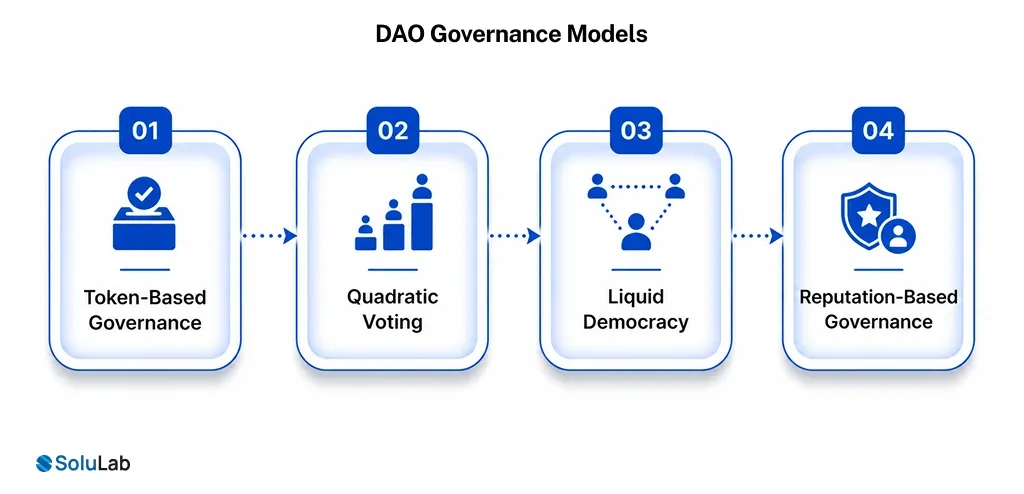
1. Token-Based Governance
The most widely adopted governance structure assigns voting power based on token ownership.
Advantages include:
- Easy implementation
- Transparent voting
- Strong economic alignment
However, concentration of token ownership may create governance imbalances.
2. Quadratic Voting
Quadratic voting helps prevent governance dominance by large token holders.
Under this model:
- 1 vote costs 1 token
- 2 votes cost 4 tokens
- 3 votes cost 9 tokens
This encourages balanced participation and protects minority interests.
3. Liquid Democracy
Liquid democracy allows token holders to delegate voting authority to trusted representatives.
Benefits include:
- Higher governance participation
- Expert-driven decisions
- Flexible delegation mechanisms
Delegation can be revoked at any time.
4. Reputation-Based Governance
Instead of relying solely on token ownership, voting power is linked to contributions and community engagement.
This model rewards active participation and long-term commitment.
DAO Native Tokens and Token Economics
A DAO’s governance framework is only as strong as its economic model. Properly designed DAO native tokens align incentives between stakeholders, contributors, and long-term ecosystem participants.
1. Governance Tokens
Governance tokens grant voting rights and influence organizational decisions.
Token holders can:
- Submit proposals
- Vote on initiatives
- Delegate voting rights
- Participate in treasury governance
2. Utility Tokens
Utility-focused custom DAO tokens provide access to products, services, or ecosystem features.
Examples include:
- Membership access
- Premium platform features
- Service discounts
- Community rewards
3. Treasury Allocation Models
Successful DAOs allocate treasury resources strategically across:
- Ecosystem growth
- Community incentives
- Development funding
- Strategic partnerships
Balanced treasury management supports long-term sustainability.
4. Vesting and Incentive Structures
To prevent short-term speculation, many organizations implement:
- Multi-year vesting schedules
- Contributor lockups
- Staking incentives
- Governance participation rewards
These mechanisms encourage long-term ecosystem alignment.
Top DAO Blockchain Platforms for Enterprise Development
Selecting the right infrastructure is a critical component of successful DAO Blockchain Development.
1. Ethereum
Ethereum remains the leading governance ecosystem due to its security, maturity, and extensive tooling.
Best suited for:
- Institutional governance
- Large treasuries
- DeFi ecosystems
2. Polygon
Polygon provides lower transaction fees while maintaining Ethereum compatibility.
Ideal for:
- Community DAOs
- Enterprise governance
- High-frequency voting
3. Arbitrum
Arbitrum offers Ethereum-level security with significantly reduced transaction costs.
Organizations use it for:
- Treasury operations
- Governance voting
- DeFi integrations
4. Base
Base is rapidly emerging as a preferred network for consumer-focused governance applications.
Advantages include:
- Scalability
- Low fees
- Strong developer ecosystem
5. Solana
Organizations requiring high throughput often choose Solana.
Benefits include:
- Fast transaction finality
- Minimal fees
- Enterprise scalability
What are the Essential DAO Integration Services for World-Class Platform Development?
Enterprise governance systems rarely operate in isolation. Professional DAO Integration Services connect governance infrastructure with operational systems and external applications.
1. Governance Platform Integration
Popular governance integrations include:
- Snapshot
- Tally
- Boardroom
These platforms simplify proposal management and voting participation.
2. Treasury Management Integration
Treasury systems often integrate with:
- Safe
- Sablier
- LlamaPay
These solutions automate treasury controls and contributor payments.
3. Oracle Integration
Oracles connect smart contracts with real-world data.
Common use cases include:
- Asset pricing
- Supply chain tracking
- Compliance automation
- Treasury monitoring
4. Enterprise Software Integration
Organizations increasingly connect DAOs with:
- SAP
- Oracle ERP
- CRM platforms
- Financial reporting systems
These integrations create seamless governance and operational workflows.
What are the DAO Development Costs in 2026?
Understanding DAO development costs helps organizations plan budgets and development roadmaps more effectively.
Several factors influence the total investment required.
1. Governance Complexity
The sophistication of governance logic directly affects development requirements.
Examples include:
- Multi-tier governance
- Delegated voting
- Sub-DAO structures
- Treasury automation
2. Smart Contract Development
Custom governance contracts require significant engineering expertise.
Costs vary based on:
- Contract complexity
- Security requirements
- Multi-chain compatibility
- Testing scope
3. Security Audits
Professional audits represent a significant but essential investment.
Typical audit ranges include:
- Basic DAO: $10,000–$25,000
- Mid-sized DAO: $25,000–$60,000
- Enterprise DAO: $60,000–$150,000+
4. Estimated DAO Development Budget
| DAO Type | Estimated Cost |
|---|---|
| Community DAO | $15,000 – $40,000 |
| Investment DAO | $40,000 – $100,000 |
| Enterprise DAO | $100,000 – $300,000+ |
The final budget depends on governance complexity, security requirements, integrations, and ongoing maintenance needs.
Build a Future-Ready DAO With SoluLab!
Launching a DAO requires more than smart contracts and governance tokens. It demands strategic architecture, security expertise, compliance planning, treasury management, and seamless ecosystem integrations.
At SoluLab, our expert blockchain developers help SMBs and modern businesses design and deploy customized DAO platforms that align with business objectives while ensuring scalability, transparency, and long-term sustainability.
Our DAO Development Services Include:
- DAO Strategy & Governance Architecture
- DAO Smart Contract Development
- DAO Token Development
- Multi-Signature Treasury Implementation
- DAO Integration Services
- Security Audits & Testing Support
- DAO Dashboard Development
- Multi-Chain DAO Deployment
- Ongoing Governance Optimization
Whether you’re building a community DAO, investment DAO, protocol DAO, or enterprise governance network, our blockchain specialists can help you launch with confidence. Contact us today!
FAQs
A DAO is most effective when multiple stakeholders need transparent decision-making, shared ownership, treasury governance, or global participation. Enterprises managing consortiums, investment communities, tokenized assets, or ecosystem partners often benefit more from DAO governance than traditional board-led structures.
Yes. Modern DAO platforms can integrate with ERP systems such as SAP, Oracle, NetSuite, and Microsoft Dynamics. Through APIs, webhooks, and blockchain middleware, governance outcomes, treasury transactions, and operational approvals can automatically sync with enterprise workflows.
While there is no fixed threshold, organizations managing more than $1 million in community funds, ecosystem incentives, investment pools, or tokenized assets often benefit significantly from automated treasury governance and transparent fund management.
Yes. Many enterprises use DAO structures to govern tokenized real estate, private credit funds, infrastructure projects, intellectual property portfolios, and venture investments. These implementations typically combine blockchain governance with regulated legal entities and compliance frameworks.
The most common mistake is focusing solely on technology while neglecting governance design. Successful DAOs prioritize governance architecture, tokenomics, legal structuring, treasury controls, and community participation before smart contract deployment begins.
Deepika is a content writer who blends storytelling with strategic thinking. She explores topics across digital innovation, emerging tech, and the evolving blockchain industry. She enjoys breaking down complex ideas into simple, engaging narratives in the growing global markets.