
Key Takeaways
- Custom software typically costs $40,000 to $300,000 in 2026, with simple MVPs from $10,000 and enterprise systems above $500,000. Scope, team location, integrations and compliance drive the price. Most projects take 3 to 9 months, and MVPs take 4 to 24 weeks. Hourly rates run from about $20 offshore to $200+ in the US and Western Europe.
Many people think software cost estimation is a technical problem that formulas and models can solve. In practice, people matter just as much. A project lead who motivates the team and keeps it focused does more to hit the budget than any calculation. Still, you need a solid starting number, and this guide gives you one.
This guide shows what a custom software development company typically charges in 2026, how the budget splits across project stages, and what moves the number. It also explains what to remember when figuring out a software project’s budget to avoid common blunders. Let’s begin by asking, “What makes estimating the cost of the software so hard?”

Software Development Cost by Project Type
| Project type | What it covers | Planning cost range | Typical timeline |
| MVP | One to a few core workflows to test demand. Basic $10,000 to $30,000, Standard $30,000 to $80,000, Advanced $80,000 to $150,000+. See our MVP development cost guide and MVP development for startups | $10,000 to $150,000+ | 4 to 24+ weeks |
| Web application | Browser-based product with accounts, dashboards, integrations and an admin panel | $40,000 to $150,000 | 3 to 6 months |
| Mobile app (iOS + Android) | Native or cross-platform apps with backend, push notifications and payments | $50,000 to $150,000 | 4 to 8 months |
| SaaS platform | Multi-tenant product with subscriptions, roles, analytics and APIs. See our SaaS product development services | $80,000 to $300,000 | 6 to 12 months |
| Enterprise system | ERP, CRM or workflow systems with legacy integrations, SSO and strict security | $200,000 to $500,000+ | 9 to 18+ months |
| AI-enabled product | Product with custom models, RAG or agents, plus data pipelines and evaluation | $80,000 to $300,000+ | 4 to 9 months |
The ranges rise when a project needs more integrations, strict compliance or custom design. They fall when it reuses proven components. So treat them as planning ranges, not a quote.
Where the Budget Goes: Cost Share by Stage
| Stage | What happens | Share of total budget |
| Discovery | Requirements, user research, scoping, architecture and a fixed feature list | 5 to 10% |
| Design | UX flows, wireframes, UI design and a design system | 10 to 15% |
| Development | Front end, back end, integrations and APIs | 40 to 50% |
| QA and testing | Manual and automated testing, security checks, performance tests | 15 to 20% |
| Deployment | Cloud setup, CI/CD, store submission and launch support | 3 to 5% |
| Maintenance (first year) | Fixes, updates, monitoring, hosting and small improvements | 10 to 15% |
Two notes. First, the QA share above is a share of the whole budget, while the 15 to 25% figure on our MVP cost guide is a share of build hours. Second, cutting discovery to save money usually costs more later, because unclear scope shows up as rework in development.
Why Is It So Challenging To Estimate Software Costs?
- There is little data on finished software projects. Yet this kind of data is exactly what helps managers make good estimates.
- Teams often rush estimates. In addition, clients usually ask for a number before the detailed requirements exist. As a result, estimators must price a system they barely know, and they must do it fast.
- Specifications are hard to write, especially early in a project. Changes and additions are the norm, not the exception, so plans and budgets need regular updates.
- Software itself is hard to measure. Abstraction, complexity and new features all make it difficult to size the work up front.
- Many factors affect effort and time, and we call them cost drivers. They include the size and complexity of the software, how involved the client team is, and how experienced the developers are. In practice, they are hard to pin down early.
- Tools and methods change fast. New frameworks, AI coding assistants and prototyping methods all affect productivity in ways that are hard to predict.
- Most estimators are project managers, and few of them have estimated many large projects. After all, how many large projects can one person run in ten years?
- Developers tend to underestimate. They price the part they know best, then apply that figure to the rest of the system. As a result, they miss the extra time that coordination and management take.
- Estimators also tend to assume they will do the work themselves. However, junior developers with less experience often do much of it, and they work more slowly.
Prerequisites For Software Cost Estimation
There are many ways to improve cost estimates. From a management view, clear roles, good decisions, and regular monitoring and audits all help. Team factors also matter, such as commitment, cohesion and leadership style. Finally, the team needs good tools for design, coding, testing and documentation.
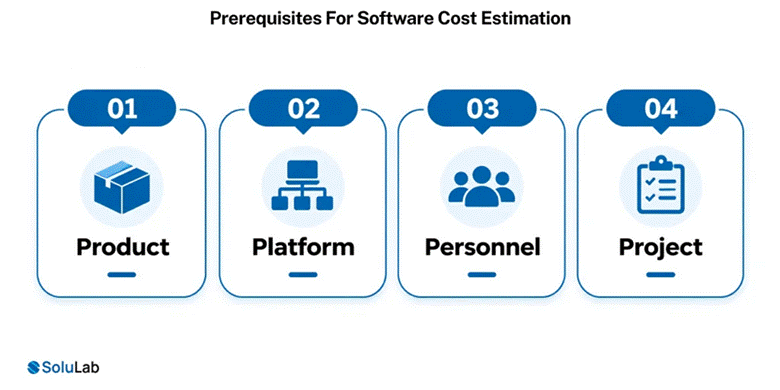
Many factors affect the time and effort a project needs. So, to estimate effort, duration and team size reliably, you first need clear answers in four areas:
Product: How reliable the software must be, how large the database is, how complex the product is, how much code should be reusable, and how much documentation it needs.
Platform: Limits on run time and storage, and how often the underlying platform changes.
Personnel: The skill of analysts and developers, their experience with the domain, platform, languages and tools, and how stable the team is.
Project: Use of modern practices and tools, whether the team works across several sites, the required schedule, and any special security needs.
Software Development Cost Estimation
Project managers often use tools such as Gantt charts, fishbone diagrams, critical path analysis and brainstorming. These tools help them control both people and money. In addition, regular progress metrics help teams deliver faster, cut costs and improve quality.
Over the years, experts have proposed many cost estimation methods. Even so, budget overruns remain common, and research has identified many factors that cause them.
Major Types Of Software Projects
Software projects come in many forms. So the first step in any estimate is to know which type of project you have, because each type needs a different level of effort and a different team.
New software development means building brand-new software, including custom software.
Software modification means improving existing business software.
Read Also: A 5-Step Guide to Successful Software Development Outsourcing
Software integration means writing custom code that connects existing software to other systems. For example, it covers syncing data between an accounting system and an inventory system, as well as plugins and add-ons.
Web development: building custom web-based software.
Factors That Affect Software Development Cost
Beyond basic labor and overhead, several factors decide how much a custom software project will cost. Here are the seven that matter most.
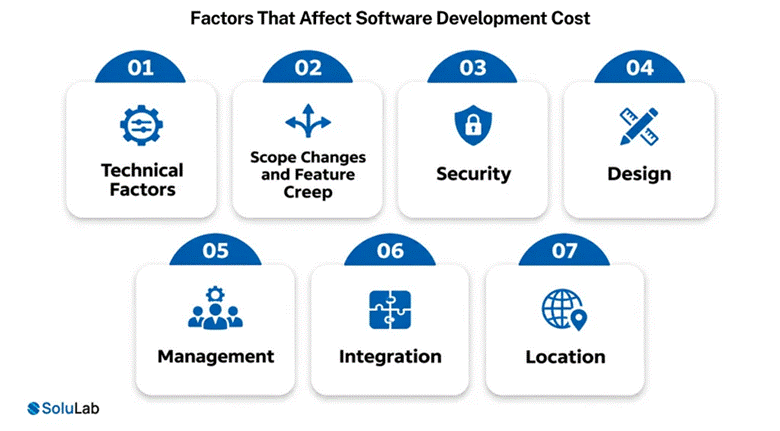
1. Technical Factors
Technical choices shape cost more than most buyers expect. For example, complex logic such as AI, real-time sync or heavy data processing takes more engineering hours than a standard web app. Compliance also adds cost. Rules such as HIPAA for health data or PCI DSS for card payments require secure architecture, audits and documentation, and that can raise the budget noticeably.
Choosing the right estimation tool also matters, because good tools give more accurate results. Most teams still use spreadsheets such as Microsoft Excel, or Microsoft Project. However, these methods are not very precise. Researchers have built many automated estimation tools, yet none of them can promise exact results.
2. Scope Changes and Feature Creep
Stakeholders give feedback throughout development, so the scope often changes along the way. The wider the scope, the higher the cost. You can add features, which raises the price, or remove the ones you don’t need.
To see how scope moves the price, compare the rows in the project type table above. A narrow MVP and a full SaaS platform can differ by more than 10 times in cost. Agree a fixed feature list at discovery, and price every later change separately.
3. Security
Security costs money, but it is not a place to cut corners. A TLS/SSL certificate to encrypt data in transit is cheap. On the other hand, custom encryption and deeper security work cost more. Even so, you should not reduce your spending on data protection.
4. Design
Design scope has a direct effect on the budget. A template-based interface is the cheapest option. Custom UX research, wireframes and a design system cost more up front, but they cut rework in development. Each extra screen, user role and animation adds design and front-end hours. As the stage table shows, design usually takes 10 to 15% of the total budget. Budget at least one revision round, because the first design is rarely the last.
5. Management
You have two options for project management. You can manage the project yourself, or you can hand it to the vendor’s project manager. The right choice depends on how involved you want to be. Managing it yourself avoids extra management fees, while a vendor manager saves you time and stress.
6. Integration
Third-party integrations can add useful features to your system, but each one adds cost. Most software needs to connect with outside apps. Some integrations are simple, while others are hard, depending on how many you need and how open each app’s API is. As a result, integration costs vary a lot from project to project.
Read Also: MVP Development Cost in 2026
7. Location
Location has a big effect on cost. Software development in North America and Western Europe costs the most. In contrast, Eastern Europe and Asia offer lower rates, and many teams there deliver high quality.
Here are typical hourly rates by region:
| Model / region | Typical hourly rate | Best for |
| In-house (US) | $80 to $150+ | Long-term product ownership |
| US / Western Europe agency | $100 to $200+ | Hands-off delivery with a clear scope |
| Eastern Europe | $35 to $70 | Balance of cost and time zone |
| India / offshore | $20 to $50 | Lowest cost and a large talent pool |
If you need extra engineers without a full project build, IT staff augmentation lets you add vetted developers to your team at these regional rates.

Conclusion
Software cost estimation helps project managers make better decisions, and it is a key step toward a successful project. However, many factors affect the final cost, and they vary from project to project. That is why two similar projects can end up with very different budgets.
No guide can predict the exact cost of your project. Still, we hope this one helps you understand software pricing and plan a realistic budget.
FAQs
Shipra Garg is a tech-focused content strategist and copywriter specializing in Web3, blockchain, and artificial intelligence. She has worked with startups and enterprise teams to craft high-conversion content that bridges deep tech with business impact. Her work translates complex innovations into clear, credible, and engaging narratives that drive growth and build trust in emerging tech markets.