Talk to an Expert
Get in Touch

A Guide to Natural Language Processing (NLP)

Natural Language Processing (NLP)

Natural Language Processing (NLP) is a subfield of AI that focuses on the interaction between computers and human languages. It aims to enable machines to understand, interpret, and generate human-like text or speech.

NLP has been used in a variety of applications, including:

  • Machine translation
  • Information retrieval
  • Sentiment analysis
  • Chatbots

In recent years, NLP has witnessed remarkable advancements, driven by the availability of large datasets of text and speech, the development of new machine learning algorithms, and the increasing computational power of computers. These advancements have made it possible for NLP to be used in a wider range of applications, and to achieve higher levels of accuracy.

NLP is still a relatively young field, and there is still much work to be done. However, the progress that has been made in recent years is very promising, and it is likely that NLP will continue to play an increasingly important role in AI and other fields.

Fundamentals of NLP

Fundamentals of NLP

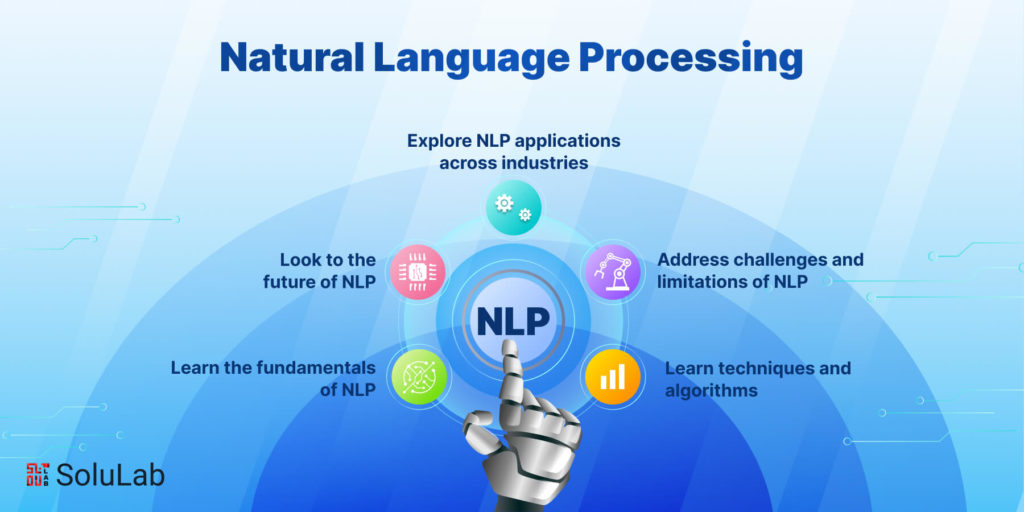
Commence on a journey into the core principles of NLP, understanding the foundational elements that enable machines to process and interpret human language. From tokenization to part-of-speech tagging, this chapter lays the groundwork for a comprehensive grasp of NLP.

Natural Language Processing Definition

At its core, NLP involves the development of algorithms and models that allow machines to comprehend and respond to human language. This includes tasks such as:

  • Language translation: Convert text from one language to another.
  • Sentiment analysis: Identify the emotional content of a piece of text.
  • Text summarization: Reduce a long piece of text to a shorter version.

NLP is a rapidly growing field, and new algorithms and models are being developed all the time. As NLP technology improves, machines will become increasingly capable of understanding and responding to human language. This will have a major impact on a wide range of industries, including healthcare, customer service, and education.

Related: What is an AI Copilot?

Core Components of NLP

  • Tokenization: Breaks text into words or tokens.
  • Part-of-speech tagging: Assigns grammatical categories to words.
  • Named entity recognition (NER): Identifies and classifies entities.
  • Parsing: Analyzes sentence structure to understand relationships between words.
  • Sentiment analysis: Determines the sentiment expressed in a piece of text.

CTA1

NLP vs. Traditional Programming

Unlike traditional programming, NLP relies on machine learning to decipher patterns and relationships in language. This flexibility allows NLP models to adapt to various linguistic nuances, such as slang, idioms, and regional dialects.

In addition to deciphering patterns and relationships in language, NLP models can be trained to perform a variety of tasks, such as:

  • Text classification
  • Named entity recognition
  • Sentiment analysis
  • Machine translation

NLP is a rapidly growing field with a wide range of applications. As NLP models become more sophisticated, they will be able to perform more complex tasks and solve more real-world problems.

Challenges and Limitations

Navigate through the challenges that NLP encounters, from the ambiguity of language to biases in models. This chapter addresses the limitations of current NLP technologies and sheds light on the ethical considerations inherent in developing language-processing systems.

  • Ambiguity in Language

Natural language is ambiguous, with words and phrases having multiple meanings based on context. This can make it difficult to understand natural language text.

There are a number of ways to address the problem of ambiguity in natural language. One approach is to use a knowledge base to provide additional context for words and phrases. Another approach is to use machine learning to learn the different meanings of words and phrases based on the context in which they are used.

The problem of ambiguity in natural language is a challenging one, but it is an important one to address. As natural language processing techniques become more sophisticated, it will become increasingly important to be able to understand natural language text accurately, even when it is ambiguous.

  • Handling Slang and Informal Language

NLP models may struggle with slang and informal language, which are prevalent in real-world communications. This is because these models are typically trained on formal, standard English.

There are a number of ways to address this issue. One approach is to augment the training data with slang and informal language. Another approach is to develop new models that are specifically trained on slang and informal language.

Addressing the issue of slang and informal language is an important area of research for NLP.

Future Trends in NLP

Future Trends in NLP

Peer into the future of NLP, where advancements in pre-trained models, multimodal NLP, conversational AI, and collaborations with emerging technologies promise to reshape language understanding. This chapter forecasts the trends that will define the evolution of NLP.

  • Advancements in Pre-trained Models

Continuous advancements in pre-trained language models are expected, which will enhance their language understanding capabilities and expand their applications. These models are trained on massive datasets of text and code, and they can learn to understand the meaning of words and phrases, as well as the relationships between them. This allows them to perform a wide variety of tasks, such as natural language inference, question answering, and text summarization.

As pre-trained language models continue to improve, they will become more and more capable of understanding and manipulating human language. This will have a significant impact on a wide range of industries, including healthcare, education, and customer service. For example, pre-trained language models can be used to help doctors diagnose diseases, create personalized learning experiences for students, and provide better customer service.

The potential applications of pre-trained language models are vast, and it is likely that we will see even more innovative uses for these models in the years to come.

  • Multimodal NLP

Integrating NLP with other modalities, such as images and videos, will lead to more comprehensive and context-aware models.

For example, an NLP model trained on text data alone may not be able to accurately identify the emotion of a person in a video. However, by incorporating video data, the NLP model can learn to identify the facial expressions and body language of the person, which can help it to better understand the emotions that they are feeling.

The integration of NLP with other modalities is still a relatively new field, but it has the potential to revolutionize the way that we interact with computers. By combining the power of NLP with the richness of other modalities, we can create more intelligent and user-friendly systems that can better understand the world around us.

Related: Applications of Natural Language Processing

  • Explainable AI in NLP

NLP models are often used to make decisions that can have a significant impact on people’s lives. To build trust in these models, it is important to make them more transparent and interpretable. This can be done by using visualization techniques to show how the model makes decisions, or by providing explanations for the model’s predictions.

  • Integration with Other Technologies

NLP is increasingly integrated with AR and VR to create immersive experiences.

NLP can be used to power chatbots in AR and VR environments, providing users with information and guidance.

NLP can also be used to generate text and audio in AR and VR, making experiences more realistic and engaging.

As NLP develops, we will see even more innovative ways to integrate it with AR and VR.

NLP in Industries

Explore how NLP transcends industry boundaries, revolutionizing healthcare, finance, education, legal, and customer service. This chapter delves into specific use cases, showcasing the transformative impact of NLP in various sectors.

1. Healthcare

NLP can be used to process vast amounts of medical literature and extract insights to improve clinical decision-making. For example, NLP can be used to identify patients who are at risk of developing a particular disease, which can then be used to provide patients with preventive care or to develop new treatments for the disease.

2. Finance

In the finance sector, NLP is employed for a variety of tasks, including:

  • Sentiment analysis in stock trading: NLP can be used to analyze the sentiment of financial news articles and social media posts to help traders make informed decisions about which stocks to buy or sell.
  • Fraud detection: NLP can be used to identify fraudulent transactions by analyzing patterns in customer behavior.
  • Customer service automation: NLP can be used to automate customer service tasks, such as answering FAQs and providing account information.

NLP is a powerful tool that can be used to improve the efficiency and accuracy of financial processes. By employing NLP, financial institutions can better understand their customers, detect fraud, and provide better customer service.

Related: Tokenization in Natural Language Processing

3. E-commerce

Natural language processing (NLP) is a subfield of artificial intelligence that gives computers the ability to understand and process human language. In e-commerce, NLP is used to power features that enhance the customer experience, including:

  • Recommendation systems: NLP can be used to analyze customer reviews and other data to generate personalized recommendations for products and services.
  • Chatbots: NLP can be used to create chatbots that can provide customer support 24/7.
  • Review analysis: NLP can be used to analyze customer reviews to identify trends and patterns that can be used to improve product quality, customer service, and marketing campaigns.

NLP is a powerful tool that can be used to improve the e-commerce experience for customers.

4. Education

NLP applications in education include:

  • Automated grading: NLP can be used to automatically grade student essays, tests, and other assignments. This can save teachers time and provide students with immediate feedback on their work.
  • Language learning platforms: NLP can be used to create interactive language learning platforms that provide students with personalized feedback and instruction. These platforms can help students learn new languages like German or Chinese more effectively and efficiently.
  • Personalized learning experiences: NLP can be used to track student progress and identify areas where students need additional support. This information can be used to create personalized learning experiences that are tailored to each student’s individual needs.

NLP is a powerful tool that can be used to improve the quality of education. By automating grading, creating interactive language learning platforms, and providing personalized learning experiences, NLP can help students learn more effectively and efficiently.

5. Legal

NLP is a subfield of Hybrid AI that deals with the interaction between computers and human language. In the legal field, NLP can be used to assist legal professionals by:

  • Analyzing legal documents to extract information such as the parties involved, the facts of the case, and the legal issues.
  • Summarizing legal documents to help legal professionals quickly identify the key points of a case.
  • Generating legal documents, such as contracts and pleadings.

By automating these tasks, NLP can help legal professionals to improve their research efficiency and focus on the more complex aspects of their work.

6. Customer Service

Chatbots and virtual assistants powered by NLP can enhance customer service by providing quick responses and resolving queries. These tools can automate tasks typically handled by human customer service representatives, freeing up human representatives to focus on more complex issues. Additionally, chatbots and virtual assistants can improve customer satisfaction by reducing wait times and providing easy access to information.

Building NLP Projects

For those eager to embark on NLP projects, this chapter serves as a guide. From data preparation and model training to deployment, learn the steps involved in creating NLP applications. Discover the tools and frameworks that empower developers in building impactful NLP projects.

Steps to Develop an NLP Project

  • Define Objectives: This step is critical to the success of any NLP project. It is important to clearly outline the goals and tasks that the project aims to achieve. This will help to ensure that the project stays on track and that the resources are used effectively.
  • Data Collection: Once the objectives have been defined, the next step is to gather relevant and diverse datasets for training and testing the model. The size and quality of the dataset will have a significant impact on the performance of the model.
  • Preprocessing: The data collected in the previous step will often need to be cleaned and prepared before it can be used to train the model. This process, known as preprocessing, can include tasks such as tokenization, normalization, and removal of stop words.
  • Model Selection: Once the data has been prepared, the next step is to choose an appropriate NLP model. There are a variety of different NLP models available, each with its own strengths and weaknesses. The best model for a particular project will depend on the specific objectives and requirements.
  • Training: The model selected in the previous step will need to be trained on the prepared dataset. This process involves feeding the data into the model and adjusting the model’s parameters so that it learns to perform the desired task.

Related: How is Geospatial AI Mapping the Transforming Analytics By Spatial Intelligence?

  • Evaluation: Once the model has been trained, it is important to evaluate its performance using relevant metrics. This will help to ensure that the model is accurate and reliable.
  • Deployment: The final step is to deploy the model into the desired application or system. This may involve integrating the model with a web application, a mobile app, or a business intelligence platform.

It is important to note that the steps outlined above are not always followed in a linear fashion. In some cases, it may be necessary to iterate through the steps several times in order to achieve the desired results. Additionally, the specific steps and tasks involved in each step may vary depending on the specific NLP project.

CTA2

Tools and Libraries for NLP Development

  • NLTK (Natural Language Toolkit) is a comprehensive library for natural language processing. It includes a wide range of features for text processing, such as tokenization, stemming, part-of-speech tagging, and named entity recognition. NLTK is a popular choice for NLP research and development, and it is also used in a variety of commercial applications.
  • Spacy is an open-source library designed for NLP tasks such as tokenization and named entity recognition. It is built on top of NLTK, and it provides a number of additional features, such as support for multiple languages and a more user-friendly interface. Spacy is a popular choice for NLP developers, and it is used in a variety of commercial applications.
  • Transformers (Hugging Face) is a library offering pre-trained models for various NLP applications. These models are trained on large datasets of text and code, and they can be used for a variety of tasks, such as text classification, summarization, and question-answering. Transformers are a popular choice for NLP developers, and they are used in a variety of commercial applications.
  • TensorFlow and PyTorch are popular deep-learning frameworks used for building NLP models. These frameworks provide a variety of tools and libraries for training and deploying deep learning models. TensorFlow and PyTorch are a popular choice for NLP researchers and developers, and they are used in a variety of commercial applications.

Conclusion

In conclusion, Natural Language Processing (NLP) has evolved into a transformative force within the realm of artificial intelligence, bridging the gap between human communication and machine understanding. As we explored the fundamental principles, applications, techniques, and future trends in NLP, it became evident that NLP is a dynamic field with vast potential. The applications of NLP are multifaceted, permeating various industries such as healthcare, finance, e-commerce, education, legal, and customer service. From sentiment analysis to virtual assistants and language translation, NLP models have demonstrated their prowess in enhancing efficiency and user experiences. While the journey of NLP has witnessed significant milestones, it is crucial to acknowledge the challenges, including language ambiguity, bias, and ethical considerations. Navigating these hurdles responsibly is imperative to ensure the ethical and equitable use of NLP technologies. Looking forward, the future of NLP holds exciting prospects. Advancements in pre-trained models, the integration of NLP with other modalities, and the emphasis on explainable AI are paving the way for more sophisticated and context-aware language understanding.

In this world of innovation, SoluLab- an AI development company stands as a prominent player, contributing to the advancements in NLP and AI. With a commitment to delivering modern solutions, SoluLab harnesses the power of NLP models and techniques to address real-world challenges across industries. SoluLab’s expertise extends to developing customized NLP applications, from sentiment analysis tools to interactive chatbots. Leveraging state-of-the-art models and frameworks, SoluLab ensures that clients benefit from the latest advancements in NLP technology. For businesses seeking to leverage NLP for enhanced customer interactions, efficient data processing, and innovative applications, SoluLab serves as a strategic partner. Through a combination of domain knowledge, technical proficiency, and a commitment to ethical AI practices, SoluLab empowers organizations to unlock the full potential of NLP. As we navigate the future of AI and NLP, SoluLab remains at the forefront, driving innovation and delivering solutions that redefine how we interact with and harness the power of natural language. Hire our AI developers at SoluLab for a transformative NLP-driven journey into AI development services.

 FAQs

1. What is Natural Language Processing (NLP)?

NLP is a subfield of artificial intelligence that focuses on enabling machines to understand, interpret, and generate human-like language. It involves the development of algorithms and models to process and analyze textual and spoken data.

2. How does NLP differ from traditional programming?

Unlike traditional programming, where explicit rules are coded, NLP relies on machine learning to decipher patterns and relationships in language. This flexibility allows NLP models to adapt to various linguistic nuances.

3. What are the core components of NLP?

NLP involves several core components, including tokenization (breaking down text into tokens), part-of-speech tagging, named entity recognition, parsing, and sentiment analysis.

4. How is NLP applied in real-world scenarios?

NLP finds applications in various industries, including healthcare, finance, e-commerce, education, legal, and customer service. It powers language translation, sentiment analysis, chatbots, and information extraction.

5. What challenges does NLP face?

Challenges in NLP include the ambiguity of language, difficulty in handling slang and informal language, biases in models, and ethical considerations. NLP models may struggle with multiple meanings of words based on context.

6. What are the future trends in NLP?

Future trends in NLP include advancements in pre-trained models, the integration of NLP with other technologies (multimodal NLP), a focus on explainable AI, and collaboration with emerging technologies like augmented reality and virtual reality.

7. How can businesses leverage NLP for innovation?

Businesses can leverage NLP for innovation by implementing applications such as sentiment analysis for customer feedback, chatbots for enhanced customer service, language translation for global reach, and information extraction for data insights.

Ultimate Checklist For Smart Contract Audits

Checklist for Smart Contract Audit

In the rapidly evolving landscape of blockchain technology, smart contracts have emerged as a revolutionary concept, transforming the way agreements are executed in a decentralized and secure manner. This paradigm shift introduces the need for meticulous evaluation and validation, giving rise to the crucial practice of smart contract audits.

Smart contracts are self-executing agreements with the terms of the contract directly written into code. These contracts run on blockchain networks and automatically enforce and execute the agreed-upon terms when predefined conditions are met. By eliminating the need for intermediaries, smart contracts enhance transparency, reduce costs, and mitigate the risk of fraud.

The dynamic nature of blockchain ecosystems and the complexity of smart contract code necessitate comprehensive audits. Smart contract audits play a pivotal role in ensuring the reliability and security of these digital agreements. Audits are conducted to identify vulnerabilities, bugs, or potential exploits in the code that could compromise the integrity of the smart contract and its underlying blockchain network.

How do Smart Contracts Work?

Smart contracts, a cornerstone of blockchain technology, have revolutionized the way transactions are executed, bringing transparency, security, and automation to various industries. Understanding the basics of smart contracts is essential for navigating this innovative landscape.

1. Basics of Smart Contracts

Smart contracts are self-executing contracts with the terms of the agreement directly written into code. Built on blockchain platforms like Ethereum, these contracts utilize the decentralized nature of blockchain to eliminate the need for intermediaries, such as banks or legal authorities.

The smart contract is deployed to the blockchain when parties agree on specific conditions. It automatically enforces and executes the terms when predefined conditions are met. The execution process is trustless, meaning it occurs without reliance on a central authority, enhancing efficiency and reducing costs.

  • Smart Contract Audit

Before deployment, smart contracts undergo rigorous auditing processes to ensure their security and functionality. Smart contract audits involve a comprehensive review of the code, identifying vulnerabilities and potential exploits. This critical step ensures that the smart contract behaves as intended and mitigates the risk of exploited vulnerabilities.Smart Contract Audit Solutions

2. Common Use Cases

Smart contracts find applications in various industries, streamlining processes and enhancing security. Some common use cases include:

  • Financial Services

Facilitating automatic payments, loans, and insurance payouts without intermediaries.

  • Supply Chain Management

Automating and securing the supply chain process by enforcing contract terms at each stage.

  • Real Estate

Simplifying property transactions through automated escrow and title transfers.

  • Token Offerings

Managing initial coin offerings (ICOs) and token sales transparently and securely.

  • Legal Agreements

Executing and enforcing legal agreements automatically when predefined conditions are met.

  • Smart Contract Auditing Services

Various companies offer smart contract audit services to address the increasing importance of security in smart contracts. These services employ sophisticated tools to analyze code, identify vulnerabilities, and ensure compliance with industry best practices. Choosing a reputable smart contract audit company is crucial to maintaining the integrity of the contract.

3. Risks Associated with Smart Contracts

While smart contracts offer numerous advantages, they are not without risks. Common risks include:

  • Coding Errors

Bugs or vulnerabilities in the code can lead to unintended consequences.

  • Oracle Issues

Reliance on external data (oracles) can introduce vulnerabilities if the data source is compromised.

  • Immutability

Once deployed, it’s challenging to modify smart contracts, potentially leading to issues if errors are discovered.

  • Legal Uncertainties

Legal recognition and enforcement of smart contracts vary globally, posing challenges in certain jurisdictions.

  • Smart Contract Audit Tools

To mitigate these risks, developers use smart contract audit tools. These tools analyze the code for vulnerabilities, ensuring a robust and secure implementation. Engaging in smart contract auditing is a proactive measure to enhance the reliability of the code and protect against potential exploits.

What is the Significance of Auditing Smart Contracts?

Significance of Auditing Smart Contracts

In the realm of blockchain technology, smart contracts have emerged as a revolutionary tool, automating and executing agreements without the need for intermediaries. However, the unchecked deployment of smart contracts can pose serious risks, making the importance of auditing these digital agreements paramount. This article explores the multifaceted significance of auditing smart contracts, delving into security concerns, financial implications, and legal and regulatory compliance.

1. Security Concerns

Smart contracts operate within a decentralized and transparent environment, making them susceptible to security vulnerabilities. Unscrupulous actors exploit weaknesses in coding, leading to potential breaches and unauthorized access. To mitigate these risks, smart contract auditing becomes a crucial step in ensuring the robustness of the code.

By employing advanced smart contract audit tools, developers can identify and rectify vulnerabilities, ensuring the integrity and security of the digital agreements. A thorough audit not only protects sensitive data but also prevents potential exploits that could compromise the entire blockchain network.

2. Financial Implications of Bugs or Vulnerabilities

Undetected bugs or vulnerabilities in smart contracts can have severe financial repercussions. The decentralized nature of blockchain transactions means that once a smart contract is deployed, it becomes immutable. Therefore, any flaws in the code can lead to financial losses, impacting both users and stakeholders.

Smart contract auditing serves as a financial safeguard, helping identify and eliminate bugs before deployment. By engaging a reputable smart contract audit company, organizations can safeguard their financial interests, prevent potential exploitation, and build trust among users in the blockchain ecosystem.

3. Legal and Regulatory Compliance

In an era where digital transactions are becoming more prevalent, legal and regulatory compliance is paramount. Smart contracts, while offering efficiency, must adhere to existing legal frameworks to ensure the validity of agreements.

Smart contract auditing extends beyond code analysis, encompassing a comprehensive review of legal and regulatory compliance. Ensuring that digital agreements align with existing laws mitigates legal risks and fosters a trustworthy environment for all stakeholders involved.

What are the Key Components for Smart Contract Auditing?

In the realm of smart contract development, ensuring the reliability, security, and efficiency of code is paramount. The Ultimate Checklist for smart contract auditing comprises crucial components that developers and auditors must meticulously examine to guarantee the robustness of their smart contracts.

A. Code Review

  • Best Practices

When conducting a code review, adherence to industry best practices is non-negotiable. This involves assessing whether the code aligns with established standards, promoting maintainability and readability.

  • Code Structure

The structure of the code can significantly impact its performance and ease of maintenance. Evaluating the organization and modularity of the code is crucial for identifying potential vulnerabilities.

  • Error Handling

A thorough examination of error-handling mechanisms is vital to prevent unforeseen issues. Auditors focus on how gracefully the code handles unexpected situations, minimizing the risk of exploitation.

B. Security Considerations

  • Vulnerability Assessment

A comprehensive vulnerability assessment is conducted to identify and address potential threats. Specialized tools are often employed to detect vulnerabilities and weaknesses that could compromise the security of the smart contract.

  • Secure Design Principles

Evaluating adherence to secure design principles ensures that the smart contract is resistant to common attack vectors. This includes secure data handling, input validation, and secure state transitions.

  • Authentication and Authorization

Robust authentication and authorization mechanisms are scrutinized to ensure that only authorized entities can interact with the smart contract. This is crucial for preventing unauthorized access and manipulation.

C. Gas Optimization

  • Gas Fees and Efficiency

Assessing gas fees and efficiency is vital for optimizing the cost-effectiveness of smart contracts. Developers aim to minimize gas consumption while maximizing functionality to enhance the economic viability of the contract.

  • Gas Limit Considerations

Analyzing gas limit considerations involves ensuring that the contract operates within the specified gas limits on the blockchain. This prevents unforeseen issues such as out-of-gas errors during contract execution.

  • Strategies for Optimization

Implementing optimization strategies involves fine-tuning the code to enhance performance and reduce gas consumption. This ensures that the smart contract functions efficiently and economically on the blockchain.

D. Testing Procedures

  • Unit Testing

Rigorous unit testing is performed to validate the functionality of individual components. This helps identify and rectify issues at an early stage, ensuring the overall integrity of the smart contract.

  • Integration Testing

Integration testing assesses the interactions between various components to ensure seamless operation. This phase verifies that different sections of the smart contract work cohesively together.

  • Scenario Testing

Scenario testing involves simulating real-world scenarios to evaluate the smart contract’s behavior under diverse conditions. This helps identify potential vulnerabilities and ensures the contract’s robustness in practical usage.

E. Documentation

  • Comprehensive Documentation Standards

Thorough and clear documentation is crucial for facilitating understanding and maintenance. The documentation should cover the smart contract’s functionality, structure, and any specific considerations for auditors.

  • Comments and Annotations

Well-placed comments and annotations within the code enhance readability and comprehension. Auditors assess the presence of descriptive comments that explain complex logic, making the code more accessible for review.

  • Version Control

Utilizing version control systems ensures traceability and provides a historical perspective on code changes. Auditors review version control practices to ensure a systematic approach to code modifications.

In the ever-evolving landscape of blockchain technology, undergoing a smart contract audit is imperative. Engaging with a reputable smart contract audit company equipped with cutting-edge smart contract audit tools and services ensures a meticulous examination of these checklist components, promoting the development of secure and efficient smart contracts.

What are the Auditing Tools and Technologies?

Auditing Tools and Technologies

In the fast-evolving landscape of blockchain technology, ensuring the security and reliability of smart contracts has become paramount. Smart contract audits play a pivotal role in identifying vulnerabilities, mitigating risks, and ensuring the robustness of blockchain technology applications. To achieve this, various tools and technologies have emerged, providing a multifaceted approach to smart contract auditing.

A. Smart Contract Auditing Tools

1. Automated Scanning Tools

Automated scanning tools have become indispensable in the smart contract auditing process. These tools leverage advanced algorithms to conduct comprehensive scans of the contract codebase, identifying potential vulnerabilities and security loopholes. 

Examples of such tools include MythX, Securify, and Slither. MythX, for instance, employs a cloud-based analysis platform to detect security issues and provide real-time feedback to developers during the coding phase.

2. Manual Inspection Tools

While automated tools offer efficiency, manual inspection tools remain crucial for a nuanced examination of smart contract code. Manual inspection involves a meticulous review by experienced auditors who delve into the intricacies of the code to identify subtle vulnerabilities that automated tools might overlook. 

This process ensures a thorough evaluation of the smart contract’s logic, ensuring that it adheres to best practices. Manual tools such as Trail of Bits’ Echidna and ConsenSys Diligence’s Mythril Classic exemplify this approach.

B. Code Review Platforms

1. Collaboration and Feedback

Effective collaboration among development teams and auditors is vital for successful smart contract auditing. Code review platforms facilitate this collaboration by providing a centralized space for teams to collaborate, discuss, and resolve issues. 

Tools like GitHub, GitLab, and Bitbucket enable seamless communication between developers and auditors, streamlining the auditing process. This collaborative approach ensures that all stakeholders are on the same page, leading to a more robust smart contract.

2. Continuous Integration and Deployment

Integrating smart contract auditing into the continuous integration and deployment (CI/CD) pipeline ensures that security checks are performed at every stage of development. CI/CD platforms such as Jenkins, Travis CI, and CircleCI allow developers to automate the auditing process, providing real-time feedback on code changes. 

By incorporating smart contract audit tools into the CI/CD workflow, development teams can identify and rectify vulnerabilities promptly, ensuring a secure and reliable smart contract deployment.

What are the Key Components of Post-Audit Maintenance for Smart Contracts?

Key Components of Post-Audit Maintenance

Smart contracts form the backbone of decentralized applications, ensuring the seamless execution of transactions on blockchain networks. Once a smart contract has undergone a thorough audit, it is crucial to implement best practices for post-audit maintenance to uphold its security and reliability. This section outlines essential steps for maintaining the integrity of smart contracts.

1. Regular Security Updates

Regular security updates are the cornerstone of maintaining a robust smart contract ecosystem. The dynamic nature of blockchain technology and the ever-evolving threat landscape necessitate continuous vigilance. Implementing timely security updates addresses vulnerabilities identified during the audit and bolsters the smart contract’s resistance against emerging threats.

In the realm of smart contract auditing, staying abreast of the latest developments in security protocols is paramount. Utilize cutting-edge smart contract audit tools to automate vulnerability detection and streamline the update process. By integrating these tools into the maintenance workflow, dedicated developers can proactively identify and address potential security loopholes, ensuring the ongoing integrity of the smart contract.

2. Monitoring and Incident Response

Effective monitoring and incident response mechanisms are essential for promptly addressing any anomalies that may arise post-audit. Continuous monitoring allows for real-time visibility into the smart contract’s performance and facilitates the early detection of suspicious activities or potential security breaches.

In the context of smart contract auditing, companies providing audit services should integrate robust incident response protocols into their offerings. This includes establishing clear communication channels, defining escalation procedures, and conducting regular drills to test the team’s ability to respond swiftly to security incidents. Proactive monitoring and swift incident response not only mitigate risks but also instill confidence in users interacting with the audited smart contract.

3. Continuous Learning and Adaptation

The landscape of smart contract technology is dynamic, and staying ahead of potential threats requires a commitment to continuous learning and adaptation. Developers and auditors alike must actively engage in ongoing education to stay informed about the latest security standards, best practices, and industry trends.

Smart contract companies play a pivotal role in this process by fostering a culture of continuous improvement. This involves investing in the professional development of audit teams, encouraging participation in industry conferences, and collaborating with the broader blockchain community to share insights and experiences. By embracing a mindset of continuous learning and adaptation, smart contract auditors can enhance their capabilities and provide more effective post-audit maintenance services.

How are Regulators Adapting to the Challenges Posed by Decentralized Technologies?

The rapid evolution of blockchain technology has ushered in a new era of decentralized applications, with smart contracts emerging as a cornerstone of innovation in transactional processes. As businesses and industries increasingly integrate these self-executing contracts into their operations, the regulatory landscape is undergoing a transformative phase to accommodate the unique challenges presented by decentralized technologies.

A. Current Regulatory Framework

In the ever-evolving landscape of emerging technologies, smart contracts have become a focal point of innovation, revolutionizing the way transactions are executed. As these self-executing contracts gain prominence, regulators worldwide are grappling with the task of adapting existing frameworks to address the unique challenges posed by decentralized technologies.

Governments and regulatory bodies are beginning to recognize the need for a nuanced approach to smart contract auditing. Ensuring the security, transparency, and legality of transactions executed through smart contracts requires a delicate balance between fostering innovation and protecting stakeholders. 

Some jurisdictions have already taken significant strides in incorporating smart contract auditing into their regulatory frameworks, aiming to create an environment that fosters responsible adoption.

B. Future Trends and Implications

Looking ahead, the regulatory landscape is expected to witness a surge in initiatives aimed at providing clearer guidelines for smart contract auditing. As the technology matures, regulators will likely collaborate with industry experts to develop comprehensive frameworks that address the unique challenges posed by decentralized applications.

Smart contract auditing is not merely a regulatory necessity but also a strategic imperative for businesses seeking to deploy decentralized applications. Future trends may see increased collaboration between regulatory bodies, industry stakeholders, and technology experts to establish standardized best practices for auditing smart contracts. 

This collaborative effort will not only enhance the credibility of decentralized applications but also foster a more secure and resilient digital ecosystem.

C. Compliance Challenges and Solutions

As with any emerging technology, smart contract adoption comes with its share of compliance challenges. Ensuring that decentralized applications comply with existing regulations while also navigating the nuances of smart contract auditing can be a complex endeavor. The decentralized and borderless nature of blockchain technology adds a layer of complexity, requiring innovative solutions to address compliance challenges effectively.

Compliance challenges in smart contract auditing may include issues related to legal recognition, data privacy, and jurisdictional disparities.

To overcome these challenges, companies may turn to specialized smart contract audit services offered by experienced firms.Smart Contract Development Services

Conclusion

In conclusion, the Ultimate Checklist for Smart Contract Audit serves as a comprehensive guide for ensuring the robustness and security of blockchain-based applications. As the landscape of decentralized technologies continues to evolve, the importance of smart contract auditing cannot be overstated. Companies like SoluLab have positioned themselves as leaders in the field, providing invaluable smart contract services to safeguard the integrity and functionality of blockchain projects.

Utilizing advanced smart contract audit tools, SoluLab employs a meticulous approach to auditing smart contracts, addressing vulnerabilities and potential exploits. Their expertise as a smart contract audit company is underscored by a commitment to excellence, thoroughness, and innovation in the rapidly changing blockchain ecosystem.

The checklist serves as a dynamic tool, evolving with industry standards and emerging threats, ensuring that smart contract auditing remains at the forefront of security measures. SoluLab’s dedication to staying abreast of these developments further solidifies its role as a trusted partner in the realm of smart contract security.

In essence, the synergy between the Ultimate Checklist for Smart Contract Audit and SoluLab’s smart contract audit services creates a formidable defense against potential risks. Through a strategic combination of industry-leading practices and cutting-edge tools, SoluLab stands as a reliable guardian for organizations seeking the highest level of security and reliability in their blockchain endeavors.

FAQs

1. What is a Smart Contract Audit?

A Smart Contract Audit is a comprehensive examination and review process conducted by experts to ensure the security, functionality, and reliability of a smart contract. This meticulous evaluation helps identify vulnerabilities, bugs, and potential issues in the code, ensuring a robust and secure smart contract deployment.

2. Why is Smart Contract Auditing Important?

Smart Contract Auditing is crucial to mitigate risks associated with vulnerabilities and flaws in the code. It ensures that the smart contract performs as intended, adheres to best practices, and is resistant to potential exploits, ultimately safeguarding the integrity and security of blockchain transactions.

3. How Does a Smart Contract Audit Enhance Security?

Through a thorough analysis of the smart contract code, auditing helps identify and rectify potential security loopholes. By addressing vulnerabilities, such as reentrancy attacks or code exploits, a Smart Contract Audit significantly enhances the overall security posture of the contract, preventing potential breaches.

4. What Are the Key Components of a Smart Contract Audit?

A comprehensive Smart Contract Audit covers aspects such as code correctness, security vulnerabilities, gas optimization, compliance with coding standards, and adherence to best practices in blockchain development. It involves a detailed examination of the codebase to ensure a robust and secure implementation.

5. How Can a Smart Contract Audit Tool Facilitate the Audit Process?

Smart Contract Audit Tools automate various aspects of the auditing process, offering efficiency and accuracy. These tools can scan for vulnerabilities, analyze code structure, and provide detailed reports, expediting the audit timeline and ensuring a more thorough examination of the smart contract.

6. Why Choose Professional Smart Contract Audit Services?

Engaging a reputable Smart Contract Audit Company is essential for a reliable and comprehensive audit. Professional audit services bring expertise, experience, and a structured approach to the process, ensuring that the smart contract undergoes a thorough evaluation by seasoned blockchain developers and security experts.

Top Artificial Intelligence (AI) Trends for 2024

Top Artificial Intelligence Trends

In the year 2024, the trajectory of artificial intelligence (AI) and its trends are set to persist in its transformative trajectory, intricately integrating into our daily routines, influencing diverse sectors, and instigating regulatory shifts. Concurrently, positions in the field of Artificial Intelligence (AI) have emerged as one of the swiftly expanding sectors on a global scale—a foreseeable outcome amidst the ongoing AI revolution. Across the spectrum, from burgeoning startups to colossal Fortune 500 enterprises, entities are actively leveraging the capabilities of AI to optimize their operational frameworks. Additionally, the assimilation of AI into everyday life has experienced a notable upswing.

As we stand at the threshold of 2024, the realm of AI continues to unfold, presenting a tapestry of advancements that promise to reshape industries, redefine user experiences, and challenge the boundaries of what we thought possible.

In this blog, we will explore top artificial intelligence trends for 2024. From personalized user experiences and ethical considerations in AI development to the synergy between quantum computing and artificial intelligence, we embark on a journey through the modern technologies and paradigms that will shape the narrative of AI this year.

So, without any further ado, let’s get started!

Brief Overview of the Current State of AI Technology

In the fast-paced realm of artificial intelligence (AI), the landscape is constantly evolving, ushering in new possibilities and reshaping existing paradigms. As we step into 2024, it becomes imperative to take stock of the current state of AI technology, gauging the strides made and anticipating the transformative trends that lie ahead.

AI, once confined to the realms of science fiction, has now become an integral part of our daily lives. Machine learning algorithms, neural networks, and sophisticated data analytics are driving innovations across industries, from healthcare and finance to entertainment and education. The capabilities of AI have expanded exponentially, enabling tasks that were once deemed impossible.

AI Development Services

Importance of Staying Updated on AI Trends

The dynamism inherent in the field of AI necessitates a proactive approach to staying informed about emerging trends. Businesses, researchers, and enthusiasts alike must keep pace with the rapid advancements to harness the full potential of AI for their respective endeavors. Understanding the latest trends not only facilitates technological adoption but also empowers decision-makers to make informed choices about integrating AI solutions into their operations.

Moreover, the intersection of AI with ethical considerations, privacy concerns, and societal impacts underscores the importance of responsible AI development. Staying updated on AI trends is not merely a strategic advantage but a responsible commitment to navigating the evolving ethical landscape that accompanies the progress of artificial intelligence.

Top 10 AI Trends to Watch Out in 2024

Top 10 AI Trends to Watch Out

1. The Next Wave in AI Evolution

As we embark on the journey into 2024, the landscape of Generative AI is poised for a groundbreaking transformation, transcending the current epitome represented by advancements like ChatGPT. The imminent emergence of a new generation, often referred to as Gen AI, promises to redefine the boundaries of AI capabilities, eclipsing conventional chatbots and image generators.

Anticipated as a top AI trend for 2024, Gen AI is set to be a multimodal powerhouse, proficient in comprehending and processing a diverse array of inputs, spanning text, voice, images, and even musical compositions. This revolutionary breed of AI will possess the unique ability to simultaneously generate various forms of content. Imagine crafting an article seamlessly paired with a relevant image or designing a stage play backdrop while effortlessly generating scripts in multiple languages. These augmented capabilities herald a new era of creative possibilities, offering users comprehensive and immersive experiences.

2. Tailored AI Models Revolutionizing Every Industry

In the artificial intelligence trends, the foundational models, crucial for the next wave of AI applications, are expected to witness continual growth in both size and capability. However, the expansion of these models comes at a steep cost for training, potentially making initial trial runs financially burdensome. Fortunately, a solution is emerging from the open-source community focusing on extensive language models (ELMs). Some are developing trial iterations of cutting-edge AI projects utilizing smaller ELMs. Customizing these compact language models to align with specific businesses or industries presents a more cost-effective alternative. Even developers of powerful closed-off models are now offering bespoke generative pre-trained transformers (GPT).

These advancements are propelling businesses towards the adoption of personalized enterprise models. The delicate balance between performance and privacy will play a pivotal role in determining model selection. As we delve into the top 10 artificial intelligence trends of 2024, the discourse surrounding open-source versus closed-source extensive language models is expected to intensify.

3. The Arrival of Artificial General Intelligence (AGI)

The year 2024 may witness the realization of Artificial General Intelligence (AGI), a form of intelligence capable of executing cognitive tasks currently exclusive to humans. Various organizations are actively engaged in endeavors to create technology that could surpass human intelligence. While the development is still in progress, the advent of AGI is poised to bring unprecedented power and introduce novel capabilities. 

The pivotal aspect of AGI is its generality, requiring the ability to perform a broad spectrum of intellectual tasks. AGI holds the potential to significantly contribute to the global economy, propel advancements in scientific exploration, and redefine the limits of achievable feats.

4. AI Transforming Software Development in 2024

The landscape of software development is evolving rapidly, with AI playing a pivotal role in enhancing not only the end-user experience but also the efficiency of developers. Many of us have experienced the impact of AI-powered features in applications, such as ChatGPT providing comprehensive information or other tools generating creative visuals and assisting in crafting engaging content.

As we delve into the top 10 trends in artificial intelligence, 2024 is poised to mark a significant milestone in the software development industry. AI is set to empower not just the users but also the developers themselves. Platforms like GitHub are at the forefront, enabling developers to harness the capabilities of AI to streamline the coding process. This evolution allows developers to spend less time on coding intricacies and more time creating software solutions tailored to meet the needs of customers.

5. The Need for Robust Data Security

As the adoption of AI technology continues to surge, the imperative for robust data security management experiences a parallel escalation. The utilization of AI in cybersecurity has become indispensable, addressing the burgeoning need effectively. AI-powered cybersecurity solutions are adept at detecting unfamiliar threats, real-time identification and mitigation of vulnerabilities, proactive response to security risks, and an array of other crucial functions. 

Businesses are increasingly turning to advanced threat detection solutions driven by AI to fortify the protection of customer data and confidential business information. With both enterprises and individuals relying on AI-powered security solutions to safeguard sensitive data, the pivotal role of AI in securing data and IT infrastructure is set to be mission-critical in 2024 and beyond.

6. Augmented Work Processes

In artificial intelligence trends set to dominate 2024, a pivotal focus revolves around leveraging AI to enhance and optimize various work processes. AI has the transformative potential to elevate human capabilities by expediting tasks, increasing efficiency, and bolstering safety measures across diverse industries. From content summarization and research tasks to document drafting, code generation, and even aiding in medical diagnoses, AI is positioned to play a multifaceted role in augmenting work functions.

A distinctive aspect of this trend is the customization of specialized AIs or intelligent virtual assistants tailored for specific industries. Whether in law, medicine, or software development, the integration of industry-specific AI solutions transforms these technologies into indispensable assistants. This approach not only opens up avenues for businesses to embrace tailored AI solutions but also aligns seamlessly with the overarching trend of enhancing work processes through the strategic application of artificial intelligence. As we navigate through the top AI trends for 2024, the augmentation of work processes emerges as a key driver of innovation and efficiency across diverse sectors.

7. The Emergence of Autonomous Vehicles and Intelligent Transport Systems

The integration of artificial intelligence into autonomous vehicles and Intelligent Transport Systems (ITS) represents a pioneering trend in the field of AI. Autonomous vehicles, equipped with sophisticated AI algorithms and sensor technologies, are revolutionizing the automotive industry by offering improved safety, increased efficiency, and optimized traffic management. Simultaneously, Intelligent Transport Systems leverage AI to create a holistic ecosystem that enhances transportation efficiency, contributing to the development of smart cities. These systems analyze vast datasets from various sources to streamline traffic flow, reduce congestion, and promote sustainable mobility solutions, marking a transformative shift in how we perceive and engage with transportation.

While the impact of AI in autonomous vehicles and ITS is profound, challenges such as regulatory frameworks, ethical considerations, and cybersecurity concerns must be addressed for widespread adoption. Despite these challenges, the continuous innovation driven by the integration of AI is reshaping the future of transportation, promising a landscape where intelligent mobility solutions play a central role in creating safer, more efficient, and environmentally conscious transportation networks.

8. Sustainable AI for Environmental Solutions

A burgeoning trend at the forefront of technological innovation is the rise of Sustainable AI, a paradigm that harnesses the power of artificial intelligence to address pressing issues in energy conservation and environmental sustainability. In the face of escalating climate change concerns, AI emerges as a transformative force, presenting novel solutions for energy efficiency, resource utilization, and pollution mitigation. 

The application of AI extends across diverse domains, ranging from optimizing the distribution of renewable energy to monitoring and mitigating carbon footprints, as well as revolutionizing waste management through intelligent sorting and recycling processes. This integration of AI into energy and environmental strategies marks a crucial stride towards sustainable development, offering not only ecological benefits but also unlocking new avenues for business growth and innovation.

Related: Geospatial AI

9. AI-Powered Personalization for Exceptional Customer Experiences

As AI trends set to dominate in 2024, a standout phenomenon is the extensive application of artificial intelligence to revolutionize customer experiences through unparalleled personalization. Advanced AI-driven recommendation technologies are increasingly proficient in analyzing vast datasets, and discerning intricate details of customer preferences, behaviors, and requirements. 

This newfound capability empowers businesses to deliver highly personalized products, services, and interactions, manifesting in tailored content recommendations on streaming platforms, individualized shopping experiences in e-commerce, and customized marketing messages. The profound level of personalization not only elevates the overall customer experience but also acts as a catalyst for heightened engagement, unwavering loyalty, and amplified revenue streams for businesses.

10. AI-Powered Cybersecurity for Seamless Experience

Last but not least frontier of the top 10 Artificial Intelligence trends is marked by the pervasive integration of artificial intelligence into cybersecurity measures. The sophisticated capabilities of AI are increasingly leveraged to bolster digital defenses, offering proactive and adaptive solutions to combat evolving cyber threats. AI-driven cybersecurity operates on multiple fronts, employing machine learning algorithms to analyze vast datasets, identify patterns, and detect anomalies in real time. This dynamic approach enables organizations to fortify their security posture, promptly addressing vulnerabilities and mitigating risks before they escalate.

The transformative impact of AI in cybersecurity extends beyond conventional threat detection, encompassing predictive analysis, automated response mechanisms, and behavioral analysis to discern abnormal activities. These AI-powered systems not only enhance the speed and accuracy of threat identification but also provide a proactive defense mechanism, staying one step ahead of cyber adversaries. As the threat landscape becomes more sophisticated, AI-powered cybersecurity emerges as a crucial trend, offering a resilient shield against the ever-evolving spectrum of cyber risks and ensuring the integrity of digital ecosystems.

Regulatory Landscape and Challenges

Regulatory Landscape and Challenges

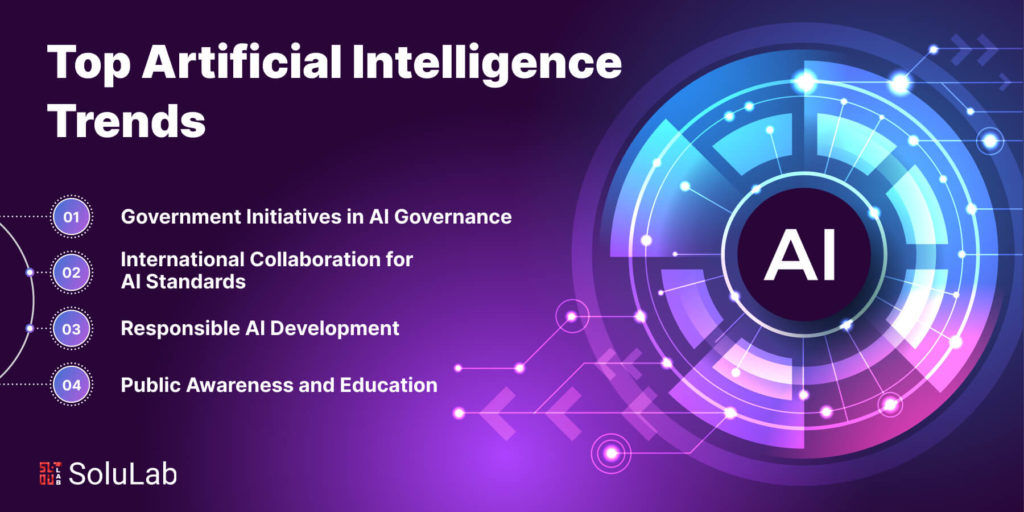
With respect to artificial intelligence trends for 2024, the regulatory framework is undergoing significant evolution to keep pace with technological developments. Governments worldwide are actively shaping policies to govern AI, focusing on ethical considerations, data protection, and risk assessment. The year 2024 sees an increasing trend of international collaboration, with organizations like the United Nations and the OECD facilitating dialogues to establish unified AI standards. This collaboration aims to standardize ethical guidelines, address cross-border data governance challenges, and encourage knowledge-sharing among nations. Concurrently, addressing ethical concerns is a top priority, emphasizing responsible AI development through mechanisms such as transparency, fairness, and accountability. Public awareness and education initiatives are also gaining traction to bridge the gap between technological advancements and societal understanding, ensuring a harmonious integration of AI into various sectors while navigating the regulatory challenges ahead.

A. Evolving Regulatory Frameworks

1. Government Initiatives in AI Governance

In 2024, governments worldwide are recognizing the critical need for robust regulatory frameworks to govern the ever-expanding realm of artificial intelligence. Nations are actively formulating policies and regulations to ensure responsible AI development and deployment. Initiatives are underway to establish guidelines that balance innovation with ethical considerations, fostering an environment conducive to the growth of AI technologies.

Government bodies are focusing on:

  • Ethical Guidelines: Crafting ethical frameworks to guide AI research and development, addressing concerns related to bias, transparency, and accountability.
  • Data Protection: Formulating regulations to safeguard user privacy and ensure responsible data usage in AI applications.
  • Risk Assessment: Developing methodologies to assess and mitigate potential risks associated with advanced AI systems.

2. International Collaboration for AI Standards

Recognizing the global nature of AI development, there is a growing trend towards international collaboration to establish unified standards. Organizations, such as the United Nations and the OECD, are facilitating dialogue and cooperation among nations to create a harmonized approach to AI governance. Collaborative efforts aim to:

  • Standardize Ethical Guidelines: Establish a set of universally accepted ethical principles to guide AI development globally.
  • Cross-Border Data Governance: Address challenges related to data flow across borders, ensuring data protection and privacy compliance on an international scale.
  • Knowledge Sharing: Encourage the exchange of best practices and knowledge-sharing among nations to collectively tackle challenges and harness the benefits of AI.

B. Addressing Ethical Concerns

1. Responsible AI Development

Ethical considerations are at the forefront of discussions surrounding AI trends in 2024. The emphasis on responsible AI development is crucial to building trust among users and stakeholders. Key components of this initiative include:

  • Explainability and Transparency: Implementing mechanisms to make AI systems more understandable and transparent, reducing the “black box” nature of certain algorithms.
  • Fairness and Bias Mitigation: Integrating strategies to identify and rectify biases in AI models, ensuring fair and equitable outcomes across diverse user groups.
  • Accountability Mechanisms: Establishing frameworks to attribute responsibility in the event of AI-related issues or failures, fostering accountability in the development and deployment process.

2. Public Awareness and Education

As AI becomes more integrated into daily life, there is a pressing need to enhance public awareness and understanding of its capabilities and limitations. Governments, along with industry stakeholders, are focusing on:

  • Educational Programs: Implementing initiatives to educate the public about AI, its potential benefits, and the ethical considerations associated with its use.
  • Media and Communication Strategies: Promoting accurate and accessible information about AI through various media channels to dispel myths and address misconceptions.
  • Community Engagement: Involving communities in discussions about AI to gather diverse perspectives and ensure that the technology aligns with societal values and expectations.

As the regulatory landscape evolves, these efforts aim to strike a delicate balance, fostering innovation while safeguarding against potential risks and ethical concerns in the dynamic landscape of AI trends for 2024.

Hire AI Developers

Final Words

In wrapping up our exploration of the top 10 trends in artificial intelligence for 2024, it is evident that the AI landscape is poised for groundbreaking transformations. The dynamic synergy between evolving regulatory frameworks, international collaboration, and a steadfast commitment to responsible AI development underscores the pivotal role of ethics in guiding innovation. As we navigate this era of personalized healthcare, autonomous industries, and immersive human-computer interactions, the convergence of cutting-edge technology and conscientious governance is reshaping the future. Embracing the potential of AI in this landscape requires a keen understanding of evolving trends, and by staying informed, we can collectively harness the transformative power of artificial intelligence for the benefit of societies worldwide.

Looking to leverage the power of AI in your endeavors? SoluLab- an AI development company stands as a leading force in driving AI innovation, providing modern AI consulting services to meet the demands of the evolving technological landscape. Our expertise extends across various AI applications, from healthcare and business to education and beyond. If you’re ready to embark on a transformative journey with AI, explore how SoluLab can tailor solutions to your specific needs. Visit our website or contact us today to embark on a path of AI-driven success.

FAQs

1. What are the key trends shaping the field of Artificial Intelligence in 2024?

The top AI trends for 2024 encompass a diverse range of innovations, including personalized medicine, autonomous processes in industries, enhanced cybersecurity measures, AI integration in education, and sustainable environmental applications. These trends collectively represent the cutting-edge developments defining the AI landscape for the year.

2. What is the role of international collaboration in shaping AI standards?

In 2024, international collaboration is on the rise, with organizations like the United Nations and the OECD fostering dialogue among nations to create unified AI standards. This collaborative effort aims to standardize ethical guidelines, address cross-border data governance challenges, and encourage the exchange of best practices to navigate the global AI landscape.

3. How are governments addressing ethical concerns in AI development?

Governments are prioritizing responsible AI development by implementing mechanisms for transparency, fairness, and accountability. Efforts include making AI systems more understandable, identifying and rectifying biases, and establishing frameworks to attribute responsibility in the event of AI-related issues or failures.

4. What initiatives are in place to enhance public awareness and education about AI?

Public awareness and education initiatives are gaining traction, aiming to bridge the gap between technological advancements and societal understanding. Educational programs, media and communication strategies, and community engagement are being implemented to ensure that the public is informed about AI, its benefits, and the ethical considerations associated with its use.

5. How does SoluLab contribute to the AI landscape?

SoluLab stands as a leading force in driving AI innovation, providing innovative solutions tailored to meet the demands of the evolving technological landscape. With expertise across various AI applications, SoluLab’s AI developers offer transformative solutions for industries such as healthcare, business, and education. Explore how SoluLab can help you leverage the power of AI to achieve your goals by visiting our website or reaching out to us directly.

Generative AI in Banking and Finance

Generative AI in Banking and Finance

The worldwide generative AI market in banking and finance is expected to be worth USD 712.4 million in 2022. It is predicted to expand at a CAGR of 33% from 2023 to 2032, reaching roughly USD 12,337.87 million by 2032.  With rapid technological advancement, the financial industry finds itself at the intersection of innovation and necessity. As financial institutions grapple with evolving customer expectations, increasing data complexities, and the perpetual quest for heightened security, the integration of modern technologies becomes not just a choice but a strategic imperative. Among the myriad breakthroughs, one technology stands out as a catalyst for transformative change — Generative Artificial Intelligence (Generative AI). This blog explores the profound impact of Generative AI in banking and finance, unraveling the potential it holds to revolutionize core functions such as fraud detection, customer service, risk management, and algorithmic trading.

In this blog, we aim to discover how Generative AI is reshaping traditional financial paradigms and propelling the banking and finance industry into a new era of efficiency, responsiveness, and unparalleled innovation. As we delve into the applications, challenges, and future possibilities of Generative AI in banking, we will unravel the layers of this transformative technology, shedding light on how it is reshaping the financial sector’s traditional modus operandi.

So, let’s get started!

What Exactly is Generative AI?

Generative Artificial Intelligence (Generative AI) is an advanced subset of artificial intelligence designed to enable machines not just to analyze data but to autonomously generate new content, responses, or outputs. Unlike traditional AI models that are task-specific and follow pre-programmed rules, generative models, often built upon deep neural networks, have the ability to produce creative and contextually relevant outputs. In the realm of finance, Generative AI utilizes complex algorithms to understand patterns, generate insights, and create content, offering a dynamic approach to problem-solving and decision-making.

1. Distinction Between Generative and Traditional AI in Banking

In the context of banking and finance, understanding the distinctions between Generative AI and traditional AI is crucial for appreciating the transformative impact of the former. Traditional AI, characterized by rule-based systems and structured data processing, excels in tasks with clear guidelines and well-defined outcomes. Generative AI, on the other hand, introduces an element of autonomy and creativity, allowing systems to generate novel solutions and responses based on learned patterns. This section will provide a detailed exploration of how Generative AI in finance differs from traditional AI approaches, emphasizing its role in handling unstructured data, fostering innovation in customer interactions, and redefining the limits of data-driven decision-making in the financial sector.

2. The Influence of Generative AI in Financial Services

The integration of Generative AI into the fabric of financial services signifies a seismic shift in the industry’s landscape, offering a spectrum of transformative impacts. At its core, Generative AI possesses the capacity to redefine traditional operational paradigms, ushering in a new era marked by heightened efficiency, superior decision-making processes, elevated compliance standards, enriched customer service experiences, and a culture of continuous innovation. In the realm of financial services, where data is a cornerstone, technology investments are paramount, customer interactions are pivotal, regulatory frameworks are stringent, and a substantial white-collar workforce drives operations, Generative AI emerges as a potent force poised to optimize and propel the industry forward.

This technology’s profound potential is particularly pronounced in the financial sector, where the sheer volume and complexity of data demand sophisticated analytical tools. Generative AI, with its ability to sift through vast datasets, identify patterns, and generate actionable insights, stands as a catalyst for productivity gains. Its integration into decision-making processes enhances precision and agility, empowering financial institutions to navigate complexities with unparalleled finesse. Moreover, in an industry where regulatory adherence is non-negotiable, Generative AI’s capacity to streamline compliance procedures becomes a strategic advantage, ensuring that financial services providers can not only meet but exceed the rigorous standards set by regulatory bodies. As financial institutions embrace this transformative technology, they embark on a journey that transcends mere automation, unlocking a realm of possibilities that promise to reshape the very essence of financial services.

Applications of Generative AI in Finance 

Applications of Generative AI in Finance 

AI and RPA in banking have a wide range of applications, changing formerly time-consuming operations. These include revolutionizing customer service with AI-powered Chatbots like ChatGPT, using AI for better fraud detection, using machine learning to anticipate financial trends, and personalizing banking services to individual tastes.

According to an Accenture study, the banking industry will experience 30% increases in staff productivity from front-office to back-office banking activities by 2028. Some examples of application of Generative AI in banking and finance include:

1. Fraud Detection

The banking sector relies significantly on AI to combat fraud, especially as the global cost of cybercrime surged to $6 trillion in 2021 and is projected to escalate to $10.5 trillion by 2025. Given the escalating threat landscape, data security has emerged as a paramount concern for financial institutions. Traditionally, banks have maintained sizable fraud detection departments, incurring substantial operational costs that may not always yield optimal results. However, Generative AI introduces a transformative approach by scrutinizing transaction details like location, device, and operating system, identifying any unusual patterns or deviations from the norm. This automated process mitigates the necessity for manual transaction scrutiny, saving time and minimizing the potential for errors.

Furthermore, Generative AI’s capability to continuously analyze synthetic data allows it to adapt and enhance its detection algorithms in response to evolving fraud schemes. This proactive stance empowers banks to predict and thwart fraudulent activities before they materialize. Additionally, Generative AI can be leveraged to implement additional verification measures for user account access. For instance, an AI chatbot can prompt users to respond to security questions or undergo multi-factor authentication (MFA), reinforcing overall security measures. As the banking industry grapples with the escalating challenges of fraud, Generative AI emerges as a dynamic solution, revolutionizing traditional fraud detection methodologies.

2. Risk Management

Banks recognize the critical importance of a robust risk management plan to maintain an optimal risk exposure level and safeguard profitability. Inadequate handling of liquidity, credit, operational, and other risks can result in significant financial losses. The Integration of Generative AI emerges as a potential solution, complementing traditional risk mitigation software systems. By leveraging historical data, Generative AI has the capability to proactively detect and recognize potential financial risks, providing early alerts on fraud and empowering banks to adapt and prevent or minimize potential losses.

CTA1

3. Credit Analysis

Generative AI presents banking agents with a potent tool to revolutionize credit analysis, surpassing conventional methods. Through a comprehensive examination of customer credit scores and financial history, it assesses creditworthiness. Additionally, Generative AI scrutinizes loan applications by analyzing data from diverse sources, including credit reports, income statements, tax returns, and other financial information. The technology goes beyond static assessments, examining borrower behavior, bank statements, and account activity to identify shifts in financial circumstances that may indicate potential default or delinquency risks. Particularly notable is its impact on retail and small-ticket-size loans, where Generative AI facilitates real-time decision-making, streamlining processes and significantly reducing the time and costs associated with traditional methods.

4. Financial Projections

Training AI on historical financial data provides banks with two important benefits: financial forecasting and synthetic data production.

Generative AI can recognize patterns and connections in data, allowing for simulations based on hypothetical scenarios. This skill enables banks to examine a range of potential outcomes and make educated decisions as a result.

Read Blog: AI in Finance: The Future of Smart Investments and Risk Management

5. Data Security

The use of synthetic data appears to be a viable answer to the difficulties of data privacy in the banking business. When it is not possible to share consumer data owing to privacy concerns and data protection rules, synthetic data might be a feasible option for developing shareable datasets. Furthermore, synthetic customer data is extremely useful in training machine learning models to assist banks in establishing a client’s eligibility for credit or mortgage loans as well as calculating the proper loan amount.

6. Underwriting

Loan underwriters can benefit from generative AI in their decision-making process. The system may deliver individualized risk evaluations and tailored suggestions by evaluating consumer data. Notably, generative AI may automate key elements of credit memoranda, such as the executive summary, firm description, and sector analysis, hence reducing underwriting time.

7. Lead Generation & Marketing

Banks must spend on focused marketing to make themselves stand out in a competitive marketplace and attract new clients. This approach, however, frequently entails considerable consumer study and creative efforts, which may be both costly and time-consuming.

Fortunately, Artificial Intelligence can help by speeding up marketing efforts. This is accomplished by assessing customer preferences and online activity, categorizing leads into unique groups, and allowing the production of specific advertising initiatives for each segment.

Generative AI Use Cases in Banking and Finance

Generative AI has ushered in a new era of possibilities for the banking industry, transforming the way financial institutions operate and serve their customers. Below are detailed use cases that highlight the diverse generative AI use cases in finance and banking:

1. Algorithmic Trading: Generative AI is increasingly integrated into algorithmic trading strategies, providing financial institutions with a competitive edge in the dynamic and fast-paced world of financial markets. By analyzing vast datasets and identifying subtle market patterns, Generative AI optimizes trading algorithms for better performance. This application empowers banks to execute trades with precision, capitalize on market opportunities, and adapt to changing conditions in real time.

2. Customer Service and Engagement: Generative AI transforms customer service in banking by enabling the development of intelligent chatbots and virtual assistants. These AI-driven interfaces use natural language processing to interact conversationally with customers. They can handle routine inquiries, guide users through transactions, and even provide personalized financial advice. The result is an enriched customer experience, improved satisfaction levels, and the ability for financial institutions to scale their customer service operations effectively.

3. Personalized Financial Planning: Generative AI use cases leverage customer data to offer personalized financial planning services. By analyzing individual spending patterns, investment behaviors, and life events, Generative AI algorithms can generate tailored financial plans for customers. This fosters a more engaging and customized relationship between the bank and its clients, ultimately leading to improved financial well-being for customers.

4. Anti-Money Laundering (AML) Compliance: Generative AI contributes significantly to AML efforts by enhancing the detection of suspicious activities and transactions. Its continuous learning and pattern recognition capabilities allow it to identify complex money laundering schemes that may evade traditional rule-based systems. This application ensures a more robust defense against financial crimes, aligning with the industry’s commitment to maintaining the integrity of the financial system.

5. Loan Decision Automation: For retail and small-ticket-size loans, Generative AI enables real-time loan decisions. By analyzing a multitude of factors, including credit scores, financial history, and real-time data, Generative AI streamlines the loan approval process. This not only enhances efficiency but also reduces the time and costs typically associated with traditional loan approval methods.

6. Regulatory Compliance and Reporting: Generative AI assists banks in navigating the complex landscape of regulatory compliance. It can analyze and interpret regulatory changes, ensuring that the bank’s operations adhere to the latest standards. By automating compliance processes, Generative AI not only enhances efficiency but also reduces the risk of non-compliance and associated penalties. This is particularly crucial in an industry where regulatory adherence is non-negotiable.

7. Chatbot-based Account Access Security: Generative AI enhances account access security by enabling the deployment of intelligent chatbots. These chatbots can prompt users for additional verification measures, such as answering security questions or undergoing multi-factor authentication (MFA). This adds an extra layer of security to user accounts, mitigating the risk of unauthorized access and fraudulent activities.

8. Automated Financial Reporting: Generative AI streamlines the process of financial reporting by automating the generation of reports. It can analyze vast sets of financial data, identify key insights, and present them in a comprehensible format. This not only saves time but also reduces the likelihood of errors associated with manual reporting processes.

9. Dynamic Pricing Strategies: In the lending and financial product offerings, Generative AI enables banks to implement dynamic pricing strategies. By analyzing customer behavior, market trends, and other relevant factors, Generative AI can optimize pricing structures in real time. This ensures that the bank remains competitive in the market while maximizing revenue and profitability.

10. Enhanced Cybersecurity Measures: Generative AI contributes to cybersecurity by identifying and addressing vulnerabilities in a bank’s digital infrastructure. It can analyze patterns of cyber threats, predict potential security breaches, and recommend proactive measures to fortify the bank’s cybersecurity defenses. This is crucial in an era where cyber threats pose a constant risk to financial institutions and their customers.

Related: Generative AI in Cybersecurity

Challenges to Generative AI Adoption in the Banking Industry

Challenges to Generative AI Adoption in the Banking Industry

The integration of Generative AI in the banking sector confronts several challenges that demand careful consideration for successful implementation.

1. Navigating Regulatory Requirements

To adhere to regulations, a comprehensive understanding of financial and data protection laws is imperative. Awareness of how these regulations impact the use of Artificial Intelligence (AI) in banking, particularly concerning customer data privacy and security, is essential.

2. Transparent and Ethical Utilization

Ensuring transparency with customers regarding the integration of AI in banking operations is critical. Organizations must communicate the purpose and intricacies of AI utilization, detailing the types of data collected and elucidating measures to safeguard this information. Maintaining ethical standards and removing biases in decision-making systems are critical components of responsible AI applications.

3. Robust Security Protocols

The implementation of strong cybersecurity measures is crucial to safeguard AI systems and the sensitive data they handle.To enhance defenses against possible attacks, regular upgrades to security processes, frequent vulnerability assessments, and adherence to industry standards are required.

4. Data Quality and Governance

Providing high-quality data inputs for AI algorithms is foundational to their efficacy. Building strong data governance frameworks becomes critical for ensuring data integrity, correctness, and privacy. Regular audits and dataset cleansing are critical techniques for improving the performance and dependability of Generative AI models.

5. Collaboration Between AI and Human Experts

Interaction between AI systems and human specialists is critical to achieving harmonic integration. AI should be perceived as a tool to augment human capabilities rather than a replacement. Human oversight is still required for complex decision-making processes, interpreting results, and dealing with unexpected obstacles.

6. Interpretability and Explainability

The selection of AI models offering interpretability and explainability is crucial. Transparent decision-making procedures become critical, particularly when regulatory compliance or consumer trust requires clarification on specific judgments made by AI systems.

7. Continuous Monitoring and Updating

It is critical to provide systems for continuous monitoring and upgrading of AI models. Because financial landscapes and client behaviors are dynamic, artificial intelligence must adjust in real time. Frequent updates, algorithm training, and staying up to current on AI technology breakthroughs are all necessary procedures.

8. Customer Education

Proactively educating customers about the benefits and limitations of AI in banking is crucial. Providing detailed information on how AI improves services, guarantees security, and offers tailored experiences helps to create consumer trust. Addressing customers’ concerns or misconceptions about AI is crucial for fostering trust.

9. Pilot Programs and Iterative Implementation

Commencing with pilot programs allows for meticulous testing of AI applications in controlled environments. Before scaling out AI projects across the whole financial ecosystem, gather feedback, identify areas for enhancement, and iteratively refine the deployment plan.

10. Legal and Ethical Impact Assessment

To analyze the legal and ethical consequences of employing AI in banking, a complete impact assessment is required. Assessing possible risks, recognizing biases, and predicting unexpected outcomes are all part of this process. A responsible AI deployment plan includes developing mitigation methods and assuring compliance with the organization’s ethical standards.

Future Trends and Opportunities in the Banking and Finance Industry

Future Trends and Opportunities in the Banking and Finance Industry

As we look ahead to the future of Generative AI, the industry stands on the brink of a technological renaissance. The convergence of innovative trends, potential applications, and collaborative opportunities creates a dynamic ecosystem ripe for exploration and advancement. Now, let’s delve into specific points that illuminate the roadmap for this transformative journey in finance.

1. Emerging Trends in Generative AI for Banking and Finance

The future landscape of Generative AI in banking and finance is poised to witness several transformative trends. One notable trend is the increasing emphasis on federated learning, enabling financial institutions to train machine learning models collaboratively without sharing sensitive data. This approach aligns with the industry’s commitment to privacy and security. Additionally, the integration of reinforcement learning in Generative AI models is gaining traction, allowing systems to learn from dynamic environments and adapt in real time. Explainable AI is another emerging trend, ensuring transparency in decision-making processes and addressing the interpretability concerns associated with complex AI algorithms. As financial institutions continue to explore these trends, the convergence of Generative AI with blockchain technology for enhanced security and decentralized finance (DeFi) applications is also anticipated.

2. Potential New Applications on the Horizon

The horizon for Generative AI applications in banking and finance is expansive, with potential innovations set to redefine industry standards. Predictive banking analytics is one such application, where Generative AI will play a crucial role in forecasting market trends, customer behaviors, and economic indicators, empowering financial institutions to make proactive and strategic decisions. Quantum computing, with its ability to process vast amounts of data at unprecedented speeds, holds the potential to revolutionize risk management and optimization tasks in banking. Moreover, Generative AI may find applications in the creation of decentralized autonomous organizations (DAOs) for community-driven financial initiatives. Exploring the integration of Generative AI with augmented reality (AR) and virtual reality (VR) could also pave the way for immersive and personalized financial experiences.

CTA2

3. Opportunities for Collaboration and Innovation in the Industry

The evolving landscape of Generative AI in banking presents numerous opportunities for collaboration and innovation within the industry. Financial institutions can collaborate with FinTech startups specializing in Generative AI solutions to co-create tailored applications addressing specific industry challenges. Partnerships with academic institutions and research centers can foster innovation by leveraging the latest advancements in Generative AI research. Moreover, cross-industry collaborations, such as teaming up with technology firms specializing in cybersecurity, can enhance the security infrastructure surrounding Generative AI applications. Collaborative initiatives for creating industry-wide standards and best practices will be crucial for ensuring the responsible and ethical use of Generative AI in the financial sector. By embracing these collaborative opportunities, the banking industry can harness the full potential of Generative AI, driving innovation and shaping the future of finance.

Final Words

In conclusion, the integration of Generative AI in the banking industry holds immense promise, revolutionizing operations and customer experiences. While the potential benefits are substantial, it is crucial for financial institutions to navigate and address the inherent challenges diligently. From ensuring regulatory compliance and transparent AI utilization to robust security measures, data governance, and ongoing collaboration between AI and human expertise, the path to successful Generative AI adoption demands a strategic and ethical approach. Continuous monitoring, customer education, and iterative implementation further underscore the dynamic nature of this transformative technology, emphasizing the need for adaptability and responsible deployment.

As financial institutions embark on the journey of incorporating Generative AI, SoluLab- a Generative AI development company stands as a strategic partner in navigating this technological frontier. With expertise in AI solutions, SoluLab offers tailored approaches to Generative AI adoption, addressing challenges and maximizing the potential for innovation. From pilot programs to full-scale implementations, SoluLab provides comprehensive support, ensuring that financial institutions harness the power of Generative AI effectively. For seamless integration into the future of banking, contact us today to learn how SoluLab’s Generative AI development services can elevate your institution’s capabilities.

FAQs

1. How does Generative AI enhance fraud detection in banking?

Generative AI enhances fraud detection by analyzing transaction details such as location, device, and operating system, flagging unusual patterns. Its continuous learning capability allows it to adapt to new fraud schemes, providing early alerts to help banks anticipate and thwart fraudulent activities before they occur.

2. What role do Generative AI developers play in credit analysis and risk management?

Generative AI developers revolutionize credit analysis by assessing creditworthiness through an in-depth examination of customer credit scores and financial history. It scrutinizes loan applications, analyzes data from various sources, and considers borrower behavior, enabling more accurate risk assessments and proactive risk management strategies.

3. How can Generative AI contribute to customer service in banking?

Generative AI transforms customer service by enabling the development of intelligent chatbots and virtual assistants. These AI-driven interfaces use natural language processing to interact conversationally, handling routine inquiries, guiding users through transactions, and providing personalized financial advice, thereby enriching the overall customer experience.

4. In what ways can Generative AI be applied to algorithmic trading in financial markets?

Generative AI is increasingly integrated into algorithmic trading strategies, offering a competitive edge in financial markets. By analyzing vast datasets and identifying market patterns, Generative AI optimizes trading algorithms for better performance, allowing financial institutions to execute trades with precision, capitalize on market opportunities, and adapt to changing conditions in real-time.

5. What challenges does the adoption of Generative AI in banking face?

Challenges in Generative AI adoption include navigating regulatory requirements, maintaining transparency and ethical use, implementing robust security measures, ensuring data quality and governance, fostering collaboration between Generative AI and human experts, achieving interpretability, continuous monitoring, customer education, pilot programs, and conducting legal and ethical impact assessments. Overcoming these challenges is crucial for the successful and responsible integration of Generative AI in banking operations.

Revolutionizing Business Efficiency: The Role of AI in Contract Management

Role of AI in Contract Management

In the complex landscape of modern business, efficient contract management is a cornerstone for organizational success. A brief overview of contract management reveals its pivotal role in overseeing agreements, mitigating risks, and ensuring compliance. Traditional methods, while effective, are often time-consuming and susceptible to human errors.

Enter AI for contract management – a technological revolution that brings forth unprecedented opportunities for organizations seeking to enhance their contractual processes. The significance of AI in streamlining contract processes cannot be overstated. By leveraging advanced algorithms and machine learning, AI for contract management solutions offers a paradigm shift in the way contracts are drafted, analyzed, and managed.

The implementation of AI in contract management transcends routine tasks, providing a multifaceted approach to handling diverse contractual challenges. From the initial stages of contract creation to the meticulous analysis of complex legal language, AI revolutionizes the efficiency and accuracy of the entire contract lifecycle. As we delve deeper into subsequent sections, AI’s true scope and impact on contract management will unfold, revealing a landscape where efficiency, accuracy, and strategic decision-making converge to redefine the future of contractual engagements.

How Can Organizations Effectively Integrate Natural Language Processing and Machine Learning?

In the rapidly evolving landscape of contract management, the infusion of Artificial Intelligence (AI) has become a game-changer. Understanding the fundamentals of AI in this context is crucial for organizations aiming to enhance efficiency and accuracy in their contractual processes.

A.Types of AI for Contract Management

At its core, AI for contract management involves utilizing intelligent technologies to automate, streamline, and optimize various aspects of the contract lifecycle. AI, in this context, refers to machines performing tasks that typically require human intelligence. There are two primary types of AI relevant to contract management:

  • Narrow AI (Weak AI)

This type of AI is designed for a specific task or a set of closely related tasks. In contract management, narrow AI systems excel at performing discrete functions, such as data extraction, classification, and basic decision-making.

  • General AI (Strong AI)

General AI, on the other hand, possesses the ability to understand, learn, and apply knowledge across diverse tasks. While still largely theoretical, advancements in this direction could potentially revolutionize the depth of AI’s impact on contract management.

B. Key AI Technologies Relevant to Contract Management

In the realm of contract management, various AI technologies play pivotal roles in augmenting traditional processes. Understanding these technologies is essential for organizations seeking to leverage AI for contract management solutions.

  • Natural Language Processing (NLP)

NLP enables machines to comprehend, interpret, and generate human-like text. In contract management, NLP proves invaluable for extracting meaningful insights from vast volumes of contracts, facilitating efficient review processes.

  • Machine Learning (ML)

ML algorithms empower AI systems to learn from data and improve their performance over time. In contract management, ML algorithms can analyze historical contract data to predict outcomes, identify patterns, and enhance decision-making.

  • Robotic Process Automation (RPA)

Robotic Process Automation (RPA) involves automating repetitive and rule-based tasks. In contract management, RPA can handle routine processes like data entry and document generation, freeing up human resources for more complex tasks.

  • Blockchain Technology

While not strictly AI, blockchain’s decentralized and secure nature complements AI applications in contract management. It enhances transparency, traceability, and security in contractual transactions.

As organizations embark on the journey of using AI for contract management, integrating these key technologies strategically can yield transformative results. In the next sections, we’ll delve deeper into how these technologies contribute to the benefits of AI in contract management, demonstrating the practical impact of this technological synergy.

Related: Integration of AI and Blockchain

What are the Benefits of AI in Contract Management?

Benefits of AI in Contract Management

In the dynamic landscape of contract management, the integration of artificial intelligence (AI) brings forth a myriad of benefits, revolutionizing the way organizations handle their contractual obligations. In this section, we delve into the advantages of employing AI for contract management, emphasizing its impact on efficiency, cost-effectiveness, and risk mitigation.

  • Increased Efficiency and Accuracy

AI for contract management solutions significantly enhances operational efficiency by automating repetitive tasks and expediting time-consuming processes. Through advanced algorithms and machine learning, AI systems can swiftly analyze vast volumes of contracts, extracting critical information with unmatched speed and precision. This not only reduces the workload on human resources but also minimizes the likelihood of errors, ensuring contracts are managed with a high degree of accuracy.

Using an AI-powered contract management platform helps streamline routine tasks such as document categorization, metadata extraction, and contract review. This heightened efficiency allows organizations to allocate their human resources strategically, focusing on more complex and strategic aspects of contract negotiation and management. 

Related: Top 10 AI Development Companies in 2024

  • Cost Savings and Resource Optimization

One of the paramount advantages of incorporating AI for contract management lies in its ability to deliver substantial cost savings and optimize valuable resources. By automating labor-intensive processes, organizations can reduce the time and effort required for manual contract review and analysis. This not only translates into direct cost savings but also frees up skilled professionals to concentrate on higher-value tasks, fostering a more productive and resource-efficient environment.

AI-driven contract management systems contribute to cost-effectiveness by minimizing the risk of contractual oversights and disputes. The proactive identification of potential issues through AI enables organizations to address challenges early on, preventing costly legal complications that may arise from overlooked clauses or non-compliance.

  • Improved Risk Management

In the realm of contract management, risk mitigation is paramount, and AI emerges as a formidable ally in this endeavor. AI-powered systems possess the capability to analyze contracts comprehensively, identifying potential risks and discrepancies that may elude human scrutiny. Through the application of advanced algorithms and natural language processing, these systems can assess the language used in contracts, ensuring compliance with regulatory standards and internal policies.

Furthermore, AI for contract management enables organizations to establish predictive models for risk assessment. By leveraging historical contract data, machine learning algorithms can forecast potential risks associated with specific contract terms or parties, empowering organizations to make informed decisions and proactively address potential issues.

CTA1

How is the Integration of AI Transforming Traditional Contract Lifecycle Management (CLM) Systems?

In the fast-paced realm of business, where contracts form the backbone of transactions, leveraging cutting-edge technology has become imperative. Artificial Intelligence (AI) is spearheading this transformation, particularly in Contract Lifecycle Management (CLM) systems. This blog explores the profound impact of AI on CLM, dissecting its overview, features, and real-world success stories.

Contract Lifecycle Management (CLM) systems serve as the digital command centers for organizations, facilitating the entire contract journey. With the infusion of AI, these systems evolve into intelligent platforms that revolutionize how contracts are created, negotiated, and managed. AI for contract management brings forth a paradigm shift, automating mundane tasks and augmenting human decision-making.

A. Features and Functionalities of AI-driven CLM Systems

  • Automated Contract Drafting

AI algorithms empower CLM systems to generate contracts swiftly, ensuring accuracy and compliance.

  • Smart Contract Analysis

AI’s natural language processing (NLP) capabilities enable CLM systems to comprehend and analyze contracts, extracting crucial insights efficiently.

  • Predictive Analytics

AI-driven CLM systems leverage machine learning to predict contract outcomes and identify potential risks, aiding proactive decision-making.

Contract Performance Monitoring: Real-time monitoring of contract performance is enhanced through AI, providing actionable insights and facilitating timely interventions.

  • Contract Negotiation Assistance

AI facilitates smoother negotiations by providing real-time insights and suggesting optimal clauses based on historical data and industry standards.

Natural Language Processing (NLP) capabilities help in understanding the intent behind negotiation points, ensuring a more nuanced and effective negotiation process.

  • Dynamic Contract Updating

AI-powered chatbot, CLM systems enable dynamic updates to contracts by tracking changes in regulations or business conditions, ensuring ongoing compliance and relevance.

Automatic alerts and notifications keep stakeholders informed of any modifications or upcoming contract milestones.

  • Intelligent Document Management

Advanced document management features ensure efficient organization, retrieval, and archival of contracts categorize and tag documents, making it easier for users to search, access, and retrieve relevant information swiftly.

  • Customizable Workflows

Tailored workflows, guided by AI, streamline the approval process, reducing bottlenecks and enhancing collaboration among various stakeholders. Adaptive workflows adjust to changing business needs, ensuring flexibility in the contract management process.

  • Risk Identification and Mitigation

AI algorithms scan contracts for potential risks, from non-compliance issues to ambiguous clauses, providing risk mitigation strategies.

Real-time risk dashboards offer a comprehensive view, allowing proactive risk management and strategic decision-making.

How is Natural Language Processing (NLP) Reshaping the Landscape of Contract Management? 

NLP Reshaping the Landscape of Contract Management

In the rapidly evolving landscape of AI for contract management solutions, Natural Language Processing (NLP) emerges as a game-changer. This blog explores the pivotal role of NLP in extracting insights from contracts, enhancing contract review processes, and providing real-world examples of its applications in contract management.

A. Role of NLP in Extracting Insights from Contracts

Natural Language Processing, a subset of AI in contract management, empowers systems to comprehend, interpret, and derive meaningful insights from the vast pool of contract data. By leveraging NLP algorithms, organizations can automate the extraction of key information, such as obligations, deadlines, and clauses, from contracts, significantly reducing the time and effort required for manual review.

B. Enhancing Contract Review Processes with NLP

AI for contract management solutions, enriched by NLP capabilities, revolutionizes the contract review process. NLP algorithms analyze contracts with a nuanced understanding of language, allowing for improved accuracy in identifying potential risks, inconsistencies, and compliance issues. This enhanced scrutiny not only accelerates the review process but also ensures a more comprehensive and error-free assessment of contractual documents.

  • Nuanced Understanding of Language

NLP algorithms are designed to understand language nuances, context, and semantics. In the context of contract review, this means that the system can go beyond basic keyword matching. It comprehends the subtleties in language, ensuring a more sophisticated analysis of contract clauses, obligations, and conditions.

  • Increased Accuracy in Risk Identification

NLP enhances the accuracy of risk identification by parsing through contracts with a level of precision that is challenging for manual reviews. It recognizes patterns and interprets language structures to flag potential risks, inconsistencies, or non-compliance issues. This not only expedites the review process but also minimizes the likelihood of oversight.

  • Efficient Identification of Key Elements

Traditional contract review methods often involve manually sifting through lengthy documents to identify key elements. NLP automates this process by swiftly and accurately extracting critical information. Whether it’s pinpointing specific clauses, obligations, or deadlines, NLP streamlines the identification of key contract elements, contributing to a more efficient review.

Related: Applications of Natural Language Processing

  • Contextual Analysis for Comprehensive Assessment

NLP systems perform contextual analysis, considering how individual clauses relate to the entire contract. This holistic approach ensures that the review process is comprehensive, addressing not only isolated clauses but also the broader context in which they exist. Consequently, it provides a more nuanced understanding of contractual relationships and potential implications.

  • Accelerated Review Timelines

By automating the analysis of contracts, NLP significantly accelerates the overall review timeline. Tasks that would traditionally take hours or days can now be accomplished in a fraction of the time. This speed not only increases operational efficiency but also enables organizations to respond promptly to time-sensitive contractual matters.

C. Real-world Examples of NLP Applications in Contract Management

  • Contract Insight Extraction

AI-driven solutions, employing NLP, have excelled in extracting critical insights from voluminous contracts. This enables businesses to swiftly identify key terms, conditions, and obligations, facilitating better decision-making.

  • Risk Mitigation through Sentiment Analysis

NLP’s sentiment analysis capabilities are harnessed to gauge the tone and implications of contract clauses. This proactive approach aids in identifying potential risks, enabling organizations to mitigate challenges before they escalate.

  • Semantic Understanding for Precision

NLP algorithms comprehend the semantic nuances of language, ensuring a precise understanding of contract terms. This semantic clarity enhances the accuracy of contract review processes, reducing the likelihood of misinterpretation.

How Does Machine Learning Enhance Predictive Analytics in Contracts?

In the ever-evolving landscape of contract management, the integration of artificial intelligence (AI) and machine learning (ML) has emerged as a game-changer. This section explores how predictive analytics, powered by machine learning algorithms, revolutionizes the way organizations approach contract outcomes and risk mitigation in the realm of AI for contract management solutions.

  • Predictive Modeling for Contract Outcomes

AI-driven predictive modeling holds immense potential in forecasting contract outcomes. By analyzing historical data and identifying patterns, machine learning algorithms can predict the likelihood of contract success or failure. This not only streamlines decision-making processes but also empowers organizations to proactively address potential issues before they escalate.

In the context of AI in contract management, predictive modeling helps businesses anticipate contract performance, enabling more informed negotiations and strategic planning. Whether it’s identifying clauses prone to disputes or predicting the probability of timely delivery, AI becomes a valuable ally in shaping favorable contract outcomes.

  • Risk Prediction and Mitigation Using Machine Learning

Effective risk management is a cornerstone of successful contract management. Machine learning algorithms, equipped with the ability to analyze vast datasets, play a pivotal role in predicting and mitigating risks associated with contracts. This not only enhances decision-making but also minimizes the potential for legal disputes and financial losses.

AI for contract management solutions utilizes machine learning to assess various risk factors, such as supplier performance, market fluctuations, and regulatory changes. By identifying potential risks in real time, organizations can implement proactive strategies to mitigate these risks, fostering a more resilient and adaptive approach to contract management.

What  Measures Should be Taken to Promote Transparency in AI Algorithms and Decision-Making Processes within Contract Management?

Transparent AI in Contract Management

  • Ethical Considerations in AI-Driven Contract Management

The infusion of AI in contract management raises important ethical considerations that cannot be overlooked. As systems become more autonomous, the potential for biased decision-making and the inadvertent propagation of existing prejudices may arise. Organizations must prioritize fairness and transparency in algorithmic processes, ensuring that AI does not perpetuate or exacerbate existing ethical concerns within the contract management sphere.

  • Addressing Security and Privacy Concerns

Security and privacy have always been paramount in the world of contract management. The introduction of AI introduces additional layers of complexity to these concerns. Organizations must implement robust cybersecurity measures to safeguard sensitive data processed by AI algorithms. Ensuring compliance with data protection regulations is crucial, requiring a thorough understanding of how AI for contract management interacts with and stores confidential information.

  • Overcoming Resistance to AI Adoption in Contract Processes

Despite the undeniable advantages, resistance to AI adoption in contract processes remains a hurdle for many organizations. Skepticism, fear of job displacement, and a lack of understanding about the technology can impede progress. To overcome these challenges, a comprehensive change management strategy is essential. Organizations must invest in employee training programs, foster a culture of openness to technological advancements, and communicate the tangible benefits that AI brings to contract management processes.

Related: Use Cases Of AI Agents

How Can Emerging Technologies Such As Machine Learning and Natural Language Processing Shape the Future of AI for Contract  Management?

In the fast-evolving landscape of contract management, Artificial Intelligence (AI) stands as a beacon, guiding businesses towards unprecedented efficiency and accuracy. As we delve into the eighth installment of our series on the future of AI in contract management, we will explore emerging technologies, potential advancements, and the anticipated impact on the legal industry.

  • Emerging Technologies Shaping the Future

The realm of contract management is witnessing a paradigm shift, with emerging technologies poised to reshape the future. From machine learning algorithms to natural language processing (NLP), these advancements are the driving force behind the next generation of contract management solutions. AI for contract management is not merely a tool; it’s a transformative force that adapts to the evolving needs of businesses.

  • Potential Advancements in AI-Driven Contract Management

AI-driven contract management is on the cusp of revolutionary advancements. The integration of AI algorithms allows for the automation of repetitive tasks, ensuring unparalleled accuracy and efficiency. Imagine a system that learns from historical data, streamlining contract creation, review, and negotiation processes. The future promises an era where businesses can leverage AI for contract management solutions that enhance productivity and reduce manual errors.

CTA2

  • Anticipated Impact on the Legal Industry 

The legal industry, often viewed as conservative, is experiencing a seismic shift with the infusion of AI into contract management. The benefits are multifold – increased speed in contract review, reduced legal risks, and improved compliance. AI for contract management solutions empowers legal professionals to focus on strategic decision-making rather than being bogged down by routine tasks. As businesses adopt AI, legal teams can unlock new levels of efficiency, leading to enhanced client satisfaction and overall industry innovation.

Conclusion 

In conclusion, the integration of Artificial Intelligence (AI) into contract management has emerged as a pivotal force in revolutionizing business efficiency. As we navigate the landscape of AI for contract management, it becomes evident that the partnership between technology and business, exemplified by innovative solutions such as those offered by SoluLab, is transforming the way organizations handle contracts.

The benefits of incorporating AI for contract management solutions extend far beyond mere automation. SoluLab an AI development company committed to harnessing the power of AI in contract management is evident in the enhanced speed and accuracy it brings to the entire contractual lifecycle. The meticulous algorithms employed by SoluLab not only streamline the creation, review, and negotiation processes but also provide businesses with a competitive edge through unparalleled efficiency.

Using AI for contract management, as exemplified by SoluLab’s solutions, doesn’t just replace manual efforts; it augments them. It empowers legal professionals and business stakeholders to make strategic decisions based on insights derived from vast amounts of data. The intelligent algorithms adapt and learn, continually refining the contract management process, reducing risks, and ensuring compliance.

FAQs

1. What is the role of AI in contract management, and how does it contribute to revolutionizing business efficiency?

AI in contract management plays a pivotal role by automating repetitive tasks, such as contract creation, review, and negotiation, leading to increased efficiency. Utilizing AI for contract management enables businesses to streamline processes, minimize errors, and boost overall productivity.

2. How does AI enhance contract management solutions, and what benefits does it bring to businesses?

AI for contract management solutions brings a transformative edge by leveraging advanced technologies like machine learning and natural language processing. This results in faster and more accurate contract processing, improved risk management, and enhanced compliance. The benefits include time savings, reduced operational costs, and heightened decision-making precision.

3. Can you provide examples of emerging technologies shaping the future of AI in contract management?

Emerging technologies like machine learning algorithms and natural language processing are shaping the future of AI in contract management. These technologies enable systems to learn from historical data, adapt to evolving needs, and facilitate more sophisticated contract analysis, ultimately contributing to smarter and more effective contract management.

4. How does using AI for contract management impact legal professionals and their daily tasks?

Utilizing AI in contract management allows legal professionals to focus on strategic decision-making rather than getting bogged down by routine tasks. The automation of repetitive processes enables legal teams to allocate their time more efficiently, resulting in improved productivity and the ability to handle more complex legal matters.

5. In what ways can businesses leverage AI to ensure better compliance and risk management in contract management processes?

AI in contract management enhances compliance and risk management by providing a comprehensive and automated approach. Through advanced algorithms, AI systems can analyze contracts for potential risks, ensuring that businesses adhere to regulatory requirements and avoid legal pitfalls.

6. What are the key advantages of using AI for contract management, and how do these translate into tangible benefits for businesses?

The benefits of using AI for contract management include increased speed in contract review, reduced legal risks, improved compliance, and overall operational efficiency. These advantages translate into tangible benefits such as cost savings, faster decision-making, and a more agile and competitive business environment.

What is AI as a Service (AIaaS)? A Beginner’s Guide


AI as a Service

AI is changing quickly and altering the corporate environment. According to McKinsey, tasks that take up 30% of working hours could be automated by 2030 because AI is what drives automation. 

Many businesses believe they cannot create or manage their systems, despite their desire to adopt AI-powered technologies. By making data and AI tools more accessible, AI as a service (AIaaS) gives companies a more cost-effective means of remaining competitive in this market. 

Third-party AIaaS providers allow companies to “rent” AI tools and services according to their requirements by investing in the development and upkeep of the AI infrastructure. Businesses can create more efficient workflows and personalized AI services with this business model, which is also far more cost-effective. 

What Is AI as a Service? 

Third-party suppliers provide a service called AI as a service (AIaaS), which enables companies to integrate AI-powered tools and capabilities into their systems. Because companies can use AI without having to invest in resources to develop and implement it from scratch, AIaaS is a low-risk and economical strategy.

Businesses can include pre-trained models, APIs, and other AI tools from AIaaS providers in their workflows or applications. The initial outlay and continuing expenses related to developing and maintaining AI infrastructure are decreased via AIaaS. 

Types of AIaaS

AIaaS encompasses various types of services that make AI capabilities accessible to businesses without the need for extensive technical expertise. Here are some key types of AIaaS:

  • Bots and Digital Assistants

Digital assistants, like virtual assistants and AI-powered chatbots, are commonly used AIaaS solutions. They leverage natural language processing (NLP) to understand and learn from human interactions. These applications find widespread use in customer service and marketing, enabling automated responses and efficient communication.

  • Application Programming Interface (APIs)

AIaaS provides APIs that allow software programs to easily integrate AI functionalities. By using these APIs, developers can incorporate powerful features into their applications with minimal code. Many AIaaS APIs focus on natural language processing, enabling tasks such as sentiment analysis, entity extraction, knowledge mapping, and translation. Additionally, some APIs offer computer vision capabilities for tasks like face detection, object recognition, and in-video search.

  • Machine Learning (ML) Frameworks

Machine learning frameworks are tools for building AI models, but they often lack a complete machine learning operations (MLOps) pipeline. AIaaS solutions in a Platform as a Service (PaaS) model offer fully managed ML and deep learning frameworks. These platforms streamline the end-to-end MLOps process, allowing developers to create, train, test, and deploy models seamlessly on the service provider’s cloud infrastructure.

Related: Use Cases of Substrate Framework

  • No-Code or Low-Code ML Services

Fully managed machine learning services within AIaaS include pre-built models, custom templates, and user-friendly interfaces that require little to no coding. This approach is designed for companies that lack development resources and don’t possess in-house data science expertise. It allows businesses to leverage AI capabilities without investing heavily in development tools.

AI Services

AIaaS Architecture: Simplified Overview

AI as a Service (AIaaS) has three main parts: AI infrastructure, AI services, and AI tools. 

1. AI Infrastructure: Powering AI and ML Models

AI infrastructure is like the backbone supporting AI and machine learning (ML) models. Two crucial elements make this happen:

  • AI Data: Big sets of data are applied to statistical algorithms to create functional ML models. These models learn from patterns in existing data, like medical reports helping detect emergencies, cancer, or tumors. ML relies on input from various sources such as databases, unstructured data, and raw data pools.
  • AI Compute: This involves using Virtual Machines (VMs), serverless computing, and batch processing to speed up ML tasks. For example, Apache Spark is a real-time data processing engine that aids in ML model computations.

2. AI Services: Accessible Cloud-based Features

AI services are ready-to-use features provided by cloud vendors, eliminating the need for custom ML models. Two types are:

  • Cognitive Computing: APIs for speech, text analytics, voice translation, and search are accessed easily by developers.
  • Custom Computing: Cloud providers are moving towards custom computing, allowing users to use their data to train cognitive services, reducing the complexity of choosing algorithms.
  • Conversational AI: As virtual assistants gain popularity, cloud providers offer services to help developers integrate voice and text bots into their applications.

Read Also: How to Develop an AI SaaS Product?

3. AI Tools: Supporting Data Scientists and Developers

Cloud vendors provide tools to assist data scientists and developers. These tools align with the data and compute platforms:

  • Wizards: Tools for amateur data scientists to simplify ML model training, acting as a multi-tenant development environment.
  • IDE (Integrated Development Environment): Investments in browser-based IDEs and notebooks facilitate easy ML model testing and management for experienced developers.
  • Data Preparation Tools: Quality data is crucial for ML models. Cloud vendors provide tools for data preparation, performing extract, transform, load (ETL) jobs, with outputs fed into the ML pipeline for training and evaluation.
  • Frameworks: Ready-to-go VM templates with frameworks like TensorFlow, Apache MXNet, and Torch simplify the setup of data-science environments. These VMs support GPU, making them efficient for training complex neural networks and ML models.

Advantages of AI as a Service (AIaaS)

Advantages of AIaaS

Here are some considerable advantages AI as a Service (AIaaS) brings to the table.

1. Reduced Dependence on Advanced Coding Skills

The demand for skilled AI experts is high, and so is the shortage of such professionals. AIaaS provides a practical solution by eliminating the need for expert AI developers. By introducing a layer of no-code infrastructure, businesses can achieve remarkable results without relying on a highly technical workforce.

2. Cost Reduction

AIaaS brings significant cost reduction benefits, especially in the development of AI solutions. The pricing transparency ensures that businesses only pay for the resources they use, following a pay-per-usage model. AI Development Cost is a key consideration in this model. This financial flexibility is a boon for organizations looking to optimize their AI investments.

3. Speedy Implementation

The cost-effectiveness of AI-as-a-Service also translates into time savings. By streamlining the development process, AIaaS expedites AI projects. This acceleration is vital in today’s fast-paced business environment where agility can make a crucial difference.

4. Access to High-Tech Infrastructure

Implementing AI and machine learning (ML) models often requires robust GPU resources. AIaaS makes these high-tech infrastructures easily accessible. This is particularly advantageous for small and medium-sized enterprises (SMEs) that may lack the internal resources and time to build such solutions in-house. Customizability within AIaaS also allows businesses to construct task-specific models.

5. User-Friendly Interfaces

While open-source platforms offer flexibility, they can be challenging to install and develop. AIaaS addresses this concern by providing ready-to-use facets. Process owners can integrate AI software without the need for formal training. Developers benefit from end-to-end ML services, including pre-built and custom models, with drag-and-drop interfaces for simplicity. Business leaders can kickstart ML projects within hours, even without expert assistance.

6. Scalability

AIaaS is an excellent solution for businesses seeking scalability. Particularly suited for tasks requiring cognitive judgment without substantial value addition in the process, AIaaS adapts well to varying workloads.

7. Customization

Recognizing that businesses have unique goals, AIaaS allows fine-tuning to align with specific business, data, or project needs. This customization ensures that AI solutions are tailored to meet the distinctive objectives of each enterprise.

8. Enhanced Security Measure

AIaaS providers often implement robust security protocols. This ensures that sensitive data used in AI processes is safeguarded against unauthorized access and potential breaches. Businesses can leverage AI technologies with confidence, knowing that their information is handled with the utmost security.

9. Global Accessibility and Collaboration

AIaaS operates on cloud-based platforms, offering global accessibility. This facilitates collaboration among teams spread across different geographical locations. Businesses can harness the power of AI and collaborate seamlessly, fostering innovation and knowledge sharing.

10. Continuous Updates and Improvements

Providers regularly update their offerings with the latest advancements in AI technology. This ensures that businesses using AIaaS can benefit from ongoing improvements, stay competitive, and adapt to the dynamic landscape of artificial intelligence without the burden of constant maintenance and upgrades.

Popular AI as a Service Provider 

AI-as-a-Service (AIaaS) providers are companies that offer artificial intelligence services through the cloud, allowing developers to access and utilize AI capabilities without having to build and maintain their own infrastructure. These services are delivered through APIs (Application Programming Interfaces), making it easier for developers to integrate AI functionalities into their applications. Let’s delve into some popular AI as a Service companies and the services they offer:

1. OpenAI

OpenAI is known for its generative AI services, providing APIs that empower developers to incorporate natural language processing features into their applications. This includes text generation, language translation, and sentiment analysis. An example of OpenAI’s work is ChatGPT, a conversational AI model.

2. Amazon Web Services (AWS)

AWS is a major player in the cloud computing space, offering a variety of AI services. These include Amazon Rekognition for computer vision, Amazon Comprehend for natural language processing, Amazon Lex for building chatbots, and Amazon Forecast for predictive analytics.

3. Google Cloud Platform (GCP)

GCP provides AIaaS with services like Google Cloud Vision for image recognition, Google Cloud Natural Language for text analysis, and Google AutoML for training machine learning models. These tools enable developers to harness the power of AI for different applications.

4. Microsoft Azure

Microsoft Azure boasts a comprehensive suite of AI services, collectively known as Azure Cognitive Services. These services cover vision, speech, language, and search functionalities. Additionally, Azure Machine Learning empowers users to create, deploy, and manage machine learning models effortlessly.

5. IBM Watson

IBM Watson is recognized for its AI services, including Watson Assistant for creating conversational AI agents and Watson Natural Language Understanding for processing and interpreting text. These services allow developers to build advanced applications with natural language capabilities.

6. Salesforce

Salesforce leverages AI to enhance its customer relationship management (CRM) solutions. This includes predictive lead scoring, automated email responses, and sentiment analysis. Salesforce’s AI-powered platform integrates seamlessly into its CRM offerings.

7. Oracle AI Platform

Oracle provides a suite of AIaaS solutions, featuring the Oracle Autonomous Database with built-in machine learning capabilities, Oracle Cloud Data Science for model building and deployment, and Oracle AI Apps for industry-specific AI applications.

8. Tencent AI Open Platform

Tencent, a prominent Chinese technology company, delivers an AI open platform offering various capabilities such as image recognition, natural language processing, voice recognition, and recommendation systems.

9. Baidu AI Open Platform

Baidu, a leading Chinese search engine, provides an open platform with AI services like image recognition, speech synthesis, natural language processing, and machine learning tools.

10. Clarifai

Clarifai specializes in visual recognition and image analysis. The company offers APIs and SDKs for tasks like object detection, image classification, and facial recognition, making it easier for developers to incorporate visual AI capabilities into their applications.

AI as a Service Across Industries

Here are some industries that can use AI to make their manual work easy and save time:

1. Healthcare: AI-powered services are changing healthcare by enabling predictive diagnostics, personalized treatment plans, and automated administrative tasks. Tools like AI-based radiology and virtual health assistants enhance patient care, improve operations, and reduce costs, making healthcare more efficient and accessible.

2. Finance and Banking: AI-as-a-Service (AIaaS) is changing finance with fraud detection, automated trading, and customer support chatbots. It offers real-time data analysis, risk assessment, and predictive modeling, enabling financial institutions to enhance security, reduce operational costs, and offer personalized financial products.

3. Retail and E-commerce: Retailers leverage AIaaS for personalized recommendations, pricing, and customer sentiment analysis. AI optimizes inventory management, predicts purchasing trends, and improves customer experience through virtual assistants, boosting sales and customer retention.

4. Manufacturing: AIaaS improves manufacturing through predictive maintenance, quality control, and supply chain optimization. AI-powered sensors detect equipment failures early, while machine learning algorithms streamline production processes, improving efficiency and reducing downtime.

5. Marketing and Advertising: AI services personalize ad targeting, automate content creation, and optimize campaign performance. AI-powered analytics tools identify consumer behavior patterns, enabling data-driven marketing strategies that increase ROI and customer engagement.

6. Transportation and Logistics: AIaaS optimizes route planning, fleet management, and delivery scheduling. Self-learning algorithms reduce fuel consumption, predict delays, and improve logistics efficiency. Autonomous vehicles and drone deliveries powered by AI are improving transportation.

AIaaS: Use-Cases 

Use-Cases of AIaaS

AIaaS empowers organizations to navigate the increasingly complex data-driven environment by providing readily available, pre-configured AI solutions. This eliminates the need for substantial upfront investment in infrastructure and expertise, paving the way for a seamless integration of AI into existing workflows.

Let’s explore three key use cases of AIaaS that demonstrably enhance business efficiency and customer satisfaction:

1. Data-driven Decision-Making: Traditional methods of relying solely on intuition or market trends for strategic decisions often prove suboptimal. AIaaS leverages the power of advanced algorithms to analyze vast quantities of data, uncovering hidden patterns and generating invaluable insights. This enables businesses to make informed decisions, optimize resource allocation, and navigate market fluctuations with greater certainty.

2. Enhanced Customer Experience: In today’s competitive landscape, delivering exceptional customer service is paramount. AIaaS facilitates the creation of sophisticated chatbots and virtual assistants capable of engaging in natural language interactions with customers, addressing their inquiries efficiently and tirelessly. This 24/7 availability enhances customer satisfaction and fosters brand loyalty.

3. Streamlined Operations: Repetitive, time-consuming tasks often impede operational efficiency. AIaaS offers a spectrum of automation capabilities, streamlining processes such as data entry, report generation, and scheduling. This frees up valuable human resources for higher-level activities, driving increased productivity and unlocking strategic potential.

4. Predictive Maintenance: Imagine foreseeing equipment failures before they happen. AIaaS can analyze sensor data from machinery to predict maintenance needs with remarkable accuracy. Taking action ahead of time reduces the chances of things stopping, makes equipment last longer, and saves money on maintenance.

Read Also: Use Cases Of AI Agents

5. Personalized Marketing: Targeting the right audience with the right message at the right time is crucial for marketing success. AI as a service empowers you to analyze customer data and behaviors, enabling you to personalize marketing campaigns and recommendations for each individual. This results in higher engagement, conversion rates, and customer lifetime value.

6. Fraud Detection and Prevention: Financial transactions are increasingly vulnerable to fraudulent activity. AIaaS can analyze transaction patterns and identify anomalies in real-time, flagging suspicious activity and preventing financial losses. This enhances security, builds trust with customers, and protects your brand reputation.

These are just a few use cases of how AIaaS can revolutionize your business operations. By integrating AI into your core processes, you can unlock a world of efficiency, profitability, and customer satisfaction. 

Hire AI Developers

Take Away 

AI is a fast-growing technology that will find many uses in the future. Artificial Intelligence (AI) is like a tool that helps organizations use things like Machine Learning (ML) without spending a lot on maintenance, hiring experts, or setting up infrastructure. By leveraging  AI as a Service, your business can tap into advanced capabilities such as machine learning and artificial intelligence, all while minimizing the challenges associated with maintenance overheads and the need for highly skilled personnel

The SoluLab team is ready to assist you in steering intelligent evolution for your business and technology through the use of Artificial Intelligence as a Service (AIaaS) tools. Our experts are committed to providing guidance on the seamless integration of the most suitable AI as a Service tool within your company, ensuring that it fosters business growth at a budget-friendly cost. Navigating the dynamic landscape of AI implementation can be challenging, but with SoluLab’s expertise, you can harness the power of AI without the need for extensive resources. We understand that adopting AI is a strategic move for your business, and our team is dedicated to making this process efficient and effective.

SoluLab’s commitment to AI development services extends beyond just providing a service; we aim to empower your organization with the right AI tools that align with your unique goals and objectives. Get in touch now!

FAQs 

1. What is AI as a Service (AIaaS)?

AI as a Service (AIaaS) is a way to use artificial intelligence tools and capabilities without having to set up and maintain the complicated technology yourself. It’s like borrowing the power of AI without all the technical headaches.

2. How does AI as a Service work?

AIaaS works by letting you access AI features through the internet. You don’t need to worry about the technical details; you just use what you need, like translating languages or recognizing images.

3. Why would a business use AI as a Service?

Businesses use AI as a Service to get the benefits of AI without spending a lot on technology and experts. It helps them do things like predicting trends, understanding data, and improving customer experiences.

4. What kind of tasks can AI as a Service help with?

AIaaS can assist with various tasks, such as analyzing data, recognizing patterns, and even understanding human language. It’s versatile and can be applied to different needs.

5. Are there different types of AI services available?

Yes, there are various AI services, each specializing in different tasks. Some focus on language translation, others on image recognition, and some on predicting future trends. 

6. Is AI as a Service secure and compliant with regulations?

Reputable AIaaS providers prioritize security and follow rules and regulations to protect your data. Before choosing a service, it’s good to check if it complies with privacy laws and industry standards.


How AI is Transforming the BFSI Sector in 2025?

AI is Transforming the BFSI Sector

In the banking industry, banking automation is no longer a nice-to-have but rather a must. Customers of today look for banks that are more than simply financial institutions; they want banks that are genuine partners in their banking journey, creating experiences that are personalized for them through all available channels. The crucial query is this, though: are banks meeting these contemporary standards?

Several intriguing statistics were revealed by the World Retail Banking Report. Customers believe that banking is not enjoyable for 52% of them, and 48% believe that their banking connections do not fit well with their everyday life. Several clients also expressed dissatisfaction with their banks’ need for more emphasis on modern technology, seamless experiences, and the level of personalization they desire. This serves as a reminder to banks to use automation technologies more effectively.

Now consider the banks that are mastering the art of banking automation. Along with providing for the requirements of their clients, they are also forging deep emotional bonds with them, increasing client loyalty, and turning them into devoted supporters. Automation in banking is also giving banks more leverage and freeing up staff time so they can concentrate on important work rather than getting bogged down in the day-to-day grind.

What is leading this movement, and why? Automation in the banking industry is being driven by artificial intelligence (AI) and AI chatbots, which are the true MVPs. 

In this blog we will go further into AI in BFSI market and examine how it has developed into a vital component of the banking industry, improving client experiences, reducing expenses, optimizing operational precision, and simplifying staff management. Now let’s get started and explore the fascinating field of banking automation!

What Does Banking Automation Involve? 

Banking automation is the hidden hero of the financial industry’s backend. It all comes down to using advanced technology and creative software to expedite and streamline banking processes. Imagine reducing the amount of physical labor you undertake. Gone will be the days of tedious data entering, lengthy account opening processes, and difficult transaction processing. It saves a significant amount of money and supports accuracy and efficiency.

Once banks automate such types of procedures, everything functions like a well-oiled machine. We’re talking about increased cost savings, decreased errors, and better services. It benefits both parties! Automated banking increases client happiness by ensuring that all of their bank interactions are more streamlined and dependable.

What Does the BFSI Sector Demonstrate?

By offering vital financial services that promote stability and economic progress, the banking, financial services, and insurance (BFSI) industry plays a vital role in the global economy. It includes a wide range of services, such as asset management, banking, investing, and insurance, all of which are intended to satisfy the various financial requirements of people, companies, and governments. A robust regulatory framework to guarantee consistency and safeguard customers, creativity through fintech and digital banking, and an emphasis on risk management to reduce financial uncertainties. 

Furthermore, the industry is progressively embracing modern technologies, like blockchain, artificial intelligence, and data analytics to boost security, optimize operations, and improve customer experience. BFSI is a dynamic and constantly evolving industry that is essential to controlling financial risks, influencing economic policy, and promoting sustainable economic growth. 

How is AI Transforming the BFSI Sector?

These devices can learn, organize, and interpret data to provide predictions. As such, it has evolved into a crucial component of technological creativity in the BFSI sector, transforming the way goods and services are provided. 

Identification of Fraud

When it comes to identifying fraudulent activity, artificial intelligence is essential for the following reasons:

  • By Comparing synthetic data, AI finds patterns suggestive of fraud by creating synthetic data and contrasting it with real data. After that, financial institutions can create fraud detection models that are more successful. 
  • For Example, JP Morgan Chase employs Gen AI to identify irregularities in transaction data and stop fraud. Significant cost reductions and an improvement in consumer trust have resulted from this. 

Client Support 

For BFSI firms, providing individualized customer service is a major responsibility. One way that artificial intelligence helps is by:

  • Recommendation engines: AI creates tailored goods and services advice based on the customer’s financial history and preferences. Customer satisfaction is increased by this strategic approach. 
  • For instance, HSBC’s AI-powered virtual assistant offers tailored investing advice, increasing client satisfaction and engagement. 

Assessment of Risks

An essential BFSI function is risk assessment, risk prediction is improved by AI technology by:

Simulating different scenarios and creating artificial information based on historical records, Making well-informed decisions is facilitated by this assessment of the likelihood of various outcomes. 

Optimization of Portfolios

Financial organizations must optimize their investment portfolios in which AI technology could be a great help in such a way:

Scenario modeling is the process of simulating various investment scenarios by creating artificial data. Financial organizations can create successful investment plans by spotting chances of diversification. 

Why are BFSI Institutions in Search of Automation?

Ever wonder why financial organizations and banks alike are concentrating on banking automation in the hectic world of modern finance? That’s a calculated action, not just a trend. Technology such as machine learning (ML), natural language processing (NLP), conversational AI, generative AI, and others enable BFSI institutions to automate complex operations, understand and identify emotions in human language, and react to real-time changes.

Let’s examine the reasons behind this trend toward automation as well as how AI in the BFSI market is assisting banks in handling complicated jobs, understanding human language, and even identifying emotions.

  • A Customized Experience for the Customer 

Personalization is the new standard in the banking industry. The key ingredient is what transforms infrequent browsers into devoted patrons and those patrons into passionate brand promoters. AI chatbots are the new designers of individualized banking. They are there to understand you, not only to provide you with answers to your questions. These sophisticated bots constantly learn from your input, examine your preferences, and predict what you want to provide optimal customer service. It goes beyond convenience, though. This in-depth exploration of personalization enables banks to make more informed, data-driven decisions that are centered around the client.

  • Markedly Increased Effectiveness 

In the current fast-paced financial industry, “high efficiency” is the required norm for success, not merely a goal. Thus, cutting-edge innovations like conversational AI and AI chatbots are starting to make a big difference. They not only expedite customer service but also free up human workers to concentrate on more difficult jobs, thus increasing total productivity. 

Artificial Intelligence AI in BFSI enables banks to make quick, well-informed choices by processing and analyzing massive amounts of data rapidly. AI chatbots play a key role in enabling the high-efficiency model that modern banking requires, from enhancing customer interaction to optimizing internal procedures.

  • Adaptability

In contrast to human resources, growing up in AI chatbot services doesn’t mean paying more money for the same job. Once put into use, Chatbots AI in BFSI ecosystem for banking provides unmatched scalability, allowing organizations to effectively handle changing client demands with little need for more funding. Their adaptability makes it simple to adjust to different languages, markets, and regulations, which makes them perfect for banks looking to expand internationally. 

Furthermore, by continuously enhancing their efficacy and efficiency through machine learning, these chatbots ideally complement the ever-changing banking industry.

CTA1

  • Lower Running Expenses

AI chatbots are significantly more capable than human workers in handling many queries at once. This effectiveness lowers the operating expenses related to handling a high volume of transactions and questions while also enhancing customer service. 

Furthermore, the necessity for physical facilities such as call centers or customer service centers is decreasing as more client interactions are handled digitally. Real estate, utility, and maintenance costs are immediately reduced as a result of this physical infrastructure decrease.

  • Improved Worldwide Presence, Diversity, and Accessibility 

Artificial intelligence chatbots are transforming the banking industry by eliminating language barriers and enabling universal access to financial services. A diversified consumer base is the standard, not the exception, in the globalized world of today. Chatbots of Artificial intelligence AI in BFSI meet this difficulty by assisting in a wide range of languages and dialects.

More than just a perk, its multilingual capacity opens the door to inclusive banking services. The truly impressive aspect of these chatbots is their ability to adjust to different linguistic subtleties, making every consumer feel appreciated and understood regardless of their level of language competence.

  • Banking Beyond the Box

From being only transaction hubs, modern banks, and financial institutions have developed into full financial instructors. They now provide a variety of services, such as financial well-being, economic education, and literacy initiatives, by utilizing the power of AI chatbots.

With everything from retirement planning to budgeting guidance available on a single, easily accessible platform, this change represents a shift towards understanding and meeting the wider financial needs of clients.

Key AI Applications in BFSI

AI Applications in BFSI

Artificial Intelligence (AI) has emerged as a game-changer for the Banking, Financial Services, and Insurance (BFSI) sector, introducing transformative applications that optimize processes, enhance security, and deliver personalized services. Below are detailed insights into applications of AI in BFSI:

A. Automation of Routine Tasks

Customer Service and Support:

  • Introduction of Chatbots and Virtual Assistants: AI-powered chatbots have revolutionized customer interactions. They offer real-time responses to customer queries, provide account information, and facilitate transactions.
  • 24/7 Availability: Automated customer support ensures round-the-clock assistance, improving accessibility for clients across different time zones.
  • Issue Resolution: Chatbots can address routine issues, allowing human agents to focus on more complex problems, thereby improving overall service efficiency.

Data Entry and Processing:

  • Reducing Manual Work: AI technologies automate data entry processes, reducing the reliance on manual input and minimizing the risk of errors.
  • Operational Efficiency: Automation streamlines data processing tasks, improving the speed and accuracy of operations. This, in turn, enhances overall back-office efficiency.

B. Fraud Detection and Prevention

Use of Machine Learning Algorithms:

  • Pattern Recognition: AI employs machine learning algorithms to analyze historical data and identify patterns associated with fraudulent activities. This enables early detection and prevention.
  • Adaptive Models: Machine learning models continuously learn from new data, evolving to recognize novel fraud patterns and adapting to the dynamic nature of financial fraud.

Real-time Monitoring and Analysis:

  • Immediate Identification: Real-time monitoring systems analyze transactions as they occur, identifying anomalies and potentially fraudulent behavior instantly.
  • Proactive Prevention: By intervening in real-time, AI systems prevent fraudulent transactions before they can escalate, minimizing financial losses and safeguarding customer assets.

C. Personalized Customer Experiences

AI-Driven Recommendations:

  • Behavioral Analysis: AI algorithms analyze customer behavior, transaction history, and preferences to generate personalized product and service recommendations.
  • Enhanced Cross-selling: Tailored suggestions improve cross-selling opportunities, boosting revenue streams by presenting relevant financial products to customers.

Tailored Financial Advice:

  • Robo-Advisors: AI-powered robo-advisors offer automated, algorithm-driven financial planning and investment advice tailored to individual customer goals and risk profiles.
  • Continuous Monitoring: These tools provide continuous portfolio monitoring, automatically adjusting investments based on market trends and changing financial circumstances.

These applications showcase how AI is not just automating processes but revolutionizing customer interactions, improving fraud detection, and delivering highly personalized financial services. The integration of AI technologies positions BFSI institutions to stay competitive in a rapidly evolving digital landscape. The subsequent sections will delve into the impact of AI on data security, risk management, and the challenges associated with its adoption in BFSI.

Enhanced Data Security and Privacy

Data security is paramount in the Banking, Financial Services, and Insurance (BFSI) sector, where the handling of sensitive financial information demands the highest levels of protection. Artificial Intelligence (AI) has emerged as a critical ally in fortifying data security and preserving customer privacy within BFSI.

A. Importance of Data Security in BFSI

Protecting Financial Assets:

  • Customer Trust: BFSI institutions thrive on trust. Robust data security measures build and maintain customer trust by assuring them that their financial information is handled with the utmost care.
  • Regulatory Compliance: Stringent regulations, such as GDPR and various financial industry standards, mandate the secure handling of customer data. Non-compliance can result in severe consequences, including hefty fines.

Preventing Fraud and Cyber Threats:

  • Fraud Prevention: Data security is intricately linked to fraud prevention. A secure system mitigates the risk of unauthorized access and fraudulent activities, safeguarding both the institution and its customers.
  • Cyber Threats: In an era of sophisticated cyber threats, data breaches can have severe financial and reputational consequences. Robust security measures are essential to repel cyber attacks and protect against data breaches.

B. AI-Driven Cybersecurity Measures

Behavioral Analysis:

  • Anomaly Detection: AI employs behavioral analysis to identify unusual patterns or deviations from established norms in user behavior. This proactive strategy enables the early discovery of possible security threats. 
  • Continuous Monitoring: AI systems continuously monitor user activities, analyzing patterns to distinguish between legitimate actions and suspicious behavior. This real-time monitoring ensures swift response to potential security breaches.

Biometric Authentication:

  • Enhanced Identity Verification: AI-driven biometric authentication methods, such as facial recognition, fingerprint scans, and voice recognition, provide more secure and reliable identity verification compared to traditional methods like passwords.
  • Reducing Unauthorized Access: Biometric authentication mitigates the risk of unauthorized access, as it is significantly harder to replicate biometric features than to compromise passwords or PINs.

These AI-driven cybersecurity measures not only fortify data protection but also enhance the overall security posture of BFSI institutions. By leveraging advanced technologies like behavioral analysis and biometric authentication, these institutions can stay ahead of evolving cyber threats and ensure the confidentiality and integrity of customer data. The following sections will explore AI’s role in risk management within BFSI and discuss future trends in AI adoption in the sector.

AI-driven Customer Experiences in the BFSI Ecosystem

In the Banking, Financial Services, and Insurance (BFSI) sector, the infusion of Artificial Intelligence (AI) has revolutionized the way institutions interact with and serve their customers. This section delves into the multifaceted dimensions of AI-driven customer experiences within the BFSI ecosystem, highlighting key advancements and their impact.

A. Personalized Recommendations and Products

  • Understanding Customer Behavior with Machine Learning

In the data-rich landscape of the BFSI sector, AI algorithms powered by machine learning sift through vast datasets to decipher intricate patterns in customer behavior. By analyzing transaction histories, spending patterns, and financial goals, these algorithms enable financial institutions to gain profound insights into individual preferences.

  • Tailored Financial Solutions

Armed with the insights derived from machine learning, AI in the BFSI ecosystem facilitates the creation of tailor-made financial solutions. From personalized investment portfolios to bespoke loan offerings, financial institutions can craft products that align seamlessly with the unique needs and aspirations of their customers.

  • Cross-selling and Upselling Opportunities

AI algorithms, cognizant of customer preferences and financial habits, identify opportune moments for cross-selling and upselling. By precisely targeting products and services that resonate with individual customers, financial institutions optimize their marketing efforts and enhance the likelihood of customer engagement.

B. Enhanced Customer Service Through Chatbots

  • 24/7 Availability and Instant Responses

The integration of AI-powered chatbots has transcended traditional customer service paradigms. These intelligent virtual assistants operate around the clock, providing customers with instant responses to inquiries and issues. The seamless availability of support enhances customer satisfaction and contributes to a positive overall experience.

  • Natural Language Processing for Seamless Interactions

Natural Language Processing (NLP) technologies enable chatbots to understand and respond to customer queries in a manner that emulates human conversation. This linguistic fluency ensures that customers can interact with the system using their natural communication style, fostering a more intuitive and user-friendly experience.

  • Process Automation for Efficiency

Routine and repetitive tasks, such as balance inquiries and transaction history requests, are automated through AI-driven chatbots. By offloading these tasks to virtual assistants, human customer service representatives can dedicate their efforts to addressing more complex issues, thereby improving overall service quality.

C. Virtual Financial Advisors and Wealth Management

  • AI-driven Investment Strategies

Virtual financial advisors leverage AI algorithms to analyze market trends, assess risk, and formulate personalized investment strategies. By dynamically adapting to changing market conditions, these advisors ensure that investment recommendations align with individual financial goals and risk tolerances.

  • Automated Portfolio Management

AI facilitates real-time monitoring of investment portfolios. Automated systems, informed by AI insights, ensure that portfolios remain aligned with predefined investment strategies. This dynamic approach to portfolio management includes automatic rebalancing based on market fluctuations and optimizing overall portfolio performance.

  • Educational Insights and Financial Planning

Beyond transactional interactions, AI-powered virtual advisors contribute to financial education. By providing informative content and interactive tools, these advisors assist customers in enhancing their financial literacy. Customized financial planning tools empower users to set and achieve long-term financial goals, fostering a sense of financial empowerment.

In short, the incorporation of AI in BFSI sector has ushered in a new era of customer-centricity. From the nuanced personalization of financial products and services to the seamless interactions facilitated by AI-driven chatbots and the sophistication of virtual financial advisors, these advancements not only elevate customer experiences but also position financial institutions at the forefront of technological innovation in the competitive landscape.

Challenges and Concerns

Challenges and Concerns

As the Banking, Financial Services, and Insurance (BFSI) sector increasingly adopts Artificial Intelligence (AI) technologies to innovate and streamline operations, several challenges and concerns emerge, ranging from ethical considerations to regulatory compliance.

A. Ethical Considerations in AI Adoption

  • Algorithmic Bias: AI algorithms may inadvertently perpetuate biases present in historical data, leading to discriminatory outcomes. Ensuring fairness in decision-making processes is a critical ethical challenge.
  • Transparency: The lack of transparency in some AI algorithms poses ethical concerns, as users may not fully understand how decisions are made, particularly in sensitive areas such as credit scoring or loan approvals.

Privacy Concerns:

  • Data Usage and Consent: The extensive use of customer data raises privacy concerns. Institutions must navigate the balance between utilizing data for personalized services and respecting customer consent and privacy rights.
  • Data Security: The risk of data breaches and unauthorized access raises ethical questions about the responsibility of BFSI institutions to safeguard customer information.

B. Regulatory Compliance and Legal Implications

Changing Regulatory Landscape:

  • Adapting to Evolving Regulations: The BFSI sector is subject to numerous regulations, and the rapid evolution of AI requires continuous adaptation to compliance standards. Ensuring AI systems align with current and future regulatory requirements is a significant challenge.
  • Cross-Border Regulations: Operating in multiple jurisdictions with different regulatory frameworks adds complexity to compliance efforts, requiring institutions to navigate diverse legal landscapes.

Legal Implications of AI Decisions:

  • Explainability: The opacity of some generative AI models raises concerns regarding the explainability of decisions. In situations like loan approvals, explaining the rationale behind an AI-driven decision becomes crucial to maintaining trust and meeting legal requirements.
  • Liability: Determining liability in the event of AI-related errors or failures poses legal challenges. Establishing accountability for AI decisions that result in financial losses or other adverse outcomes is a complex legal consideration.

C. Integration Challenges and Workforce Adaptation

Legacy System Integration:

  • Compatibility Issues: Integrating AI technologies with existing legacy systems can be challenging, leading to compatibility issues and potential disruptions in operations.
  • Cost of Integration: The financial investment required for integrating AI systems into existing infrastructure is a significant consideration for BFSI institutions, particularly smaller entities with limited resources.

Workforce Adaptation:

  • Skill Gaps: The rapid adoption of AI may outpace the development of necessary skills among the workforce. Bridging the skill gap and ensuring that employees can effectively work alongside AI systems is a crucial challenge.
  • Employee Resistance: Resistance to change is a common challenge during AI adoption. Employees may fear job displacement or be hesitant to trust AI-driven processes, necessitating effective change management strategies.

Addressing these challenges requires a comprehensive approach that encompasses ethical guidelines, ongoing regulatory awareness, and strategic workforce planning. As the BFSI sector continues to embrace AI, institutions must navigate these challenges to ensure responsible and effective implementation.

Future Trends in AI for BFSI

Future Trends in AI for BFSI

The future of Artificial Intelligence (AI) in the Banking, Financial Services, and Insurance (BFSI) sector holds exciting prospects, promising to redefine traditional practices and foster innovation. Here, we explore key trends that are set to shape the trajectory of Artificial Intelligence AI in BFSI market.

A. Continued Integration of AI in Traditional Banking

  • Enhanced Customer Engagement and Personalization

As technology continues to advance, traditional banks are increasingly leveraging AI to deepen customer engagement. AI-driven tools will enable banks to offer hyper-personalized services, predicting customer needs and preferences to deliver tailored financial solutions.

  • Risk Management and Fraud Prevention

The integration of AI into traditional banking systems will fortify risk management practices. Advanced machine learning algorithms will provide real-time risk assessments, aiding in the prevention and detection of fraudulent activities, and ultimately ensuring the security of financial transactions.

  • Operational Efficiency and Cost Reduction

AI applications in traditional banking will extend to optimizing operational processes. Automation of routine tasks through robotic process automation (RPA) and AI-driven algorithms will streamline workflows, leading to increased efficiency and substantial cost savings.

B. Emergence of Quantum Computing in Financial Services

  • Unprecedented Computational Power

The emergence of quantum computing is poised to revolutionize the BFSI sector by providing unparalleled computational power. Quantum computers have the potential to solve complex financial calculations and simulations at speeds unimaginable with classical computers, offering a quantum leap in processing capability.

  • Advanced Cryptography for Enhanced Security

Quantum computing brings both opportunities and challenges to cybersecurity. While it poses a threat to traditional encryption methods, it also opens the door to quantum-resistant cryptographic techniques. The BFSI sector will need to adapt to quantum-safe encryption to ensure the continued security of financial transactions.

  • Optimization of Portfolio Management

Quantum computing’s ability to process vast datasets in real-time will significantly impact portfolio optimization. Financial institutions can leverage quantum algorithms to fine-tune investment strategies, manage risk more effectively, and explore new frontiers in algorithmic trading.

CTA2

C. Evolution of AI-driven Fintech Startups

  • Innovative Product Offerings

Fintech startups are at the forefront of AI innovation in the BFSI market. These nimble organizations leverage AI to create innovative financial products and services, challenging traditional models and catering to the evolving needs of tech-savvy consumers.

  • Data-driven Decision Making

AI-driven fintech startups harness the power of big data and machine learning to make data-driven decisions. This enables them to assess creditworthiness, customize financial products, and create agile business models that adapt swiftly to market changes.

  • Partnerships and Collaborations

As AI becomes increasingly central to the BFSI landscape, traditional financial institutions are recognizing the value of collaboration with fintech startups. Partnerships facilitate the infusion of cutting-edge AI technologies into established banking systems, fostering a symbiotic relationship that benefits both parties.

In summary, the future trends in AI for BFSI encompass a spectrum of advancements that promise to reshape the industry. From the continued integration of AI in traditional banking to the potential revolution brought about by quantum computing and the dynamic evolution of AI-driven fintech startups, these trends underscore the transformative power of artificial intelligence in the financial services landscape.

SoluLab Transforms Banking and Finance with Gen AI

Challenge

The banking industry struggles with meeting rising customer expectations, streamlining manual processes, managing risks, adapting to evolving regulations, and protecting data from increasing cyber threats.

Solution

SoluLab used Gen AI to automate tasks, deliver personalized customer experiences, and improve cybersecurity, helping banks operate more efficiently.

Impact

  • 3x increase in customer satisfaction with personalized services.
  • 70% faster processes, cutting operational costs.
  • 98% fewer cyber threats, ensuring data safety.

Conclusion

In conclusion, the integration of Artificial Intelligence (AI) into the Banking, Financial Services, and Insurance (BFSI) sector has propelled the industry into a new era of innovation and efficiency. The personalized customer experiences facilitated by AI-driven recommendations, chatbots, and virtual financial advisors have not only elevated user satisfaction but have also optimized internal processes, leading to improved operational efficiency. Furthermore, the exploration of future trends such as the continued integration of AI in traditional banking, the emergence of quantum computing, and the evolution of AI-driven startups promises to redefine the BFSI landscape, offering unprecedented opportunities for growth, security, and collaboration.

As the BFSI sector continues to navigate the transformative impact of AI, partnering with experts becomes crucial for harnessing the full potential of these technologies. SoluLab, an AI consulting company, stands at the forefront of empowering BFSI institutions with its AI development services. From personalized customer engagement platforms to implementing state-of-the-art security measures, SoluLab ensures seamless integration of AI into financial systems. With a commitment to innovation and a focus on client success, SoluLab is poised to drive the future of AI in BFSI sector. Take the next step in your AI journey – contact SoluLab today for tailored AI solutions that empower your organization and propel you ahead in the dynamic world of banking and finance.

FAQs

1. How is AI transforming traditional banking practices in the BFSI sector?

AI is transforming traditional banking by enhancing customer engagement through personalized services. Machine learning algorithms analyze customer data to provide tailored financial solutions, while chatbots offer 24/7 support, and virtual financial advisors optimize investment strategies. Additionally, AI in BFSI market aids in risk management, fraud prevention, and operational efficiency, reshaping the banking experience.

2. What role does quantum computing play in the future of financial services?

Quantum computing holds immense potential in the BFSI sector. It offers unprecedented computational power for solving complex financial calculations, optimizing portfolio management, and exploring new frontiers in algorithmic trading. However, it also necessitates the adaptation of quantum-safe encryption to ensure the security of financial transactions in the face of evolving cybersecurity threats.

3. How are AI-driven fintech startups influencing the BFSI landscape?

AI-driven fintech startups are at the forefront of innovation, creating dynamic financial products and services. Leveraging big data and machine learning, these startups make data-driven decisions, customize financial offerings, and challenge traditional banking models. Collaborations with established financial institutions pave the way for a symbiotic relationship, benefiting both the startups and the incumbents.

4. Can AI development services enhance security in the BFSI sector?

Absolutely. AI development services play a crucial role in bolstering security measures in the BFSI sector. From fraud detection and prevention to the implementation of advanced cryptographic techniques, AI ensures the integrity and confidentiality of financial transactions. Solutions provided by experts like SoluLab focus on the seamless integration of AI to fortify cybersecurity in financial systems.

5. How can SoluLab assist in AI development services for the BFSI sector?

SoluLab is a leading provider of AI development services, specializing in empowering BFSI institutions with innovative solutions. From personalized customer engagement platforms to robust security measures, SoluLab’s expertise ensures the seamless integration of AI into financial systems. With a commitment to innovation and client success, SoluLab stands ready to drive the future of AI in the BFSI sector. Contact SoluLab today for tailored AI solutions that propel your organization forward in the dynamic world of banking and finance.

Role of Blockchain Technology in Cybersecurity

Blockchain Technology in Cybersecurity

In today’s digital world, blockchain cyber security is becoming increasingly important. The threat of cyberattacks has risen significantly as our dependence on technology and the internet has expanded. As a result, different solutions, including the usage of blockchain technology, have been created to assist in securing against these vulnerabilities. Blockchain technology initially emerged primarily as the underpinning technology for Bitcoin, but its potential uses have now moved well beyond the domain of cryptocurrency. A particular field where blockchain technology is rapidly being used is to improve cybersecurity.

This technology has certain characteristics that have made it well-suited for data security and cyberattack prevention. For example, because blockchain is decentralized, it cannot be regulated by a single body, making it less susceptible to assaults. Furthermore, because of the use of cryptographic algorithms and digital signatures, data kept on a blockchain is very safe and tamper-proof.

In this blog, we will look at the role of blockchain in cyber security. We will go over the numerous ways blockchain may be used to safeguard data and avoid cyberattacks, such as identity management, secure data storage, and secure communication. We will also look at some of the issues that come with adopting blockchain for cybersecurity and how to overcome them.

So, without any further ado, let’s get started!

What Exactly is Blockchain Technology?

Due to blockchain technology, a distributed ledger system, data may be safely and freely stored and transmitted. A blockchain is simply a digital record of transactions that is distributed over a network of computers rather than being housed on a single server. Before being transferred to the blockchain, each transaction is validated by a network of nodes. Once uploaded to the blockchain, a transaction cannot be changed or erased, thus providing a secure and tamper-proof method of storing and exchanging data.

The term “blockchain” refers to how the technology works. By adding blocks of linked transactions, the blockchain gets updated in a sequential, linear fashion. Every block includes a unique digital signature, referred to as a hash, that links it to the previous block on the chain. This results in a continuous sequence of blocks that serves as a permanent and transparent history of all network transactions.

Blockchain technology tends to be more secure and resistant to assaults than traditional centralized systems because of its decentralized nature, which prohibits it from being managed by a single entity. Blockchain technology has several potential uses, including cryptocurrencies, supply chain management, and healthcare data, among others.

Blockchain Development Services

How Does Blockchain Technology Work?

Blockchain operates as a decentralized and distributed network where data blocks are shared among interconnected members. Each block contains the previous block’s hash, creating an immutable transaction history. The network community’s vigilance ensures tampering is swiftly rejected, bolstering the security of various sectors such as finance, healthcare, supply chains, and more.

  • Decentralized Storage: Through a massive network of computers, blockchain scatters data, rendering it impervious to theft. Any attempt to tamper with a block triggers collective scrutiny, preventing unauthorized access and ensuring data security.
  • IoT Security: Blockchain’s decentralized architecture and distributed records play a pivotal role in securing Internet of Things (IoT) devices. Smart contracts validate transactions, manage IoT activities, and fortify devices against potential hacker threats.
  • DDoS Protection: Decentralization in blockchain safeguards against Distributed Denial of Service (DDoS) attacks, which can cripple entire infrastructures. This resilience ensures the system remains functional, even in the face of orchestrated attacks.
  • Eliminating Human Factor in Authentication: Blockchain eliminates the need for traditional usernames and passwords, employing a distributed public key system for device and user authentication. SSL certificates replace passwords, enhancing security protocols and thwarting potential cyber threats.
  • Secure Private Messaging: Blockchain facilitates private messaging with robust encryption, surpassing conventional encrypted apps. Utilizing a Public Key Infrastructure (PKI), ensures the confidentiality of textual conversations, shielding private information from cyber-attacks.

In summary, blockchain technology employs encryption and cryptographic keys to secure and privatize data. Its decentralized nature and stringent validation mechanisms ensure the integrity of data records, making it a formidable defense against hacking and unauthorized access.

How Does Blockchain Technology Improve Cyber Security?

Cybersecurity blockchain technology has the ability to improve in a variety of ways, including:

  • Decentralized Architecture

The decentralized design of blockchain technology is one of its primary features. Because there is no one point of control, hackers will find it harder to attack and corrupt the system. Every node in the network has an extra copy of the blockchain ledger, and every modification to the ledger requires network agreement, making it almost difficult to change anything on the blockchain without being detected.

  • Immutable Records

A blockchain’s information is immutable, which means that once a transaction has been saved, it cannot be changed or removed. This helps to avoid data tampering and guarantees data integrity. This capability is especially beneficial for applications requiring a high level of data protection, such as monetary transactions, healthcare records, and supply chain management.

  • Public Key Cryptography

To enable safe transactions, blockchain technology employs public key cryptography. Every individual has a distinct public and private key, and transactions are signed using the private key. Without the user’s private key, it is almost difficult for anybody to gain access to and change transactions.

  • Smart Contracts

Smart contracts are programs that run on their own and are maintained on the blockchain. They are capable of automating complicated operations and enforcing rules without the use of middlemen. Because smart contracts are tamper-proof and transparent, they are perfect for applications requiring trust and transparency.

Blockchain Use Cases in Cybersecurity

Blockchain Use Cases in Cybersecurity

Blockchain technology has emerged as a potent tool in fortifying blockchain cyber security measures, offering innovative solutions to address the evolving challenges in the digital realm. Here are key use cases where cybersecurity in blockchain is making a significant impact:

  • Ensuring Software Integrity: Blockchain’s utility extends to verifying the integrity of software downloads and installers, offering a robust defense against malicious software infiltration. Hashes are recorded in the blockchain, enabling a comparison with new software identities to validate the authenticity of downloads and updates, safeguarding devices from potential security breaches.
  • Securing Data Transmission: Utilizing encryption, Blockchain use cases serves as a protective shield for data in transit, preventing unauthorized access. This ensures that sensitive information remains confidential and secure during transmission, mitigating the risk of interception by malicious actors.
  • Decentralized Storage for Critical Data: As the volume of generated data continues to escalate, blockchain-based storage solutions play a pivotal role in achieving decentralized storage. This approach not only addresses scalability challenges but also enhances data protection by distributing critical information across the network, reducing vulnerabilities associated with centralized storage systems.
  • Mitigating DDoS Attacks: In the face of rampant Distributed Denial of Service (DDoS) attacks, Blockchain emerges as a formidable solution. The inherent properties of immutability and cryptography contribute to its effectiveness in countering these attacks, as it can withstand the onslaught of malicious traffic, ensuring the uninterrupted flow of services.
  • DNS Security Reinforcement: The Domain Name System (DNS), akin to a public directory linking domain names to IP addresses, is susceptible to exploitation by hackers. Blockchain’s immutability and decentralized systems offer an enhanced layer of security for storing DNS records. Users can seamlessly check DNS records with greater transparency and trust. This approach mitigates the risk of unauthorized access and manipulation, fortifying the DNS against potential attacks that could compromise website availability.

In summary, using blockchain in cyber security measures addresses critical concerns surrounding data protection, software integrity, secure data transmission, decentralized storage, and resilience against various cyber threats, making it a versatile and effective solution in the evolving landscape of digital security.

Related: Artificial Intelligence (AI) in Modern Cybersecurity

Blockchain Application in Cybersecurity

The CIA triad model is used in cybersecurity to examine the safety of an organization model. The triad is made up of-

  • Confidentiality
  • Integrity
  • Availability

Blockchain enables us to ensure that all of these policies are followed.

1. Confidentiality

It involves ensuring that only interested and legally permitted individuals have access to the relevant data. Full encryption of blockchain data guarantees that unauthorized parties cannot access the data as it travels over untrusted networks. To avoid assaults from within the network, safety precautions such as access restrictions should be applied directly at the application level. Blockchain can provide additional security measures by authenticating participants and encrypting their communication using a public key system. However, storing backups of private keys in secondary locations offers a high danger of theft of private keys. Key management processes such as IETF or RFC and cryptographic techniques that use integer factorization issues should be applied to prevent this.

2. Integrity

The immutability and traceability embedded into blockchains assist enterprises in ensuring data integrity. In the case of a 51% cyber control assault, consensus model protocols can also assist businesses in implementing ways to avoid and manage ledger splitting. In Blockchain, the past state of the system is saved with each successive iteration, creating a completely traceable history log. Smart contracts may be used to verify and impose norms between parties to stop miners from mining data blocks.

3. Availability

 In recent years, cyberattacks seeking to disrupt the availability of technological services have increased, with DDoS being the most popular sort of assault. DDoS assaults, on the other hand, are costly in blockchain-based systems because the attacker attempts to overwhelm the network with a large number of little transactions. Because blockchains possess no single point of failure, IP-based DDoS assaults are less likely to affect routine operations. Utilizing a VPN with a dedicated IP can also help mitigate DDoS attacks by providing a stable and secure network endpoint. Data stays accessible via numerous nodes, allowing entire copies of the ledger to be retrieved at all times. Platforms and systems are more resilient due to the combination of several nodes and distributed operations.

Advantages of Employing Blockchain in Cybersecurity

Advantages of Blockchain in Cybersecurity

In cybersecurity, the advantages offered by blockchain technology play a pivotal role in fortifying digital defenses. The assurance of user privacy through public key cryptography, transparent data records with traceability, and secure data storage underscores the reliability and integrity of blockchain systems. The decentralized resilience, eliminating single points of failure and withstanding DDoS attacks, ensures the continuous availability of critical systems. Additionally, the secure data transfers facilitated by the Public Key Infrastructure (PKI) and automated execution of agreements through smart contracts further contribute to a robust cybersecurity posture. These advantages collectively position blockchain as a valuable asset in safeguarding sensitive information and mitigating various cyber threats.

Let’s have a look at some of the advantages of using blockchain in cybersecurity:

1. User Privacy Assurance: Public key cryptography within the Blockchain network safeguards user confidentiality, ensuring secure and authenticated access to sensitive information.

2. Transparent Data Records and Traceability: Blockchain maintains an immutable history of transactions, enabling anytime tracing. Digital signatures from Blockchain network members enhance transparency, providing a verifiable record of all transactions.

3. Secured Data Storage and Processing: Blockchain’s immutability and meticulous record-keeping ensure the safe and secure storage of data, guarding against unauthorized alterations or compromises.

4. Decentralized Resilience: The decentralized nature of Blockchain systems eliminates single points of failure. In the face of DDoS attacks, where multiple copies of ledgers are maintained, the system remains uncompromised, ensuring continuous operation.

5. Secure Data Transfers: The Public Key Infrastructure (PKI) in Blockchain ensures authentication during data transfers, while smart contracts automate the execution of agreements between parties, ensuring safe and reliable data transfers.

Drawbacks of Utilizing Blockchain in Cybersecurity

Despite the numerous advantages, the integration of blockchain technology into cybersecurity is not without challenges. The reliance on private keys for data encryption poses a significant drawback, as the irreversible loss of these keys can lead to permanent data inaccessibility. Issues of adaptability and scalability must be carefully navigated, considering the limitations on block volume and transactions per second in blockchain networks. Moreover, the elevated operating costs associated with the demanding computing power and storage requirements present a financial challenge compared to non-blockchain alternatives. The absence of comprehensive global governance for blockchain concepts adds a layer of complexity to cybersecurity blockchain applications, necessitating the development of regulatory frameworks. Furthermore, the shortage of blockchain-literate professionals hampers widespread adoption, highlighting the need for increased education and expertise in the field to fully harness the potential of blockchain in cyber security.

Now, let’s have a look at some of the drawbacks of blockchain in cybersecurity:

1. Dependency on Private Keys: Blockchain heavily relies on private keys for data encryption, and the irrecoverability of lost private keys poses a risk of permanent data inaccessibility.

2. Challenges in Adaptability and Scalability: Blockchain networks face limitations in block volume and transactions per second, necessitating careful consideration of scalability issues during integration into existing systems.

3. Elevated Operating Costs: The computing power and storage demands of Blockchain contribute to higher operating costs compared to non-Blockchain applications in the realm of cybersecurity.

4. Lack of Global Governance: Globally, Blockchain concepts lack comprehensive regulation and frameworks, posing challenges in maintaining governance and compliance in cybersecurity applications.

5. Shortage of Blockchain Literacy: Despite the myriad applications of Blockchain in cyber security, a shortage of skilled developers exists, requiring profound knowledge of various development tools and programming languages. This scarcity hinders the widespread adoption of Blockchain technology in cybersecurity practices.

Real-World Applications Demonstrating Blockchain in Cybersecurity

In cybersecurity, the showcased real-world applications of blockchain technology underscore its versatility and efficacy in diverse sectors. These examples demonstrate blockchain’s potential not only in traditional banking and financial transactions but also in critical domains such as healthcare, government, and defense. The collaborative efforts of global institutions, governments, and enterprises highlight the growing recognition of blockchain as a transformative force in fortifying digital security. As technology continues to advance, these pioneering applications pave the way for further innovations, positioning blockchain as a cornerstone in the ongoing efforts to address the complex challenges posed by cyber threats.

Let’s look at some of the real-world applications of how blockchain has worked in cybersecurity:

1. Barclays – Reinventing Fund Transfers: In London, Barclays has sought to revolutionize the security of fund transfers by leveraging blockchain technology. Their patent filing underscores the intent to enhance stability in cryptocurrency transfers through the use of Distributed Ledger Technology (DLT). By storing customer information securely on the blockchain, Barclays aims to fortify the security of traditional banking transactions.

2. CISCO – Securing IoT Devices: In San Jose, California, CISCO is exploring the integration of blockchain to enhance the security of Internet of Things (IoT) devices. Leveraging blockchain’s elimination of single points of failure and robust encryption, CISCO aims to ensure the protection of sensitive data transmitted by IoT devices.

3. Coinbase – Fortifying Cryptocurrency Security: Coinbase, based in San Francisco, California, exemplifies the application of encryption in securing cryptocurrency wallets and passwords. Beyond technology, Coinbase implements rigorous background checks on employees to further fortify the security of cryptocurrencies held within its platform.

4. Australian Government – Blockchain-Powered Cybersecurity Network: Canberra, Australia, envisions a robust cybersecurity network built on Distributed Ledger Technology (DLT). Collaborating with IBM, the Australian government aims to establish a secure blockchain ecosystem for storing government documents, showcasing the potential of blockchain in national security.

5. Philips Healthcare – Transforming Healthcare with Blockchain: In Andover, Massachusetts, Philips Healthcare is at the forefront of revolutionizing the healthcare industry. Collaborating with global hospitals, the company utilizes blockchain and artificial intelligence to create an ecosystem that analyzes operational, administrative, and medical data, emphasizing the role of blockchain in healthcare innovation.

6. Chinese Military – Safeguarding Intelligence: Beijing, China, witnesses the Chinese government and military harnessing blockchain for cybersecurity. With a focus on securing vital government and military information, China explores the potential of blockchain in bolstering national defense and intelligence.

7. Founders Bank – Decentralized Banking: Valletta, Malta, is home to Founders Bank, aiming to be the world’s first decentralized bank owned by its users. Utilizing encryption and distributed ledgers, the bank focuses on securing users’ cryptocurrencies and reshaping the traditional banking model.

8. The State of Colorado – Blockchain-Secured Records: In Denver, Colorado, the State Senate has passed a bill advocating the use of blockchain to secure record storage. The initiative aims to mitigate the rising tide of cyber attacks by implementing blockchain technology in the management of sensitive government records.

9. J. P. Morgan – Private Transactions with Quorum: New York, NY, sees J. P. Morgan’s Quorum platform leveraging blockchain to process private transactions. Integrating smart contracts and cryptography, the platform ensures the security of traditional banking transactions while exploring the potential of blockchain in the financial sector.

10. Health Linkages – Secure Patient Records: In Mountain View, California, Health Linkages envisions using blockchain to maintain the security of patient records. This innovative application allows only authorized personnel to access sensitive healthcare information, creating a chronological record of healthcare events to aid in informed decision-making by medical professionals.

Read Also: Generative AI in Cybersecurity

Future of Blockchain Cybersecurity

Future of Blockchain Cybersecurity

The future of blockchain in cybersecurity holds promise for transformative changes and innovative solutions, driven by the evolving threat landscape and the dynamic nature of technology. Several key trends are likely to shape the future of blockchain cybersecurity:

1. Integration with Artificial Intelligence (AI):The convergence of blockchain and AI is expected to enhance cybersecurity capabilities significantly. AI algorithms can leverage the transparent and secure nature of blockchain to analyze vast datasets, identify patterns, and proactively detect and respond to cyber threats in real time.

2. Zero-Trust Security Models: Blockchain’s decentralized and trustless architecture aligns with the principles of zero-trust security. Future cybersecurity strategies are likely to adopt a zero-trust approach, where verification is required from everyone and everything attempting to connect to the network, mitigating the risks associated with unauthorized access.

3. Interoperability and Standardization: As blockchain applications become more widespread, the need for interoperability and standardization will increase. Future developments may focus on creating common standards, allowing different blockchain networks to seamlessly communicate and share information, enhancing overall cybersecurity resilience.

4. Privacy-Focused Blockchains: With an increasing emphasis on data privacy, future blockchain implementations in cybersecurity may prioritize privacy-focused features. Zero-knowledge proofs, homomorphic encryption, and other privacy-preserving techniques could become integral to blockchain protocols, ensuring confidential transactions and secure data sharing.

5. Decentralized Identity Management: Blockchain’s ability to provide secure and decentralized identity management is likely to gain prominence. Future systems may leverage blockchain to enable individuals to have greater control over their digital identities, reducing the risk of identity theft and unauthorized access.

6. Enhanced Smart Contracts: Smart contracts, self-executing contracts with coded terms, are poised for refinement. Future innovation Technology iterations may incorporate advanced security features, such as formal verification methods, to ensure the correctness and security of smart contract execution, reducing vulnerabilities and potential exploits.

7. Quantum-Resistant Cryptography: As quantum computing advancements pose potential threats to current cryptographic methods, the future of blockchain cybersecurity may see the adoption of quantum-resistant cryptography. This involves developing cryptographic algorithms that can withstand the computational power of quantum computers, ensuring long-term security.

8. Regulatory Developments: Global regulatory frameworks for blockchain and cryptocurrencies are expected to evolve. Clearer regulations will provide a more secure and stable environment for blockchain implementations in various sectors, fostering widespread adoption and compliance.

Overall, the future of blockchain in cybersecurity holds exciting possibilities. As technology continues to advance, the integration of blockchain with emerging technologies, coupled with a focus on privacy, interoperability, and enhanced security measures, is set to redefine the landscape of cybersecurity, providing robust solutions to the ever-growing challenges posed by cyber threats.

Hire Blockchain Developers

Concluding Remarks

In conclusion, the role of blockchain in cybersecurity is undeniably transformative, ushering in a new era of secure, transparent, and decentralized digital ecosystems. Blockchain’s ability to ensure confidentiality, integrity, and availability aligns seamlessly with the foundational principles of cybersecurity, offering innovative solutions to combat evolving cyber threats. The real-world applications across industries, from banking and healthcare to government and defense, underscore the versatility and potential of blockchain technology in fortifying digital defenses. As we look ahead, the dynamic intersection of blockchain with emerging technologies like AI, the advent of privacy-focused blockchains, and the ongoing pursuit of quantum-resistant cryptography paint a promising future for cybersecurity.

Navigating the complexities of blockchain implementation requires expertise and innovation. SoluLab- a blockchain development company stands as a reliable partner in the realm of blockchain development, providing tailored solutions that harness the full potential of this transformative technology. With a commitment to security, scalability, and blockchain applications, SoluLab empowers businesses to stay ahead in the ever-evolving landscape of cybersecurity. Explore the possibilities with SoluLab’s blockchain development services and take the next step towards a secure and resilient digital future. Contact us today to embark on your blockchain journey and fortify your digital presence.

FAQs

1. How does blockchain enhance cybersecurity? 

Blockchain enhances cybersecurity through its decentralized, transparent, and tamper-resistant nature. It ensures confidentiality with robust encryption, maintains data integrity through immutability, and guarantees availability by eliminating single points of failure. These features by blockchain developers collectively fortify digital systems against cyber threats.

2. What are the key advantages of using blockchain in cybersecurity?

The key advantages include user confidentiality through public key cryptography, transparent data records and traceability, secure data storage with immutability, resilience against single points of failure, and safe data transfers using the Public Key Infrastructure (PKI) and smart contracts.

3. Can blockchain be applied beyond financial sectors for cybersecurity?

Absolutely. Blockchain’s applications extend beyond finance. Examples include healthcare record security, securing IoT devices, protecting military intelligence, and creating decentralized banks. Its decentralized and transparent nature makes it versatile for various cybersecurity needs across industries.

4. How can SoluLab assist in blockchain consulting for cybersecurity?

SoluLab is a leading blockchain consulting company, providing tailored solutions for businesses aiming to fortify their cybersecurity. Their expertise in blockchain consulting services encompasses security, scalability, and cutting-edge applications. SoluLab empowers clients to harness the full potential of blockchain, ensuring a secure and resilient digital future.

5. What challenges are associated with using blockchain in cybersecurity?

Challenges include the reliance on private keys for encryption, adaptability and scalability issues, high operating costs due to computing power demands, lack of global governance, and a shortage of blockchain-literate professionals. Addressing these challenges is crucial for maximizing the benefits of blockchain in cybersecurity.

Why Businesses Are Turning to Hybrid AI for Smarter Automation?

Hybrid AI

What if you could combine the strengths of two different types of intelligence to create something even smarter? That’s Hybrid AI! 

It brings together two main types of artificial intelligence, machine learning and rule-based logic to solve problems better than either could alone. By combining the learning capabilities of Machine Learning with the reasoning power of Symbolic AI, Hybrid AI creates smarter, more adaptable systems. 

It’s not just theory, it’s powering real-life applications from fraud detection to healthcare diagnostics. AI not only learns from data but also explains its decisions like a human. That’s what makes Hybrid AI unique. It bridges the gap between data-driven insights and logic-based reasoning. 

In this blog, we’ll break down how Hybrid AI works, explore its components, and dive into real-world use cases that are transforming industries. Let’s get started!

What Is Hybrid  AI Technology?

Hybrid AI technology combines multiple AI approaches, typically symbolic AI (rules-based systems) and machine learning (data-driven algorithms), to create more intelligent and flexible solutions. 

Symbolic AI excels at logic, rules, and reasoning, while machine learning is great at pattern recognition and learning from data. When combined, Hybrid AI can handle complex tasks with greater accuracy and adaptability it can explain decisions using logic (symbolic) while also learning and improving over time (ML). 

For example, if a chatbot fails to properly respond to an end user, a human can step in and intervene. This ensures the interaction proceeds smoothly and the user gets a satisfactory response.

Essential Components Of Hybrid AI 

Hybrid AI brings together different ways that computers learn and make decisions. The main goal is to make a stronger and better AI system that can do a lot of different tasks really well. In hybrid AI, there are two main components:

Symbolic AI (Declarative AI)

This part is like creating a smart system that can think logically and follow clear rules. It involves making models and systems that can solve problems by using rules set by human experts. For example:

  • Expert systems act like a computer version of a human expert, solving tough problems using a lot of knowledge programmed by experts.
  • Business Rules Management Systems (BRMS) help companies make decisions based on rules that can be changed without messing with the system’s main code.

Machine Learning (Non-declarative AI)

This part uses algorithms to create a kind of mathematical structure using a part of data called “training data.” Then, this structure is used to make predictions or decisions without directly telling the computer how to do the task. For example:

  • Decision tree learning uses a tree-like model to make decisions based on tests and outcomes.
  • Deep learning, like neural networks, mimics the human brain and is excellent for tasks like speech recognition and visual object identification.
  • Support Vector Machines (SVMs) are good for classification and regression tasks in spaces with many dimensions.

Hybrid AI takes a bit of both these approaches to make a smarter and more flexible system. It uses the strengths of each method to cover up for their weaknesses. This way, a hybrid AI system can do many different tasks really well. It can learn on its own, adapt to new situations, and solve complex problems effectively.

Types OF Hybrid AI 

Types OF Hybrid AI 

A hybrid AI ecosystem strategically incorporates different types of AI, along with human oversight, to achieve optimal outcomes. The complementary strengths of human and machine pave the way for more versatile, relatable, and trustworthy AI applications.

1. Adaptive AI refers to hybrid artificial intelligent systems that take in data and observations to change their operations and responses accordingly. It evolves and learns as it gathers experiences instead of rigorously adhering to pre-defined instructions. As it takes in new information, adaptive AI modifies its decision-making and performance.

2. Learning AI leverages data to progress its capabilities without needing any explicit programming for enhancements. By utilizing information on hand for self-improvement, learning AI constantly refines its predictions and outputs to achieve better results over a period of time.

3. General AI points to artificial intelligence that has the capacity to undertake any intellectual task executed by humans. Also known as Artificial General Intelligence (AGI), the concept denotes a hypothetical system with the ability to demonstrate human intelligence in all its facets – from natural language processing to planning and problem-solving.

4. Narrow AI systems excel in specific use cases but cannot match the well-rounded intelligence displayed by humans. Also called weak AI, narrow AI can effectively take on specialized tasks like playing strategic games, driving vehicles, or product recommendations. However, its skills are limited to its domain of expertise.

5. Parallel AI taps into the combined computational abilities of multiple machines operating in synchronization to quickly process complex data and algorithms. By ensuring workloads are shared across systems working in parallel, such AI can evaluate immense datasets and run intricate programs faster and more efficiently.

6. Specialized AI works on niche domains to resolve issues in areas like medical diagnosis, stock market analysis or linguistic interpretation. It is adept at tasks within its field of specialization but does not fare as well when presented with unrelated jobs.

7. Symbiotic AI enables different artificial intelligence systems to collaborate and exchange information. This allows the networked AI to take on more multilayered tasks and grasp nuanced problem contexts beyond individual comprehension.

8. Virtual AI is confined within digital spaces like computers and handheld devices. Well known examples include AI chatbots, smartphone assistants, and AI gaming characters who interact with end users to exchange information, process data and fulfill roles.

The Key Advantages of Using Hybrid AI in Business

Benefits Of Hybrid AI 

Hybrid AI stands as a transformative force that bridges the gap between technological advancements and human expertise. As businesses continue to adopt and refine these hybrid systems, the benefits will extend beyond efficiency gains, impacting the very essence of customer-business relationships.

For Businesses:

  • Operational Efficiency

Hybrid AI optimizes business processes by automating repetitive tasks and decision-making processes. This not only reduces human error but also allows employees to focus on more strategic and creative aspects of their roles, ultimately boosting overall operational efficiency.

  • Cost Savings

Routine tasks automation help the businesses to cut down on operational costs. Hybrid AI systems can handle large volumes of data and tasks at a fraction of the time and cost it would take for human counterparts. This allows companies to reallocate resources strategically and invest in areas that drive growth.

  • Data Analysis and Insights

The combination of AI algorithms and human expertise enables businesses to extract valuable insights from vast datasets. Hybrid AI systems can analyze complex data patterns, providing actionable information for decision-makers. This empowers organizations to make informed choices and stay ahead in competitive markets.

  • Customer Relationship Management (CRM)

Hybrid AI plays a pivotal role in enhancing customer interactions. By combining AI’s ability to analyze customer data with human empathy, businesses can deliver personalized and meaningful experiences. This fosters stronger customer relationships and builds loyalty, crucial for sustained success.

  • Adaptability and Scalability

Hybrid AI solutions are adaptable to changing business needs and can scale with ease. Whether handling a sudden surge in customer inquiries or adapting to new industry trends, these systems ensure businesses remain agile and responsive.

CTA1

For Customers:

  • Personalized Experiences

Hybrid AI excels in providing personalized services by understanding customer preferences and behaviors. This leads to tailored recommendations, content, and interactions, creating a more enjoyable and relevant experience for customers.

  • Improved Customer Service

The integration of AI in customer service enhances response times and problem resolution. Virtual assistants powered by AI can handle routine queries, freeing up human agents to focus on more complex issues that require empathy and nuanced understanding.

  • Enhanced Productivity

Customers benefit from the efficiency of businesses employing Hybrid AI, as streamlined processes result in quicker and more reliable services. This is particularly evident in industries such as e-commerce, where faster order processing and delivery contribute to an overall improved customer experience.

  • 24/7 Accessibility

With AI-driven chatbots and virtual assistants, customers can access information and support round the clock. This level of availability enhances convenience, allowing individuals to interact with businesses at their preferred time, irrespective of time zones or working hours.

  • Innovative Products and Services

Businesses leveraging Hybrid AI are more likely to introduce innovative products and services that cater to evolving customer needs. The combination of human creativity and AI capabilities results in solutions that are both cutting-edge and aligned with customer expectations.

Real-Life Applications of Hybrid AI You Should Know

1. IBM Watson and Healthcare

IBM Watson Health is a prominent example of hybrid AI in practice. Watson mixes AI with medical expertise. Watson’s natural language processing and machine learning can help healthcare providers find patterns in massive patient data, medical records, and research papers to improve diagnosis. Doctors may make faster, more informed judgments with this hybrid AI method, saving lives and improving outcomes. 

2. Google’s AI-Powered Content

Google has pioneered the integration of AI into its core services, and its hybrid AI solutions demonstrate how combining machine learning with human decision-making can improve platform efficiency and safety. AI algorithms at Google learn and evolve to better search results. They rank and index billions of online pages using machine learning. Google’s content moderators analyze reported content and ensure that the AI’s decisions comply with ethical and user safety criteria to optimize search results.

3. Spotify’s Personalized Playlists

Spotify’s millions of users get a tailored music streaming experience with hybrid AI. Spotify’s AI algorithms mix user listening history, preferences, and patterns with human-curated playlists. Curated playlists and genre expertise complement AI-powered recommendations‘ accuracy and speed. Spotify’s algorithms recommend new music based on listening history, but human curators personalize playlists for a more authentic experience. 

4. Amazon’s Hybrid Customer Service AI

Amazon instantly comes to mind for AI in customer support.  Amazon’s AI is supported by human teams. Amazon Alexa and chatbots have helped the company handle customer inquiries, track purchases, and provide personalized recommendations. Amazon’s AI-driven recommendation system, which proposes products based on customer behavior and preferences, improves product discovery and user experience by combining machine learning with human data interpretation.

5. Volvo and the Self-Driving Cars

Volvo’s hybrid AI solutions have advanced autonomous car development. Volvo’s AI-powered autonomous driving uses sensors, cameras, and machine learning to navigate different situations. Volvo hasn’t perfected its self-driving cars just with AI. Human drivers are essential to progress. Volvo has developed a safer, smarter self-driving system by combining AI’s ability to process massive quantities of data swiftly with human understanding of driving behaviour and safety.

Top Hybrid AI Use Cases Across Industries

Hybrid AI is like a smart team player that combines traditional rule-based thinking with modern learning skills to tackle real-world challenges. Let’s take a look at some use cases of AI.

  • Healthcare

Hybrid AI in healthcare works like a guide for doctors. It follows strict rules for treating patients but also learns from lots of health data. So, it not only sticks to the rules but also predicts how patients might respond to treatment. This helps doctors make better decisions and take care of us in the best way possible.

  • Finance

When it comes to money matters, hybrid AI is on the job. In finance, it manages risks, predicts stock trends, and catches those tricky fraudsters. The rule-based part sets the money rules, while the learning part spots odd patterns in big piles of data, predicting where the money wind might blow next.

  • Autonomous Vehicles

Ever wonder how self-driving cars navigate the roads? Hybrid AI plays a big role. The rule-based part makes sure the car follows road rules and respects traffic signs. Meanwhile, the learning part helps the car recognize obstacles, pedestrians, and choose the best route. It’s like having a smart co-pilot ensuring a safe ride.

  • Manufacturing

In factories, hybrid AI takes charge of making things run smoothly. The rule-based system sets quality control rules, and the learning part analyzes tons of data to predict and catch defects. This means better products, less waste, and more efficient production lines.

  • Supply Chain and Logistics

Hybrid AI is also a wizard in managing supplies and deliveries. The rule-based system ensures everything follows the rules, while the learning part uses past data to find the fastest routes and predict delays. So, your packages reach you on time, and shelves stay stocked.

Check Blog Post: Role of AI Agents in Supply Chain and Logistics

  • Retail and E-commerce

When you shop online, hybrid AI is at work making suggestions. The rule-based part follows the store’s strategies, and the learning part studies how you shop. The result? Personalized recommendations that feel like a friend helping you find exactly what you want.

  • Smart Cities

In smart cities, hybrid AI helps manage services efficiently. The rule-based part makes sure everything sticks to city rules, while the learning part uses loads of data to allocate resources wisely. It’s like a city manager making sure everything runs smoothly.

  • Cybersecurity

Online, hybrid AI acts as a digital guard. The rule-based system sets security rules, and the learning part analyzes internet traffic to spot anything fishy. This teamwork helps keep our online spaces safe from cyber threats.

Read Also: Generative AI in Cybersecurity

How To Create a Hybrid AI Solution? 

Developing a Hybrid AI model involves combining the strengths of different AI approaches to enhance overall performance. This process requires careful planning and execution. Below is a step-by-step guide to creating a Hybrid AI solution.

  • Define Objectives

Clearly articulate the objectives of the Hybrid AI system. Understand the specific tasks or problems it should address and the goals it aims to achieve.

  • Assess AI Models

Evaluate various AI models, including machine learning, rule-based systems, and neural networks. Identify the strengths and weaknesses of each model in relation to the defined objectives.

  • Data Collection and Preparation

Collect relevant data for training and testing the AI models. Ensure the data is clean, well-organized, and representative of the real-world scenarios the Hybrid AI system will encounter.

  • Model Selection

Choose the most suitable AI models based on the assessment in step 2. Consider factors such as accuracy, interpretability, and scalability.

  • Integration Framework

Develop a framework for integrating different AI models into a cohesive Hybrid AI system. This involves designing interfaces, communication protocols, and data flow mechanisms.

  • Training

Train each AI model using the prepared data. Fine-tune the models to optimize their performance for the specific tasks they are assigned within the Hybrid AI system.

  • Validation and Testing

Validate the trained models using separate datasets to ensure their generalization capabilities. Conduct thorough testing to identify any potential issues and refine the models accordingly.

  • Integration

Integrate the trained models into the Hybrid AI system framework. Establish seamless communication and coordination between the models to achieve a synergistic effect.

  • Optimization

Fine-tune the Hybrid AI model by optimizing parameters, improving algorithms, and addressing any bottlenecks. Ensure the system meets performance expectations.

  • Monitoring and Maintenance

Implement a monitoring system to track the Hybrid AI system’s performance in real-time. Establish a maintenance plan to address any issues, update models, and adapt to changing requirements.

The Future of Hybrid AI

Future of Hybrid AI

Hybrid AI is rapidly evolving, poised to shape our future in ways we can only begin to imagine. 

1. Democratization of AI: Forget expensive, complex AI setups. Hybrid AI will make AI accessible to everyone. Imagine user-friendly tools that combine intuitive human interfaces with AI’s analytical power, enabling anyone, from artists to farmers, to leverage AI for their specific needs. Think drag-and-drop coding platforms infused with AI automation, empowering creators and problem solvers of all skill levels.

2. Enhanced Human-Machine Collaboration: The future isn’t about humans or machines dominating but about seamless collaboration. Hybrid AI will amplify human expertise, providing real-time data and insights to guide decision-making. Doctors analyzing medical scans with AI assistance, surgeons performing delicate procedures with AI-powered robotic arms or firefighters battling blazes with AI-driven situational awareness – these are just a few examples of how humans and machines will work together, achieving results far beyond either alone.

3. Personalized Experiences: No more one-size-fits-all solutions. Hybrid AI will usher in an era of hyper-personalization. Imagine educational programs that adapt to each student’s learning pace and style, powered by AI algorithms that analyze their strengths and weaknesses. Or, fitness routines tailored to individual fitness goals and health conditions, guided by AI-powered wearable devices and human trainers. Hybrid AI will make our lives more efficient, productive, and ultimately, more fulfilling.

4. Responsible and Ethical AI: As AI becomes more integrated into our lives, ensuring its ethical use is paramount. Hybrid AI offers a solution. Human oversight and control will be crucial in mitigating bias, ensuring transparency, and upholding ethical considerations. Imagine AI algorithms constantly being refined by human input, preventing discriminatory outcomes and fostering responsible advancements.

CTA2

Conclusion 

Hybrid AI represents the next step in artificial intelligence, blending the strengths of machine learning and symbolic reasoning to create smarter, more adaptable systems. By combining data-driven insights with logical decision-making, it enables businesses to tackle complex challenges across industries like healthcare, finance, retail, and more. 

Its ability to learn from data while also following rules makes it ideal for real-world applications that require both accuracy and transparency. As AI continues to evolve, hybrid models will play a crucial role in building trustworthy, efficient, and human-centric solutions.

SoluLab, a leading AI development company in the USA, can help you create personalized hybrid artificial intelligence systems that blend human and machine intelligence. Get in touch with us today! 

FAQs

1. Why should I build a Hybrid AI system instead of a traditional AI model?

Traditional AI models can struggle with interpretability or data scarcity. Hybrid AI offers the best of both worlds – the logic and transparency of symbolic AI and the flexibility and pattern recognition of machine learning.

2. How long does it take to build a Hybrid AI solution?

The timeline depends on the complexity of your use case. A basic prototype might take 6–8 weeks, while an enterprise-level solution can take 3–6 months or more, especially if integration with existing systems is involved.

3. Is Hybrid AI more expensive to implement than other AI models?

Not necessarily. While it may require more upfront planning and a multidisciplinary team, Hybrid AI often leads to more robust and cost-effective long-term outcomes due to its efficiency, interpretability, and adaptability.

4. Can Hybrid AI be integrated with existing systems?

Yes. Most hybrid AI solutions are designed to be modular and interoperable, allowing integration with legacy software, APIs, databases, and enterprise systems.

5. Can Hybrid AI be used for real-time decision-making?

Yes, Hybrid AI can be optimized for real-time decisions, especially in sectors like finance (fraud detection), autonomous vehicles, and manufacturing, where fast and accurate decisions are critical.

Conversational AI – A Complete Guide for 2026

Conversational AI

Conversational AI, a groundbreaking technological paradigm, represents the synthesis of artificial intelligence and natural language processing to enable human-like interactions between computers and users. At its core, Conversational AI seeks to imbue machines with the ability to understand, interpret, and conversationally respond to human language. This transformative technology has rapidly evolved, ushering in a new era of human-computer interaction.

As we look ahead to 2026, the importance of Conversational AI is poised to reach unprecedented heights. Businesses, organizations, and industries increasingly recognize the strategic significance of deploying Conversational AI platforms. This technology enhances user experience and streamlines customer service, leading to increased efficiency and customer satisfaction. The ability of Conversational AI to handle complex queries, personalize interactions, and provide real-time assistance positions it as a cornerstone in the digital transformation landscape.

The future of Conversational AI has been marked by continuous innovation and rapid growth. From its nascent stages, where basic chatbots handled simple queries, to the present era where sophisticated conversational AI platforms employ natural language understanding and generation, the journey has been remarkable. This growth can be attributed to advancements in machine learning, increased computational power, and the vast datasets that have refined Conversational AI algorithms.

What is Conversational AI?

Conversational AI, short for Conversational Artificial Intelligence, is a cutting-edge technology designed to enhance human-machine interaction by enabling computers to understand, interpret, and respond to natural language inputs. In essence, it strives to make interactions with machines more conversational, mimicking the way humans communicate.

At its core, Conversational AI utilizes advanced natural language processing (NLP) algorithms and machine learning techniques to comprehend user inputs, such as spoken or written language, and generate contextually relevant responses. This transformative technology has gained immense traction across various industries, driven by the growing demand for seamless and efficient communication between users and machines.

A key component of Conversational AI is the conversational AI platform, which serves as the foundation for developing and deploying interactive chatbots. These platforms leverage sophisticated algorithms to understand user intent, extract meaningful information, and craft responses that mirror natural conversation. The flexibility of conversational AI platforms allows organizations to create custom chatbots tailored to their specific needs and industries.

Why Does Your Business Need Conversational AI in 2023? 

Implementing a robust conversational AI platform is not just a trend; it’s a strategic imperative. These platforms empower businesses to automate routine tasks, offer 24/7 customer support, and gather valuable insights through data analytics. The benefits of conversational AI are multifold, making it an invaluable asset for businesses in 2023.

A. Benefits of Conversational AI

  • Enhanced Customer Experience

Conversational AI chatbots offer instant and personalized responses, enhancing the overall customer experience. This leads to increased customer satisfaction and loyalty.

  • Operational Efficiency

By automating repetitive tasks, conversational AI streamlines operations, allowing businesses to allocate resources more effectively and focus on strategic initiatives.

  • 24/7 Availability

Conversational AI operates around the clock, providing continuous customer support and engagement. This ensures businesses are always accessible to their global audience.

  • Data-Driven Insights

Conversational AI platforms gather and analyze vast amounts of data from customer interactions. These insights can be utilized to understand customer behavior, preferences, and trends, enabling data-driven decision-making.

  • Cost Savings

Automating customer support and routine tasks with conversational AI reduces the need for human intervention, leading to significant cost savings in the long run.

B. Conversational AI Chatbot: Your Business Ally

A key component of conversational AI, chatbots are digital assistants that facilitate real-time conversations. These intelligent bots are capable of understanding user intent, answering queries, and even completing transactions. The versatility of conversational AI chatbots makes them invaluable across various industries, from e-commerce and healthcare to finance and beyond.

What are the Components of Conversational AI? 

Components of Conversational AI

Conversational AI, an evolving field within artificial intelligence (AI), focuses on enhancing human-computer interaction through natural and interactive conversation. Let’s explore the fundamental components of Conversational AI without delving into cutting-edge technologies.

  • Natural Language Processing (NLP)

Foundational to Conversational AI, NLP enables machines to understand, interpret, and generate human-like language. This component ensures that the system comprehends user inputs, facilitating seamless and intuitive interactions.

  • Speech Recognition

Conversational AI often incorporates speech recognition technology, allowing systems to convert spoken words into text. This feature enhances accessibility and supports communication in scenarios where typing may be impractical.

  • Intent Recognition

Understanding user intent is critical for effective communication. Conversational AI platforms utilize intent recognition algorithms to decipher the purpose behind user queries, ensuring accurate and relevant responses.

  • Dialog Management

Dialog management is crucial for maintaining context and managing the flow of a conversation. Conversational AI platforms use this component to track ongoing interactions, ensuring coherent and meaningful conversations.

  • Conversational AI Chatbot

Chatbots serve as virtual assistants within Conversational AI, engaging users in conversations. These bots leverage NLP, speech recognition, and intent recognition to understand user queries, formulate responses, and execute tasks, offering personalized and efficient user experiences.

CTA2

  • Conversational AI Platform

A central component, the Conversational AI platform serves as the infrastructure integrating various elements. These platforms facilitate the development, deployment, and management of conversational applications, simplifying the implementation and scaling of Conversational AI solutions.

What are the Challenges of conversational AI technologies? 

Conversational AI is reshaping the way we interact with machines, presenting a host of opportunities and challenges. This article explores the hurdles associated with Conversational AI, shedding light on its essence, benefits, and the pivotal role of conversational AI platforms.

It involves technologies that facilitate natural language communication between humans and machines. It encompasses applications such as conversational AI platforms and chatbots, aiming to enable machines to comprehend and respond to human language in a way that mirrors authentic conversation.

A. Challenges in Conversational AI

  • Natural Language Understanding (NLU)

The ongoing challenge lies in developing a robust NLU that allows machines to grasp context, nuances, and user intent accurately.

Context RetentionSustaining context across multiple turns in a conversation proves challenging, requiring seamless recall of previous interactions for coherent responses.

  • Handling Ambiguity

The inherent ambiguity of human language poses a hurdle, demanding the ability to decipher ambiguous queries and provide precise responses.

  • Integration Complexity

Implementing Conversational AI within existing systems is complex, requiring seamless integration with various databases, applications, and platforms.

  • Personalization Challenges

Striking the right balance between personalization and privacy is a challenge, as Conversational AI aims to tailor responses to individual user preferences.

B. The Role of Conversational AI Platforms

Conversational AI platforms serve as the backbone, providing a framework for designing, deploying, and managing conversational agents. These platforms integrate natural language processing, machine learning, and analytics to refine performance continually.

The journey of Conversational AI, while filled with potential, is not without its challenges. Overcoming these obstacles will drive the technology into new frontiers, enriching digital experiences and redefining human-machine interaction. As Conversational AI evolves, it will undoubtedly play a pivotal role in shaping the future of communication with machines.

How to Create Conversational AI?

How to Create Conversational AI

In the ever-evolving world of artificial intelligence, Conversational AI stands out as a game-changer, reshaping how businesses interact with users. This guide will take you through the process of creating Conversational AI, explaining what it is, the importance of conversational AI platforms, and the numerous benefits tied to using conversational AI chatbots.

To create Conversational AI, follow these steps:

  • Define Objectives

Clearly outline your goals for the Conversational AI system. Whether it’s for customer support, lead generation, or providing information, having a clear purpose will guide the development process.

  • Choose a Platform

Pick a conversational AI platform that suits your project needs. Popular platforms like Dialogflow, Microsoft Bot Framework, and Rasa offer a variety of tools for building, training, and deploying enterprise chatbots.

  • Data Collection and Preparation

Gather relevant data to train the conversational model. This data should cover a range of user inputs and scenarios to ensure the AI system is versatile and robust.

  • Model Development

Develop the conversational model using machine learning techniques. Train the model on your dataset, fine-tuning it to understand user intents and generate appropriate responses.

  • Integration and Deployment

Integrate the Conversational AI system into your chosen communication channels, such as websites, mobile apps, or messaging platforms. Deploy the model and keep an eye on its performance.

How does Conversational UX Design Enhance User Engagement and Personalization?

Conversational UX Design has emerged as a critical aspect of user interaction, revolutionizing the way individuals engage with technology. In the realm of Conversational AI, user experience (UX) holds paramount importance.

A. Importance of User Experience (UX)

  • Creating User-Friendly Conversational Interfaces

Conversational AI, powered by natural language processing, strives to emulate human-like interactions. The significance lies in crafting interfaces that users find intuitive and comfortable to navigate. User-friendly interfaces enhance engagement and facilitate seamless communication.

  • Design Principles for Effective Communication

Designing effective Conversational UX involves adhering to principles that govern clear, concise, and context-aware communication. Ensuring that the interface understands user intent, provides relevant responses, and maintains a coherent conversation contributes to a positive UX.

B. Personalization in Conversational UX

  • Tailoring Experiences Based on User Preferences

Personalization is a key driver of Conversational UX. By understanding user preferences, Conversational AI platforms can tailor responses and suggestions, creating a more individualized experience. This not only enhances user satisfaction but also strengthens user-brand relationships.

  • Utilizing User Data for Personalized Interactions

Leveraging user data responsibly enables Conversational AI to offer personalized interactions. By analyzing past interactions and learning from user behavior, these systems can adapt and improve, delivering more accurate and relevant responses over time.

C. Multimodal Interfaces

  • Integrating Text, Voice, and Visuals

Conversational UX design goes beyond text-based interactions, incorporating voice and visual elements for a richer experience. This integration allows users to communicate through their preferred medium, making the interaction more versatile and inclusive.

  • Providing a Seamless User Experience Across Channels

A hallmark of advanced Conversational UX is the ability to seamlessly transition between channels. Whether users prefer text, voice, or visual interfaces, the design should ensure a cohesive and consistent experience, fostering user confidence and satisfaction.

How can Developers Optimize Conversational AI Development Through Effective Conversation Flow Design and Continuous Testing?

How can Developers Optimize Conversational AI Development

In the rapidly evolving landscape of artificial intelligence, Conversational AI has emerged as a transformative technology, offering interactive and human-like interactions between machines and users. To harness the full potential of Conversational AI, developers must adhere to best practices throughout the development process. In this article, we explore two crucial aspects: designing effective conversation flows and testing for continuous improvement.

  • Designing Effective Conversation Flows

Creating a seamless and engaging user experience begins with thoughtful conversation flow design. Understanding the context and user intent is paramount. 

  • Contextual Understanding

Conversational AI platforms should be equipped to comprehend the context of a conversation. Utilize natural language processing (NLP) algorithms to interpret user input accurately. This ensures that the AI responds appropriately, maintaining a coherent and contextually relevant dialogue.

  • Personalization

Tailor conversations to individual users by leveraging user data. Incorporate user preferences, history, and behavior to provide personalized responses. This enhances the user experience and fosters a sense of connection with the AI.

  • Multi-Modal Capabilities

Extend beyond text-based interactions. Incorporate voice, images, and other modalities to create a more dynamic and versatile conversational experience. Ensure that the AI platform can seamlessly transition between different modes of communication.

  • Testing and Iterating for Continuous Improvement

The journey of Conversational AI development is an ongoing process that requires meticulous testing and continuous refinement. This phase is critical to ensuring the effectiveness and reliability of the conversational system.

  • Comprehensive Testing

Rigorous testing is essential to identify and rectify potential issues. Conduct thorough tests on various devices, platforms, and browsers to ensure compatibility. Evaluate the AI’s ability to handle different input variations and scenarios.

CTA2

  • User Feedback Integration

Actively seek user feedback to understand their experience. Integrate feedback loops into the development process to identify areas for improvement. Address common user concerns and refine the conversational flow accordingly.

  • Machine Learning Model Optimization

Continuously update and optimize machine learning models powering the Conversational AI. Regularly retrain models with new data to enhance accuracy and stay abreast of evolving language patterns.

Conclusion

In conclusion, as we embark on the journey into 2026, Conversational AI stands at the forefront of technological innovation, reshaping the way we interact with digital systems. This comprehensive guide has delved into the intricacies of Conversational AI, providing valuable insights into its applications, benefits, and potential for transformative change.

One prominent player in this arena is SoluLab, a trailblazer in AI development services. Their expertise in crafting AI-powered solutions, including cutting-edge chatbots, positions them as a key ally for businesses aspiring to stay ahead in the rapidly evolving digital landscape.

By choosing to hire AI developers linked with SoluLab, organizations can unlock a world of possibilities. The synergy between skilled developers and SoluLab’s innovative solutions ensures the seamless integration of Conversational AI, fostering enhanced user experiences and driving operational efficiency.

In the realm of Conversational AI for 2026, the collaboration between forward-thinking businesses, talented AI developers, and pioneering companies like SoluLab holds the key to unlocking new dimensions of success. As we navigate the future, the evolution of Conversational AI promises to be an exciting journey, with SoluLab leading the way in shaping the digital interactions of tomorrow.

FAQs

1. What is Conversational AI, and how does it differ from traditional AI?

Conversational AI refers to the use of artificial intelligence (AI) in creating natural and interactive conversations between computers and humans. Unlike traditional AI, Conversational AI emphasizes communication through chatbots, virtual assistants, and other language-driven interfaces.

2. How can businesses benefit from implementing Conversational AI in 2026?

Businesses can leverage Conversational AI to enhance customer engagement, streamline customer support, and automate routine tasks. The technology helps in providing personalized interactions, improving user satisfaction, and increasing operational efficiency.

3. Why should companies consider hiring AI developers for Conversational AI projects?

Hiring AI developers is crucial for creating robust and customized Conversational AI solutions. These professionals possess the expertise to design, implement, and optimize AI chatbots that align with specific business needs and industry requirements.

4. What are the key features of AI-powered chatbots?

AI-powered chatbots are equipped with natural language processing (NLP) capabilities, enabling them to understand and respond to user queries in a human-like manner. Additionally, these chatbots can learn and adapt through machine learning algorithms, improving their performance over time.

5. How can businesses ensure the security of Conversational AI systems?

Implementing secure protocols and encryption mechanisms is vital for safeguarding Conversational AI systems. Regular security audits and updates, along with data anonymization, contribute to protecting sensitive information exchanged during conversations.

6. Is it possible to integrate Conversational AI with existing business applications?

Yes, Conversational AI can be seamlessly integrated with existing business applications, CRM systems, and other software solutions. This integration enhances workflow efficiency and ensures a unified user experience across different platforms.

WhatsApp Telegram