
Most teams don’t get stuck on the AI part. They get stuck before it. Which problem deserves a model at all, which tools are worth the lock-in, and how a whiteboard idea turns into something a customer will actually pay for.
AI sounds impressive and expensive at the same time, and that combination is the trap. Skip the roadmap and you get bloat, a cloud bill nobody budgeted for, and features your users quietly ignore. SaaS was already hard on its own. Bolting a model onto it adds a second set of failure modes: drift, latency, hallucinated output landing in front of a paying customer. The usual result of building without a plan is a product that confuses people instead of helping them.
Get the strategy, the stack, and the people right, though, and the AI stops being decoration. This piece walks the whole path with you: idea, MVP, and everything after. Let’s start.
Why is Artificial Intelligence & SaaS a Strong Combination?
According to Coherent Market Insights,, the AI SaaS market moves from $101.73 billion in 2025 to $1.04 trillion by 2032. That is a 39.4% CAGR.

Generative AI SaaS development changed what the word “automation” covers. The tools no longer just move data between fields. They draft the copy, surface the insight, and sit in the loop while somebody decides. Here is what that buys you.
- Enhanced Operational Efficiency
AI absorbs the dull, repetitive work. That gives SaaS providers their hours back for the part that compounds: building, testing, growing. Less copy-paste labour, more actual thinking.
- Data-Driven Personalization
The system watches how people actually use it and adjusts. One-size-fits-all dashboards start feeling like they were built for one person in particular. Users notice that, and they stay.
- Predictive Analytics
Want to know what’s coming before it lands on you? AI aids in predictive analytics as it spots trends, tightens workflows, and backs smarter calls while they still matter.
- Scalability & Cost Reduction
SaaS scales well already. AI pushes it further by allocating resources with some sense and trimming the spend nobody was tracking. You add users without adding the same line items.
- Improved Customer Experience
Think AI-powered chatbots, automation that knows what the user asked last time, and handoffs that don’t drop context. It’s the upgrade your support team has been asking for, running at 3 a.m. as well as 3 p.m.
- Competitive Advantage
AI in the stack keeps you quick. You read the market sooner, serve better, and stop losing deals to whoever shipped the smarter feature first.

How to Develop an AI-Powered SaaS Product?
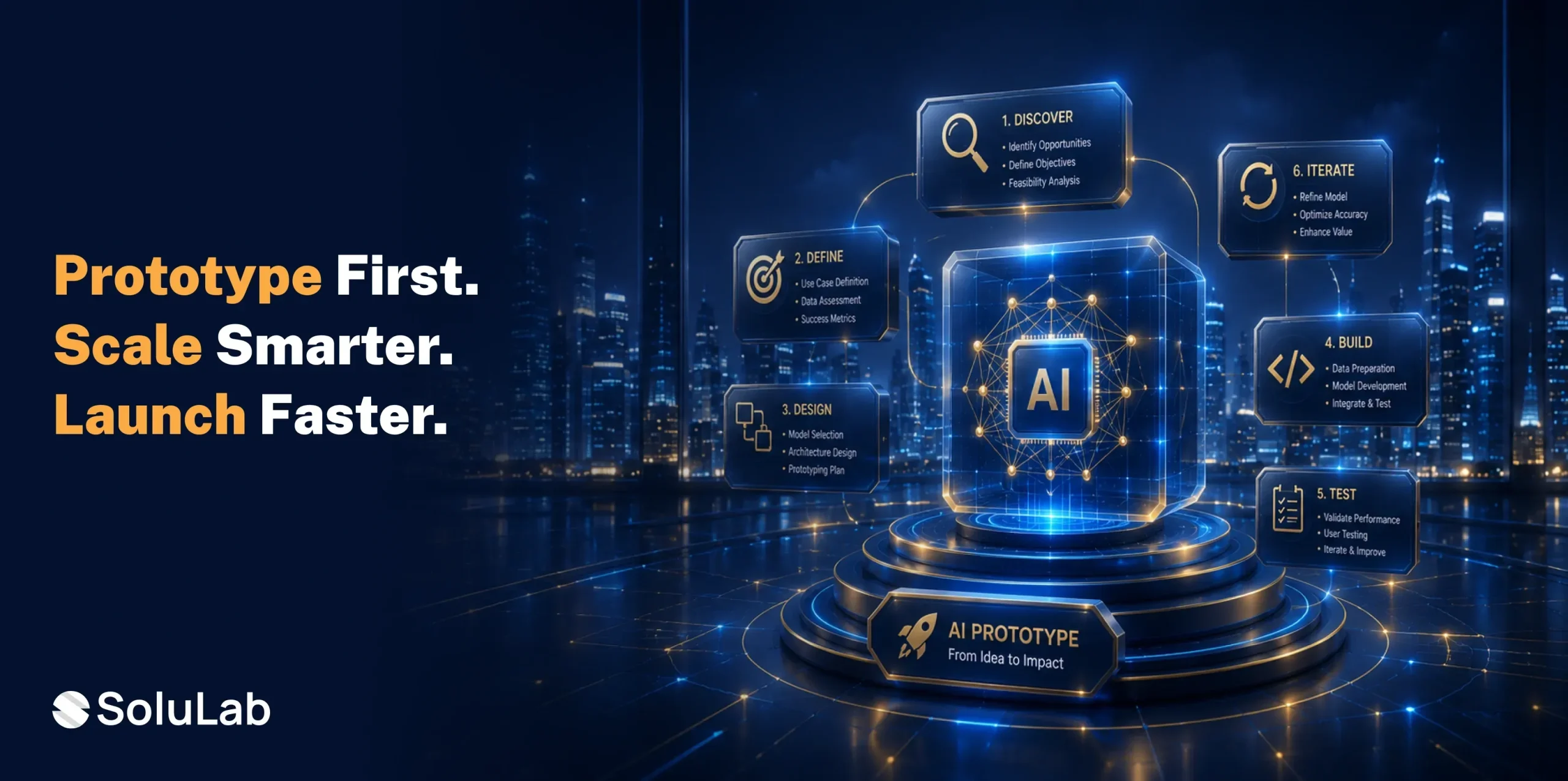
Plenty of AI SaaS companies find it hard to build AI-powered tools. Code is the smallest part of it. The work is picking a real problem, automating it with judgment, planning honestly, and iterating once real users start poking holes. Here’s the sequence that tends to hold up.
1. Planning and Ideation
Begin with a problem somebody would pay to make go away. Talk to the people who have it. Study what competitors already shipped, and find the gap they left open. Two questions decide this stage: is the idea useful, and is it buildable with AI as it exists today? Then map exactly where AI product development adds value a rules engine couldn’t.
2. Define AI SaaS Features
Write the must-have list next. Be specific about what the model is responsible for: recommendations, forecasts, routing, all three? Nail the core functionality, the flow a user walks through, and what counts as a good outcome. Solve the pain points. Resist the urge to pile on features because the API makes them cheap.
3. Conducting the Discovery Phase
This is your research sprint. Test the assumptions you’ve been treating as facts, build out user personas, sketch the workflows in their roughest form. The point is learning before building: how people behave, where the technical risk hides, what the business actually needs. Everything downstream leans on what you find here.
4. Choosing the Tech Stack
Choose tools that match the goal, not the résumé. In practice that means cloud services, a backend framework you trust under load, and machine learning libraries such as TensorFlow or PyTorch. Weigh scalability and response time, and ask how much friction your stack puts between you and AI integration.
5. Hiring a Team
You’ll need the right mix of talent: AI/ML engineers, SaaS platform developers who have built multi-tenant billing and access control, UI/UX designers, and a product manager. In-house hiring gets expensive fast. If the budget won’t stretch, look at hiring AI developers or freelancers who have shipped AI SaaS before, not just read about it.
6. Building an MVP
Perfection is not the assignment. A working version of the core is. Put the weight on whatever your AI does that nothing else does, keep the interface plain, and check that a first-time user can reach the main function without a tour guide.
7. Test for Quality Assurance
Now go break it on purpose. QA has to cover performance under load, security, and the odd inputs nobody planned for. And test the AI models themselves. Accuracy, fairness, reliability: a model that’s confidently wrong will cost you more trust than a crash ever did.
8. Iterate and Improve
Ship it, listen, fix quickly. Models age badly without attention, so plan on regular tuning as real usage data arrives. Feed that loop back into features, bugs, and the model itself, and the product keeps earning its subscription instead of coasting on launch week.
Real World Examples of AI SaaS Product
Five AI-powered SaaS products already doing this in public, with a short note on each:
- Fireflies.ai: Records your meetings, transcribes them, and hands back a summary. It plugs into Zoom, Google Meet, and the rest. You get the decisions and action items without replaying an hour of call.
- Grammarly: Reads your text for grammar, tone, and clarity, then suggests the fix. Professionals, students, and whole teams run it inside email and Google Docs.
- Zendesk AI: Routes tickets automatically, runs chatbot support, and detects intent before a human sees the message. Machine learning trained on billions of interactions is what lets support teams grow without the quality sliding.
- Notion AI: Generates content, condenses notes, and rewrites drafts, all inside the workspace people already live in. It sits somewhere between productivity tooling and a writing partner, useful for team planning and personal notes alike. Teams weighing the spend can compare a Notion discount against the free plan before committing
- Jasper: A writing assistant aimed at marketers. Feed it your brand voice and goals and it produces ad copy, blog posts, and emails. Underneath sit large language models like GPT-4.
Read More: AI-Led Development
How Much Does it Cost to Develop an AI SaaS Product?
It isn’t cheap. It also isn’t out of reach. Three things move the number: how complicated your idea really is, how big the team gets, and how deep the AI goes into the product.
A basic AI SaaS MVP tends to land between $40,000 and $100,000.
That assumes you’re outsourcing to a decent agency or running a remote team. Go bigger, with custom AI models rather than API calls, and $150,000 becomes the floor rather than the ceiling. Research, design, development, AI model training, testing, and deployment all sit inside that figure.
Roughly how it splits: discovery and design take 10-15%. AI development and integration eat 40-50%, which surprises people every time. Backend and frontend work, QA, and post-launch support absorb whatever’s left.
Read Also: How AI Integration Streamlines Operations for Small & Mid-Sized Companies?
Future of AI SaaS Product Development
The barrier keeps dropping. A small SaaS company can now ship predictive analytics, chatbots, and personalized experiences without standing up a data science department first. OpenAI’s APIs, Google Vertex AI, and AWS SageMaker did most of that work already.
Add generative AI to that and SaaS stops being about automation alone. Products will write the content, the code, the report, the analysis, and hand it over finished. Security and ethics get louder in the same breath, because users and regulators both want to know how a decision got made.
AI isn’t going to sit beside SaaS. It’s going to set the shape of it. Adaptive, alert, still built around a person: that becomes the baseline, not the differentiator.

Conclusion
An AI SaaS product beats a traditional one on the things buyers care about now: it adapts to the individual user, and it keeps adapting. Put artificial intelligence together with the delivery model SaaS already perfected and you get personalization at a price that works.
None of it happens without planning, a stack that fits, and the discipline to keep improving after launch. The upside is that the door is open to startups now, not just the companies with a research budget. SoluLab has built a reputation around top-notch AI development services, and the track record behind that is what we bring to your problem.
Niche problem or broad market, the investment in AI-powered SaaS development is what buys you room to keep innovating. We recently worked with a tech-savvy client on an AI-powered recruitment platform, and the results spoke for themselves.
SoluLab, a generative AI development company, can build your AI SaaS product and answer the awkward questions along the way. Get in touch and let’s talk specifics.
FAQs
Shipra Garg is a tech-focused content strategist and copywriter specializing in Web3, blockchain, and artificial intelligence. She has worked with startups and enterprise teams to craft high-conversion content that bridges deep tech with business impact. Her work translates complex innovations into clear, credible, and engaging narratives that drive growth and build trust in emerging tech markets.