Most teams start building a crypto payment gateway with a number in their head that has nothing to do with reality. Then the timeline slips, the budget swells, and someone has to explain both to the board.
Pricing for crypto payment gateway development services is all over the map. Tech stack, feature list, compliance burden, who is actually writing the code: each one moves the number. Without a clear roadmap you will pay handsomely for features nobody asked for.
The good news? Careful scoping and the right crypto payment gateway solutions get you a working system without gutting the bank account. Below, we go through what a gateway really costs, which decisions drive that cost up, and where you can trim without regret.
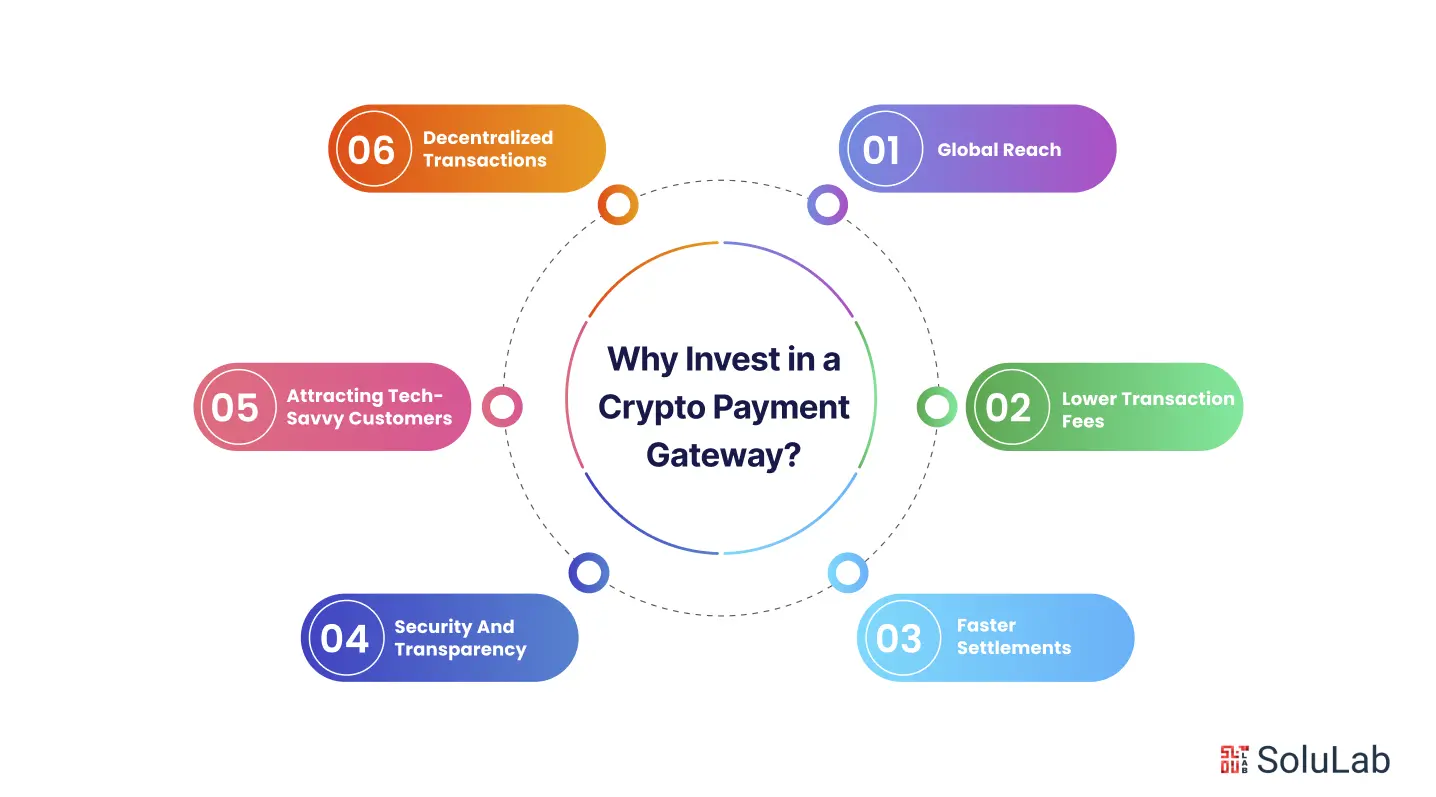
Why Invest in a Crypto Payment Gateway?
A crypto payment gateway behaves a lot like the conventional kind. The difference sits underneath: it settles Bitcoin transactions instead of credit or debit card payments. That single swap is what lets a company take money in Bitcoin, Ethereum, and a long list of other altcoins.
So businesses get a door into the cryptocurrency market without rebuilding their checkout from the ground up. Gateways of this kind are secure, quick, and cheap to run, which is why they keep showing up as a serious alternative to legacy payment rails. The case for building one comes down to these:
- Global Reach: Take payment from a customer anywhere, skip the currency conversion headache, and stop bumping into banking limits. Scaling across borders stops being a finance project.
- Lower Transaction Fees: Set against card networks and bank transfers, crypto transactions usually cost less per charge. Multiply that across volume and the savings stop being rounding errors.
- Faster Settlements: Payments running through blockchain technology clear in minutes, not business days. Your cash flow notices the difference well before your accountant does.
- Security and Transparency: Each transaction is encrypted and written to the blockchain. Fraud and chargeback exposure drops, and both the merchant and the buyer can see exactly what happened.
- Attracting Tech-Savvy Customers: Taking crypto signals something about how you build. It pulls in younger buyers who would rather pay in digital assets than reach for a card.
- Decentralized Transactions: No central authority sits between you and your money. That means fewer third-party limits, and no sudden freeze on funds you were counting on.

Cost Breakdown for Building a Crypto Payment Gateway: An Executive’s Overview
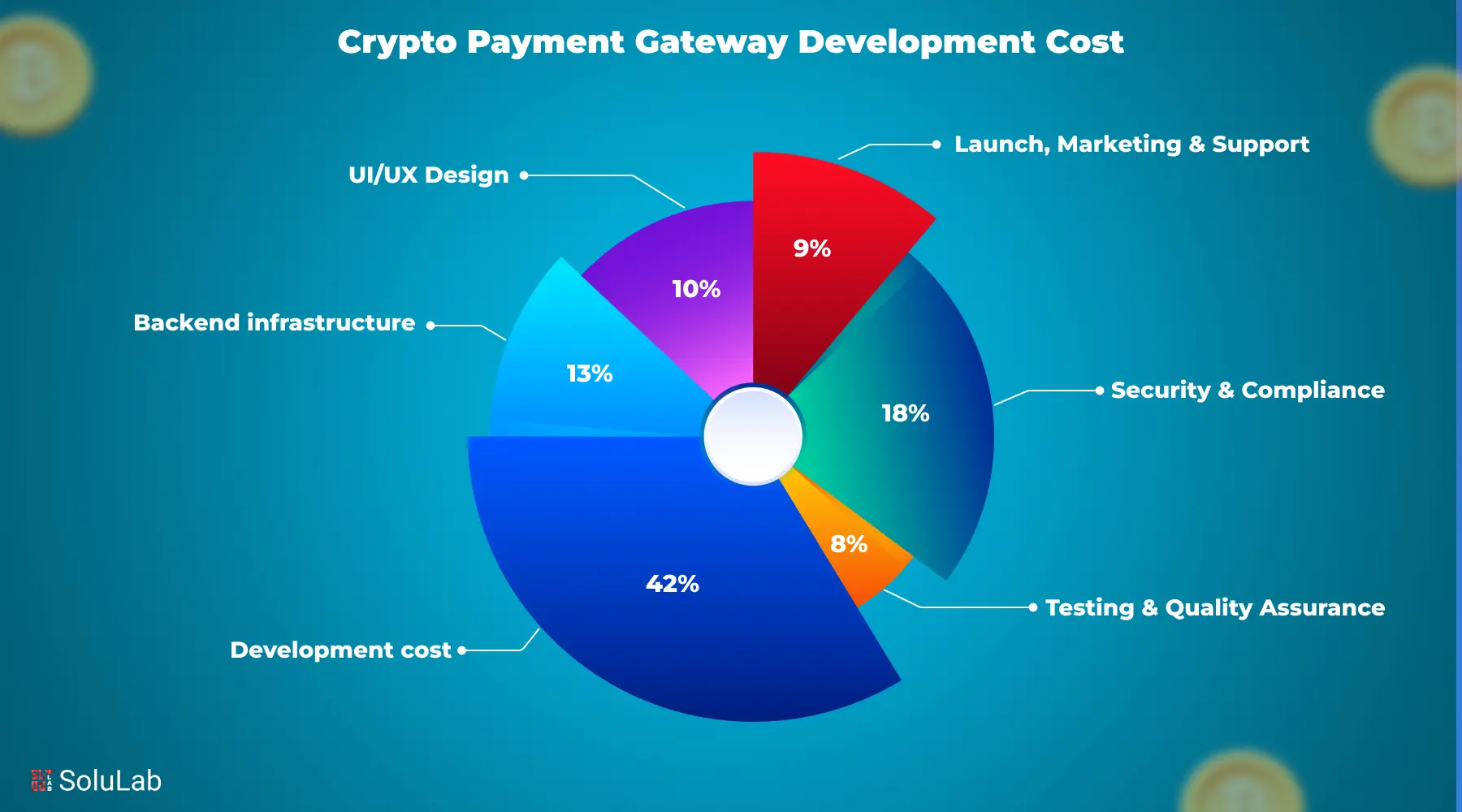
On a slide, a cryptocurrency payment gateway sounds like a moonshot. On a budget sheet it is just line items. Here they are, in the form an executive actually has to approve.
According to Global Market Insights, the Crypto Payment Gateway Market size was valued at USD 1.2 billion in 2023 and is estimated to register a CAGR of over 15% between 2024 and 2032.
1. Development Cost
Scratch build or white-label? The answer swings this number more than anything else. Plan on $10,000 to $30,000, moving with complexity, blockchain integration, and how senior your developers are.
2. Security & Compliance
A crypto gateway has to be airtight. KYC and AML tooling, encryption at rest and in transit, a proper smart contract audit: figure $3,500 to $12,000. And none of it is optional, because the rules are not gentle.
3. Backend Infrastructure
Hosting that holds up, node providers you trust, APIs pulling live conversion rates. Budget $2,500 to $7,500 a year, more if you are chasing serious scale or strict uptime targets.
4. UI/UX Design
Trust is a design problem before it is a security one. A clean dashboard, wallet connections that make sense, layouts that behave on a phone: roughly $2,000 to $5,000 for interface work that looks professional rather than improvised.
5. Testing & QA
Skip this and you will pay for it in public. Security testing, load testing, functional QA before anyone touches production: set aside $1,200 to $3,000.
6. Launch, Marketing & Support
Getting the thing in front of people adds $2,500 to $6,000: early marketing, a support desk that answers, launch logistics. This is the money that turns signups into merchants who stay.
Read More: What Problems Do HTLC Smart Contracts Solve in Crypto Payments?
Factors Affecting the Cost of Building a Crypto Payment Gateway
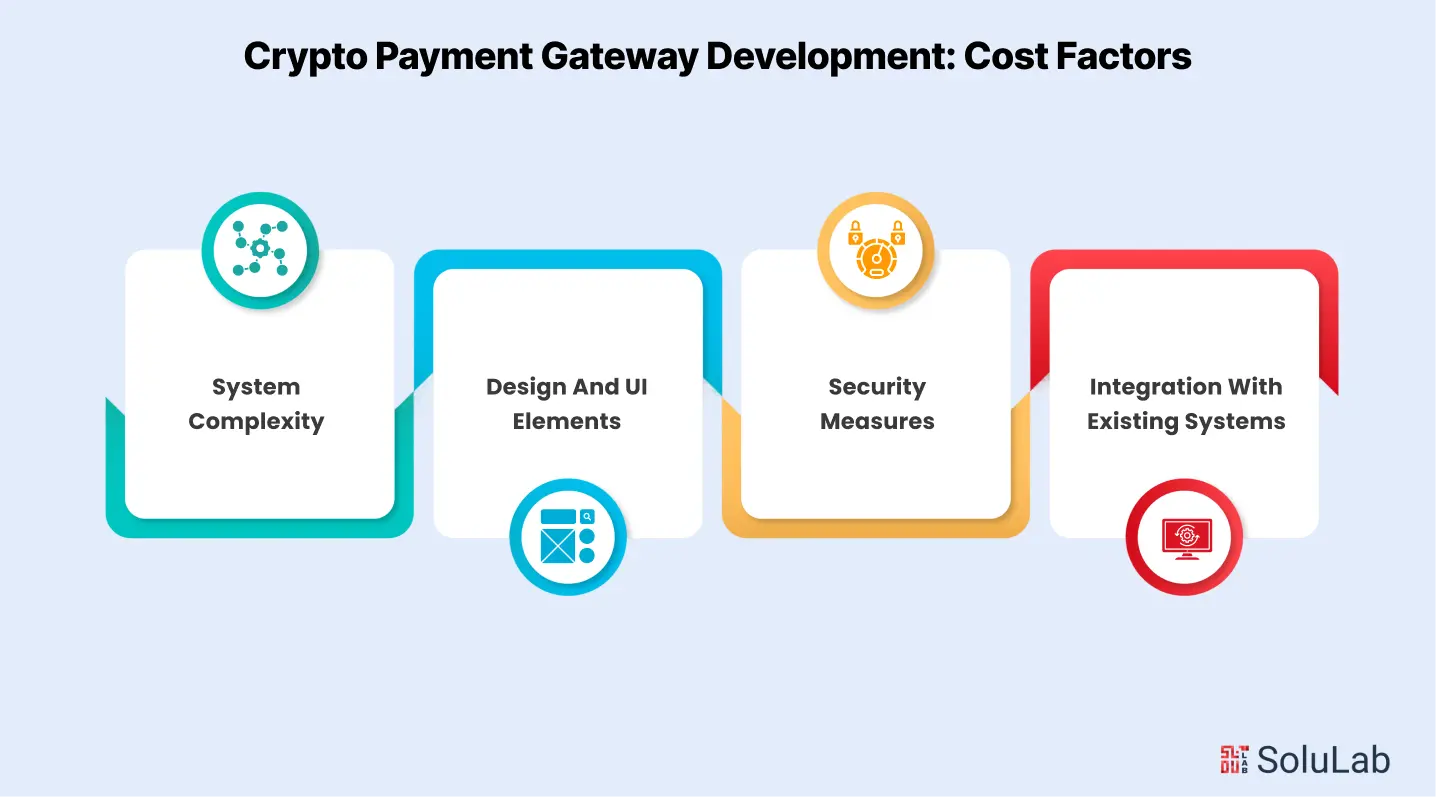
The estimate only makes sense once you see what sits behind it. These are the technical and strategic calls that push your build budget in one direction or the other.
1. System Complexity
Supporting a dozen coins, settling in real time, exposing custom APIs: each one is more code to write and a lot more code to verify. Complexity does not add cost linearly, it compounds, and testing is where you feel it.
2. Design and UI elements
People stay on a platform that feels obvious. Getting there means a custom interface, considered motion, and layouts that hold together from a 13-inch laptop down to an old Android handset. That work needs designers who have done it before, and their hours show up on the invoice.
3. Security Measures
Nobody negotiates on security once real money is moving. Building those protections, then paying someone to hunt for the holes you missed, is a real line item and not a small one.
4. Integration with Existing Systems
Accounting software, the eCommerce platform, whatever wallets your users already hold. Plugging into all of that is rarely a plugin. In practice you end up writing middleware, and the price scales with how stubborn the systems on the other side are.
5. Compliance and Regulatory Requirements
KYC, AML, data protection law that changes by jurisdiction. You will be paying lawyers as well as engineers, building compliance features into the product, then budgeting for audits and the updates that follow them. This cost never fully goes away.
6. Scalability and Performance
A gateway expected to absorb heavy transaction volume needs load balancing, redundancy, and a database design that does not fall over at peak. Servers, DevOps time, architecture work. Cheap to ignore now, expensive to retrofit later.
Read Also: Why Cryptocurrency Payment Gateways Are Gaining Traction Among UAE Enterprises?
What is the Cost of Developing a Crypto Payment Gateway?
Say you want something in the shape of BitPay or CoinGate. What does that actually run you? The honest answer is that the feature list writes the invoice.
A basic gateway lands somewhere around $15,000 to $50,000. That buys wallet integration, KYC and AML checks, transaction history, and a dashboard that is locked down properly.
Start adding multi-currency support, native mobile apps, staking, or smart contract automation and you are looking at $100,000 and up.
A few other things quietly move the number:
- Where your team sits (developers in India cost less than US/Europe).
- How custom the UI/UX has to be.
- The depth of your security layers and compliance obligations.
Plenty of startups skip all of that and start from a white-label product at $5,000 to $10,000 (₹4 to 8 lakhs), then customize on top of it.
Read Also: How to Build a Crypto Payment Gateway Platform Like Stripe in 2026?
Tips to Reduce Crypto Payment Gateway Development Cost
Yes, this gets expensive. It also gets cheaper fast once you make a few decisions deliberately instead of by default. Eight that consistently pay off:
1. Go for Open-Source Solutions: Why write what already exists? Open-source frameworks cost nothing, bend where you need them to, and ship with enough built in that your team starts weeks ahead.
2. Choose a White-Label Platform: White-label solutions hand you working infrastructure on day one. Cheaper, faster, and yours to rebrand.
3. Outsourcing to Experienced Developers: A good external team, particularly out of a region like India, usually costs less than carrying the same headcount in-house. Quality is a hiring question, not a geography one.
4. Focus on MVP First: Ship a Minimum Viable Product and nothing more. Core features only, in front of real users, before you commit another rupee to the roadmap they may not want.
5. Use Scalable Cloud Infrastructure: AWS or Azure bill you for what you actually consume. Your upfront infrastructure spend drops to near nothing, and capacity arrives when the traffic does.
6. Avoid Over-Customization: Every bespoke tweak has a price tag attached. Early on, build what users need and leave the rest in the backlog.
7. Reuse Existing APIs: Wallet integration, KYC checks, live crypto rates. Mature APIs cover all three. Buy them back in hours instead of spending a sprint rebuilding them.
8. Plan Security from Day One: Get the basic protocols in while the codebase is still small. Patching a hole after launch costs more, takes longer, and occasionally costs you the customer too.

Conclusion
Crypto payment gateways are quietly rewriting how money moves online, and they do it by being cheaper, quicker, and harder to tamper with than what came before. Lower fees per transaction. Stronger security. Settlement measured in minutes. Customers who can pay you from anywhere.
As crypto adoption grows and the technology behind these gateways matures, they stop looking like an experiment and start looking like plumbing. The companies that move early will own that ground in online retail while everyone else is still writing the business case.
SoluLab, a thriving Crypto Payment Development Company in the USA, builds crypto payment gateways and, just as usefully, argues with you about which parts you do not need to pay for. Contact us today to discuss further.
Faqs
Shipra Garg is a tech-focused content strategist and copywriter specializing in Web3, blockchain, and artificial intelligence. She has worked with startups and enterprise teams to craft high-conversion content that bridges deep tech with business impact. Her work translates complex innovations into clear, credible, and engaging narratives that drive growth and build trust in emerging tech markets.