Every few years, tech hands us a new idea that is supposed to change how people talk to each other online. Most fade. The Metaverse has stuck around longer than most, and it has pulled in engineers, investors and plenty of dreamers along the way. Our view is fairly simple: the Metaverse development looks like the next form digital connection will take. Below, we’ll cover what the Metaverse actually is, what it is already changing about how we meet online, and why we think it points toward a more immersive, more connected way of living on the internet.
Let’s start at the beginning.
The Emergence of the Metaverse
None of this is new. People in tech and science fiction have been kicking the idea around for decades. So what’s different now? Two things: Metaverse development has finally broken into mainstream conversation, and serious money is being spent to build it for real.
Historical Context and Development
The word itself comes from fiction. Neal Stephenson coined it in his 1992 novel “Snow Crash,” where he pictured a shared digital universe built on virtual reality. It was a story, nothing more. But it stuck in the heads of a lot of people who would later go on to build software.
The idea kept growing as the technology caught up. Films like “The Matrix” and “Ready Player One” gave it a look and a mood, and creators and gadget lovers ate it up. Even so, for most of that time it lived on paper and on screen, not in anything you could log into. That only started to change recently.
Read Our Blog: 10 Real-World Use Cases of the Metaverse in 2023
Major Tech Companies Investing in the Metaverse
Now the big players are in. Facebook (renamed Meta), Microsoft, Google and others have all made public, expensive bets on the Metaverse. Mark Zuckerberg has been the loudest of the bunch, calling it the successor to the internet we use today. That is a big claim. He clearly means it.
These companies are spending billions on the hardware, software, infrastructure and platforms needed to make the Metaverse development companies work. They are bringing in specialists from virtual reality, augmented reality and artificial intelligence to turn an ambitious pitch into something people can actually use.
How the Metaverse Has Gained Prominence?
A few forces pushed it forward at once. The biggest is raw computing power, which has grown fast enough that detailed, immersive virtual spaces can now be rendered in real time. Fast internet has spread too. Without it, you get lag, and lag kills the feeling of being somewhere with other people.
Then came COVID-19. Suddenly work, school and family gatherings all moved online, and everyone found out, at the same time, how flat a video grid feels after the fortieth call of the week. A space that promised more presence, more personality and more movement started to look very attractive.
Put simply, the Metaverse AI integration has walked out of science fiction and whiteboard debates and become a real target for engineering teams. Better computers, better networks and a public that got tired of flat screens all pushed in the same direction. That is why it now sits in the mainstream, and why it is shaping how people picture the future of connecting online.
What the Metaverse Offers?
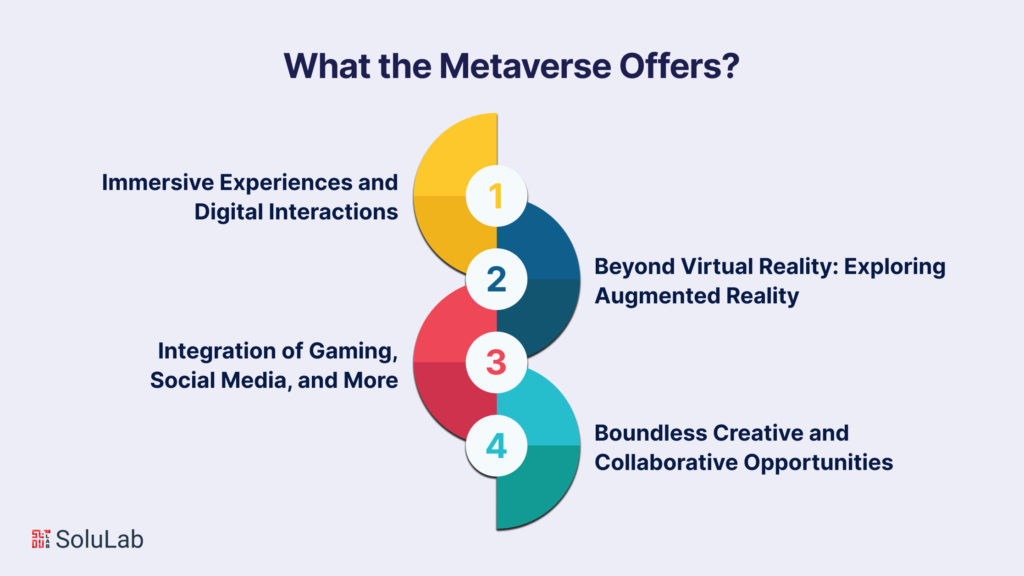
Yes, “Metaverse” gets thrown around as a buzzword. Look past that, though, and there is a real change underneath in how people meet and interact online, one that goes well beyond chat windows and video calls. Here is what it actually puts on the table.
Immersive Experiences and Digital Interactions
Immersion is the whole point. You put on a VR headset and you’re standing in a lifelike space, talking to people who feel like they’re right next to you. Go to a concert. Walk through a museum. Or just hang out with friends. The Metaverse lets you do all of that in a way that comes surprisingly close to the physical version.
And it isn’t only about what you see. Haptic devices add touch, and better audio systems add sound that actually comes from somewhere. As the hardware improves, these worlds will feel fuller and harder to tell apart from the real thing.
Beyond Virtual Reality: Exploring Augmented Reality
VR gets most of the attention. Augmented reality matters just as much. AR lays digital information over the room you’re already in, so the space around you becomes something you can query and interact with. In other words, the Metaverse doesn’t have to live inside a headset. It can sit on top of the real world.
Picture a pair of AR glasses that shows you live details about a person you’ve just met or the street you’re walking down. That’s the idea. You move between the digital and the physical without really noticing where one stops and the other starts.
Read Also: How Will Metaverse Change the World? A New Era of Connectivity and Innovation!
Integration of Gaming, Social Media, and More
This is not one app. Think of it as a huge web of linked spaces covering gaming, social media, online shopping, education and a lot more. Because those spaces connect, you can hop from one activity to the next without logging out and starting over somewhere else.
A normal day might look like this: a virtual workout in the morning, a team meeting at noon, and an evening spent gaming or just chatting with friends in some shared world. Work and play, same place. That range is exactly what makes it useful.
Boundless Creative and Collaborative Opportunities
For us, the most exciting part is creative freedom. People build and decorate their own spaces, design their own avatars, and end up feeling that a corner of this world genuinely belongs to them. Artist, developer, teacher, founder: whoever you are, you get a blank canvas.
Teamwork changes too. A team can meet in a virtual room laid out like a real office, which makes remote work feel less like a string of calls and more like working together. Is that better than a video meeting? For brainstorming and problem-solving, often yes, because people can move, point, sketch and react the way they would in a room.
Digital Connection Reinvented
The Metaverse Artificial Intelligence is more than a piece of tech. It changes how we connect and talk to each other online at a pretty basic level. This section looks at how, and at the kinds of experiences it opens up that ordinary online interaction can’t match.
Virtual Social Interactions in the Metaverse
Social life is where the change is biggest. Talking online usually feels a bit distant. You lose the small signals that make an in-person chat work. The Metaverse tries to win those back by building spaces that behave like real social settings.
Say your family is scattered across three countries. In the Virtual Reality Metaverse, you can all stand in the same virtual room, see each other’s avatars, and even pick up the gestures and expressions that make face-to-face time feel like it counts. It won’t replace a hug. It does get people who live far apart a lot closer than a phone call does.
Borders stop mattering here as well. You can meet people anywhere in the world, and distance no longer decides who you get to know.
Transforming Remote Work and Education
Work and learning could change a lot. Remote jobs and online classes are everywhere now, yet both tend to lose the energy and teamwork of a shared room. Virtual offices and interactive classrooms are the Metaverse’s answer to that.
On the work side, staff meet in a virtual office built to feel like a real one, so meetings feel more personal. Need to brainstorm? Everyone gathers round a virtual whiteboard, much like they would in a conference room.
In schools, students sit in a virtual class that behaves like a real one. Teachers get interactive tools and simulations to keep people interested. The result is the convenience of online learning with some of the presence of a real classroom, which is what online courses have been missing.
Enhanced Communication and Personalization
Communication is built into the design. You still get voice and text, but you also get visual and sensory cues much closer to a real conversation. Avatars can show emotion. Spatial audio means a voice sounds like it’s coming from the person on your left, which makes talking feel a lot more normal.
Then there’s personalization. You can shape your avatar, your space and your experience to suit yourself. It sounds cosmetic, but it isn’t. Those choices make digital interactions feel more personal and more genuine.
Your presence in the Metaverse becomes part of who you are, and you decide how to show up. Friends, coworkers, total strangers: you can adjust how you appear to each of them and build the kind of connection you’re after.
Read Our Blog Post: Top 15 Metaverse Startups to Watch out in 2023
Experiencing Global Events and Spaces Virtually
Big events and famous places get easier to reach too. Virtual concerts, landmarks you can tour from the sofa. Plenty of things that used to be out of reach suddenly aren’t.
You could catch your favorite artist live alongside friends who are thousands of miles away. You could spend an afternoon in a museum or gallery, clicking into interactive exhibits and actually picking up some art history as you go.
The upshot: where you live matters less when it comes to seeing the world’s best sights. You get shared experiences and room to explore that come about as close to being there as today’s technology allows.
Potential Benefits of the Metaverse Technology
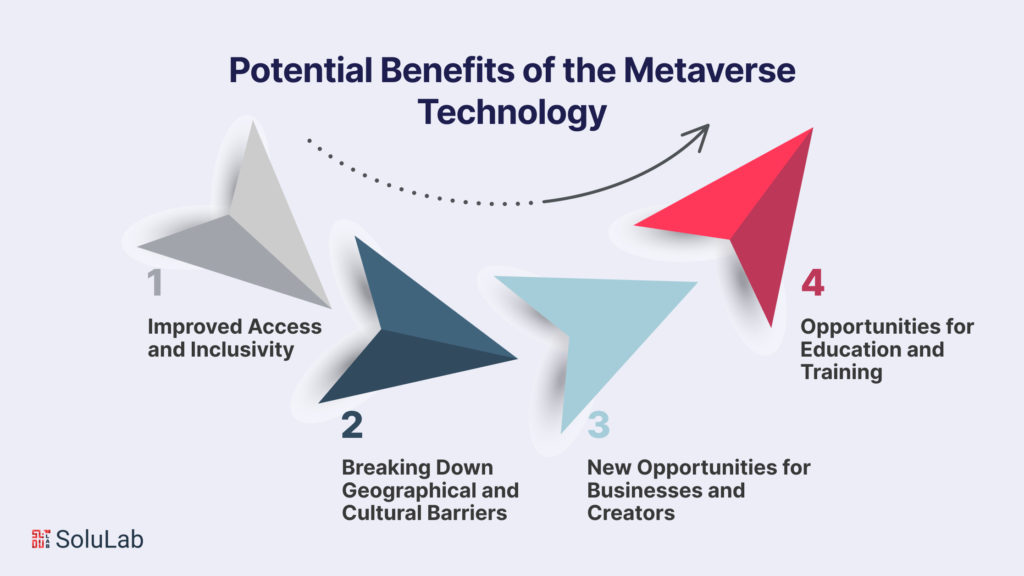
It would be easy to write the Metaverse off as a digital playground. That would miss a lot. It could change how we live, work and stay in touch, and a few of the benefits are worth spelling out.
Improved Access and Inclusivity
Access is one of the strongest arguments for it. Online communication today still shuts people out, whether because of distance, physical disability or money. The Metaverse is built, almost by definition, to get around those limits.
For people with physical disabilities, the top Metaverse platformsprovide a level playing field. Virtual spaces can be designed so anyone can use them, and an avatar can represent a person without their physical limitations getting in the way. That opens digital spaces up to a wider, more varied crowd, on equal terms.
It could also help close the digital divide by putting advanced tech and experiences in front of more people. The cheaper and simpler the gear gets, the more people from different backgrounds can take part.
Breaking Down Geographical and Cultural Barriers
Distance and culture usually decide who we end up talking to. Online, a lot of that falls away. You meet people from the other side of the planet without booking a flight. When the miles stop mattering, friendships, partnerships and global projects have room to grow.
It’s also a place where cultures run into each other. People hear new languages, see how others live and swap views, and that tends to build tolerance and empathy. The more experiences people share in these spaces, the better the chance of a world that is more connected and more comfortable with its own variety.
New Opportunities for Businesses and Creators
Businesses have a lot to gain. Commerce, marketing and customer relationships all get new ground to work on. A brand can open a virtual store, build an immersive shopping trip, and find fresh ways to reach its buyers.
Creators may gain the most. Musicians, artists, game developers and other makers can reach audiences worldwide without shipping anything physical. Virtual shows, exhibitions and events create new income and let creators talk to fans directly, with no middleman in between.
Marketing gets interesting too. Companies can run interactive campaigns inside the Metaverse that people remember because they took part in them, not just scrolled past. For brands trying to stay relevant as online habits keep shifting, that is a real advantage.
Read Also: Metaverse Vs Virtual Reality
Opportunities for Education and Training
Education may be where Metaverse development pays off most. Immersive learning helps students, working professionals and whole organizations alike.
Students get classrooms that are interactive and, frankly, more fun, and people tend to learn better when they’re having fun. They can walk through historical sites, run science simulations and meet teachers and classmates from anywhere.
At work, companies can use it for training, meetings and team projects. It’s a flexible, cost-effective way to run professional development and help teams get more done. And it can recreate real-world scenarios for hands-on practice that would be hard, or just impractical, to stage in a physical room.
Add it up and Metaverse development offers a long list of wins: better access and inclusion, fewer geographic and cultural walls, fresh openings for businesses and creators, and new ways to teach and train. If it keeps maturing, it could drive real, positive change across a lot of everyday life.
The Future of Metaverse in the Digital World
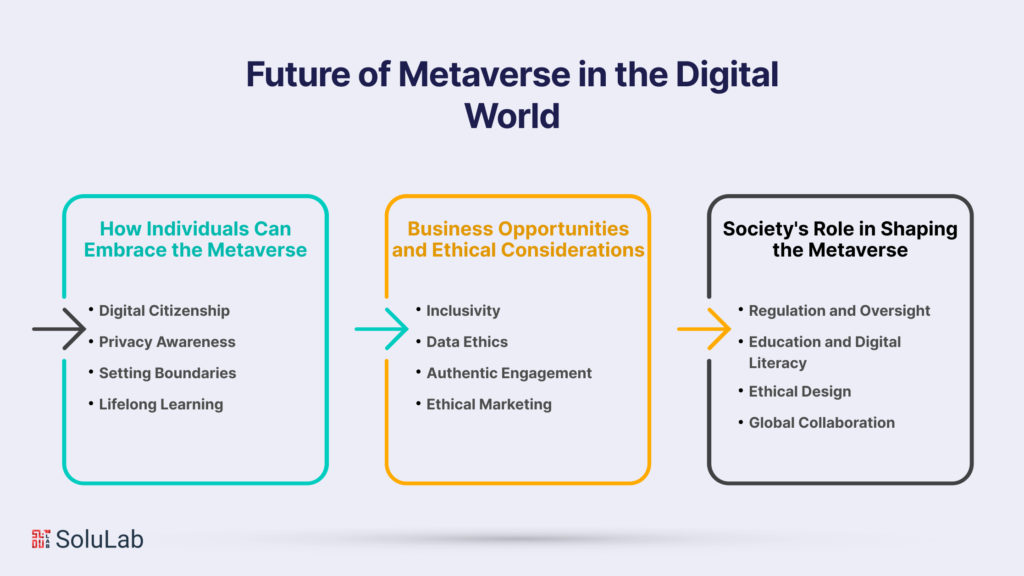
We’re close to the point where the Metaverse becomes part of ordinary life. Before that happens, it’s worth asking how to handle new territory like this carefully and responsibly. Here’s what individuals, businesses and society at large can each do to shape the future based on Metaverse.
How Individuals Can Embrace the Metaverse
If you’re jumping in yourself, bring curiosity and a bit of caution in equal measure. A few things to keep in mind:
- Digital Citizenship: Learn how to behave well online, then actually do it. Treat other people’s digital spaces with the same respect you’d show their homes.
- Privacy Awareness: Watch your privacy closely. Know what data you’re handing over and who can see it.
- Setting Boundaries: Immersive worlds are easy to lose hours in. Set limits so you don’t burn out or get hooked, and keep your online and offline life in balance.
- Lifelong Learning: Keep up with how the Metaverse is changing, and with the ethical questions that come with it.
Business Opportunities and Ethical Considerations
Businesses have plenty to chase here. They also carry more responsibility than most people realize:
- Inclusivity: Build Metaverse projects that everyone can use, people with disabilities included. Make it a requirement, not an afterthought.
- Data Ethics: Be open about what data you collect and how you use it. Respect privacy, and ask for consent.
- Authentic Engagement: Build experiences that are honest, immersive and true to what your brand stands for. Stay away from anything exploitative or harmful.
- Ethical Marketing: Market responsibly inside the Metaverse and stick to established ethical guidelines. The old rules still apply.
Society’s Role in Shaping the Metaverse
As a society, we’ll need some shared ground rules. A few that should guide us:
- Regulation and Oversight: Lawmakers and governments should write rules that protect users’ rights and keep the Metaverse fair and ethical.
- Education and Digital Literacy: Back digital literacy programs so people know how to get around the Metaverse safely and sensibly.
- Ethical Design: Push for a Metaverse built to clear ethical standards, one that respects different cultures and values.
- Global Collaboration: Get countries working together on it. A space with no borders raises problems no single country can sort out alone.
So the Metaverse is new territory, with huge room for connection and new ideas. Whether it helps everyone depends on building it responsibly and ethically. If we think about the social and ethical side together, not as an afterthought, we can shape a Metaverse that makes life better, brings people closer and still holds on to the values that matter most.

Final Words
Is the Metaverse the future of digital connection? We think the honest answer is yes, with conditions. It’s more than a tech project. It changes how people meet and talk online. It points to a world where distance counts for less, access is designed in from day one, and creative people have very few limits. Social spaces that close physical gaps, offices and classrooms rebuilt from scratch: the potential is real. The catch is that it has to be handled well. Individuals, businesses and society all need to stay curious and careful at once, and to keep ethics and digital responsibility at the front of the queue.
There will be problems along the way. Some of them will be serious. But the upside is too big to dismiss, and whether the Metaverse turns out to be a good thing for a connected world depends on the choices people make while it’s still being built. That window is open now. Stay alert, keep empathy in the room, and think a few steps ahead, and the Metaverse has a real chance of becoming the next form of digital connection.
SoluLab, a Metaverse development company, brings deep experience in technology and digital innovation to Metaverse work. We design immersive Metaverse experiences, build platforms with security and privacy at the core, and help businesses spot and act on the openings this space creates, all through practical, creative Metaverse development services. We look ahead, and we take responsible development seriously. If you need a partner to hire Metaverse developersfor your business and figure out where the Metaverse fits, we’d like to help. Get in touch and let’s talk about what the future of digital connection could look like for you.
FAQs
Shipra Garg is a tech-focused content strategist and copywriter specializing in Web3, blockchain, and artificial intelligence. She has worked with startups and enterprise teams to craft high-conversion content that bridges deep tech with business impact. Her work translates complex innovations into clear, credible, and engaging narratives that drive growth and build trust in emerging tech markets.