Key Takeaways
- The Problem: Blockchain development is slow by nature, as multi-layer architecture, security requirements, and audit cycles mean traditional development timelines stretch to 6–9 months even for mid-complexity projects. Clients lose competitive windows.
- The Solution: Embedding AI at every phase of the AI-driven blockchain development process, from scoping and smart contract generation to testing and deployment, compresses timelines dramatically without cutting corners on quality or security.
- How Solulab Can Help: We’ve built and refined an AI blockchain development workflow that’s already proven across real enterprise and startup projects. If you’re planning a blockchain build and need it done right and done fast, we should talk.
Most blockchain teams are not losing because of bad tech; they are losing because they are too slow to ship. Here’s something that hit me a while back: a Statista report from 2024 showed that global enterprise blockchain spending is on track to cross $67 billion by 2026.
If you’ve shipped a blockchain product before or tried to, you know how it goes.
- The scoping takes forever.
- Smart contract audits drag.
- Testing cycles pile up. A
- And by the time you launch, the market’s moved.
We’ve seen it. And it’s the exact reason we started rethinking how we build, not just what we build. This piece is about shifting your thoughts on how we brought AI into our blockchain development, what changed, what didn’t, and why it genuinely cut delivery time on real client projects by around 30%.

What AI-Driven Blockchain Development Services Really Mean in Practice?
Let’s clear something up first. AI in blockchain development doesn’t mean you hand your project to a bot and wait. It means your human developers are working faster, smarter, and with fewer redundant tasks eating their time.
The role of AI in blockchain app development is mostly about compression, compressing the time between idea and deployment by removing the manual, repetitive, and error-prone work that slows teams down.
And when we talk about AI blockchain development solutions, we’re not talking about replacing developers. We’re talking about giving your best engineers a 10x toolkit, so the person who used to spend two days writing boilerplate Solidity can now spend those two days on architecture decisions that actually matter.
The shift toward enterprise blockchain development with AI automation is real, and it’s accelerating. A World Economic Forum report noted that organizations adopting AI-augmented development practices were seeing productivity gains of 20–40% across complex software cycles. Blockchain is no exception.
The benefits of AI in blockchain development really come down to a few honest wins:
- Faster smart contract drafting with fewer syntax errors out of the gate
- Automated security scanning that catches vulnerabilities before a human auditor even opens the file
- AI-assisted test generation that gives you 80% coverage in a fraction of the time
- Smarter sprint planning through AI-powered project management that flags blockers early
None of this is magic. It’s an engineering discipline, backed by the right tools.
How AI Speeds Up Blockchain Development by 30%?
I’ll be honest, when we first started tracking this, I didn’t expect it to be as consistent as it turned out to be. But across four different projects, the pattern held.
1. Yellow: Smart Taxi Booking Platform ‘
Yellow needed a blockchain-backed ride settlement system with transparent fare logic. Traditional build estimate: 22 weeks. With our AI-powered app development services workflow in place, featuring AI-generated contract templates, automated test scaffolding, and AI code review, we shipped in 15 weeks, which is roughly 32% faster. The client’s words: We expected delays, but we got the opposite.
2. KEC TrackPlanner: Supply Chain Traceability
KEC Trackplanner came in needing blockchain traceability for their supply chain operations, which involved complex data flows, multi-party permissioning, and compliance requirements. Our blockchain development with AI integration approach lets us auto-generate about 40% of the smart contract logic and run parallel testing cycles, and we delivered 28% under the projected time after auditing.
Across these two, the average sits at around 30%. And that’s not counting the quality improvements with lower defect rates, fewer post-launch patches, and cleaner audit reports.
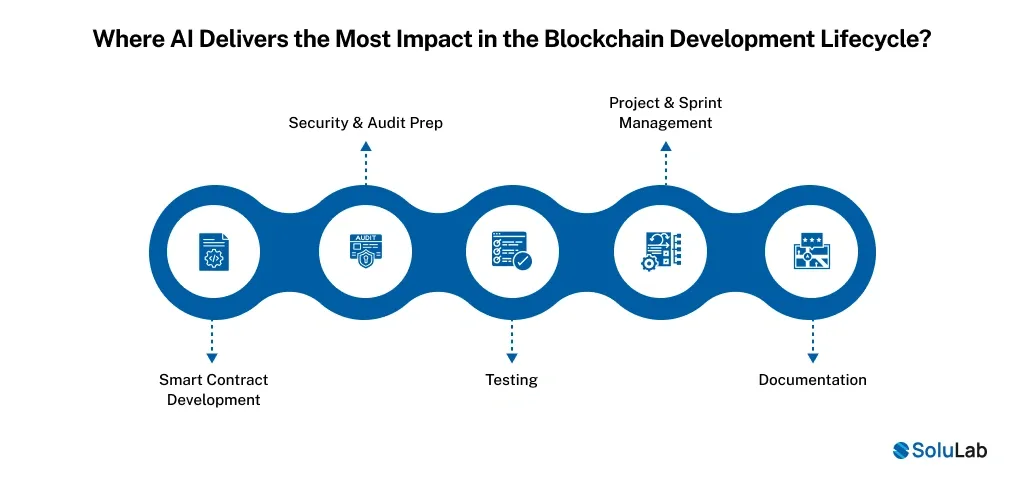
Where AI Delivers the Most Impact in the Blockchain Development Lifecycle?
You don’t need AI everywhere. That’s actually a lesson we learned early by spraying AI tools across a process without thinking about fit, which just creates noise. Here’s where it truly makes a difference:
1. Smart Contract Development
AI coding assistants trained on Solidity, Rust, and Vyper can generate solid first drafts in minutes. Our blockchain developers then refine it, not build it from scratch. This alone cuts contract development time by 35–40% on average.
2. Security & Audit Prep
Its effectiveness is most pronounced in security scanning. Tools like Slither with AI enhancements catch reentrancy bugs, overflow issues, and access control gaps before any human touches the audit queue.
3. Testing
Writing test cases manually is one of the biggest time sinks in blockchain dev. AI test generation tools can build out 70–80% of unit and integration tests automatically, based on contract logic. This is core to how we reduce blockchain development time with AI.
4. Project & Sprint Management
These tools are the enhanced Jira integrations and AI sprint planners, which flag dependency blocks before they become delays. We catch scope creep early, and we reallocate resources in real time. Less firefighting with more building.
5. Documentation
Nobody loves writing docs. Our AI-generated technical documentation means your team spends time on code, not on writing spec sheets. And for enterprise clients, good docs matter, as they speed up stakeholder reviews with proper review.
Common Pitfalls in AI-Driven Blockchain Development
Even with great tools, teams mess this up. Here’s what we’ve learned to watch for:
1. Over-relying on AI-generated contract code without expert review.
AI drafts are starting points, not finished products. A senior developer has reviewed every contract we ship, with no exceptions.
2. Skipping the human audit because AI flagged it clean.
AI pre-scans reduce audit time, but they don’t replace formal audits. We always do both.
3. Underestimating integration complexity.
How AI reduces blockchain development time is real, but enterprise integrations, especially with legacy ERP, HRMS, or CRM systems, still require custom engineering. That’s why we say AI helps, but it doesn’t solve everything
4. Poor AI tool selection.
Not every AI development tool works well with blockchain-specific code. We’ve tested a lot of them and now our stack is curated for this use case specifically.
Tech Stack Blueprint for Enterprise Blockchain Development with AI Automation
Here’s what’s in our toolkit for AI-based blockchain app development services delivery:
| Layer | Tools |
|---|---|
| Smart Contracts | Solidity, Rust, Vyper with GitHub Copilot and Claude |
| Security Scanning | Slither, MythX, AI-enhanced static analysis |
| Testing | Hardhat, Foundry with AI test generation layers |
| Project Management | Jira + Linear with AI sprint assistants |
| Documentation | Notion AI, custom LLM-powered doc generators |
| Monitoring | Tenderly, Forta Network |
| Infrastructure | AWS, GCP, Azure with IaC with AI-assisted Terraform |
This is the operational backbone of what we’d call an AI blockchain development workflow that actually ships product, not just theory anymore.
For teams wanting to go deeper on the fundamentals, how blockchain works at the protocol level matters when you’re making architectural decisions. And understanding top blockchain development use cases helps align your build with what the market’s already validating.
If you’re looking to hire AI developers who actually understand both sides of this equation, that intersection is rarer than people think, and it’s where most of the value lives.
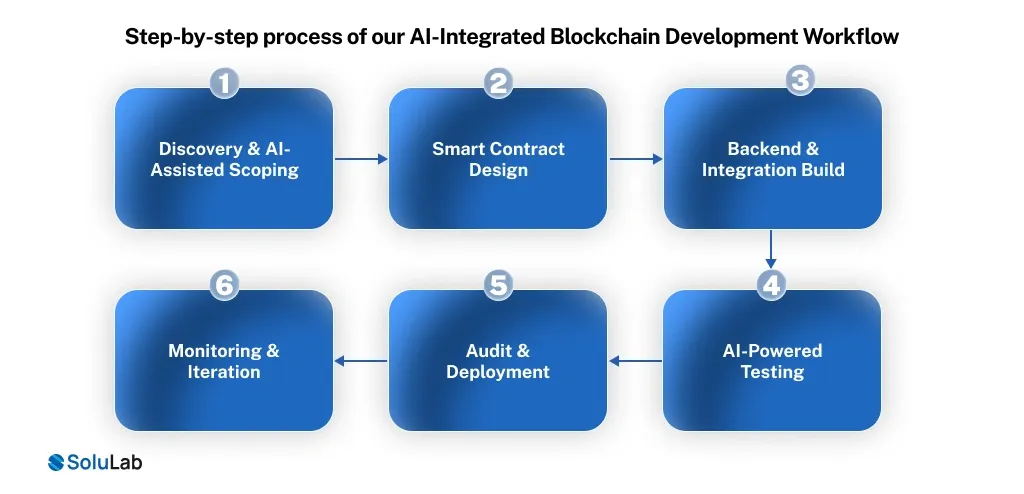
Step-by-step process of our AI-Integrated Blockchain Development Workflow
Here’s how our AI-driven blockchain development process actually looks end-to-end:
Phase 1: Discovery & AI-Assisted Scoping
We use LLM-based scoping tools to analyze requirements, flag ambiguities, and generate a first-pass technical architecture. This cuts discovery from 3 weeks to under 10 days on most projects.
Phase 2: Smart Contract Design
AI-assisted contract drafting, reviewed and refined by senior Solidity/Rust developers. A parallel track with AI security pre-scan runs while dev continues.
Phase 3: Backend & Integration Build
Standard blockchain backend paired with AI integration solutions that automate API generation, data pipeline wiring, and middleware, especially for enterprise systems connecting to legacy infrastructure.
Phase 4: AI-Powered Testing
Automated test generation with manual review for edge cases. This is where a lot of our time savings stack up. We’re discussing a testing phase that previously took 4–5 weeks but now runs in 2–3 weeks with comparable or better coverage.
Phase 5: Audit & Deployment
Pre-audited code reaches formal auditors in better shape, with faster turnaround and deployment. This is the compounding effect of AI automation in blockchain development done right, with each phase feeding the next.
Phase 6: Monitoring & Iteration
Post-launch, we use AI monitoring tools to track on-chain anomalies, gas usage spikes, and contract behavior in real time. Issues surface faster. Patches deploy faster.
Why AI-Driven Blockchain Development Is Becoming the New Agency Standard?
The blockchain agencies that survive the next three years will not be the ones with the biggest teams; they will be the ones who have embedded AI into how they build. AI is already compressing blockchain development timelines, and teams that ignore that reality are creating a permanent productivity gap.
A 2024 article by Forbes stated unequivocally that organizations that do not adopt AI-augmented development by 2026 will be structurally disadvantaged compared to those that do. That gap compounds fast, and in Web3, speed compounds outcomes.
AI-led development for blockchain solutions is not just about shipping faster. It reduces developer burnout, improves audit quality, tightens feedback loops, and increases margins without scaling headcount. That is sustainability, not automation theater.
We made a conscious decision years ago to become an AI-driven blockchain development company, not a traditional blockchain shop that occasionally uses AI tools. That shift required a new operating model, new workflows, and a different mindset. You cannot bolt AI onto a broken process and call it a transformation.
As the market is maturing, clients are getting smarter, and showing us your AI-augmented workflow is becoming a standard RFP question.
Teams that can answer with real process, data, and shipped projects will win. The rest will struggle to keep up. That’s why AI-driven blockchain development is not a feature; it is a capability you build over time or partner for if you are already behind.
Build In-House vs Partner With an AI-Driven Blockchain Development Company
This is the decision most teams wrestle with once they understand the benefits of AI in blockchain development.
Building AI-enabled workflows in-house sounds attractive, but in practice, it comes with hidden costs:
- Tool experimentation and failures
- Model fine-tuning for blockchain-specific logic
- Process redesign across scoping, testing, audits, and delivery
- Months of learning before measurable speed gains appear
That learning curve is expensive.
Partnering with an AI-powered blockchain development company compresses that curve. You inherit a battle-tested AI blockchain development workflow, proven delivery metrics, and teams who already know where AI native strategy adds leverage and where it doesn’t.
For enterprises, this issue matters even more. Enterprise blockchain development with AI automation is less about tools and more about governance, audit readiness, compliance, and predictable delivery. Those are process problems, not software problems.
The real question is not whether AI speeds up blockchain development; it does. The question is whether you want to build that capability from scratch or work with a team that already operates that way.
Ready to Reduce Blockchain Development Time With AI? Partner With SoluLab
If you’ve read this far, you’re probably either building something or planning to. Regardless of your situation, the opportunity to act swiftly is crucial. Our team is working with a limited number of new partners each quarter, and spots fill up.
AI-based blockchain app development services that actually cut timelines by 30% aren’t common. We can show you the process, the data, and the case studies, and the conversation costs you nothing. Waiting costs you weeks.

Conclusion
The 30% isn’t a marketing number; it’s a consistent outcome we’ve tracked across real projects with real clients. And it comes from one thing: treating AI as a first-class part of how you build, not an afterthought.
Blockchain development with #1 AI development company done right means your developers work better, your clients ship faster, and your products are more reliable at launch. That’s the trade, and it’s a beneficial one. The role of AI in blockchain software development will only grow from here. The teams building that operational muscle now will have a structural advantage that compounds over time.
If you’re ready to stop losing time to slow development cycles and start shipping blockchain products that actually hit their timelines, and you know where to find us.
FAQs
Shipra Garg is a tech-focused content strategist and copywriter specializing in Web3, blockchain, and artificial intelligence. She has worked with startups and enterprise teams to craft high-conversion content that bridges deep tech with business impact. Her work translates complex innovations into clear, credible, and engaging narratives that drive growth and build trust in emerging tech markets.