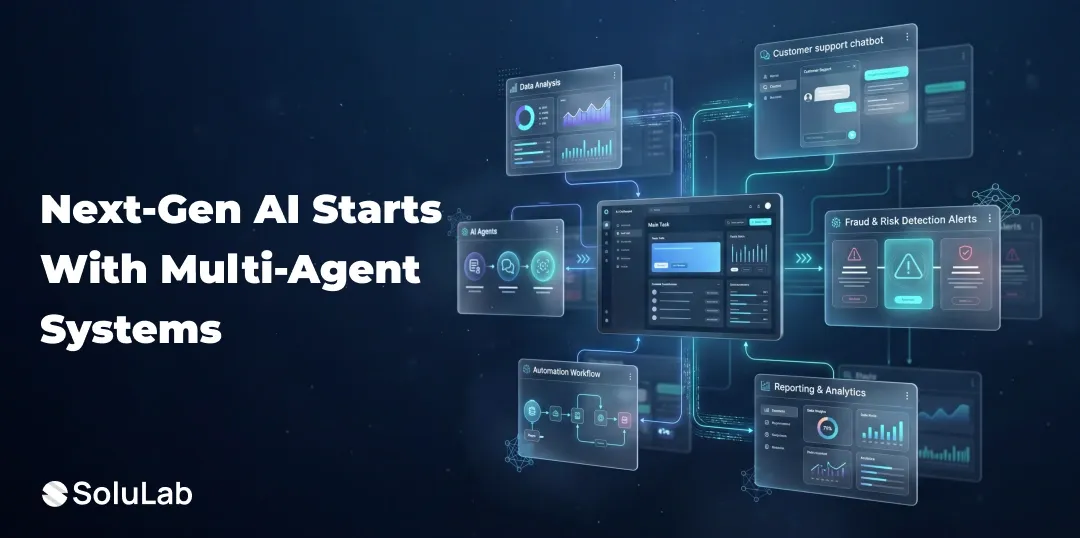
Managing complex systems today often feels overwhelming. Businesses struggle with fragmented data, slow decisions, and disconnected processes that limit growth and efficiency. This becomes a bigger challenge as operations scale across departments, markets, and technologies.
By enabling multiple intelligent AI agents to collaborate, share information, and make autonomous decisions, they simplify complexity and improve coordination. Instead of relying on rigid, centralized control, these systems adapt in real time to changing conditions.
The global multi-agent system market is projected to grow to $184.8 billion by 2034. Continue reading this blog to learn everything you need to know about multi agent system.
Key Takeaways
- The Issue: Businesses are faced with operations that are complex in nature, and single systems cannot provide real-time decision-making, coordination, and scalability, which results in inefficiencies, delays, and increased operational expenses.
- The Solution: The multi-agent systems allow distributed intelligence involving multi-agent collaboration to make decisions, adapt, and automate decisions, which enhance efficiency, scalability, and real-time responsiveness within industries.
- How SoluLab Can Help: SoluLab is an AI-native firm that employs AI in its processes to develop advanced multi-agent applications at a lower cost and faster, and help companies to scale efficiently through automation.
What is a Multi-Agent System?
A multi-agent system is a system in a network of agents that interact, collaborate, or compete to accomplish certain objectives. All the agents do not engage with one another but share information to tackle complex issues efficiently in an independent manner.
These systems are widely used in robotics, supply chains, finance, and AI-driven decision-making environments.
The Key Components of Multi-Agent Systems
Multi-Agent Systems are not only smart components but also functional in assisting to solve complex problems effectively while also providing a way to easily scale a little bit of automation, smarter decision making, and also work well together in a dynamic and data-driven world.
- Large Language Models (LLMs): Large Language Models are the cognitive layer that sees agents comprehend context, generate responses, and make informed choices based on natural language and large-scale patterns of data.
- Agents: Agents are separable structures that sense their surroundings, decide, and carry out actions all by themselves as they interact with fellow agents in achieving collective or personal goals.
- Tools: Tools augment the capabilities of agents by enabling them to be linked with external systems, APIs, databases, or software, enabling them to be capable of taking actions, retrieve data, and perform real-world tasks.
- Coordination: The coordination allows the agents to work cooperatively based on the communication protocol, distribution of tasks, and resolution of conflicts to allow running of the complex workflows without some cases of redundancy and inefficiencies.
- Processes: Processes are the generalized workflows and rules on which agents perform to stay consistent, reliable, and achieve the goals of the entire system.
Benefits of Multi-agent Systems
Multi-agent systems provide a dynamic approach to solving complex problems by providing a flexible mechanism to address and solve problems through a multi-intelligent system in which various intelligent agents can interact, evolve, and make decentralized decisions in real time.
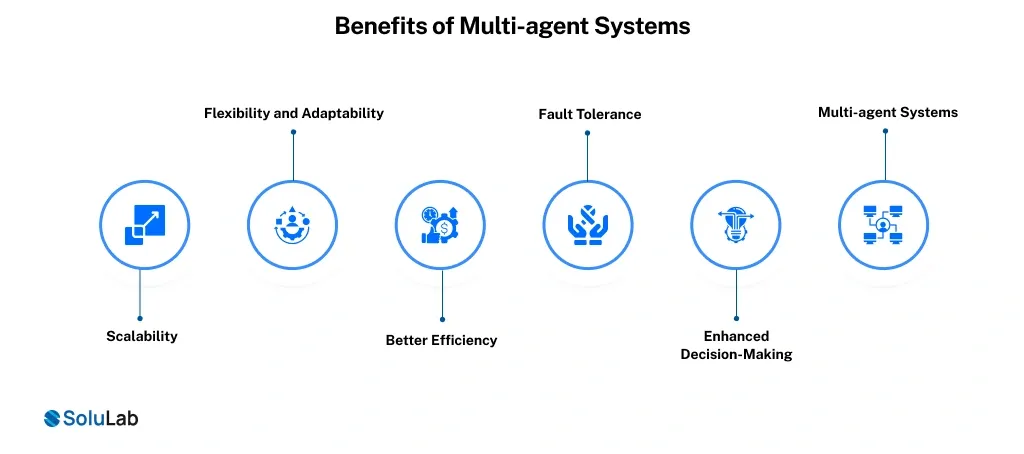
- Scalability: Multi-agent systems have the ability to scale up and down with ease, as a lack of a single agent can disrupt the whole system, and are therefore suited to growing, data-intensive, and distributed settings.
- Flexibility and Adaptability: They were able to respond to changes at the individual level, which means that the system can learn fast in dynamic conditions, uncertainties, or business needs without central control.
- Better Efficiency: Workloads are processed simultaneously by the distribution of tasks among several agents, and the processing time decreases, as well as a better system performance and operational efficiency. According to Research Gate, multi-agent systems can improve operational efficiency by 40–60% in complex processes.
- Fault Tolerance: In case of failure of one agent, others can still be active, and the system can remain reliable, and the likelihood of total failure of the system in case of operation-critical processes is minimized.
- Enhanced Decision-Making: Agents can exchange data and experience, facilitating more informed decisions using data and taking into account various points of view, which results in an optimization of outcomes in complicated situations.
- Multi-agent Systems: Multi-agent systems are able to process and respond to real-time data rapidly, and hence they are relevant in such applications as logistics, autonomous systems, and financial trading environments.
How Multi-Agent Systems Work?
Multi-agent systems work based on cooperation among autonomous agents which communicate, share information, and make decisions jointly to effectively solve complicated tasks in a more efficient manner than uni- or centralized systems.
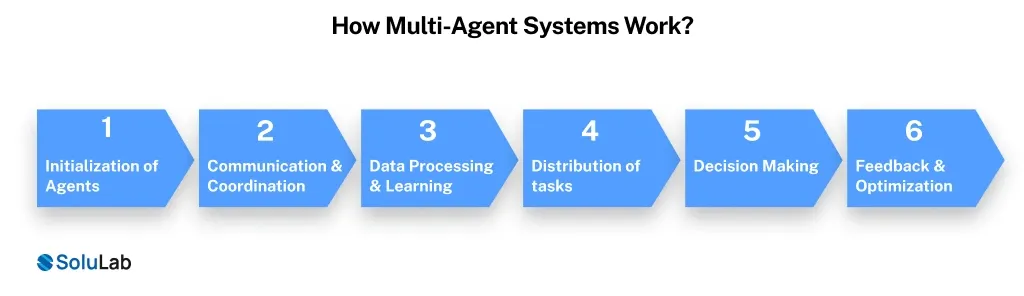
- Initialization of Agents: Every agent has roles, goals, and decision-making abilities. They will be programmed to act independently, but in the interest of the entire system’s goal.
- Communication & Coordination: Agents communicate and share information and updates on the basis of established protocols. This coordination will make sure that all the agents remain in line, do not conflict, or work with each other in a manner that will address common objectives.
- Data Processing & Learning: The agent is constantly processing received data and learning through interactions. This enables them to be flexible to environmental changes and enhance decision-making over time.
- Distribution of tasks: Multifaceted issues are decomposed into smaller tasks and allocated to the agents. Every agent is a part and makes the execution faster, and makes the whole system more efficient.
- Decision Making: Agents make local decisions that are made using the available data and rules. It is through the interactions that collective decisions are derived, and in that way, problem-solving becomes dynamic and scalable.
- Feedback & Optimization: The system assesses results continuously and gives feedback to the agents. This assists in sharpening strategies, eliminating errors, and improving performance as time goes by.

Single-agent vs. Multi-agent Systems: Key Differences
Single-agent systems involve one autonomous entity making decisions independently, while multi-agent systems feature multiple interacting agents coordinating for complex tasks, here’s a comparison of their key differences-
| Aspect | Single-Agent Systems | Multi-Agent Systems |
|---|---|---|
| Number of Agents | One agent handles all tasks and decisions. | Multiple agents collaborate or compete. |
| Scalability | Limited by a single agent’s capacity and resources. | Highly scalable; add agents for larger problems. |
| Complexity | Simpler interactions with the environment. | Emergent behaviors from agent interactions. |
| Fault Tolerance | Single point of failure if the agent crashes. | Resilient; others can compensate for failures. |
| Communication | None required internally. | Essential via protocols (e.g., messages, auctions). |
| Examples | Chess-playing AI like AlphaZero; robot vacuum. | Robotics, traffic simulation, and market trading bots. |
| Coordination | Not applicable. | Requires mechanisms like consensus or hierarchy. |
Best Practices for Implementing Multi-Agent Systems
The effective implementation of the multi-agent systems involves proper planning, coordination, and design, to provide a smooth collaboration between the agents, effective scaling, and high- quality and reliable results in the complex and changing environments.
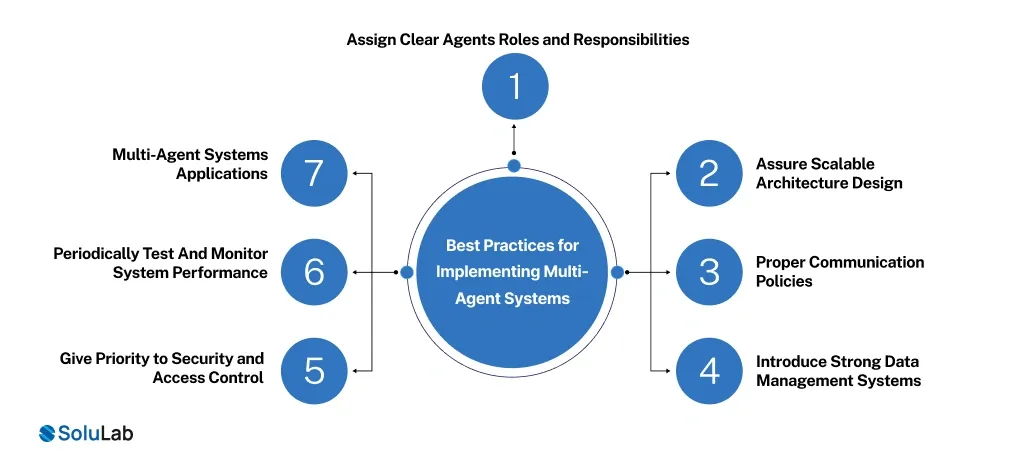
#1. Assign Clear Agents Roles and Responsibilities
Definitely divide tasks and boundaries for every agent in order to eliminate overlaps and conflicts. Clear roles enhance accountability, coordination, and efficiency of the system in complicated environments.
#2. Assure Scalable Architecture Design
Design the system to support growing agent and data loads without scaling problems. Scalable architecture helps in growth, flexibility, and long-term sustainability in diverse business requirements.
#3. Proper Communication Policies
Implement structured communication among the agents over standardized protocols. With effective data sharing, the decision making process becomes quicker, errors are minimized, and coordination improves among the distributed system components.
#4. Introduce Strong Data Management Systems
Maintain consistency and accuracy in centralized or well-synced data systems. The credibility in data management enhances the decision-making of the agent and eliminates interdependency inconsistency.
#5. Give Priority to Security and Access Control
Make sure that there is good authentication, authorization, and protection of data. Secure systems ensure that only the authorized users access information, and only sensitive information is accessed through the interaction of multiple agents.
#6. Periodically Test And Monitor System Performance
Measure and constantly monitor the behavior of agents, system output, and system performance. Frequent monitoring enables the detection of problems in time, the streamlining of processes, and their constant reliability.
#7. Multi-Agent Systems Applications
Multi-agent systems are transforming the way complex problems are being solved by facilitating smart, decentralized decision-making in every industry where independent agents interact, evolve, and react in real time to their surroundings.
Applications of Multi-Agent Systems
Multi-agent systems are transforming the way complex problems are being solved by facilitating smart, decentralized decision-making in every industry where independent agents interact, evolve, and react in real time to their surroundings.
1. Autonomous Vehicles and Robotics
Multi-agent systems (MAS) in autonomous driving and robotics allow vehicles and robots to communicate with each other, coordinate their movement, prevent collisions, and ensure paths are optimized in real-time to achieve better safety, efficiency, and adaptability during dynamic conditions.
2. Healthcare & Medical Systems
There are several AI agents in healthcare to monitor patients, assist in diagnosis, treatment planning, and resource management. These agents are working together to analyse data better and faster to provide personalised and real-time healthcare solutions.
3. Supply Chain & Logistics
In logistics, MAS is used to optimize routing, inventory, and demand forecasts by letting the various agents share the information between suppliers, warehouses, and transport systems. This synchronization of AI agents in logistics makes the supply chain efficient, minimizes delays, and provides visibility of the supply chain.
4. Automation in Manufacturing and Industry
In contrast to the traditional single-agent systems and multi-agent systems, modern manufacturing makes use of the MAS to organize mechanisms, control production lines, predict maintenance, and streamline workflows, which have led to increased productivity, less downtime, and intelligent factory processes.
5. Financial Markets & Trading
Intelligent Agents in Finance MAS allows agents to learn the market trends and make trades, detect fraud, and deal with risks in real time. They are able to make quick data-driven decisions in very dynamic environments through their collaborative intelligence.
Conclusion
Multi-agent systems are changing how businesses solve complex, dynamic problems by enabling decentralized intelligence, real-time collaboration, and adaptive decision-making. From autonomous operations to predictive insights, their impact spans industries and use cases.
As organizations move toward automation and intelligent ecosystems, adopting multi-agent architectures offers scalability, efficiency, and resilience. Understanding their types, working models, applications, and benefits is essential for staying competitive in an AI-driven world.
If you are planning to implement multi agent solutions, SoluLab, an AI agent development company, can help your business design, develop, and scale customized multi-agent systems effectively.
FAQs
Neha is a curious content writer with a knack for breaking down complex technologies into meaningful, reader-friendly insights. With experience in blockchain, digital assets, and enterprise tech, she focuses on creating content that informs, connects, and supports strategic decision-making.