Key Takeaways
- The problem: Traditional software systems depend heavily on manual coding and fixed workflows, making them slow to adapt, expensive to scale, and inefficient in handling dynamic, real-time decision-making needs.
- The solution: Agentic development introduces autonomous AI systems that can plan, execute, and optimize tasks on their own, enabling faster development cycles, smarter applications, and scalable, adaptive software architectures.
- How SoluLab helps: SoluLab is an AI-native company that integrates AI directly into its development workflows, helping businesses build agentic systems faster, reduce costs, and launch intelligent, production-ready solutions efficiently.
Software demand is growing rapidly, but development speed is struggling to keep up. Teams still rely heavily on manual coding, rigid workflows, and constant human intervention, which slows innovation and increases costs.
Gartner predicts 33% of enterprise software applications will include agentic AI by 2028, compared to less than 1% today.
The industry is transitioning from AI development solutions that support developers to AI that can act independently. An agentic development solution is an approach where autonomous AI systems can plan, execute, and optimize software tasks with minimal human input.
For technical leaders, this is more than a trend. It changes how software is built, deployed, and scaled. In this blog, you’ll explore how agentic systems work, their real-world impact, and how to start building.
What Is Agentic Development?
Agentic development is a way of building software where smart AI agents take an active role in writing and improving code, while humans guide the overall direction.
Instead of just giving small code suggestions, these AI agents can handle bigger tasks. They can build full features, clean up messy code, write tests, and even decide the best way to solve a problem based on the instructions they receive.
The word “agentic” is important because these systems don’t just assist, they act. They understand goals, make decisions, and carry out tasks, much like a junior developer working alongside you.
In this setup, the role of a developer shifts. Rather than writing every line manually, developers focus on guiding the AI, reviewing its work, and making key decisions about how the software should be designed.
How Does the Agentic Development Work?
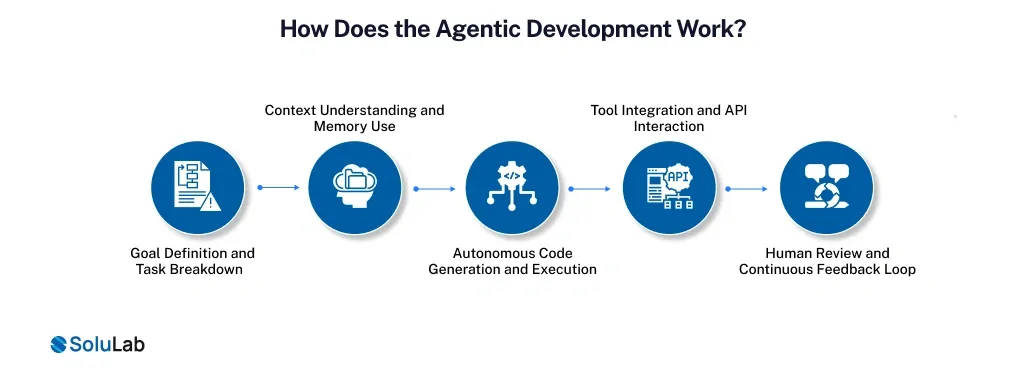
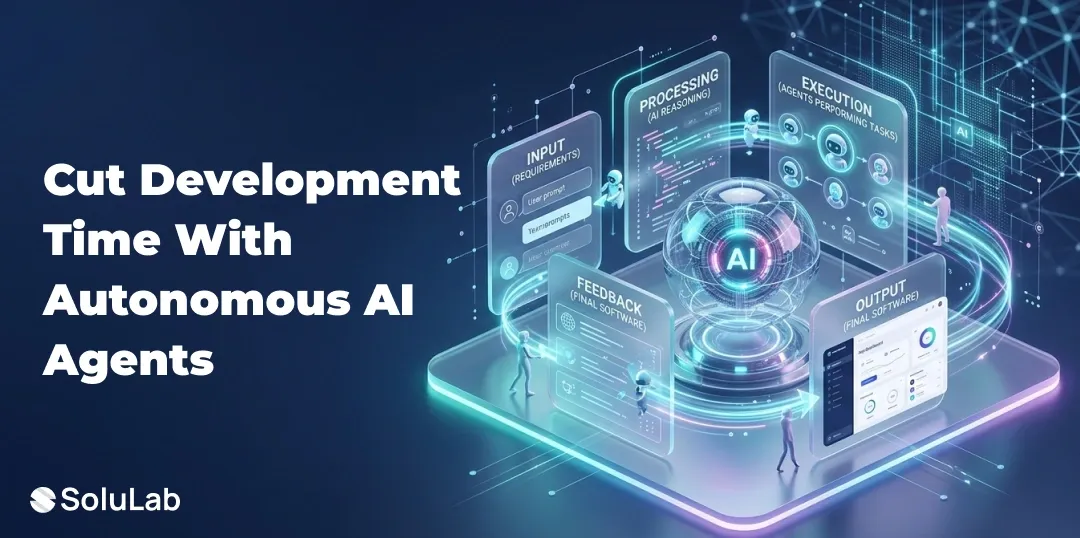
Agentic development entails combining AI agents with human supervision or control so that the systems can plan, carry out, and enhance tasks on their own, with the developers steering the results, maintaining standards, and regulating high-level architectural decisions.
- Goal Definition and Task Breakdown: Developers specify the high-level goals, and the AI agents decompose them into smaller jobs to be done, with clear indicators for carrying out the tasks and ensuring the overall goals of agentic software development are met.
- Context Understanding and Memory Use: Agents consider the existing codebase, documentation, and previous interactions through memory systems, enabling them to make informed decisions and maintain consistency throughout the software development lifecycle.
- Autonomous Code Generation and Execution. After that, based on the assigned tasks, the AI agents independently write code, run processes, and integrate features, eliminating manual work and speeding up turnaround time in modern agentic system development environments.
- Tool Integration and API Interaction: Agents integrate with external tools, APIs, and services to retrieve data, validate outputs, or roll out features, facilitating end-to-end execution in complex, real-world software ecosystems.
- Human Review and Continuous Feedback Loop. Based on this feedback, developers also iterate on the system-level instructions, so the agents evolve and get better over time, while making sure the final output is up to the mark in terms of performance, security, and architecture.
Core Components of Agentic Systems
Agentic systems combine intelligent decision-making with execution capabilities, enabling software to act independently while staying aligned with human goals, making development faster, smarter, and more adaptive.
- Autonomy: Agents make decisions and execute tasks without constant supervision
- Tool Usage: Agents interact with APIs, databases, and external systems effectively
- Iterative Process: Continuously refine outputs through feedback and repeated execution cycles
- Human-in-the-Loop: Humans guide, validate, and control critical decisions and outcomes
Benefits for Technical Leaders
Agentic development allows technical leaders to build faster and smarter systems by pairing AI-led development with human oversight, boosting efficiency, scalability, and long-term product innovation in modern software landscapes.
- Faster Deployment Cycles: AI agents accelerate the development process by providing feature generation, test creation, and issue resolution services, enabling teams to deliver updates more rapidly with reduced manual coding input.
- Reduced Engineering Overhead: Agentic systems obviate the need to employ large teams by automating mundane tasks such as debugging, monitoring, and code optimization, hence reducing engineering overhead.
- Scalable Intelligence: Agentic systems are designed to tackle escalating workloads without a proportional increase in resources, allowing enterprises to efficiently expand decision-making and operational capacities across various products and environments.
- Better Decision Automation: AI agents analyze data, select the best course of action, and carry out tasks autonomously, allowing teams to automate sophisticated decisions while preserving consistency and eliminating human mistakes in workflows.
- Continuous System Improvement: With feedback loops and learning capabilities, agentic AI frameworks continuously refine performance, improve outputs, and adapt to changing requirements without requiring constant manual interventions.
Five Stages Of Agentic Development
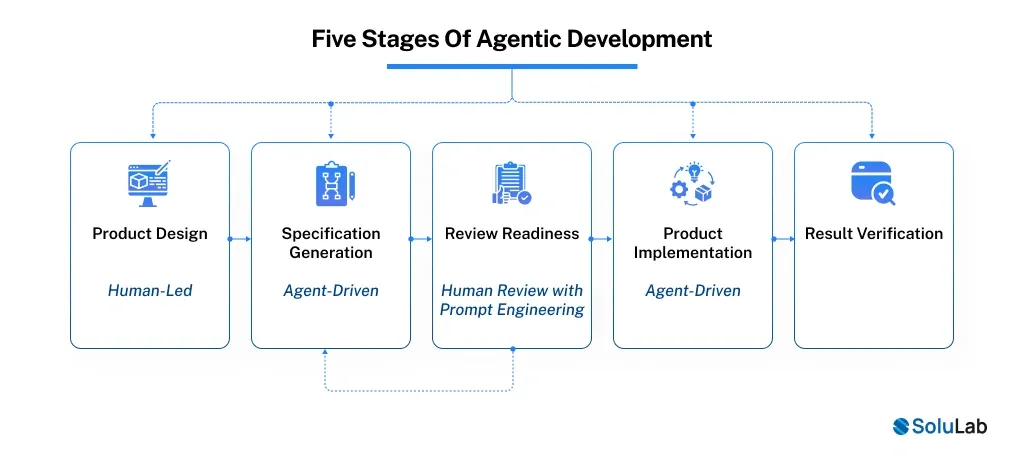
Agentic development follows a structured flow where humans guide strategy, and AI agents handle execution, combining creativity, control, and automation to build smarter, faster, and more adaptive software systems.
1. Product Design (Human-Led)
This stage is fully driven by humans, where leaders define the product vision, user needs, and business goals. It sets the direction, ensuring clarity on what needs to be built before AI agents begin execution.
2. Specification Generation (Agent-Driven)
AI agents translate high-level ideas into detailed technical specifications, including workflows, system logic, and architecture suggestions. This reduces manual effort and speeds up planning while maintaining alignment with initial human inputs.
3. Review Readiness (Human Review with Prompt Engineering)
Humans review AI-generated specifications, refine prompts, and correct any gaps or misinterpretations. This stage ensures accuracy, feasibility, and alignment with business goals before moving into actual product development.
4. Product Implementation (Agent-Driven)
AI agents take over execution by generating code, building features, integrating APIs, and writing tests. Expert AI Developers supervise the process, ensuring quality and consistency while significantly accelerating development timelines.
5. Result Verification
Humans validate the final output, test performance, and refine results using targeted prompts. This stage ensures the product meets quality standards, functions correctly, and aligns with both technical and business expectations.
How Is Agentic Development Different From Traditional AI?
Agentic development represents a shift from passive AI assistance to active, decision-making systems, enabling software to independently plan, execute, and adapt tasks while humans focus on direction and control.
| Aspect | Traditional AI | Agentic Development |
| Role of AI | Assists with predefined tasks and outputs | Acts autonomously to plan, decide, and execute tasks |
| Decision Making | Limited and rule-based | Dynamic, goal-driven decision-making |
| Human Involvement | High involvement in every step | Humans guide strategy, AI handles execution |
| Flexibility | Fixed workflows | Adaptive and evolving workflows |
| Output Scope | Small tasks or suggestions | End-to-end task completion (features, code, workflows) |
| Learning Approach | Reactive responses | Iterative improvement with feedback loops |
| Speed of Development | Slower, manual-heavy | Faster with automated execution |
Future of Agentic Development
Agentic development is a movement toward the future of software systems that think, act, and improve themselves, minimize manual labor, and allow for the creation of faster, smarter, and more adaptive digital products.
- Rise of autonomous systems: Future applications will rely heavily on AI agents that are capable of independently planning, executing, and optimizing assigned tasks with minimal human intervention, and at the same time enhancing the speed, efficiency, and intelligence of the overall system.
- Multi-agent collaboration: Instead of single-agent systems, there will be a shift to multi-agent systems working in concert, coordinating their tasks, sharing context, and collaboratively addressing complex issues more efficiently than isolated AI models or traditional software pipelines could manage.
- Continuous self-improvement: These systems will learn from their experiences, get feedback, and use it to improve over time. This means software will get smarter and more efficient without needing updates or manual intervention.
- Human-in-the-loop governance: While autonomy is on the rise, humans will remain critical to goal-setting, boundary creation, and ethical considerations, establishing a middle ground between independence and controlled oversight in complex and potentially dangerous scenarios.
- AI-native application architecture: Instead of rigid workflows, future software will be built with AI native strategy from the ground up around agents with flexible, goal-driven designs that can adapt to changing requirements without extensive reprogramming.
Conclusion
Agentic development is changing how software gets built and scaled. By shifting from static, rule-based systems to autonomous, goal-driven AI agents, businesses can move faster, reduce manual effort, and get smarter decision-making across workflows.
This approach is not just about efficiency; it is about building systems that continuously adapt and improve over time. As enterprises look to stay competitive, adopting agentic architectures will become a strategic advantage rather than an option.
If you are planning to integrate intelligent agents into your products, SoluLab, an AI agent development company, can help your business design, build, and deploy scalable agentic solutions.
FAQs
Neha is a curious content writer with a knack for breaking down complex technologies into meaningful, reader-friendly insights. With experience in blockchain, digital assets, and enterprise tech, she focuses on creating content that informs, connects, and supports strategic decision-making.