Key Takeaways
- Commodity tokenization has crossed the pilot phase and is now attracting institutional capital globally.
- Gold-backed digital assets currently dominate the market, while carbon credits, agriculture, and energy assets are rapidly gaining traction.
- Enterprise commodity tokenization platforms rely on smart contracts, oracle infrastructure, compliance systems, and secure custody frameworks.
- Regulatory fragmentation, liquidity gaps, and off-chain asset verification remain major concerns.
- Financial institutions are increasingly exploring commodity-backed tokens to improve 3x settlement efficiency, manage collateral, and access global liquidity.
Commodity tokenization is rapidly becoming a serious institutional market instead of remaining a niche blockchain concept. The Real World Asset (RWA) sector, excluding stablecoins, has already crossed nearly $29 billion. Meanwhile, tokenized commodities surged from around $1.9 billion to more than $7.3 billion within a short period.
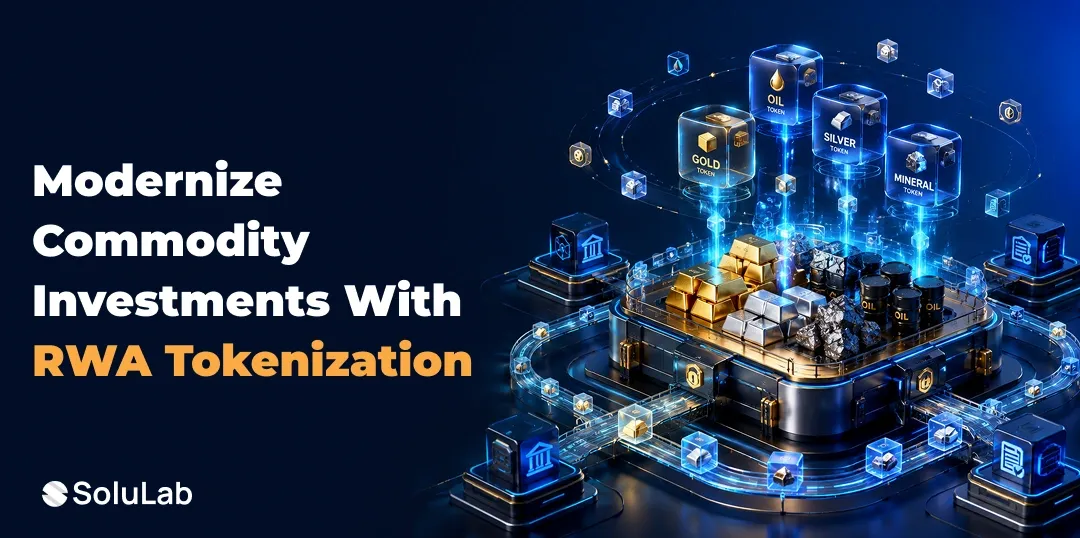
Generally, enterprises are now exploring tokenization development solutions for commodities like gold, silver, oil, carbon credits, and agricultural reserves. The goal is to improve settlement speed, liquidity access, and fractional ownership of commodities.
Traditional commodity systems still depend heavily on intermediaries, delayed settlements, and manual verification processes. However, blockchain commodity trading platforms support faster transactions, transparent reserve audits, and commodity-backed digital assets secured through enterprise-grade custody and compliance infrastructure.
Why Are Institutions Eyeing Commodity Tokenization As a Golden Duck in 2026?
Asset tokenization is attracting institutional attention because traditional commodity infrastructure remains operationally expensive, fragmented, and slow. While commodity ETFs improved accessibility for investors, they still limit direct ownership flexibility and real-time settlement capabilities.
Tokenized commodities platforms, however, combine digital accessibility with programmable ownership rights and blockchain settlement infrastructure.
1. Institutional Demand for 2x Faster Capital Movement
Traditional commodity settlements generally require T+2 to T+5 execution cycles. If cross-border banking approvals, warehouse documentation, customs processing, and intermediary clearances enter the workflow, delays become even longer.
However, blockchain commodity trading systems significantly reduce operational settlement friction.
This matters heavily for:
- Commodity trading firms
- Hedge funds
- Institutional treasury operators
- Precious metals investment firms
- Energy trading companies
- Cross-border exporters
Hence, tokenized commodities help institutions move capital more efficiently without continuously relying on legacy financial rails.
2. Commodity-Backed Tokens as Inflation Protection
Persistent inflation and geopolitical instability are pushing institutional capital toward real-world commodities with stronger long-term value retention.
The reasons why gold tokenization and silver tokenization are seeing aggressive institutional demand are that commodity-backed digital assets provide:
- Direct ownership exposure
- Fractional ownership of commodities
- Faster global transferability
- Better liquidity accessibility
- On-chain collateral functionality
- Improved portfolio diversification
Generally, traditional physical commodity investment requires high minimum participation thresholds. Tokenized precious metals reduce those barriers substantially.
3. Enterprise DeFi and On-Chain Collateral Usage
Another major reason behind commodity tokenization growth is enterprise DeFi participation.
Institutions increasingly want digital commodity assets capable of interacting with:
- Lending protocols
- Treasury management systems
- Liquidity infrastructure
- Margin systems
- Institutional custody platforms
- Automated settlement frameworks
At least from a treasury optimization perspective, tokenized real-world assets (RWA) offer significantly better capital utilization compared to idle fiat reserves.
How Are Real Commodity Tokenization Platforms Actually Structured Behind the Scenes?
Enterprise commodity tokenization platform development involves far more than blockchain token issuance. Actually, institutions require synchronized infrastructure connecting physical custody, legal frameworks, smart contracts, banking systems, compliance engines, and reserve verification layers.
1. The Core Infrastructure Layers
A modern tokenized commodities platform generally operates through multiple interconnected layers:
| Infrastructure Layer | Enterprise Function |
| Physical Custody Layer | Stores physical commodity reserves inside regulated vaults or warehouses |
| Legal & Trust Layer | Handles ownership structures, SPVs, compliance, and statutory protections |
| Oracle Layer | Syncs reserve verification data with blockchain infrastructure |
| Smart Contract Layer | Controls minting, burning, settlement, transfers, and compliance logic |
| Application Layer | Supports wallets, trading dashboards, APIs, and enterprise integrations |
Hence, commodity tokenization platform development depends heavily on operational synchronization rather than simple token creation.
2. Minting and Redemption of Commodity Tokenization Workflow
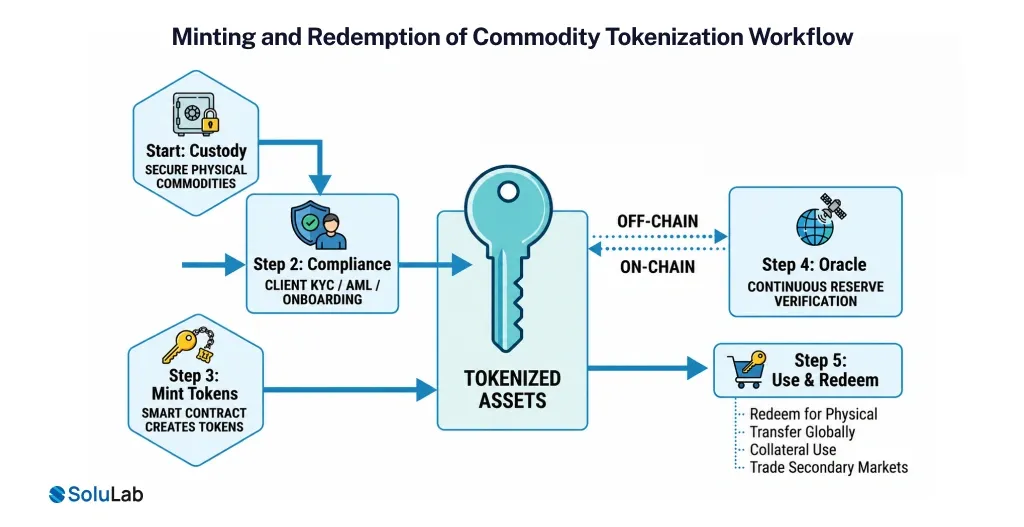
If institutions want to tokenize gold, platinum, oil, or agricultural reserves, the process usually follows a structured operational sequence.
Step 1: Asset Custody and Verification
The physical commodity gets secured inside regulated vaults, bonded warehouses, or approved storage facilities.
Step 2: Enterprise Compliance Checks
The client passes:
- KYC verification
- AML screening
- Jurisdiction checks
- Ownership verification
- Institutional onboarding reviews
Step 3: Smart Contract Minting
Once reserve verification is completed, smart contracts mint commodity-backed tokens proportional to the secured physical commodity.
Step 4: Oracle Synchronization
Oracle systems continuously validate whether the on-chain token supply matches the off-chain reserve balances.
Step 5: Redemption and Secondary Market Usage
Token holders can:
- Redeem physical commodities
- Transfer ownership globally
- Use assets as collateral
- Trade tokenized commodities on secondary platforms
3. Enterprise Integrations and Infrastructure Requirements
Modern institutions cannot operate isolated tokenization systems. Therefore, tokenization consulting increasingly focuses on integration readiness.
Enterprise adoption generally requires:
- ERP integrations
- Banking infrastructure connectivity
- Treasury management APIs
- Institutional wallet systems
- Oracle integrations
- CRM synchronization
- Audit reporting systems
- Compliance monitoring tools
- Multi-chain support
- Custody infrastructure integrations
While startups often focus mainly on token issuance, enterprises require a complete operational infrastructure.
Modern enterprise infrastructure also increasingly integrates:
- Chainlink Proof of Reserve
- IoT warehouse sensors
- AI-native services and solutions
- Vault API synchronization
- Automated audit reporting
- Multi-party reserve verification
Therefore, these systems are becoming one of the most important infrastructure layers in commodity tokenization platform development.
4. Enterprise Smart Contracts Now Operate With Compliance Hooks
Modern enterprise commodity tokenization platforms no longer rely on basic ERC-20 token issuance models. Institutions require compliance-aware smart contract infrastructure capable of adapting dynamically across jurisdictions.
Generally, enterprise systems now integrate:
- Upgradable proxy smart contracts
- ERC-3643 compliance frameworks
- Institutional KYC registries
- Wallet credential verification
- AI automated solutions
- Transfer restriction engines
- Automated jurisdiction controls
If an institutional user transfers a commodity-backed token, the smart contract development does not simply validate token balances. Instead, it checks whether the receiving wallet satisfies regional compliance rules and institutional identity requirements.
However, if the wallet lacks approved credentials or violates jurisdiction restrictions, the smart contract can:
- Freeze transfers
- Block settlement execution
- Restrict secondary trading
- Pause minting activity
- Trigger compliance alerts
Hence, enterprise commodity tokenization solutions increasingly operate as programmable compliance infrastructure instead of simple blockchain assets.
Where Is Commodity Tokenization Already Working in Practice Across Industries?
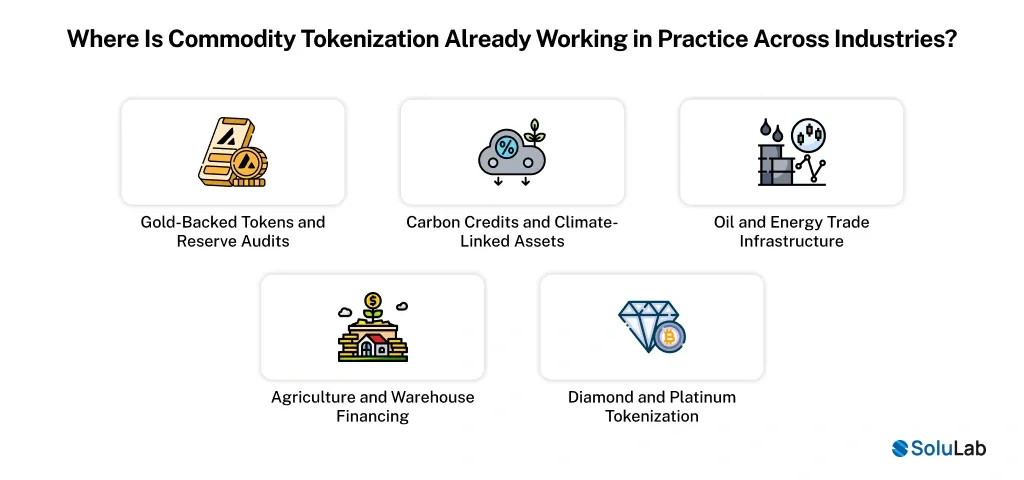
Commodity tokenization is already gaining operational adoption across multiple industries, including precious metals, agriculture, energy trade, and carbon markets.
1. Gold-Backed Tokens and Reserve Audits
Gold tokenization currently dominates the tokenized commodities ecosystem. Tokenized precious metals account for more than 95% of the total commodity tokenization market share.
Gold-backed tokens attract institutional participation because they combine:
- Fractional ownership of commodities
- Transparent reserve visibility
- Real-time settlement
- Cross-border accessibility
- Digital liquidity access
Actually, tokenized gold trading volumes have already crossed hundreds of billions globally. Therefore, institutions increasingly view gold-backed digital assets as operationally useful financial instruments rather than speculative blockchain products.
Why Institutions Prefer Gold Tokenization
Institutions generally prefer to invest in gold tokenization because:
- Gold remains globally accepted collateral
- Settlement becomes significantly faster
- Liquidity improves operational flexibility
- Reserve audits integrate with blockchain verification
- Treasury systems become more efficient
Hence, commodity tokenization services around precious metals continue expanding rapidly.
Example: HSBC Is Already Offering Fractionalized Gold Ownership
HSBC Hong Kong launched its own HSBC Gold Token infrastructure for retail and private wealth clients. The platform allows users to own fractionalized institutional bullion allocations down to 0.001 troy ounce.
Generally, this matters because traditional physical commodity ownership often remains inaccessible for smaller participants. However, tokenized commodities platforms reduce entry barriers while maintaining institutional-grade custody standards.
2. Carbon Credits and Climate-Linked Assets
Carbon credits tokenization is becoming increasingly important because traditional carbon markets suffer from fragmented verification systems and opaque reporting structures.
Blockchain commodity trading platforms now support:
- Transparent carbon ownership records
- Immutable retirement tracking
- Automated burn verification
- Public audit trails
- Better sustainability reporting
If governments continue strengthening ESG compliance frameworks, tokenized carbon infrastructure may become operationally necessary across enterprise supply chains.
3. Oil and Energy Trade Infrastructure
Oil tokenization and tokenized energy assets are also attracting institutional attention. However, energy trade systems remain more operationally complicated compared to precious metals because logistics and settlement structures are highly fragmented.
Still, enterprise commodity tokenization solutions in the energy sector are supporting:
- LNG financing
- Electricity tokenization
- Shipping collateralization
- Commodity-backed settlements
- Energy trade automation
While liquidity remains lower compared to gold-backed tokens, institutional interest continues growing steadily.
One major example is Galactica, which completed bridge financing for a 145,000 CBM Liquified Natural Gas (LNG) vessel using InvestaX’s Monetary Authority of Singapore (MAS)-licensed platform.
4. Agriculture and Warehouse Financing
Agriculture remains one of the strongest long-term opportunities for tokenizing commodities.
Generally, agricultural exporters and farmers often face delayed working capital cycles because commodity verification and settlement take significant time.
However, tokenized supply chain assets allow physical inventory to operate as digitally tradable collateral.
Agriculture-focused platforms are already exploring:
- Warehouse receipt tokenization
- Commodity-backed lending
- Agricultural liquidity systems
- Digital commodity assets
- Cross-border trade financing
Hence, demand for commodity token development company expertise is growing strongly across emerging economies.
5. Diamond and Platinum Tokenization
Diamond tokenization and platinum tokenization are still relatively niche compared to gold tokenization. However, high-value commodities often suffer from illiquid ownership structures and operational opacity.
Tokenized ownership helps improve:
- Fractional investment accessibility
- Ownership transparency
- Provenance verification
- Cross-border transferability
- Liquidity participation
What Still Breaks in Commodity Tokenization and What Needs to Be Solved Next?
Despite strong institutional growth, commodity tokenization still faces several operational bottlenecks.
- The enterprise tokenization software market is projected to grow from nearly $4.7 billion to $15.9 billion by 2034, with BFSI firms controlling more than 52.32% of market demand.
- However, the actual on-chain asset market is scaling much faster.
- With tokenized U.S. Treasuries already crossing $13.4 billion. Resulting in institutions and investment banks increasingly projecting the broader on-chain RWA ecosystem to eventually reach between $10 trillion and $16 trillion during the early 2030s.
1. Trust Gap Between On-Chain Tokens and Off-Chain Assets
This remains one of the largest structural concerns.
A blockchain smart contract can track digital ownership accurately. However, if physical commodity reserves are mismanaged, duplicated, or inaccurately audited, the entire tokenization structure becomes unreliable.
Therefore, enterprise commodity tokenization solutions increasingly require:
- Real-time reserve audits
- Oracle verification systems
- IoT-based warehouse monitoring
- Multi-party custody validation
- Tamper-resistant tracking infrastructure
Actually, institutional trust depends more on reserve integrity than token design itself.
2. Regulatory Fragmentation Across Jurisdictions
Commodity-backed digital assets face inconsistent classifications globally.
Depending on the jurisdiction, tokenized commodities may be treated as:
- Securities
- Commodities
- Derivatives
- Digital assets
- Investment contracts
Hence, enterprises entering this sector increasingly require commodity tokenization consulting support for global compliance planning.
3. Liquidity vs Real Exit Risk
Gold-backed tokens maintain relatively strong liquidity. However, other tokenized commodities still face thin secondary markets.
If large institutional holders demand physical redemption simultaneously, operational bottlenecks involving shipping, customs clearance, and warehouse coordination may create settlement delays.
Therefore, liquidity management remains one of the most important areas for enterprise platform operators.
4. Interoperability and Institutional Integration Challenges
Institutional finance still operates through fragmented technology systems.
Private banking networks, ERP software, custody infrastructure, compliance engines, and public blockchain networks rarely communicate efficiently.
Hence, enterprise commodity tokenization platform development increasingly focuses on:
- API standardization
- Multi-chain interoperability
- Enterprise wallet infrastructure
- Permissioned-public chain compatibility
- Institutional identity systems
- Cross-chain compliance frameworks
While retail tokenization platforms may survive within isolated ecosystems, institutional adoption requires broader infrastructure compatibility.
Conclusion
As we can analyse from the above discussion, commodity tokenization is steadily becoming a practical institutional infrastructure layer for global trade, settlement, and real-world asset ownership. However, building secure tokenized commodities platforms requires enterprise-grade architecture, compliance systems, custody integrations, and scalable blockchain infrastructure.
SoluLab has delivered 1500+ projects across 30+ countries with a 97% customer success score and 250+ blockchain and AI specialists supporting enterprise deployments globally.
As the best tokenization development company, SoluLab helps enterprises build compliant, scalable, and future-ready commodity-backed digital assets platforms.
Contact us to launch your enterprise commodity tokenization platform.
FAQs
Deepika is a content writer who blends storytelling with strategic thinking. She explores topics across digital innovation, emerging tech, and the evolving blockchain industry. She enjoys breaking down complex ideas into simple, engaging narratives in the growing global markets.