Key Takeaways
- Oil tokenization is helping enterprises maintain trade continuity when traditional clearing systems slow down during geopolitical disruptions.
- Real-world asset tokenization is making energy transactions faster, more transparent, and easier to manage across borders.
- Enterprises are adopting tokenized oil trading to reduce settlement delays, improve liquidity access, and strengthen supply chain visibility.
- AI-backed reserve verification and compliant smart contracts are becoming core requirements for secure commodity tokenization.
- Businesses that build early tokenized energy infrastructure can improve resilience, unlock faster capital movement, and gain operational flexibility.
As tensions around the Strait of Hormuz disrupted shipping lanes and raised supply concerns, Brent crude surged to $113.24 per barrel. For energy traders, refiners, and logistics firms, this was more than another price spike. It exposed how fragile traditional settlement systems still are.
Legacy oil markets rely on paperwork, clearinghouses, delayed audits, and banking rails that often take T+2 to T+5 days to settle a single trade.
In a fast-moving geopolitical crisis, that delay can lock up working capital, increase margin exposure, and weaken supply chain decisions.
This is where RWA tokenization is changing the equation. Through real-world asset tokenization, physical barrels, storage reserves, royalty streams, and shipping contracts can be converted into programmable digital assets. These Oil Assets move faster, settle instantly, and carry verified ownership data.
In 2026, commodity tokenization is becoming a resilience layer for the global energy system.
How is Oil Tokenization Mitigating 2026 Geopolitical Supply Risks?
The biggest challenge during geopolitical shocks is not just supply loss. It is a delayed access to liquidity.
In early 2026, shipping disruptions in the Gulf created panic across physical oil markets. Traditional futures markets reflected price volatility, but they could not solve settlement delays, financing gaps, or weekend liquidity blackouts.
This is where tokenized oil trading is creating practical value.
1. 24/7 liquidity during market disruptions
Unlike traditional exchanges with fixed trading windows, tokenized energy market platforms run continuously. Traders can hedge positions, rebalance exposure, and transfer ownership instantly.
A major example is OIL1, launched at WEF Davos 2026 by Gulf Energy Exchange. Built for the $2.4 trillion global oil market.
2. Key benefits of OIL1 and oil-backed token systems
- 1:1 crude-backed collateral structure
- Linked to diversified institutional stablecoin rails
- Real-time settlement across borders
- Reduced reliance on correspondent banks
This model has helped reduce counterparty risk by nearly 85% by removing settlement gaps between payment and delivery.
OIL1 alone has seen nearly $20 million in daily trading volume during peak volatility.
This matters because enterprises no longer need to wait days for banks to release funds while crude prices move $5 to $10 intraday.
3. Fractional access improves hedging flexibility
With tokenizing crude oil, a $100 million cargo can be split into smaller token units.
This allows:
- Mid-market manufacturers to hedge fuel costs
- Logistics operators to lock pricing faster
- Smaller buyers to access institutional-grade exposure
This is one of the clearest benefits of oil tokenization in volatile markets.

What New Development Standards are Powering Tokenized Energy Platforms in 2026?
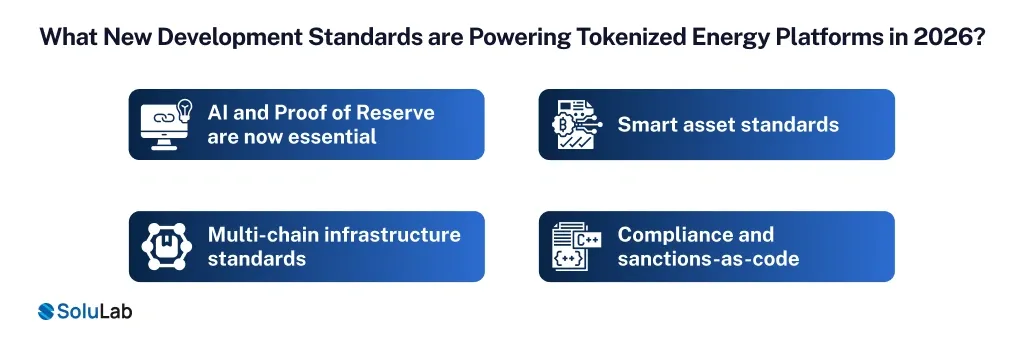
The shift toward asset tokenization in energy is being driven by better technical standards, not just market demand.
In 2026, successful tokenized oil platforms depend on three core layers: reserve verification, smart contract controls, and cross-chain settlement.
1. AI and Proof of Reserve are now essential
A major concern in commodity tokenization has always been trust between digital tokens and physical reserves.
AI-backed verification stack
- Satellite imagery for tanker movement
- IoT sensors in storage tanks
- Live pipeline flow monitoring
- Automated reserve audits
Using Chainlink Proof of Reserve (PoR) and similar oracle systems, every energy token can be linked to verified physical inventory.
This reduces the risk of:
- Double issuance
- Reserve misreporting
- Hidden inventory manipulation
2. Smart asset standards
Modern tokenized commodities are moving beyond simple ERC-20 models.
2026 standards include:
- ERC-3643 for permissioned compliance
- Built-in transfer controls
- KYC-linked wallet access
- Automated jurisdiction checks
This is especially important for oil-linked assets, where sanctions and jurisdiction rules directly affect transfer rights.
3. Multi-chain infrastructure standards
The leading stack for RWA tokenization in energy includes:
- Ethereum for secure settlement
- Polygon / Solana for higher throughput trading
- Chainlink CCIP for cross-chain asset movement
4. Compliance and sanctions-as-code
With the U.S. Treasury tightening oversight on shadow fleets, tokenized energy platforms now support:
- wallet screening against sanctioned entities
- automated transfer restrictions
- jurisdiction-aware compliance rules
This gives enterprises more confidence in cross-border energy movement.
Read more – Top 7 White-Label Tokenization Development Partners
Enterprise-Grade Tokenization Solutions: Mitigating Trade Risk Through Atomic Settlement
One of the biggest reasons enterprises are shifting toward asset tokenization services is settlement efficiency.
Traditional cross-border oil settlements often involve:
- Multiple banks
- Intermediary brokers
- Manual invoice validation
- Delayed reconciliation
That creates a capital lock-up.
1. Why atomic settlement matters
In tokenized oil trading, smart contracts can complete payment and ownership transfer simultaneously.
2026 impact on enterprise trade
| Trade Factor | Traditional System | Tokenized Oil |
| Settlement | T+2 to T+5 | Instant |
| Verification | Manual | Automated |
| Capital lock-up | High | Lower |
| Transparency | Limited | Real-time |
Enterprises adopting real-world asset tokenization platforms are reporting up to 35% lower trade friction.
2. Institutional proof points
BlackRock and Securitize
BlackRock’s BUIDL fund reached $1.7 billion in March 2026, showing clear institutional appetite for tokenized assets.
Securitize’s $1.25 billion valuation through Cantor-backed expansion signals growing infrastructure confidence.
Société Générale-FORGE
SG-FORGE deployed EURCV across XRPL and Stellar, helping settle industrial trade invoices across 27 EU nations.
These examples show that RWA tokenization development company services are now tied directly to global capital efficiency.
Read more – Natural Resource Tokenization Platform Development
How are Energy-as-a-Service (EaaS) Models Redefining Global Distribution?
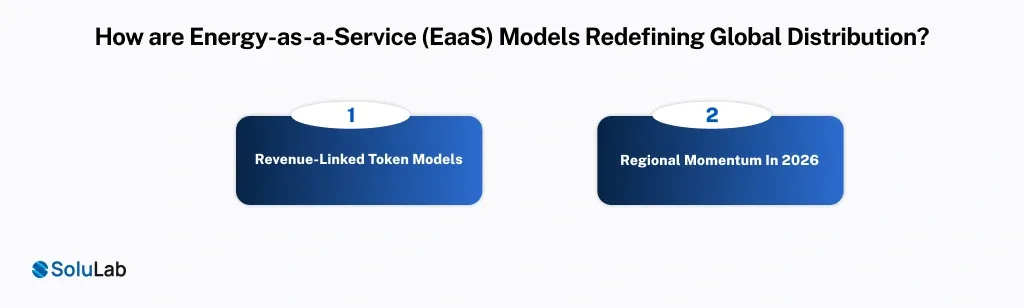
The next stage of tokenized energy is not only trading. It is a distribution.
Energy-as-a-Service models allow token holders to access revenue, supply rights, and utility-linked value from energy infrastructure.
1. Revenue-linked token models
Instead of owning physical cargo, enterprises can buy:
- Royalty-linked tokens
- Revenue-sharing energy pools
- Infrastructure-backed reserves
This reduces logistics complexity while maintaining yield exposure.
2. Regional momentum in 2026
The global countries are not just promoting tokenization but defining the right way and securing their people’s money.
2.1 UAE and Singapore corridor
The UAE–Singapore corridor saw a 4.07% increase in tokenization activity in the last 30 days.
This region is leading due to:
- Faster regulatory approvals
- Digital settlement rails
- VARA burn-and-reissue mandate in the UAE
- Institutional sandbox support
2.2 Europe’s MiCA framework
MiCA Article 16 now allows passporting across the EU.
That means a licensed energy token issued in Luxembourg can move across the bloc more efficiently.
This is making the Tokenized Energy Market more scalable.
What Can SoluLab Do As a Tokenization Development Partner Amid Global Oil Market Shifts?
For enterprises, moving into tokenized oil assets requires more than launching a token.
It needs infrastructure built for compliance, reserve accuracy, and secondary liquidity.
As a tokenization platform development company, SoluLab helps businesses build secure energy token ecosystems.
1. Custom infrastructure development
- Oil reserve digital twin setup
- Smart contract architecture
- ERC-3643 compliance deployment
- White-label tokenization platform customization
2. Oracle and AI integration
- Sensor-to-chain pipelines
- Proof of Reserve integrations
- AI-based valuation systems
3. Compliance automation
- KYC and AML workflows
- Sanction-screening logic
- Cross-border jurisdiction controls
4. Secondary market readiness
- White-label exchange modules
- Institutional wallet integration
- Liquidity partner onboarding
For companies operating in volatile global oil markets, this creates faster response capability and lower operational exposure.

Conclusion
The 2026 oil crisis has made one thing clear: speed, transparency, and trust now matter as much as physical supply.
With Brent at $113.24, energy-linked tokenized assets are helping enterprises reduce delays, improve liquidity access, and manage geopolitical uncertainty more effectively.
The real-world asset (RWA) tokenization market, crossing $36 billion, with nearly $24 billion in energy exposure, shows that this shift is already underway.
From oil-backed token systems and atomic settlement to AI-led reserve validation, oil tokenization is turning energy into a programmable asset class.
For businesses that need resilience in an unstable market, tokenization is no longer optional infrastructure. It is becoming a competitive necessity.
So, to increase your ROI in the oil market with SoluLab today!
FAQs
Deepika is a content writer who blends storytelling with strategic thinking. She explores topics across digital innovation, emerging tech, and the evolving blockchain industry. She enjoys breaking down complex ideas into simple, engaging narratives in the growing global markets.