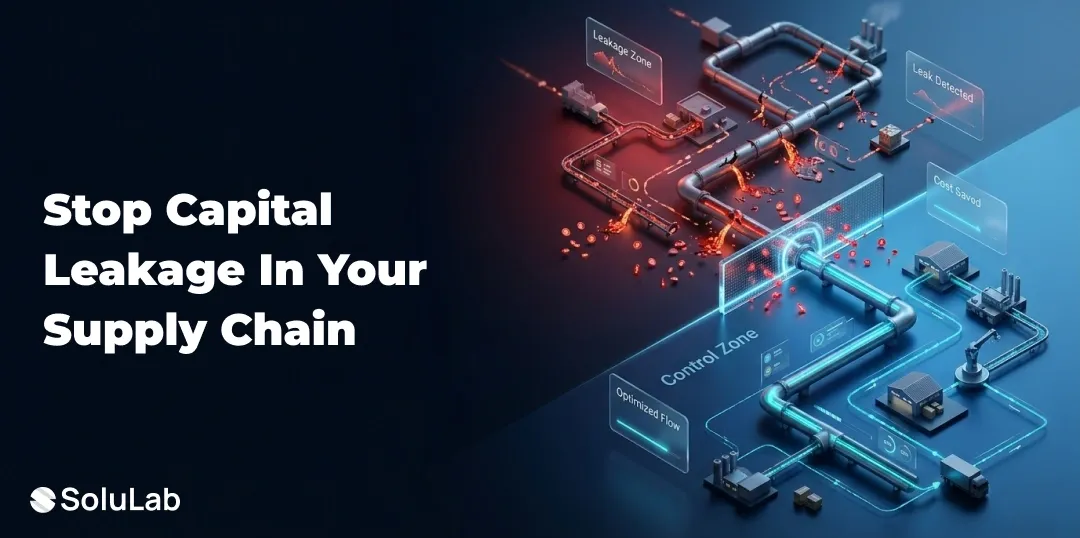
In the current tech period, supply chains will no longer be judged only by delivery timelines. The real benchmark is how efficiently capital moves across the network.
- Many enterprises still operate with strong logistics but weak financial flow.
- Payments sit locked in 60 to 90-day cycles.
- Inventory holds capital without generating yield.
- Trade finance processes depend on manual verification and slow approvals.
This is where the gap builds.
The global trade finance deficit remains close to $2.5 trillion in 2026. The issue is not capital availability. It is access, visibility, and trust in data across multi-tier supply chains.
This is where asset tokenization solutions come into play. Instead of treating invoices and purchase orders as static documents, enterprises now convert them into digitally tokenized assets with embedded financial value and real-time liquidity potential.
If your financial layer still depends on PDFs and manual checks, capital efficiency will remain limited. Therefore, we are here to build your supply chain that aligns with 100% global asset tokenization standards.
Key Takeaways
- Tokenized supply chain rights are now used to unlock liquidity from invoices, purchase orders, and logistics data in real time.
- Enterprises in the US and Germany report up to 30% lower financing costs using tokenized supply chain finance models.
- ERP-integrated tokenization platforms enable instant reconciliation and automated settlements without manual intervention.
- Institutional capital from the UAE and Australia is actively entering trade finance via tokenized asset supply chain instruments.
- SoluLab, backed by 250+ expert developers and consultants, can align your supply chain business requirements with the finest blockchain and tokenization solution without breaking the bank.
What are Tokenized Supply Chain Rights, and Why is the Enterprise Moving Toward Them in 2026?
Tokenized rights represent ownership or payment claims tied to real-world transactions. These can include invoices, bills of lading, or purchase orders.
1. What defines Tokenized Rights in the Supply Chain?
A tokenized right is a legally enforceable digital asset that reflects a financial claim.
- Each token is backed by a verified transaction
- Ownership can be divided and transferred
- Settlement conditions are predefined via smart contracts
This model supports tokenized asset supply chain structures where assets are not just recorded but actively financed. Here is why enterprises are standardizing this in 2026.
2. Legal Recognition and Compliance
In 2026, regulatory clarity has improved significantly.
- The US has updated digital asset frameworks for trade finance
- Germany aligns tokenized assets with EU MiCA standards
- UAE supports blockchain-backed trade documentation in free zones
This allows TradFi tokenization to operate within legal boundaries.
3. Verifiable Identity and Data Trust
Each transaction is linked to decentralized identity systems.
- Supplier credentials are verified.
- ESG and compliance data are attached
- Shipment tracking is integrated
This reduces fraud and improves lender confidence.
4. Flexible Ownership Structures
Unlike traditional loans, tokenized rights allow partial financing.
- Suppliers can sell portions of receivables.
- Multiple investors can participate.
- Risk can be distributed efficiently.
This directly supports supply chain finance optimization at scale.
How Do Programmable Rights Solve the $2.5 Trillion Trade Finance Gap?
The trade finance gap exists because traditional lenders lack visibility into supplier performance and risk.
ADB Head Steven Beck said: “Without the financing to back trade, imports, and exports, we’re just not going to be able to realise the kind of growth and development that we can from trade.”
However, tokenized supply chain finance solves this through programmable logic and real-time data.
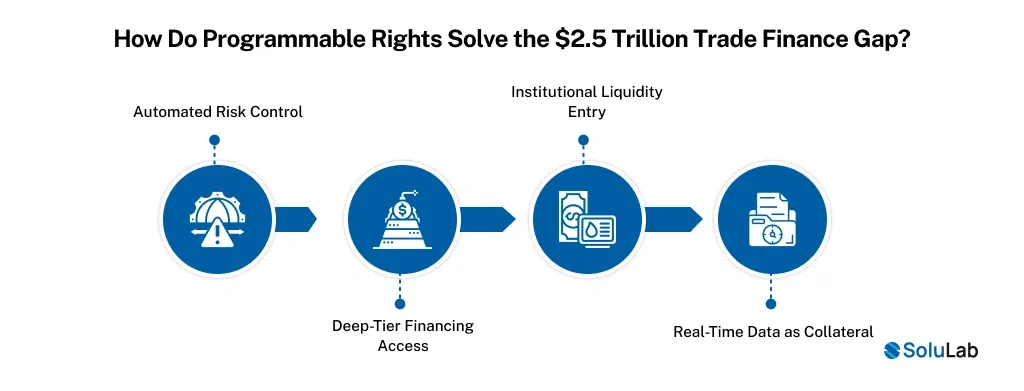
1. Automated Risk Control
Smart contracts define conditions for financing.
- Payment triggers only after shipment confirmation.
- Customs clearance updates release funds
- Delivery verification completes settlement
- AI-powered document intelligence validates trade documents against UCP600 and ISBP standards in seconds.
- Automated checks reduce dependency on paper-based verification, which is still used in nearly 80% of cross-border transactions.
This reduces manual due diligence while improving compliance accuracy and processing speed.
2. Deep-Tier Financing Access
Large buyers extend their credit strength across the supply chain.
- Tier 1 suppliers pass credit access to Tier 2 and Tier 3
- Smaller vendors receive lower interest rates
- Risk is tied to transaction data, not just company size
- AI predictive analytics and structured trade data enable lenders to assess deeper supplier tiers with higher confidence
- Predictive analytics flag anomalies across supplier networks before risk escalates
In Germany and the US, this model is already used in the automotive and electronics sectors, where multi-tier supplier visibility is critical.
3. Institutional Liquidity Entry
Non-bank capital is now active in trade finance.
- UAE-based funds invest in tokenized receivables.
- Australian pension funds participate in supply chain yield pools
- Private credit firms use blockchain supply chain finance models
- Platforms like Traydstream report up to 70% faster processing and 30% fewer compliance issues, making these assets more investable
This expands liquidity beyond banks and makes trade finance more accessible at scale.
4. Real-Time Data as Collateral
Instead of static documents, lenders rely on live data.
- IoT-enabled shipment tracking
- ERP-generated transaction logs
- Oracle-based validation systems
- Limited adoption of frameworks like MLETR (only 7 countries) makes digital validation layers critical for global interoperability.
This improves trust, reduces default risk, and allows lenders to act on verified data rather than delayed paperwork.
Can Tokenized Assets Really Be Integrated with Existing ERP and Banking Systems?
Integration was a major barrier earlier. In 2026, this is largely resolved. Modern supply chain tokenization platforms act as middleware between enterprise systems and blockchain networks.
1. SAP and Oracle Compatibility
- Tokenization modules are now built into ERP systems
- Financial teams continue using existing dashboards
- Backend settlement occurs on-chain
2. Real-Time Synchronization
When a transaction is updated in ERP:
- Smart contracts are triggered instantly
- Token status updates automatically
- Payment workflows begin without delay
This ensures Blockchain Supply Chain Efficiency without disruption.
3. ISO 20022 Standardization
Tokenized transactions follow global messaging standards.
- Banks can process blockchain-powered token payments.
- Fiat and stablecoin conversion happens instantly
- Cross-border settlements are faster
4. Reconciliation Automation
Traditional reconciliation cycles are eliminated.
- Shared ledger removes mismatches.
- Audit trails are always updated.
- Compliance checks are automated.
Enterprises in the US and UAE report near-zero reconciliation delays using these systems.
What is the Step-by-Step Practical Implementation for a Tokenized Supply Chain?
In 2026, implementation is modular and focused on quick ROI. It’s time you took advantage of this financial gap and built a supply chain using tokenization solutions. Adopt smart contract features for faster payments. Let’s see what you have to build to make your supply chain capital efficient.
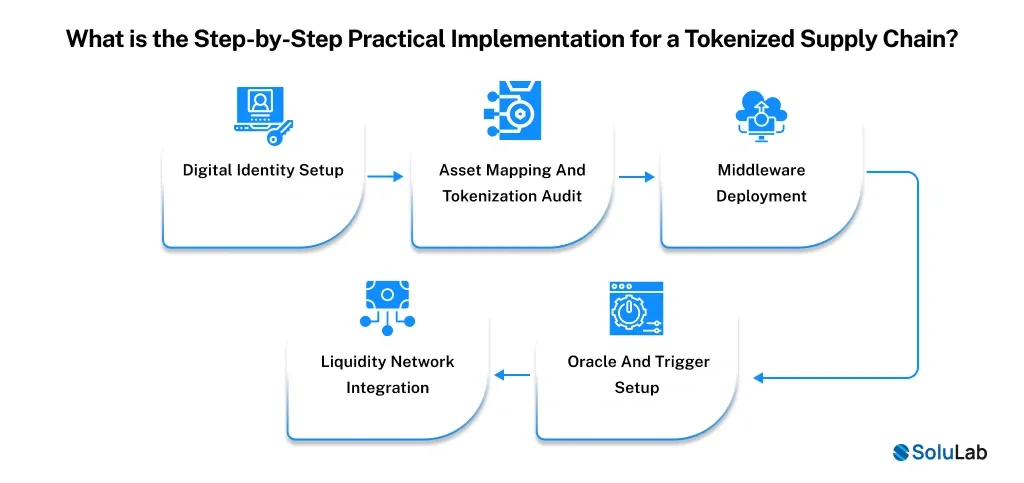
Step 1: Digital Identity Setup
Every participant is assigned a decentralized identity.
Implementation:
- Conduct KYC/KYB once
- Store credentials on secure identity networks
- Link identities with ERP systems
This forms the base for Real-world asset tokenization(RWA).
Step 2: Asset Mapping and Tokenization Audit
Identify where capital is locked.
Implementation:
- Analyze accounts receivable cycles
- Map invoice lifecycle
- Define token creation triggers
Most enterprises start with receivables.
Step 3: Middleware Deployment
Connect ERP with blockchain systems.
Implementation:
- Use API-based gateways
- Enable secure data exchange
- Apply zero-knowledge proofs for privacy
This enables blockchain supply chain finance without exposing sensitive data.
Step 4: Liquidity Network Integration
Connect with funding sources.
Implementation:
- Partner with banks offering token custody
- Integrate DeFi liquidity pools
- Set financing rules and limits
Regions like the UAE lead in liquidity aggregation.
Step 5: Oracle and Trigger Setup
Define event-based automation.
Implementation:
- Integrate IoT sensors for shipment tracking
- Use logistics APIs for updates
- Trigger financing events automatically
This enables real-time Supply Chain Liquidity Solutions.
Step 6: Pilot and Scale
Start small, then expand.
Implementation:
- Run pilot with selected suppliers
- Measure cost savings and speed
- Expand across regions (US, Germany, Australia)
Measuring the ROI: Tangible Gains in 2026 Operations
To improve this financial deficit, companies are now adapting to local currencies.
The ADB report also noted a gradual growth in alternative currencies used, including China’s yuan. Though the U.S. dollar was still used in over 82% of traditional trade finance transactions, ADB found that nearly 57% of bank respondents perceive a growing need for the use of local currencies.
Let’s see how this improved the modern supply chain.
2026 Supply Chain ROI Comparison
| Metric | Traditional Model | Tokenized Model (2026) | Impact |
|---|---|---|---|
| Days Sales Outstanding | 45–90 days | < 24 hours | Faster cash access |
| Cost of Capital | 8%–12% | 4.5%–6% | Lower financing cost |
| Reconciliation Time | 15–20 hrs/month | Near zero | Reduced overhead |
| Audit Readiness | Manual | Real-time | Better compliance |
| Liquidity Access | Limited | Global pools | Increased funding |
Operational Impact
1. Cash Flow Stability: Suppliers gain immediate liquidity, reducing dependency on credit lines.
2. Cost Efficiency: Lower financing costs improve margins across supply chains.
3. Stronger Supplier Relationships: Faster payments increase trust and retention.
4. Scalable Financial Systems: Enterprises can expand globally without increasing financial friction.

Conclusion
Enterprises are adopting tokenization services because they deliver measurable financial outcomes. This flexibility allows businesses to manage their short-term and long-term financial needs better. It’s like having a financial Swiss Army knife.
It brings some solid benefits like faster payments, lower risks, and better access to cash for everyone involved. But it’s not all sunshine and rainbows. However, SoluLab, a tokenization platform development company, is here to turn odds into your asset. Our services include:
- Smart Contact development
- AI-Powered predictive analytics
- Blockchain-powered cross-border payments
Can boost your supply chain services. Contact us today to discuss your requirements!
FAQs
Deepika is a content writer who blends storytelling with strategic thinking. She explores topics across digital innovation, emerging tech, and the evolving blockchain industry. She enjoys breaking down complex ideas into simple, engaging narratives in the growing global markets.