Key Takeaways
- With an AI transformation roadmap for enterprises, businesses can move scattered experiments to structured AI adoption without development failure, security risks, and wasted tech investment.
- The roadmap involves AI readiness assessment, use cases, integration, governance, deployment, and scaling for measurable ROI.
- SoluLab helps enterprises build AI-powered solutions by providing the 6-step AI business transformation roadmap framework.
AI has now moved beyond the mere automation experiments or chatbot pilots. Founders and technology leaders now use it to make sharper decisions, modernize legacy systems, automate workflows, and build smarter digital products. However, the available ideas, tools, and data are still limited, and without a clear AI business transformation roadmap, the efforts to build production-ready AI-powered solutions are scattered and hard to measure.
This blog explains how to create an AI transformation roadmap, the key AI transformation roadmap phases, practical AI use cases, and how SoluLab helps companies move from AI ideas to scalable execution.
Understanding AI Transformation Roadmap
An AI transformation roadmap is a strategic plan for enterprises to deploy and scale artificial intelligence across all business operations. With this roadmap, businesses can implement AI initiatives with business goals to generate measurable AI and long-term scalability.
For deploying the AI transformation roadmap in business, it is crucial to have answers to the following questions:
- Where can AI create the highest business value?
- Which AI use cases should be prioritized first?
- Is the enterprise data ready for AI?
- Which systems need modernization before AI integration?
- What AI models, tools, and platforms are required?
- How will AI be deployed and monitored?
- What governance framework is needed?
- How will ROI be measured?
This will help the enterprises to create an operating model with high adoption, clear ownership, and measurable business value.
Why Do Enterprises Need an AI Transformation Roadmap?
In 2026, almost every organization is using AI tools for numerous business operations. From startups to SMBs and mid-level organizations, these tools can help to increase business outcomes through automating numerous processes. However, due to a lack of strategy and unification among business processes, most deployments fail.
An enterprise AI roadmap helps businesses fill this gap. It creates direction, control, and measurable execution that enable the leadership team to make appropriate decisions on where to invest, how to manage risks, and how to scale AI across the organization. Enterprises need an AI roadmap to:
- Align AI investments with business goals
- Identify high-value AI transformation use cases
- Improve data quality and system readiness
- Modernize legacy workflows
- Reduce manual operations
- Improve decision-making speed
- Build secure and compliant AI systems
- Move from pilot projects to production AI deployments
- Track ROI from AI initiatives
- Create an AI-first enterprise operating model
The AI transformation enterprise framework works like a decision framework for these businesses and helps to plan AI adoption with clarity instead of reacting to trends.
How to Create an AI Transformation Roadmap?
To build an AI transformation roadmap, start with business priorities. Clearly define where AI integration can improve operations, revenue, customer experience, delivery, or productivity.
The process should include business, technology, data, security, compliance, and leadership stakeholders. Never handle the AI transformation as a standalone IT project; connect it to enterprise-wide goals.
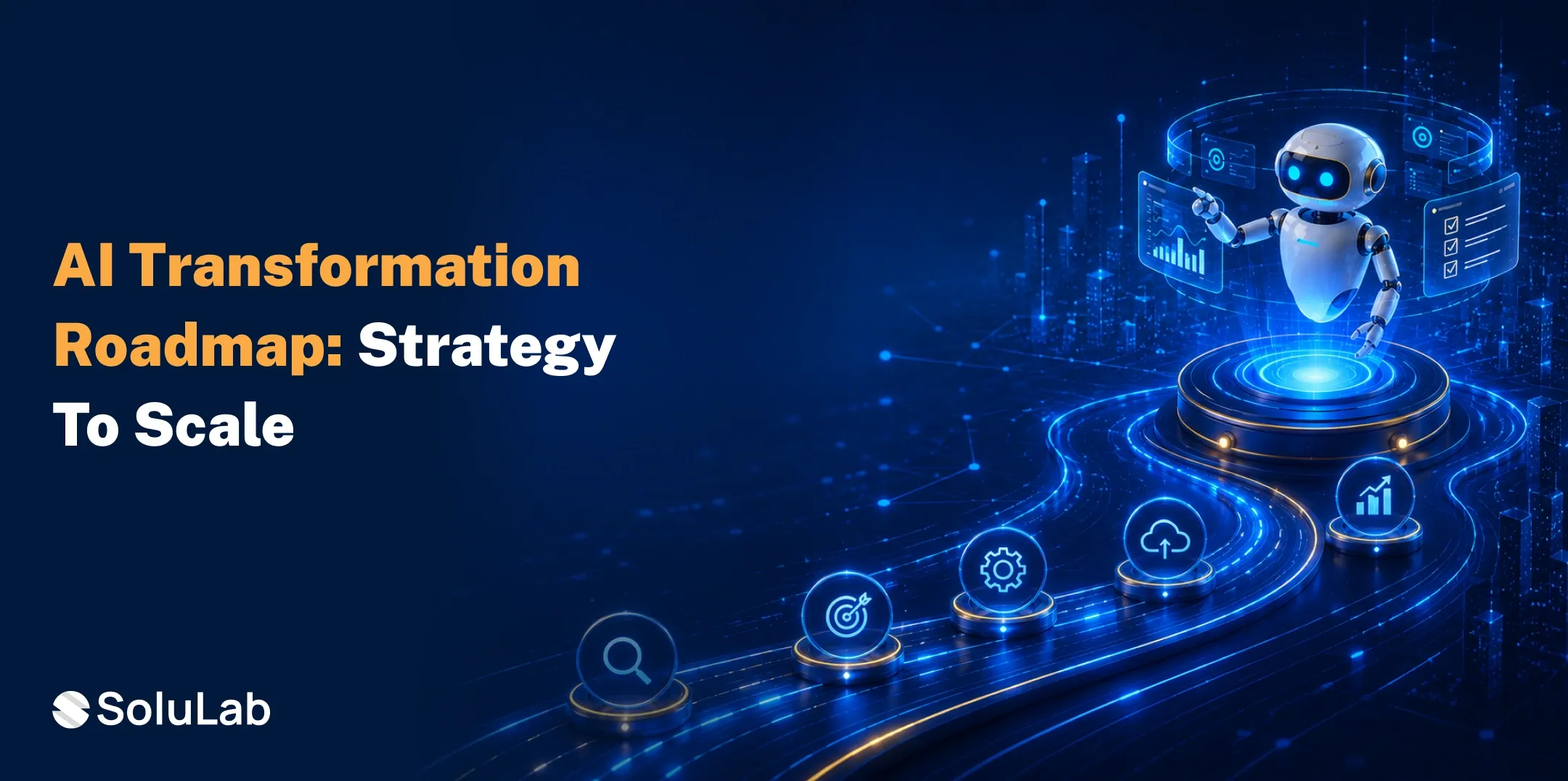
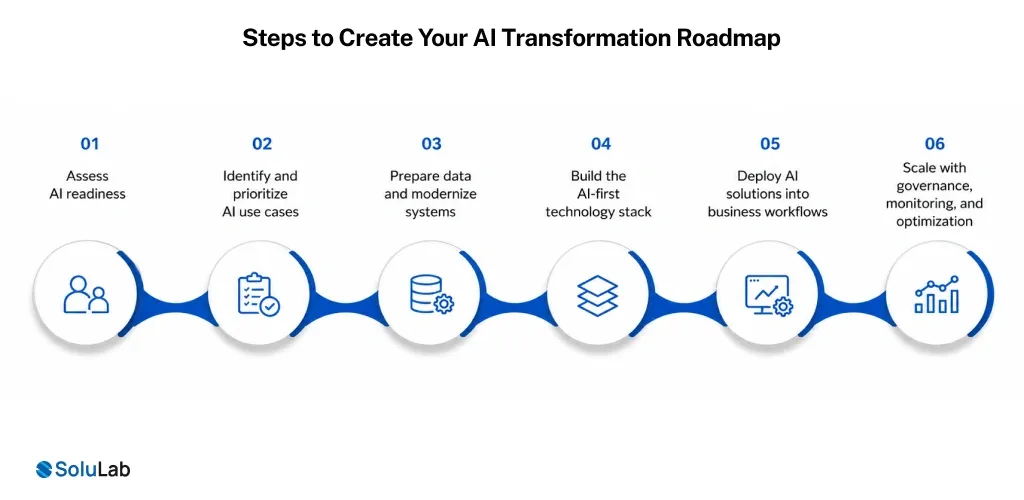
A strong AI transformation process includes six major stages. These stages create a practical roadmap from strategy to execution.
- Assess AI readiness
- Identify and prioritize AI use cases
- Prepare data and modernize systems
- Build the AI-first technology stack
- Deploy AI solutions into business workflows
- Scale with governance, monitoring, and optimization
AI Transformation Roadmap Phases: 6-Step Enterprise Framework
The following Enterprise AI transformation framework gives businesses a structured way to plan and execute AI adoption.
| Roadmap Phase | Main Objective | Business Outcome |
| AI Readiness Assessment | Review data, systems, teams, risks, and business goals | Clear understanding of AI maturity |
| Use Case Prioritization | Select high-value AI use cases | Better ROI and focused execution |
| Data and Legacy Modernization | Prepare data and upgrade outdated systems | AI-ready enterprise foundation |
| AI-First Tech Stack | Select models, cloud, data, security, and integration tools | Scalable AI architecture |
| AI Deployment and Integration | Launch AI into workflows and enterprise systems | Real business adoption |
| Governance and Scaling | Monitor performance, manage risks, and expand AI | Secure and sustainable AI transformation |
Step 1: Start with an AI Readiness Assessment
To build an AI implementation roadmap, understanding whether the enterprise is ready for AI is crucial. This step identifies what is already available and what must be fixed before AI deployment.
The assessment should review:
- Business goals and transformation priorities
- Existing technology infrastructure
- Data availability and data quality
- Legacy system limitations
- Cloud readiness
- Integration requirements
- Security and compliance risks
- Team skills and adoption readiness
- AI governance maturity
- Current automation and analytics capabilities
For example, to deploy AI for predictive maintenance, machine data must not be fragmented or incomplete, else the AI model will not deliver accurate results.
This phase gives leadership a clear view of AI opportunities, technical gaps, cost expectations, and implementation risks.
Step 2: Identify High-Value AI Transformation Use Cases
After the readiness assessment, select the right AI transformation use cases. Enterprises must prioritize use cases based on business value, data availability, implementation complexity, risk level, and scalability.
Common AI use cases for enterprises include:
- Customer service automation
- Predictive maintenance
- Demand forecasting
- Fraud detection
- Document processing
- AI-powered analytics
- Inventory optimization
- Personalized recommendations
- Sales intelligence
- HR automation
- Risk management
- Quality inspection
- Knowledge management
- AI copilots for internal teams
- Legacy workflow automation
The goal is to select use cases that solve problems. For example:
- A manufacturing enterprise may use AI for equipment failure prediction.
- A retail company may use AI for demand forecasting and personalization.
- A healthcare organization may use AI for clinical documentation and patient workflow support.
- A fintech company may use AI for fraud detection and credit risk analysis.
- A logistics company may use AI for route optimization and delay prediction.
Each use case must have clear KPIs. These may include cost reduction, faster processing time, better customer satisfaction, improved accuracy, higher revenue, fewer errors, or reduced operational risk.
Step 3: Prepare Data and Modernize Legacy Systems
AI depends on clean, accessible, and structured data. If enterprise data is fragmented across legacy systems, spreadsheets, disconnected applications, and outdated databases, AI implementation becomes difficult. Here, the AI modernization services and AI-driven legacy modernization services play an important role in enterprise AI transformation.
Legacy modernization helps businesses upgrade outdated systems so AI can work with real-time, reliable, and connected data. This phase may include:
- Data cleaning and standardization
- Data warehouse or data lake setup
- API development
- Legacy application modernization
- Cloud migration
- Workflow digitization
- Database modernization
- Data governance setup
- Enterprise system integration
- Automation of manual data processes
Modernization creates the base for AI-powered operations. It allows models to access relevant data, generate accurate insights, and connect with existing systems like ERP, CRM, HRMS, supply chain platforms, customer support systems, and finance tools.
Step 4: Build an AI-First Enterprise Tech Stack
Once data and systems are ready, enterprises need the right AI-First Enterprise Tech Stack. The technology stack must support model development, data pipelines, deployment, monitoring, security, governance, and integration. It should also be flexible enough to support future AI expansion.
A strong AI-first stack may include:
| Stack Layer | Tools and Capabilities | Purpose |
| Data Layer | Data lake, data warehouse, ETL pipelines, vector databases | Store and prepare enterprise data |
| AI/ML Layer | Machine learning models, LLMs, NLP, computer vision, forecasting models | Build intelligent capabilities |
| Cloud Layer | AWS, Azure, Google Cloud, hybrid cloud | Scalable AI infrastructure |
| Integration Layer | APIs, middleware, ERP/CRM connectors, workflow automation | Connect AI with business systems |
| Application Layer | AI copilots, dashboards, chatbots, automation tools, decision systems | Deliver AI to business users |
| Security Layer | Access control, encryption, monitoring, and identity management | Protect data and AI systems |
| Governance Layer | Model monitoring, audit trails, bias checks, policy controls | Manage responsible AI operations |
The right stack depends on the enterprise goal. Here, expert AI Development companies can help enterprises avoid wrong technology choices.
Step 5: Execute AI Implementation and Deployments
The next phase is AI development, integration, testing, and deployment. Move the roadmap from AI strategy consulting to execution. The selected use cases are converted into production-ready AI-powered solutions that work inside real business environments.
A strong implementation phase includes:
- AI solution design
- Data pipeline development
- Model development or model selection
- Model training and fine-tuning
- API and system integration
- User interface development
- Workflow automation
- Security testing
- Quality assurance
- Pilot deployment
- User testing
- Production rollout
- Performance monitoring
Prefer the controlled pilot helps test accuracy, usability, security, and business impact. Once the pilot proves value, the solution can be scaled across departments, locations, or business units.
Successful AI deployments must also be integrated into existing workflows. If AI stays outside daily business operations, adoption will remain low. Integration turns AI from a tool into a business capability.
Step 6: Scale AI with Security, Governance, and Continuous Optimization
The final phase of the AI transformation roadmap is scaling AI responsibly.
As AI adoption grows, enterprises must manage security, compliance, model performance, bias, data access, user permissions, and business accountability. Here, Enterprise AI Security & Governance becomes essential.
Monitor and improve models continuously with continuous optimization. An AI governance consultant helps define policies, controls, and monitoring systems for safe AI adoption. AI governance should include:
- Data privacy rules
- Access control
- Model audit trails
- Bias monitoring
- Output validation
- Human-in-the-loop workflows
- Explainability requirements
- Risk classification
- Compliance checks
- Model performance monitoring
- Incident response
- Usage policies
- Vendor and model evaluation
This stage turns AI from a project into a long-term enterprise capability.
Enterprise AI Use Cases to Include in Your AI Roadmap
An AI roadmap should include use cases that match enterprise goals. Below are some practical enterprise AI use cases for different industries-
Customer Service
AI chatbots, voice agents, and support copilots can handle common queries, route tickets, summarize conversations, and support agents with faster answers.
Sales and Marketing
AI can help with lead scoring, customer segmentation, personalization, campaign optimization, content generation, and sales forecasting.
Finance
AI can support invoice processing, fraud detection, cash flow forecasting, risk scoring, expense analysis, and automated reporting.
Operations
AI can improve workflow automation, process optimization, demand planning, inventory control, and resource allocation.
Human Resources
AI can help with resume screening, employee support, workforce planning, training recommendations, and HR document automation.
IT and Engineering
AI can support code generation, incident detection, AIOps, system monitoring, documentation, QA automation, and software modernization.
Supply Chain
AI can support route optimization, demand forecasting, supplier risk analysis, shipment tracking, and inventory planning.
Compliance and Risk
AI can help monitor transactions, identify anomalies, review documents, classify risks, and support audit workflows.
The best AI implementation roadmap usually starts with 2 to 3 high-impact use cases and then expands after successful deployment.
What Should Enterprises Avoid During AI Transformation?
AI transformation can fail when enterprises focus too much on tools and too little on execution. A roadmap helps avoid common mistakes. Enterprises should avoid:
- Starting without clear business goals
- Choosing use cases without ROI planning
- Ignoring data quality
- Deploying AI without integration
- Scaling pilots too quickly
- Using AI without governance
- Ignoring security and compliance
- Not involving business users
- Treating AI as only an IT project
- Underestimating change management
AI success depends on business alignment, technical readiness, data quality, and user adoption. The roadmap must connect all four.
Want to check your AI readiness score? Click here!
AI Transformation Roadmap Checklist
Before starting enterprise AI transformation, businesses should review this checklist:
- Have we defined clear AI business goals?
- Have we completed an AI readiness assessment?
- Do we know which AI use cases provide the highest value?
- Is our enterprise data clean and accessible?
- Do we need legacy modernization?
- Have we selected the right AI-first tech stack?
- Do we have integration requirements mapped?
- Have we defined security and governance rules?
- Do we have KPIs for each AI initiative?
- Do we have a pilot-to-production plan?
- Do we have an AI scaling and monitoring strategy?
This checklist helps enterprises plan AI native strategy adoption with better control and lower risk.
Conclusion
AI transformation is building a clear roadmap that connects AI with business goals, enterprise systems, data, people, security, and measurable outcomes. With an AI transformation roadmap for enterprises, businesses can deploy AI-powered operations to reduce failed pilots, improve adoption, control risks, and create long-term value from AI.
How SoluLab Helps Enterprises Build an AI Transformation Roadmap?
Move from AI ideas to production-ready AI systems with a structured and business-focused approach with SoluLab. We are the leading AI development company that helps businesses create and execute enterprise AI roadmaps with AI development, modernization, integration, deployment, and governance support. Our AI Development services are specifically designed to help businesses to identify the right use cases, prepare data, modernize systems, build AI-ready architecture, create AI-powered applications, and integrate them into existing enterprise workflows.
FAQs
Shipra Garg is a tech-focused content strategist and copywriter specializing in Web3, blockchain, and artificial intelligence. She has worked with startups and enterprise teams to craft high-conversion content that bridges deep tech with business impact. Her work translates complex innovations into clear, credible, and engaging narratives that drive growth and build trust in emerging tech markets.