Anthropic’s Claude Code tool has disrupted legacy modernization by automating COBOL analysis and refactoring, resulting in a significant drop in IBM’s stock and erasing tens of billions in market value.
This event marks a significant shift from traditional, expensive AI consulting models to AI-driven efficiency, where firms like SoluLab deliver comparable results at a fraction of the cost. The question for enterprise leaders is no longer whether to modernize – it’s who to trust with the transformation, and at what price.
Key Takeaways
- Status quo: Large consulting-led modernization projects often cost millions and take years, putting AI transformation out of reach for many enterprises.
- Solution: An AI-first modernization approach that embeds generative AI, automation, and intelligent APIs directly into legacy infrastructure instead of rebuilding everything from scratch.
- ROI impact: AI-driven modernization can reduce operational costs by 30–50% while accelerating product delivery and digital transformation timelines.
- SoluLab delivers AI-native legacy modernization while combining generative AI, automation frameworks, and scalable cloud architectures to help enterprises modernize faster, cut costs, and unlock innovation without the enterprise consulting price tag.
IBM, Claude, and the $36B Shock
On February 23, 2026, Anthropic announced that Claude Code—its agentic AI coding tool—could read, analyze, and modernize COBOL systems at scale. The implications were immediate and profound. IBM, whose mainframe and consulting services division has long depended on the complexity of legacy modernization, saw its stock plunge 13.2%, erasing approximately $36 billion in market capitalization in a single session. It was IBM’s steepest single-day decline since 2000.
But beyond the headline numbers, the real story is structural. Claude Code’s ability to parse decades of COBOL logic, map data dependencies, generate documentation, and suggest refactored code in modern languages exposed a long-standing truth: the high cost of legacy modernization has always been driven more by human labor and institutional complexity than by actual technical difficulty.
As Anthropic noted in its documentation, “Modernizing a COBOL system once required armies of consultants spending years mapping workflows – Claude Code automates that.” This single capability shift forces every enterprise technology leader to ask: if AI can do the heavy lifting, why are we still paying for the army?
This is not a crisis for enterprises. It is an opportunity. The question is whether your modernization partner is built for this new era or still billing you like it’s 2010.
The Real Story: It’s Not Just About COBOL
COBOL is not the problem. COBOL is the symptom. The real story is that enterprises across banking, insurance, healthcare, and government are sitting on decades of mission-critical logic embedded in systems that were never designed for the speed, scalability, or security demands of today’s digital economy.
Consider these numbers:
• Over 43% of banking systems and 95% of ATM transactions still run on COBOL (Reuters, 2025)
• More than 70% of Fortune 500 enterprise software is over 20 years old (Gartner, 2025)
• U.S. enterprises carry an estimated $1.52 trillion in technical debt, according to McKinsey
• Only 16% of enterprises have a clear, funded legacy modernization roadmap (IDC, 2025)
The deeper challenge is that modernizing these systems isn’t just about rewriting code. It’s about preserving business continuity, maintaining regulatory auditability, managing change control across interdependent processes, and ensuring that risk is minimized at every stage.
As the Economist Intelligence Unit observed, “The competitive advantage in the next decade will not come from owning the most data, but from modernizing the systems that process it.”
Bang Transformations Are Too Expensive
For decades, IBM and the Big 4 consulting firms defined the playbook for enterprise modernization. It followed a familiar formula: assemble a large team of specialists, spend 12-18 months on discovery and design, then embark on a multi-year program to rebuild from the ground up.
• Average modernization cost per workload: $3–5 million (Gartner, 2025)
• Average time-to-ROI: 18–24 months
• 80% of enterprise IT budgets consumed by maintenance (IDC, 2025)
• Over 60% of large-scale transformation programs face delays or cost overruns (McKinsey, 2025)
SoluLab’s AI-First Modernization Playbook
SoluLab is an AI-native development company with deep experience in enterprise modernization, blockchain integration, and AI-powered system transformation. Where traditional consulting firms bring volume, SoluLab brings velocity and a fundamentally different economic model.
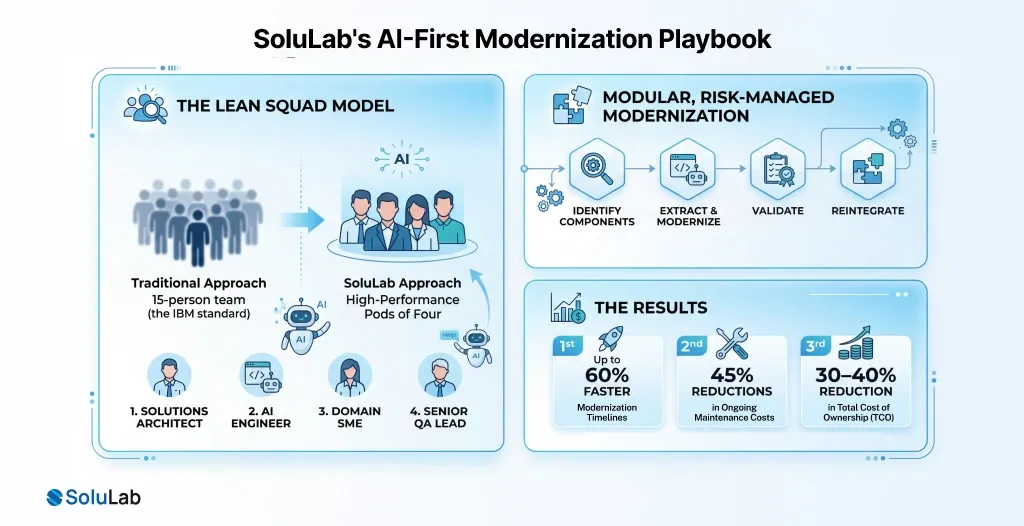
AI Does the Heavy Lifting
1. The Lean Squad Model
Rather than deploying a 15-person team—the IBM standard—SoluLab operates in high-performance pods of four: one Solutions Architect, one AI Engineer, one Domain SME, and one Senior QA Lead.
2. Modular, Risk-Managed Modernization
SoluLab rejects the big-bang rewrite model in favor of modular, domain-by-domain modernization. Each component is extracted, modernized, validated, and reintegrated before the next piece is touched.
The results: Clients report up to 60% faster modernization timelines, 45% reductions in ongoing maintenance costs, and a 30–40% reduction in total cost of ownership (TCO) compared to traditional consulting engagements.
How SoluLab Delivers Without Huge Spend?
- Tool-Led Discovery: A typical legacy assessment that would take 6-8 weeks in the old model is completed in 5-7 business days—with richer, more structured outputs.
- Reusable Accelerators: When a new bank engages SoluLab to modernize its payments infrastructure, 60-70% of the framework already exists. This accelerates time-to-value.
- Small, Senior Pods: Every SoluLab engagement is staffed with senior professionals. The lean pod model means fewer status meetings, faster decision cycles, and higher output quality per hour worked.
- Outcome-Based Pricing: SoluLab ties its pricing to business outcomes—not billable hours. Milestone-based contracts are structured around measurable deliverables.
A Sample Engagement Blueprint: From Days 0 to 90
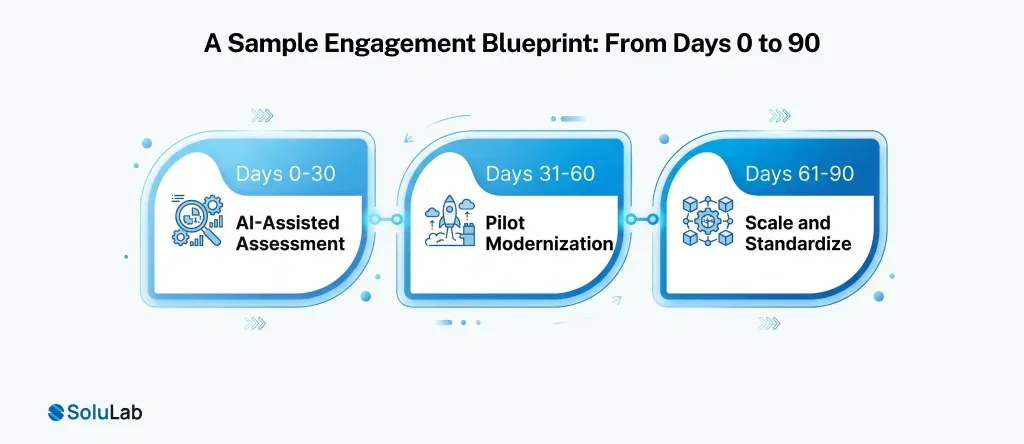
Days 0-30: AI-Assisted Assessment
- Objective: Understand what you have before deciding what to change.
- Deliverable: A 20-page Legacy AI Readiness Report with a recommended modernization sequence.
Days 31-60: Pilot Modernization
- Objective: Prove the model works before scaling it.
- Deliverable: A live, modernized service with documented performance benchmarks. Typical results: 40-50% latency reduction, 99.9% uptime, and 20-30% cost-per-transaction savings.
Days 61-90: Scale and Standardize
- Objective: Convert pilot learnings into a scalable enterprise program.
- Deliverable: A full modernization roadmap with a 12-18 month execution plan, governance model, and continuous improvement framework.
Why This Is the Right Time for Lean Modernization?
The IBM-Claude episode has moved legacy modernization from the IT agenda to the boardroom agenda. Consider the pressure points converging right now:
• 65% of organizations plan to automate 40%+ of their legacy transformation work by 2027 (IDC forecast)
• Regulatory pressure on financial institutions to modernize core systems is intensifying globally
• The average age of core banking and insurance systems now exceeds 25 years
• Cloud-native competitors are taking market share from incumbents
Mid-market enterprises carry the same legacy risk as large enterprises but have a fraction of IBM’s budget. This is exactly the gap SoluLab was built to fill.
| As Bill Gates famously observed: “We always overestimate the change that will occur in the next two years and underestimate the change that will occur in the next ten.” The smartest enterprises are moving now, while the competitive window is still open. |
From Fear of Disruption to an Actionable Roadmap
The traditional approach to legacy modernization often stalls because it focuses on the wrong question: “What technology should we use?” Instead, successful modernization starts with: “What business outcomes do we need?”
This mindset shift, from technology-first to outcome-first, defines the modern approach to legacy transformation. It’s about connecting modernization initiatives directly to measurable business value.
The Strategic Framework for AI-Driven Modernization:
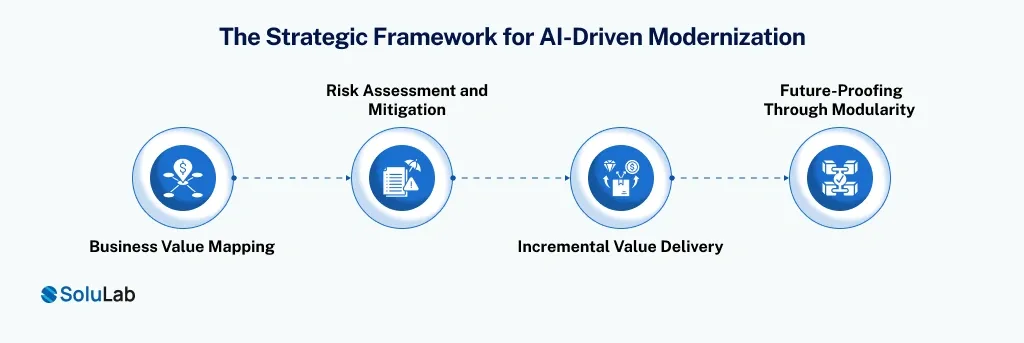
1. Business Value Mapping
Start by identifying which legacy limitations are costing your business the most. Is it slow time-to-market for new features? Inability to scale during peak demand? High maintenance costs eating into innovation budgets? Poor customer experience due to system limitations?
2. Risk Assessment and Mitigation
Legacy systems carry operational risk, but modernization carries transformation risk. The key is balancing both. AI helps by:
• Analyzing system dependencies to identify safe modernization pathways
• Predicting which components can be modernized independently
• Identifying critical business logic that must be preserved
• Testing modernized code against historical behavior patterns
3. Incremental Value Delivery
Rather than big-bang replacements, modern approaches favor continuous value delivery:
• Start with high-value, low-risk components
• Use AI to automate the heavy lifting of code conversion
• Maintain system stability while gradually migrating functionality
• Deliver business benefits incrementally, not after years of development
4. Future-Proofing Through Modularity
AI-powered modernization doesn’t just update old code—it restructures it for future flexibility:
• Converting monoliths to microservices
• Implementing API-first architectures
• Enabling cloud-native deployment patterns
• Building in observability and monitoring from day one
The most successful modernization projects we’ve seen share a common trait: they’re driven by business leaders and technologists working together, not siloed IT initiatives.
Why Now Is Different: The AI-Powered Modernization Advantage
The Anthropic-IBM story isn’t a crisis for enterprises that have been waiting to modernize. It’s a green light. The market has validated that AI-driven modernization is real, viable, and necessary.
1. AI Can Actually Read and Understand Legacy Code
Previous modernization attempts relied on manual code analysis or simplistic pattern matching. Modern AI models can:
• Understand business logic embedded in decades-old code
• Identify dependencies and side effects automatically
• Preserve the intent of the original code while modernizing the implementation
• Generate documentation that was never written
These aren’t theoretical tools like GitHub Copilot, Amazon CodeWhisperer, and specialized modernization platforms are doing this today.
2. Cloud Economics Have Fundamentally Changed
The cost of running legacy systems versus modern cloud-native systems has reached a tipping point. Mainframe costs continue to rise while cloud costs continue to fall. The financial case for modernization is stronger than ever.
3. The Skills Gap Is Closing Through AI
One of the biggest barriers to modernization has been the shortage of developers who understand both legacy and modern systems. AI bridges this gap by:
• Helping modern developers understand legacy code
• Automating the translation between old and new paradigms
• Reducing the need for rare, expensive legacy expertise
4. Risk Can Be Managed Through Intelligent Automation
Artificial Intelligence doesn’t just accelerate modernization—it makes it safer:
• Automated testing against historical behavior
• Gradual, validated migration paths
• Rollback capabilities and safety nets
• Continuous verification of business logic preservation
For mid-market companies, this combination of factors creates an unprecedented opportunity. You can now modernize with enterprise-grade tools and approaches, but without enterprise-sized budgets or timelines.
The SoluLab Approach: Making AI-Powered Modernization Accessible
At SoluLab, we’ve built our legacy modernization practice specifically for mid-market enterprise companies that need enterprise-grade modernization without enterprise complexity or cost.
Our approach combines three critical elements:
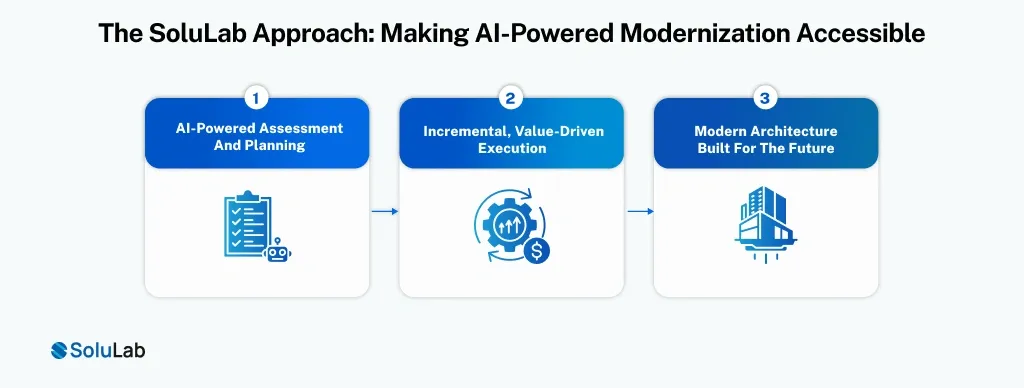
1. AI-Powered Assessment and Planning
Before any code changes, we use AI to:
• Map your entire legacy system architecture automatically
• Identify business-critical workflows and dependencies
• Quantify the business value of modernizing different components
• Create a risk-ranked modernization roadmap
This assessment phase typically takes weeks instead of months and provides clarity on exactly what you’re modernizing and why.
2. Incremental, Value-Driven Execution
We don’t believe in 18-month modernization projects that deliver value only at the end. Instead:
• We start with high-value, lower-risk components
• Each sprint delivers working, tested functionality
• Your legacy system continues running while we modernize incrementally
• You see business benefits throughout the process, not just at the end
3. Modern Architecture Built for the Future
When we modernize your code, we’re not just translating COBOL to Java. We’re building:
• Cloud-native microservices architectures
• API-first designs that enable integration and innovation
• Containerized deployments for flexibility and scale
• Modern observability and monitoring from day one
The result is a system that’s not just modernized—it’s future-proofed.
Real Results from Real Companies
Our clients typically see:
• 40-60% reduction in maintenance costs within the first year
• 3-5x faster time-to-market for new features
• 70-80% reduction in system outages and incidents
• Complete projects in 6-12 months instead of multi-year marathons
More importantly, they gain the agility to compete with digital-native competitors and respond to market changes quickly.
Getting Started: Your Modernization Journey
If you’re reading this and thinking, “We need to do this,” here’s how to start:
Step 1: Assess Your Current State
You don’t need to hire AI expert to tell you what you already know—which systems are holding you back. Start by identifying:
• Systems that are expensive to maintain
• Bottlenecks that slow down new feature development
• Areas where you’re losing to competitors because of technical limitations
• Critical systems dependent on retiring or scarce expertise
Step 2: Quantify the Business Impact
Modernization isn’t a technology project—it’s a business investment. Build a business case that includes:
• Current maintenance and operational costs
• Opportunity costs of delayed features and innovations
• Risk costs of system failures or compliance issues
• Competitive disadvantages from technical limitations
Step 3: Start Small, Think Big
Don’t try to modernize everything at once. Instead:
• Choose one high-value, manageable component to start
• Prove the approach works with real results
• Build organizational confidence and momentum
• Expand to additional systems based on lessons learned
Step 4: Partner With Experts Who Understand Both Worlds
Successful modernization requires understanding both legacy systems and modern architecture. Look for partners who:
• Have deep experience with your specific legacy technology
• Understand modern cloud-native architectures
• Use AI to accelerate and de-risk the process
• Can deliver incrementally, not just in big-bang projects
The Cost of Waiting
Every month you delay modernization:
• Your competitors get further ahead
• Your maintenance costs continue rising
• Your legacy expertise becomes harder to find and more expensive
• Your technical debt compounds
• Your ability to innovate diminishes
The Anthropic-IBM deal proves that AI-powered modernization works at a massive scale. The question isn’t whether this approach is viable—it’s whether you’ll be among the companies that seize this opportunity or those that wait until competitive pressure forces your hand.
Conclusion: The Window Is Open
The Anthropic-IBM partnership represents more than a $500 million contract—it’s validation that AI-powered legacy modernization has arrived. For years, enterprises have been told that legacy modernization was too risky, too expensive, and too slow. AI has changed that equation fundamentally.
For mid-market companies, this is your moment. The same AI-powered tools and approaches that work for IBM’s mainframe systems can transform your legacy applications—with mid-market timelines and budgets.
The companies that will thrive in the next decade aren’t necessarily those with the newest technology today. They’re the ones with the agility to evolve, the courage to modernize, and the wisdom to use AI integration solutions to accelerate their transformation.
Your legacy systems were built to solve yesterday’s problems. AI-powered modernization helps you transform them to solve tomorrow’s opportunities.
The question is: will you lead this transformation or follow it?
—
Sources & References:
1. Economic Times – Decoding Anthropic’s Claude Code Update That Triggered IBM Selloff (2026)
2. Lunabase.ai – Claude COBOL Modernization Crashes IBM Stock 13% (2026)
3. The Register – IBM Share Dive: Anthropic COBOL AI Consulting Selloff (2026)
4. Gartner – Enterprise Legacy Modernization Trends (2025)
5. IDC – AI-Driven Modernization Forecast (2025)
6. McKinsey Global Institute – Technical Debt and Legacy Modernization (2025)
7. Reuters – COBOL Banking Systems Report (2025)
Bhavya is driving growth through data-backed demand generation for AI and Web3 solutions. With 9+ years in digital marketing, he has spearheaded initiatives that led to a 40% increase in qualified inbound leads. Bhavya shares insights on marketing ROI and scaling a digital presence via AI workflows. He is open to connecting with startups and enterprise teams to help them overcome their challenges.