Artificial intelligence is gaining momentum within businesses. Most companies use AI in departments without clear controls, visibility and accountability.
It results in data leak, biased results, compliance lapses, and data insecurity that may harm reputation and income. The problem is not AI itself. The problem is unmanaged AI. Even the best systems may be a liability when such models are run without policies, monitoring, and risk structures.
The remedy is a business-friendly decision support system on AI security and governance. The enterprise AI system framework assists organizations in ensuring the safety of data pipelines, tracking model behaviors, complying with regulations as well as constructing transparent and trusting systems of AI.
Having the appropriate governance approach, businesses can be creative and secure customers, stakeholders, and business value in the long-term.
Key Takeaways
- The problem: Businesses are expanding AI readiness assessment more quickly than they are adopting it. In the absence of defined controls, AI systems pose threats to the privacy of data, bias, compliance issues, model drift, and security gaps that may harm the trust and brand image.
- The Solution: An efficient enterprise AI security and governance framework is a set of policies, risk controls, monitoring systems and compliance processes. It makes the AI models secure, explainable, auditable, and regulatory and ethical.
- How SoluLab Help: With an appropriate framework, organizations create trusted AI systems that decrease the risk, enhance transparency, fulfill expectations of regulators, and scale-up innovation with minimal risk.
Understanding AI Security & Governance Frameworks
Enterprise AI governance is a structured approach to managing how AI models are developed, deployed, monitored, and audited across an organization. It defines accountability, risk controls, ethical standards, and regulatory compliance processes to ensure AI systems operate responsibly.
AI security focuses on protecting data, models, and infrastructure from breaches, adversarial attacks, bias manipulation, and misuse. Together, AI security and governance frameworks help enterprises reduce risk, maintain transparency, meet regulatory requirements, and build trusted AI systems that support long-term innovation and business growth.
Enterprise AI governance is a formalized method of managing AI model development, deployment, monitoring and auditing of an organization. It establishes accountability, risk management, ethical practices and requirements in compliance procedures to allow AI systems to be responsibly operated.
AI security majors in the protection of data, models and infrastructure against breaches, adversarial attacks, manipulations of bias and misuse. Collectively, the artificial intelligence security and governance structures assist companies in minimizing risk, sustaining transparency, fulfilling regulatory needs, as well as developing reliable AI systems that assist in sustaining long-term innovation and business development.
Why Enterprise AI Governance Matters in 2026
Governance is no longer a choice as enterprises scale AI to the departmental level in 2026. A robust AI governance will apply ethical application, regulatory adherence, risk management, and sustainability of the business in the long-term.
- Regulatory compliance: As AI policies become stricter across the world in 2026, businesses will have to be transparent, accountable and documented. Governance systems aid organizations to remain within the law and not to fall under heavy fines or legal issues.
- Risk mitigation: When left unchecked, AI systems have the potential to produce operational, reputational, and financial risks. Governance puts in place explicit policies, watchdog systems and man oversight to minimize unintended consequences and model failures.
- Data security and privacy: Artificial intelligence is based on large volumes of data, so the privacy issue is crucial. Governance can guarantee the data management, encryption, consent control and protect against the breach or misuse.
- Ethical AI deployment: Prejudice, discrimination, and unjust results may hurt brand faith. The governance systems facilitate fairness, explainability and responsible AI practices in line with organizational values.
- Operational consistency: With the growth of AI into various departments, governance provides consistency in various processes, tools, and responsibilities which will guarantee the same performance, cooperation, and quantifiable business results.
AI Security: Protecting Data, Models, and Infrastructure
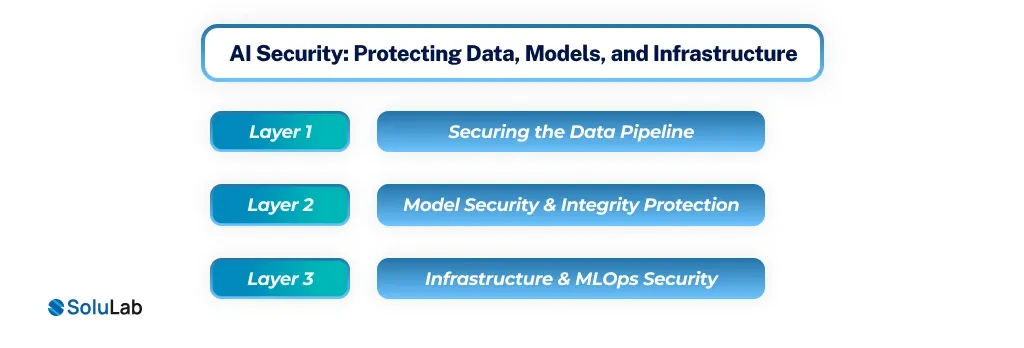
AI systems are only as trustworthy as the data, models, and infrastructure that support them. Securing each layer is essential to prevent silent failures, manipulation, or large-scale breaches.
Layer 1: Securing the Data Pipeline
AI models depend on vast volumes of data flowing through ingestion, preprocessing, labeling, training, and storage environments. If this pipeline is compromised, the model’s integrity is compromised.
Key Threats in AI Data Pipelines
Data Poisoning
Attackers deliberately inject manipulated or malicious data into training datasets to influence model behavior. This can introduce hidden backdoors, biased outcomes, or subtle vulnerabilities that only activate under specific conditions.
Data Drift Manipulation
Gradual, engineered changes in incoming data can shift model outputs over time. These shifts may go unnoticed but can significantly degrade performance, distort predictions, or alter automated decisions in production systems.
Unauthorized Data Access
Training datasets often include financial, healthcare, or personal information. Weak access controls, poor encryption practices, or exposed storage environments can lead to breaches, compliance violations, and reputational damage.
Synthetic Data Injection
Low-quality or maliciously generated synthetic data can contaminate training environments. When unchecked, it distorts learning patterns, embeds incorrect correlations, and weakens model reliability.

Layer 2: Model Security & Integrity Protection
Once trained, the model itself becomes a high-value target. Protecting its architecture, weights, and outputs is critical for maintaining reliability and preventing exploitation.
Key Risks to Model Integrity
Adversarial Attacks
Small, carefully crafted input changes can trick models into producing incorrect results. In high-stakes sectors like BFSI or healthcare, even minor misclassifications can create serious consequences.
Model Theft & Reverse Engineering
Attackers may query APIs repeatedly to reconstruct proprietary models. This not only steals intellectual property but also exposes weaknesses that can later be exploited.
Model Tampering
Unauthorized modifications to model parameters or deployment configurations can alter outcomes without immediate detection. Integrity verification mechanisms are essential to prevent silent manipulation.
Lack of Monitoring & Validation
Without continuous evaluation, models may degrade over time due to evolving data patterns, leading to operational and compliance risks.
Layer 3: Infrastructure & MLOps Security
Even if data and models are secure, vulnerabilities in infrastructure can expose the entire AI system. Secure MLOps practices ensure resilience across development, deployment, and monitoring environments.
Infrastructure-Level Vulnerabilities
Cloud Misconfigurations
Improperly configured storage buckets, exposed APIs, or weak identity management in cloud environments can create open attack surfaces.
CI/CD Pipeline Exploits
If the model deployment pipeline is compromised, attackers can insert malicious code or tampered models directly into production systems.
Insufficient Access Governance
Over-privileged roles and poor identity controls increase the risk of insider threats and accidental exposure.
Lack of Incident Response Preparedness
AI systems require dedicated monitoring and response playbooks. Without them, organizations struggle to detect and contain AI-specific security incidents.
Read More: How to Build an Agentic AI Governance Framework Like Singapore?
How to Implement AI Governance: 7-Step Framework
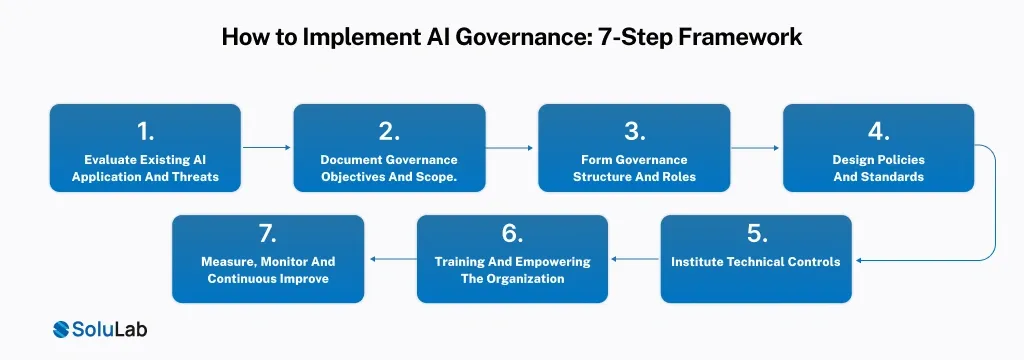
Effective AI management does not simply occur. It should be structured, leader-oriented, and continuously monitored to ensure which AI systems are secure, adhering, ethical, and in line with long-term business strategy.
1. Evaluate Existing AI Application and Threats
Begin by conducting an overview AI readiness assessment to determine the application of AI, data interdependency, third-party applications, and the risk exposure. The 2023 Cost of a Data Breach Report by IBM revealed that the average cost of data breach across the globe was 4.45 million, which explains why risk mapping at the beginning is important.
2. Document Governance Objectives and Scope.
Aware of what should be safeguarding by governance: data privacy, regulatory compliance, bias minimization, and model integrity. Gartner predicts that by 2026, organizations that make AI transparency and trust operational will achieve 50 percent higher adoption rates as compared to organizations that do not.
3. Form Governance Structure and Roles.
Appoint responsibility in leadership, legal, IT, and data science departments. According to McKinsey, those companies that have well-established AI ownership are 1.5 times the companies that get a measurable ROI on AI efforts.
4. Design Policies and Standards.
Develop written policies that address data sourcing, model testing, bias testing and audit trails. World Economic Forum highlights the fact that formal AI policy frameworks decrease reputational and regulatory risk to a considerable degree in regulated industries.
5. Institute Technical Controls.
Enhance Enterprise AI Security by encryption and access controls, model monitoring, and adversarial testing and logging. The AI Risk Management Framework by NIST emphasizes technical protection as fundamental in the establishment of reliable AI systems.
6. Training and Empowering the Organization.
Governance can only be effective when the teams comprehend it. PwC reports that three out of five executives believe that workforce upskilling is the key to responsible AI use, but most of them do not have developed training programs.
7. Measure, Monitor and Continuous Improve.
AI models drift over time. There should be continuous monitoring and bias audits and performance tracking. According to IBM research, the organizations that actively monitor AI systems experience risk incidents significantly lower than organizations with the static deployment.
Industry-Specific AI Security and Governance Considerations
The security and governance of enterprise AI should align with the needs of the industry as regulatory risk, data sensitivity and operational risk are diverse across sectors, ranging between finance and manufacturing. Organizations looking to operationalize this typically rely on AI governance platforms to automate policy enforcement, model monitoring, and compliance tracking. Good structures protect systems and create trust.
- BFSI (Banking, Financial Services and Insurance): Financial industry is the most advanced in AI adoption with 78 percent of organizations indicating that AI has been used in various functional areas such as fraud detection, risk scoring and automation. In this case, security governance should be more flexible in terms of balancing innovation and compliance, lending ethically, and securing customer data with strict rules.
- Healthcare: Healthcare Artificial intelligence systems deal with personal information, which is sensitive, and life-or-death decisions. Secure governance models are the ones that provide patient privacy, auditability, bias alleviation, and safe clinical results, but remain in compliance with HIPAA standards and ethical use principles.
Read More: Build HIPAA-Compliant AI Health Platform
- Retail & E-commerce: AI makes shopping personal and supply chains efficient, although the amount of consumer data poses ethical and privacy concerns. Retail governance should ensure transparency, fairness and data protection standards to ensure trust.
- Manufacturing: AI is a motivator of predictive maintenance and quality control, but the models need to be dependable, secure and explainable so that it does not lead to expensive errors or risky actions on the production floor. The model drift and adherence to safety regulations should be checked by the governance structures.

Conclusion
Security and governance of enterprise AI is no longer a control of choice. They are the foundations of establishing systems that can be trusted by businesses, regulators and customers.
Due to the integration of AI in operations and decisions, the uncontrolled risks will soon translate into either compliance failures, reputation, or loss. The practical framework assists the organizations to implement a single structured approach to security, ethics, performance monitoring, and regulatory requirements.
Enterprises are able to innovate without fear by entrenching the concept of governance throughout the AI lifecycle, during the design and deployment phases, as well as during continuous monitoring.
Performance is not the only factor of trusted AI. It deals with responsibility, sustainability and stability in the fast-changing digital environment. SoluLab, an enterprise AI development company can help you design, implement, and scale secure AI systems with a governance-first approach.
Book a free discovery call today!
FAQs
Neha is a curious content writer with a knack for breaking down complex technologies into meaningful, reader-friendly insights. With experience in blockchain, digital assets, and enterprise tech, she focuses on creating content that informs, connects, and supports strategic decision-making.