Key Takeaways
- The problem: Most enterprise technology solutions are not developed to deliver real-time information, scale, or integration with AI, resulting in slow decision-making, siloed systems, and a lack of ROI opportunities.
- The solution: Replace an AI-secondary architecture of disparate data, a scalable workforce, and imbued AI functions to allow quicker understanding, robo-mechanisms, and quantifiable business results.
- How SoluLab can help: SoluLab is an AI-native firm, and it applies AI to its self-processes to develop solutions more quickly and at less cost, and develops scalable and enterprise-grade AI systems.
AI is no longer something companies experiment with. It is becoming an essential tool for how modern businesses operate. From chatbots to predictive analytics, AI is changing decisions, saving time, and reducing costs. But here’s the real question. Is your tech stack actually ready for this shift?
Many organizations still rely on systems built for a different era. They work, but they are slow, disconnected, and not designed for real-time intelligence. According to Mckinsey 33% of organizations have scaled AI, but most are still in pilot stages.
An AI-first enterprise thinks differently. With the right AI consulting services, it builds systems where data flows freely, and decisions happen faster. This does not mean replacing everything overnight; it means evolving with purpose, guided by expert strategy and execution.
In this blog, we will break down what it really takes to move toward an AI-first setup, where your technology does not just support your business but actively drives it forward.
What Does It Mean to Be an AI-First Enterprise?
An AI-first organisation integrates artificial intelligence in its daily operations, decision-making, and customer experiences instead of assuming it as an auxiliary. It depends on de facto-based systems and automation, along with forecasting models, to streamline processes, save costs, and add growth.
AI forms the basis of innovation processes by facilitating quicker, smarter, and more established business results throughout the functions. According to Gartner, AI will touch all IT work by 2030, and it is high time now to start using AI effectively.
Why an AI-First Enterprise Outpaces Traditional Approaches?
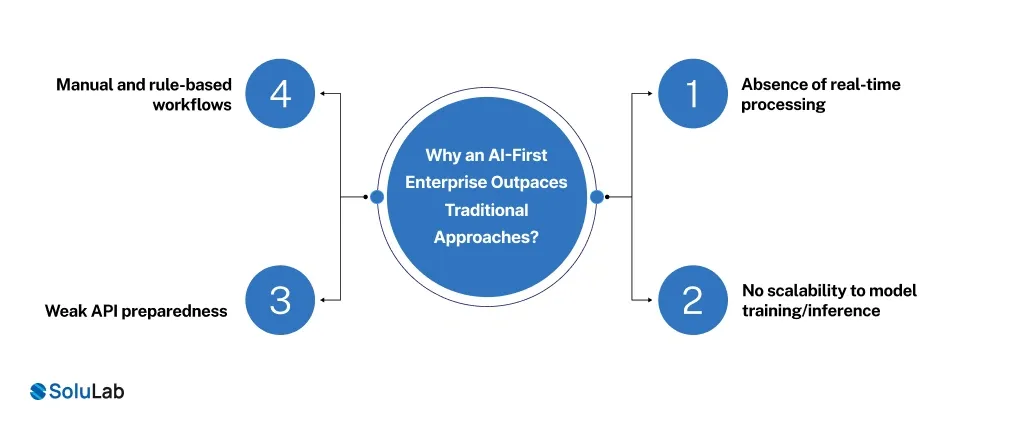
Organizations that choose AI integration solutions for their system make decisions more quickly and efficiently, scale more efficiently, and with less effort, whereas conventional systems cannot keep pace with speed, data needs, or changing customer expectations.
- Absence of real-time processing: The older systems are based on batch processing and delayed data updates, which only provide insight in time and slow down the decision-making process in scenarios where real-time responsiveness is important as a competitive advantage.
- No scalability to model training/inference: Traditional infrastructure cannot even easily support the high-performance computing requirement, so it is challenging to plan AI development costs that can be trained, deployed, and expanded in ultimate datasets and applications.
- Weak API preparedness: The outdated systems have ineffective API and integration facilities, which create obstacles to the integration of AI tools, third-party platforms, and recent applications that are needed to automate and exchange data.
- Manual and rule-based workflows: The intensive dependence on manual operations and fixed rules restricts opportunities for flexibility, and making decisions automated and/or utilising predictive intelligence in dynamic business is challenging.

Key Pillars of Enterprise-Grade AI Infrastructure
Businesses are moving toward an AI-driven business where infrastructure is not a support but rather the base that facilitates scalability, high-velocity, and intelligent decision-making in various business processes.
- Scalable compute systems: Enterprise AI needs high-performance computing infrastructures that have supportive graphics processing units and TPU compute units to support model training and inference processes and to maintain the same level of performance as data volumes and workloads increase exponentially.
- Single data ecosystem: Data silos prevent the work of AI. A data layer that is controlled, centralized, and well-managed allows easy flow of information and enhances access, quality, and consistency of data to enhance accuracy and insights into the model.
- Real-time data processing: AI systems rely on data pipelines to provide real-time insights to make faster decisions as well as to underpin more use cases such as fraud detection, recommendations, and predictive analytics.
- Strong MLOps pipelines: An effective model lifecycle management, such as deployment, monitoring, and retraining, real-time improvement, scaling, and reliability of AI systems in production systems.
- API-first integration layer: Contemporary AI infrastructure demands loosely structured APIs and a microservices structure to make it compatible with the current systems, so that less time is consumed during its application process, and that is interoperable with the rest of the enterprise applications.
- Data security and governance: Data security and governance issues, such as robust compliance elements, access controls, and good ethical AI practices, are necessary to defend sensitive data and foster transparency and confidence in AI-informed decisions.
- AI readiness assessment: A formal AI readiness assessment would assist in revealing infrastructure weaknesses, the maturity of the data, and scaling issues, and facilitate a better shift towards an AI native enterprise.
- Constant optimization and monitoring: Performance monitoring and feedback loops, and system tuning are important steps needed to keep the AI enterprise-ready to ensure that the models are accurate, efficient, and aligned with the business requirements.
Read More: AI Readiness in Dubai
Step-by-Step Approach to Transition to an AI-First Tech Stack
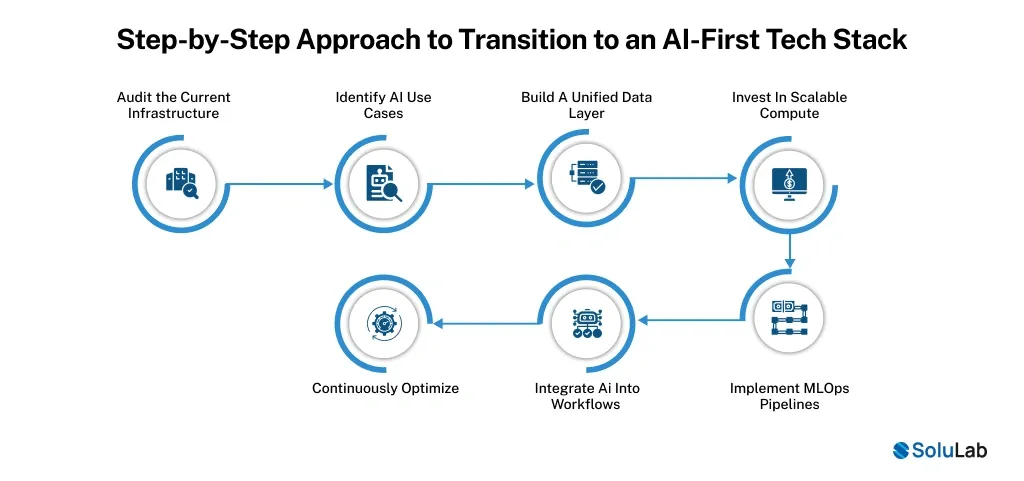
Transitioning to an AI-first enterprise requires a structured, outcome-driven approach that aligns technology, data, and business goals, ensuring long-term scalability, efficiency, and measurable impact across operations.
Step 1. Audit the Current Infrastructure
Evaluate existing systems, data pipelines, and tools to understand gaps, scalability limits, and integration challenges. This step defines your baseline for enterprise AI readiness and highlights what needs modernization or replacement.
Step 2. Identify AI Use Cases
Prioritize high-impact use cases that deliver measurable value, such as automation, predictive analytics, or personalization. Focus on areas where AI in enterprise systems can reduce costs, improve efficiency, or unlock new revenue opportunities.
Step 3. Build A Unified Data Layer
Consolidate siloed data into a centralized, accessible architecture. Clean, structured, and real-time data is critical for effective AI models and forms the backbone of reliable AI infrastructure for enterprises.
Step 4. Invest In Scalable Compute
Adopt cloud, hybrid, or GPU-powered environments that support model training and real-time inference. Scalable compute ensures your infrastructure can handle growing AI workloads without performance delays.
Step 5. Implement MLOps Pipelines
Establish automated pipelines for model development, testing, deployment, and monitoring. MLOps consulting services ensure faster iteration, consistent performance, and seamless integration of AI into production environments.
Step 6. Integrate AI into Workflows
Embed AI into daily business operations, from customer support to decision-making systems. This ensures AI delivers real value rather than remaining an isolated experimental initiative.
Step 8. Continuously Optimize
Monitor model performance, retrain with new data, and refine systems regularly. Continuous optimization ensures your AI systems stay relevant, accurate, and aligned with evolving business goals.
Read More: How Businesses in the Middle East Are Scaling with Enterprise AI Integration?
Real-World Use Cases of AI-native Tech Stacks
AI-native technology stacks are changing how industries will be run, allowing for faster automation and the anticipation of intelligent decisions over workflows, and helping businesses achieve efficiency, accuracy, and scalable growth in competitive markets.
1. Finance: Fraud Sensor, Risk Modelling
Enterprise systems with AI models are more proactive and more reliable, as they can analyze real-time transactions with machine learning models to identify anomalies and prevent fraud, and enhance credit risk assessment.
2. Health industry: Forecast Diagnostics
AI for Healthcare providers can early predict disease, achieve better diagnosis accuracy, and better outcomes by utilizing patient data to predict disease, using AI models, which is indicative of the rising trend towards using AI-first in critical care systems.
3. Retail: Recommendation Engines
AI is utilized by retail platforms to predict and provide personalized recommendations based on user behavior, preferences, and purchase history, with the goal of reaching higher conversion rates and customer experience; this approach is popular with AI-first start-ups.
4. Logistics: Optimization Of Route
The AI-based logistics solutions process real-time data about traffic, weather, and delivery, optimizing routes, saving fuel, and enhancing delivery times, and make AI in enterprise systems stronger.
Signs Your Tech Stack Is Not AI-Ready!
Many enterprises believe they are AI-ready, but hidden gaps in infrastructure, data, and workflows slow progress. Recognizing early warning signs helps avoid failed AI initiatives and wasted investments.
- Fragmented: Data scattered across multiple tools with no unified access layer.
- Manual: Operations still rely heavily on human intervention over automation.
- Delayed: No real-time analytics to support instant decision-making.
- Slow: Long deployment cycles for models, updates, and integrations.
- Limited: AI initiatives are stuck in the pilot stage with minimal integration.
- Constrained: Deployed AI lacks scalability, monitoring, and performance tracking.
- Restricted: No dedicated environment for safe AI experimentation and testing.
How SoluLab Helps Enterprises Become AI-First?
Companies that want to be AI-first require more than tools; they require the appropriate partner to coordinate technology, data, and implementation to be scaled in real-world AI adoption.
- AI native development strategy: SoluLab develops AI-driven solutions with a focus on the core, not added as an additional functionality, and makes sure that both integrate and provide smarter workflows and systems that can be expanded as the business intelligence needs grow.
Read Also: AI-Native Solution Development Strategy
- More rapid deployment through automation: With the help of existing AI accelerators and automation platforms, SoluLab will shorten the development cycle and allow enterprises to accelerate the production of their idea into a product as quickly as possible with a minimum amount of operational overhead.
- Economical AI implementation: SoluLab will enable businesses to apply AI development solutions at an optimal resource usage, model selection, and infrastructure, and achieve performance and scalability without requiring unrealistically high costs.
- End-to-end AI lifecycle services: From strategies and data engineering to model deployment and continued optimization, SoluLab promises its enterprises long-term value and lasting performance of their AI investments.

Conclusion
Turning into an AI-first enterprise is no longer a future consideration but a current need of businesses that want to remain competitive. The tech stack that you operate on is a key to the success of your adoption, scaling, and the ability to benefit in terms of the AI-driven systems.
Between data preparedness and scalable infrastructure, automation and real-time decision-making should be supported at all levels.
Businesses that move first have an obvious efficiency, innovation, and growth advantage. The first step to change is to assess your present capabilities. SoluLab, an AI app development company, can help your business build and scale the right foundation for success.
FAQs
Neha is a curious content writer with a knack for breaking down complex technologies into meaningful, reader-friendly insights. With experience in blockchain, digital assets, and enterprise tech, she focuses on creating content that informs, connects, and supports strategic decision-making.