Key Takeaways
- Data modernization services move legacy data platforms to cloud, lakehouse, and AI-ready architectures, covering the platform itself, pipelines, governance, and AI readiness.
- The main approaches map to the “6 Rs” of migration: rehost, replatform, refactor/re-architect, rebuild, and replace, with effort and payoff rising as you move down the list.
- A project runs in four gated phases: assess, design the target architecture, migrate and validate, then govern.
- Modernization is what makes data AI-ready — fragmented, ungoverned data is the reason most GenAI and RAG projects fail before they start.
- Choose a partner on platform certifications, security posture, migration methodology, and whether they also deliver AI, since data and AI depth increasingly need to sit on the same team.
Data modernization services move legacy data platforms to cloud, lakehouse, and AI-ready architectures. A provider handles four things: the data platform itself, the pipelines that feed it, the governance that keeps it trustworthy, and the readiness work that lets AI query it. The result is faster analytics, lower cost, and data your models can actually use.
SoluLab runs data modernization as a consulting-led engagement that pairs cloud architecture with AI and software delivery. If you’re scoping a migration or a full data-platform rebuild, our cloud computing consulting services cover assessment, target architecture, and delivery under one team. For the related question of moving legacy applications rather than legacy data, see our companion guide on mainframe modernization.
What Are Data Modernization Services?
Data modernization services are the work of moving an organization’s data off aging systems and onto current cloud platforms, then reshaping the pipelines, governance, and access layers around it. Scope usually spans four areas: the storage and compute platform (data warehouse or lakehouse), the ingestion and transformation pipelines, data governance and quality, and the readiness work that makes data usable for analytics and AI.
It’s broader than a one-time lift of a database. A modernization program touches architecture (how data is stored and modeled), movement (ETL to ELT, batch to streaming), and consumption (who queries it and how). Cloud data modernization specifically means the target sits on a managed cloud platform rather than on-premises hardware you patch and scale yourself.
Definition box: data modernization = re-platforming legacy data systems onto cloud-native architecture, plus the pipeline, governance, and AI-readiness changes that make the new platform faster, cheaper, and query-ready.
Why Do Enterprises Modernize Their Data Now?
Enterprises modernize data because legacy warehouses limit three things at once: analytics speed, cost control, and AI adoption. When data sits in siloed on-premises systems, teams wait on slow queries, pay for capacity they cannot scale down, and cannot feed clean, unified data to AI models. Modernization removes those constraints.
1. AI Readiness
Generative AI and machine learning need unified, governed, well-labeled data. Fragmented legacy stores block this directly.
2. Cost and Scale
Cloud platforms separate storage from compute, so you pay for what you query instead of provisioning for peak load year-round.
3. Analytics Latency
Business teams want near real-time reporting, not overnight batch loads.
4. Compliance and Risk
Aging systems are harder to audit and secure against standards like SOC 2, HIPAA, and GDPR.
5. Talent and Maintenance
Fewer engineers know legacy stacks, so upkeep gets slower and more expensive over time.
What Are the Main Data Modernization Approaches?
The main approaches map to the migration strategies cloud providers call the “6 Rs”: rehost, replatform, refactor, re-architect, rebuild, and replace (Microsoft groups these under application modernization, and Microsoft Learn documents each in detail). IBM frames a similar set as the 7 Rs, adding relocate and retain. For data workloads, the same logic applies, with the effort and payoff rising as you move down the list.
1. Rehost (Lift and Shift)
Move the database to cloud infrastructure with minimal change. Fast and low-risk, but you carry the old design forward.
2. Replatform
Move to a managed cloud database and make light optimizations. A common middle path.
3. Refactor / Re-Architect
Redesign schemas, pipelines, and storage to fit a cloud-native pattern such as a lakehouse.
4. Rebuild
Recreate the data platform from scratch on modern services when the old design cannot be salvaged.
5. Replace
Swap a legacy system for a SaaS or managed alternative.
Which one fits depends on the workload, the deadline, and how much of the legacy design is worth keeping. Most real programs mix approaches across systems.
Data modernization approaches compared
The table below maps each approach to its effort, cost, risk, and the workload it suits best. Use it to decide where each system in your estate belongs before you commit to a single strategy.
| Approach | Effort | Relative Cost | Risk | Best-Fit Data Workload |
| Rehost (lift and shift) | Low | Low | Low | Stable legacy databases you need moved quickly |
| Replatform | Low to medium | Medium | Low to medium | Workloads that gain from a managed cloud database with light tuning |
| Refactor / re-architect | High | Medium to high | Medium | Analytics workloads targeting a lakehouse or ELT pipeline |
| Rebuild | High | High | Medium to high | Legacy platforms whose design blocks scale or AI use |
| Replace | Medium | Varies | Medium | Systems better served by a SaaS or managed product |
Effort and cost above are directional, not quotes. Actual figures depend on data volume, source complexity, and target design.
What Does a Data Modernization Project Include, Step by Step?
A data modernization project runs in four phases: assess, design the target architecture, migrate and validate, then govern. Each phase gates the next, so you do not move data before you know where it’s going or how you’ll prove it landed correctly.
1. Assessment and Data Inventory
Catalog source systems, data volumes, quality issues, lineage, and compliance obligations. This phase decides which approach fits each workload.
2. Target Architecture Design
Choose the platform (warehouse, lake, or lakehouse), the pipeline pattern (batch or streaming, ETL or ELT), and the governance model.
3. Migration and Validation
Move data in waves, transform it, and reconcile record counts and values against the source so nothing is lost or corrupted.
4. Governance and Enablement
Stand up data quality checks, access controls, cataloging, and the consumption layer for analytics and AI.
Running the business through the migration matters as much as the migration itself. Most programs keep the legacy system live and dual-write or run parallel loads until the new platform is validated, then cut over.
Which Tools and Platforms Power Data Modernization?
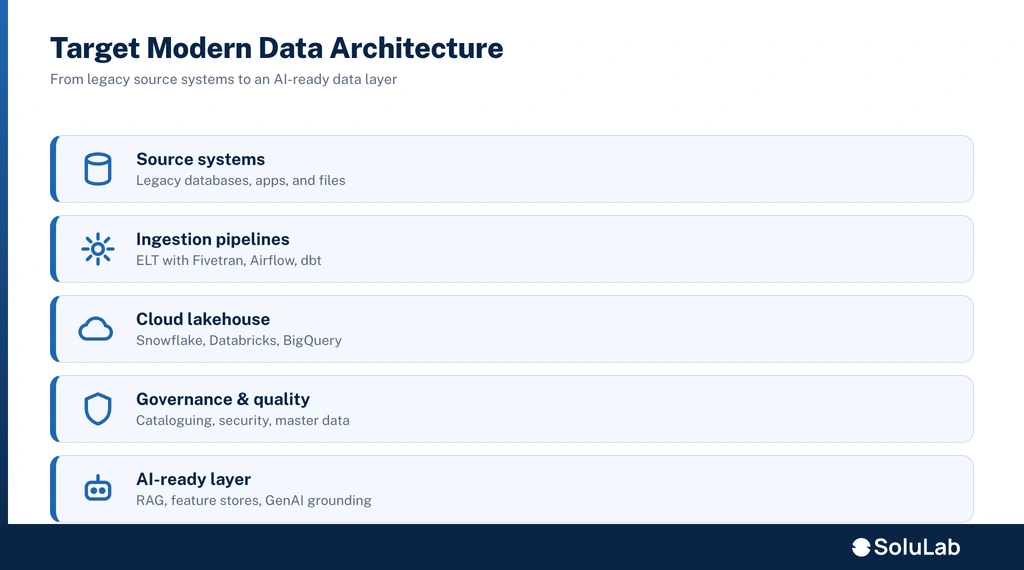
Data modernization runs on a modern data stack: a cloud platform for storage and compute, ingestion and transformation tools for the pipelines, and orchestration to schedule it all. Naming the stack matters because it tells a buyer whether a provider works with the technologies their team already knows.
1. Cloud Data Platforms
Snowflake, Databricks, Google BigQuery, and Amazon Redshift for warehousing and lakehouse workloads.
2. Ingestion and Integration
Fivetran for managed connectors and Apache Kafka for real-time streaming.
3. Transformation
dbt for ELT modeling and testing inside the warehouse.
4. Orchestration
Apache Airflow to schedule and monitor pipelines.
The stack a provider recommends should follow your target architecture, not the other way around. SoluLab’s data science consulting and enterprise software development teams build and integrate these components as part of a broader delivery, covering the application layers that sit on top of the modernized data.
What Is a Data Lakehouse and Do You Need One?
A data lakehouse combines the low-cost, open storage of a data lake with the reliability, structure, and governance of a data warehouse in one platform. Databricks, which coined the term, describes it as unifying both models so you can run analytics and AI on the same data without copying it between systems. IBM describes the architecture as a layered stack spanning ingestion, storage, metadata, and consumption.
You likely need a lakehouse when you have both structured data (transactions, tables) and unstructured or semi-structured data (documents, logs, events) and you want analytics and AI to use all of it. If your workloads are purely structured BI reporting, a cloud data warehouse may be enough. The honest answer depends on your data types and use cases, which is what the assessment phase decides.
How Does Data Modernization Make Data AI-Ready?
Data modernization makes data AI-ready by unifying it, cleaning it, and structuring it so models can retrieve trustworthy context on demand. AI systems fail on fragmented, ungoverned data, so the modernization work is a prerequisite for reliable AI, not an add-on. This is where a data-and-AI provider differs from a pure migration shop.
1. Grounding Data for Retrieval-Augmented Generation (RAG)
RAG connects a language model to your own governed data so answers cite real content instead of guessing. IBM describes RAG as retrieving and integrating information from your data sources in response to a query.
2. Feature Stores for Machine Learning
Centralized, versioned features let ML models train and serve on consistent data.
3. Data Quality and Labeling
Clean, well-labeled data is what separates a useful model from an unreliable one.
SoluLab folds this readiness work into modernization because the same team also delivers AI. See our enterprise AI development and machine learning development services for how the modernized data feeds production models.
How Much Do Data Modernization Services Cost?
Data modernization cost depends on scope rather than a single list price, so treat any published figure with caution. The drivers that move the number are data volume, the number and complexity of source systems, how much refactoring the target design requires, the pipeline pattern (batch versus real-time streaming), and the governance and compliance work involved.
A small replatform of one database is a fraction of the cost of a full estate re-architecture onto a lakehouse with new governance. Engagement model matters too: a fixed-scope project, a dedicated team, or time-and-materials each total differently.
To get an accurate estimate, talk to SoluLab’s cloud consulting team with your source systems, data volumes, and target use cases.
How Do You Choose a Data Modernization Partner?
Choose a data modernization partner on four things: platform certifications, security posture, domain and workload fit, and verifiable references. The provider should prove capability on your target platform, not just claim it, and show how they keep the business running through the migration.
1. Platform Expertise
Certified, hands-on experience with your target (Snowflake, Databricks, BigQuery, or Redshift), not slideware.
2. Security and Compliance
A clear answer on how they handle SOC 2, HIPAA, or GDPR obligations during and after migration. SoluLab’s current published compliance set spans SOC 2, GDPR, HIPAA, CCPA, ISO/IEC 27001, ISO/IEC 42001, ISO 9001, CMMI Level 3, and NIST AI RMF alignment.
3. Migration Methodology
A documented approach to zero-downtime cutover, validation, and rollback if something breaks.
4. Data and AI Depth
If AI readiness is a goal, pick a partner who also delivers AI, so the data lands in a shape models can use.
5. References and Track Record
Ask for engagements similar to yours in size and industry. SoluLab holds a 4.9/5 rating on Clutch and a 4.9/5 rating on GoodFirms.
Route real buyer objections such as downtime risk, data loss, cost overruns, and vendor lock-in to the provider directly and get the answers in writing before you sign.
Why SoluLab for Data Modernization
SoluLab runs data modernization as one consulting-led engagement that spans cloud architecture, data engineering, software delivery, and AI. That matters because most modernization programs are not really about moving data; they’re about making the data useful afterward, for analytics and increasingly for AI.
The team assesses your estate, designs the target platform, runs the migration in validated waves, and stands up the governance and readiness work so the result is query-ready and model-ready. Delivery ties into our DevOps consulting services for the automation and reliability side of the new platform. SoluLab’s own AI development work confirms Google Cloud, Azure, and AWS as current cloud platform partners, and 11+ years in business.
FAQs
Chintan leads SoluLab's highest-level AI consulting conversations, assessing whether a client's business problem actually justifies an AI investment before any solutioning begins.