Artificial intelligence is a strategic investment that has a direct effect on efficiency, competitiveness, and long-term growth. However, most companies find it difficult to go beyond pilot projects and to extend the AI activities into quantifiable business outcomes.
This is where an AI consulting framework comes in as an essential one. It offers a systematic method of determining high-impact use cases, prepping enterprise data, deciding on the appropriate technology stack, and responsible deployment.
More importantly, it assists organizations in scaling AI projects between teams without compromising governance, security, and performance criteria. In this guide, we’ll explore how an enterprise AI consulting model can assist enterprises in structuring AI solutions, scale them without hesitation, and attain sustainable achievement in reality.
Key Takeaways
- An enterprise AI consulting model assists firms in transitioning out of point-to-point AI pilot projects into scalable and value-oriented AI implementations that are aligned with overall business objectives.
- Effective AI projects begin with a definition of their problems and quantifiable business KPIs, and not model accuracy or technical performance.
- The preparedness of data is important; effective data governance, data quality, and data security underpinnings directly affect the success and ROI of AI.
- Selecting an appropriate AI stack and deployment plan is necessary to make sure the AI will integrate with the existing enterprise systems and processes without issues.
- SoluLab, backed by a team of AI experts, offers promising consultation from use case discovery to strategic implementation with a flawless execution roadmap.
What Is an Enterprise AI Consulting Framework?
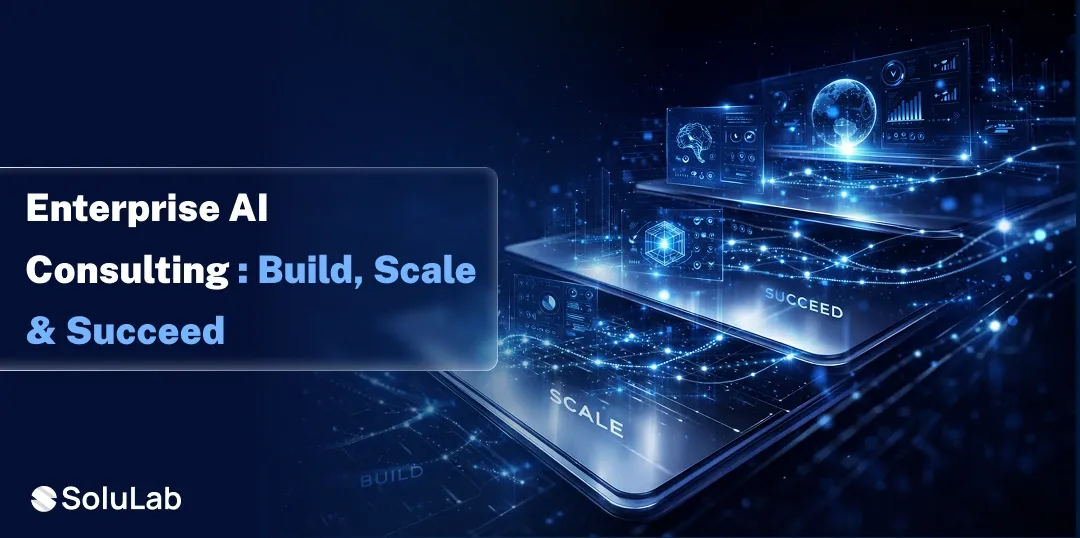
Enterprise AI Consulting Framework is a roadmap that companies follow to design, develop, and scale AI solutions throughout the organization, without mess and unnecessary expenditure.
It usually covers:
- Business goals alignment – where, in fact, AI can generate value.
- Data check-up – verification of data quality, security, and availability.
- Technology selection – selecting the appropriate AI models, tools, and infrastructure.
- Implementation and integration- rolling out AI into the systems.
- Governance and ethics – making sure that people comply, are private,e and that they use AI responsibly.
- Scaling & optimization: increasing performance and ROI over time.
Why Business Leaders Need an Enterprise AI Consulting Framework?
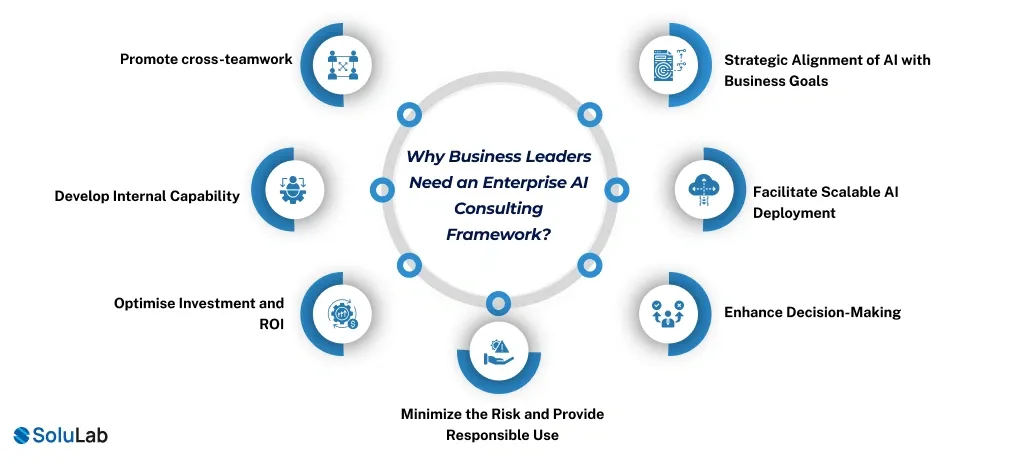
Enterprise AI Consulting Framework is necessary for business leaders since AI is no longer an experiment, but a strategy; it has not been adopted as a structure, and as such, investment in AI projects is disjointed, with many organisations failing to realise the real value of AI projects.
1. Strategic Alignment of AI with Business Goals: An AI consultancy model assists leaders in understanding where AI can help create the greatest value and coordinate the efforts of initiatives with long-term organisational goals, eliminating wasted time spent on insignificant pilots.
2. Facilitate Scalable AI Deployment: Businesses tend to find it difficult to deploy AI beyond a single project; a framework establishes repeatable processes and controls so that experiments become predictable production systems throughout the organisation.
3. Enhance Decision-Making: Structured consulting focuses on robust data approaches and analytics, enabling executives to make effective decisions, predict trends, and create competitiveness in volatile markets.
4. Minimize the Risk and Provide Responsible Use: Artificial Intelligence (AI) systems combine governance, compliance, and ethical controls and reduce the risks to bias, exposure to regulatory actions, and reputational risk since AI systems are deployed on an enterprise scale.
5. Optimise Investment and ROI: With clear metrics and monitoring, leaders can rationalise AI spending, optimise resource allocation, and quantify the ROI instead of making uninformed, blind decisions to invest in technology that does not produce measurable effects.
6. Develop Internal Capability: A framework evaluates organisational preparedness, reveals potential gaps in skills or infrastructure, and facilitates specific upskilling to help teams maintain and expand AI in the long term.
7. Promote cross-teamwork: The framework enhances interdependence among business units through the creation of common processes and general goals, so AI project efforts are not divided and fragmented, but rather through collaboration.

Benefits of an Enterprise AI Strategy
Enterprise AI strategy provides organizations with a clear, scalable set of directions to deploy AI solutions, enable leaders to reduce risk, focus on high-impact use cases, and to achieve measurable business results.
- Obvious business alignment: An enterprise AI strategy ensures that AI programs align with the business objectives, and business investment is not made (in vain), experimenting with one of them.
- Organized AI implementation: A company can quickly transition to production once it has an AI adoption framework, as companies require less time to establish an adoption framework compared to pilots, which create delays due to unclear ownership, data, or misunderstood tools.
- Enhanced data usage: A good plan enhances data governance, quality, and access to allow teamstoh better use enterprise data to predict, automate, and make decisions.
- Lower costs of operation: Unified AI application decreases redundancy of efforts, accurately uses infrastructure, and assists in implementing an acceptable enterprise AI solution for businesses in the appropriate magnitude.
- Manage risk, security, and compliance: Company-wide strategy built in governance, privacy, and ethics practices early in AI, and mitigates regulatory risk, responsible AI use within the company.
How to Build an Enterprise AI Strategy Framework?
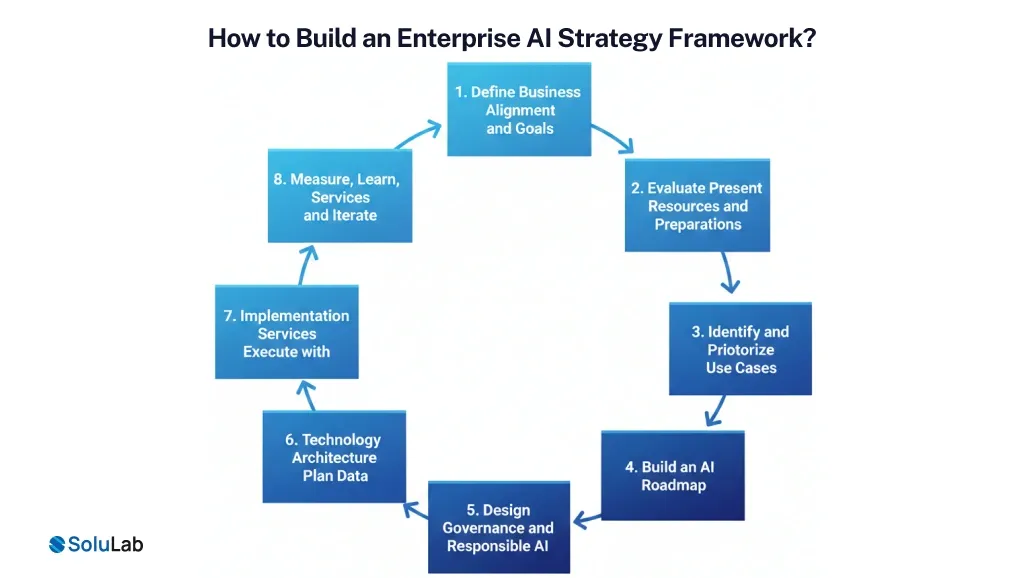
The framework of an effective Enterprise AI strategy provides an opportunity to align business objectives with AI opportunities, to focus on use cases, to prepare data systems, and to plan the implementation by using the Enterprise AI roadmap consulting service and Enterprise AI implementation service.
1. Define Business Alignment and Goals.
Begin by defining your business priorities: revenue growth, cost reduction, and customer experience, so that your AI projects can work on delivering quantifiable value and not technology experiments.
2. Evaluate Present Resources and Preparations.
Measure your quality of data, infrastructure, talent, and processes to inform yourself of what you require to proceed with creating AI solutions that can scale conscientiously and efficiently.
3. Identify and Prioritize Use Cases.
Brainstorm possible AI uses, rank them based on the business impact and feasibility to prioritize those with the most value and those that can be deployed the fastest.
4. Build an AI Roadmap
Use Enterprise AI roadmap consulting to design a staged workflow, which organizes projects, resources, milestones, and plans AI projects both in the short term and in the long term.
5. Design Governance and Responsible AI.
Establish roles, policies, and governance frameworks that address ethical risks, compliance, and accountability in your AI efforts.
6. Technology Architecture Plan Data.
Make sure that your data strategy and pipelines, as well as AI platforms, are scalable and connected to the already existing systems and future AI tools.
7. Implementation Services Execute with
Enterprise AI Implementation services to test, pilot, scale, and deploy selected AI projects and monitor business impact and performance.
8. Measure, Learn, and Iterate
Measure your progress and track results, check your advancement,t and improve your strategy according to the experience and emerging business requirements.
Challenges Businesses Face in Measuring Enterprise AI Success
Enterprise AI success is hard to measure since its results are not limited to accuracy and include business value, data maturity, adoption rates, and long-term team and system operating effects.
1. Lack of Clear Business KPIs: Most businesses measure technical indicators such as model accuracy but do not relate AI performance to the increase in revenue, the decrease in costs, or the rise in productivity, which makes its success difficult to justify.
Solution: Measure AI success by business-aligned KPIs, including ROI, process efficiency, customer satisfaction, or time saved, which are directly linked to organizational objectives in the first place.
2. Hard to believe that AI is impactful: AI is commonly implemented in collaboration with human beings, and with the system that is already in place, it is hard to separate the contribution of AI from the other improvements made through operations or in the market itself.
Solution: Apply baseline performance standards and controlled pilots to compare the results of pre-AI and post-AI, and assist in the quantification of the direct and indirect effects of AI on the business.
3. Poor Data Quality: Unconsistent, unfinished, or siloed enterprise data is going to give untrustworthy AI results that cause performance measurement errors and misstatements.
Solution: Invest in data governance, normalised data pipeline,s and routine data audits so that AI performance measures are calculated using clean, reliable, and consistent data.
4. Low Team Adoption of the users: Even the high-performing AI systems fail when their employees do not trust, understand, and or use them, leading to poor measurable business outcomes.
Solution: Measurement. This is achieved by tracking metrics of adoption, training, change management, and engaging end users early on, so AI tools can be applied, trusted, and embedded into workflows.
5. Absence of Continuous Monitoring and Optimization: Most companies focus on the success of AI at the point of deployment and do not pay attention to model drift, changing data trends, and evolving business requirements.
Solution: Introducing constant monitoring systems to detect performance, bias, and ROI regularly to ensure that AI systems remain in line with business goals.

Conclusion
The successful development and expansion of AI requires more than just the use of advanced technology- it needs a well-designed enterprise AI consulting model. Organizations can mitigate risk and optimize ROI by aligning AI efforts with business objectives, building quality data, choosing an appropriate technology stack, and implementing governance.
It can also be identified by a clear structure that facilitates the implementation of continuous monitoring, adoption by users, and scalability (long-term). With the adoption of AI as a business capability, any business that adopts a strategic, consulting-oriented approach will go through experimentation to measurable impact.
SoluLab, an enterprise AI development company, helps you design, scale, and implement AI frameworks that actually drive ROI. Book a free discovery call today!
FAQs
Neha is a curious content writer with a knack for breaking down complex technologies into meaningful, reader-friendly insights. With experience in blockchain, digital assets, and enterprise tech, she focuses on creating content that informs, connects, and supports strategic decision-making.