


The term gets used two ways:
Building AI-powered products. The product itself uses AI: a support copilot, a document-reading engine, a pricing model, an agent that completes tasks.

SoluLab's AI product development services take an AI-powered product from idea to launch: we validate the use case, design the data and model architecture, build an MVP in weeks, and scale it to production. You get a fixed-price MVP scope within 48 hours and one team that owns strategy, engineering, and MLOps.












AI product development is the process of building a software product where artificial intelligence is a core feature, such as an assistant, recommendation engine, prediction model, or AI agent. It adds data strategy, model selection, evaluation, and monitoring to the usual product cycle, because an AI feature's quality depends on data, not just code.
Building AI-powered products. The product itself uses AI: a support copilot, a document-reading engine, a pricing model, an agent that completes tasks.
Using AI to build products faster. AI tools speed up research, specs, design and coding for any product team.
Most buyers need the first and benefit from the second. If you're researching how AI changes the product process in general, our guide to AI in product development walks through the stages and use cases.
SoluLab's AI product development services cover every stage of an AI product: discovery and feasibility, UX for AI features, MVP and proof of concept builds, generative AI and LLM products, AI agents, machine learning and predictive features, AI integration into existing products, and MLOps. One team takes the product from a validated idea to production.

We test whether users want the product and whether your data can support it, then define success metrics before a line of production code. Discovery draws on our AI consulting practice and ends with a cost build plan.
AI features fail when users can't tell what the system knows or how confident it is. We design prompts, confidence cues, fallbacks, and human hand-offs into the interface so your users trust the output.
We build a working AI MVP on real data, usually in 8 to 16 weeks after a 4 to 8 week proof of concept, so investors and early users can test the core AI value, not a mockup. Scope and price are fixed before we start.
Our engineers build generative AI products such as copilots, content engines and document-processing tools on GPT, Claude, Gemini or open-source models. RAG, guardrails and evaluation sets ship with the first release.
We build AI agents that complete multi-step work across your systems, from transaction lookups to workflow execution, with audit logs and human approval where it matters. UpdateIA runs 14 of them in production.
Recommendation, forecasting, scoring and anomaly detection models turn your product data into features users pay for. We handle feature engineering, training, explainability and retraining through our machine learning development team.
Already have a SaaS product? We add AI features to your current stack through APIs and microservices without a rewrite, which is often the fastest way to lift retention and pricing power. See our SaaS product development services for the wider platform work.
After launch, AI products drift as data changes. We set up monitoring, evaluation pipelines, cost controls, and retraining so quality and unit economics hold as usage grows.

SoluLab builds AI products in six stages: discovery, AI proof of concept, product design, MVP build, launch, and scale with MLOps. Each stage ends with a decision point backed by evidence, so you only fund the next stage once users, data and unit economics have proven the product is worth building further.
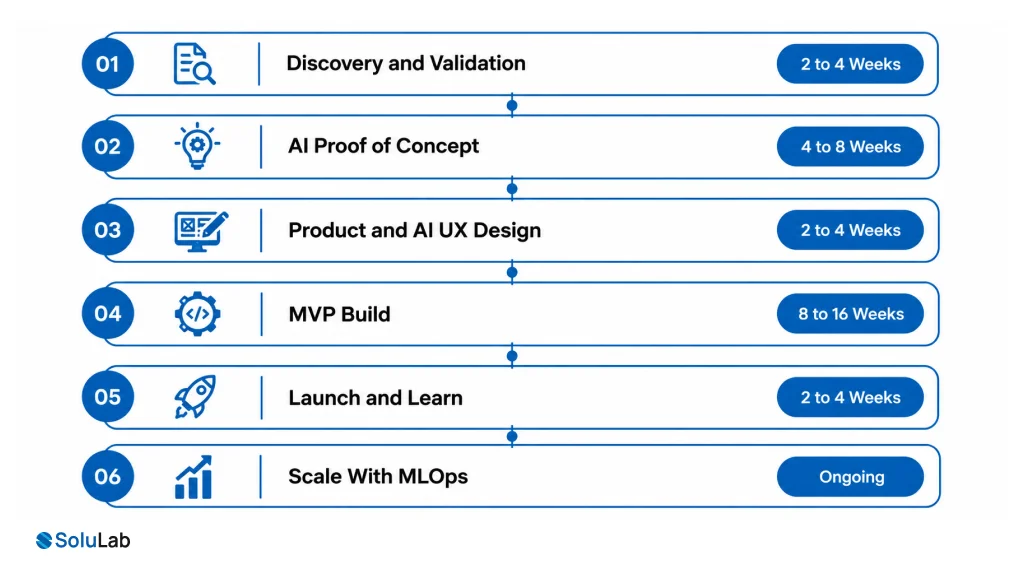
The proof of concept is the step most traditional product teams skip, and it's where AI products are won or lost.
We interview users, map the job your product does, and define the metric that proves value. Output: a validated problem, success metrics, and the fixed-price build plan.
We test the core AI capability on your real data before anything else gets built. If accuracy, latency or cost doesn't clear the bar, you've spent weeks, not quarters, finding out.
We design user flows, confidence cues, error states and human hand-offs, then test clickable prototypes with real users.
Our engineers build the product in two-week sprints with evaluation sets, guardrails and cost tracking from sprint one. You see working software at every demo.
We release to early users, watch usage, quality and cost per request, and fix what real behavior exposes.
We add monitoring, retraining and model upgrades, and extend the product with the features users ask for most.
AI product development differs from traditional software development because AI output is probabilistic, not fixed. Teams must prove data feasibility before building, test with evaluation sets rather than only unit tests, budget for per-request model costs, and monitor quality after launch, since models drift as real-world data changes.
| Traditional product development | AI product development | |
|---|---|---|
| Behavior | Deterministic: same input, same output | Probabilistic: output varies and can be wrong |
| Biggest early risk | Market demand | Market demand and data feasibility |
| Testing | Unit, integration and UI tests | Those plus evaluation sets, red-teaming and human review |
| Running cost | Mostly fixed hosting | Hosting plus per-request model or GPU cost |
| After launch | Bug fixes and features | Plus drift monitoring, retraining and model upgrades |
| UX | Show results | Show results, confidence and a way to correct the AI |
AI also changes how the product gets built. In a McKinsey study of 40 product managers, generative AI tools improved PM productivity by about 40% and shortened time to market by about 5% over a six-month cycle.
Speed has a catch, though: Uplevel's analysis of about 800 developers found 41% more bugs among GitHub Copilot users with no significant gain in cycle time. That's why we pair AI-assisted coding with senior code review and automated tests rather than treating it as free velocity.
AI product development with SoluLab typically costs $15,000 to $50,000 for a proof of concept, $25,000 to $50,000 for a SaaS MVP, $50,000 to $150,000 for a mid-complexity AI product, and $150,000 to $500,000+ for enterprise platforms. Timelines run from 4 weeks for a proof of concept to 12 months for enterprise builds.
| Engagement | What you get | Typical cost | Typical timeline |
|---|---|---|---|
| Product discovery | Validated problem, metrics, fixed-price build plan | $10,000 to $25,000 | 2 to 4 weeks |
| AI proof of concept | Core AI capability tested on your data | $15,000 to $50,000 | 4 to 8 weeks |
| AI MVP | Launchable product with one core AI feature | $25,000 to $50,000 | 8 to 16 weeks |
| Mid-complexity AI product | Multiple AI features, integrations, admin tools | $50,000 to $150,000 | 4 to 6 months |
| Enterprise AI platform | Multi-tenant, compliance-heavy, several models | $150,000 to $500,000+ | 6 to 12 months |
| AI features in an existing product | AI added to your current SaaS without a rewrite | From $25,000 | 3 to 9 months |
Clean, labeled, accessible data shortens the proof of concept; scattered data adds preparation work.
API models are fastest to start; fine-tuned or self-hosted models cost more up front but can lower running cost at scale.
Each connected system (CRM, payments, ERP) adds build and testing time.
HIPAA, SOC 2, or financial-services requirements add design, logging, and review work.
Plan for running costs too. Model API or GPU spend scales with usage, so we model cost per request during the proof of concept and set budgets before launch.
SoluLab picks the AI stack per product, balancing quality, latency and running cost. Typical builds pair GPT, Claude, Gemini or open-source Llama and Mistral models with LangChain or LangGraph orchestration, Pinecone or pgvector retrieval, Python and FastAPI back ends, React or Flutter front ends, and AWS, Azure or Google Cloud hosting.
 GPT-4o
 Claude
 Gemini
 Llama
 Mistral
 LangChain
 LangGraph
 Function calling
 Pinecone
 pgvector
 Weaviate
 XGBoost
 Random
Forest
 Prophet
 LSTM
 TensorFlow
 Tesseract OCR
 Hugging Face Transformers
 spaCy
 Python
 FastAPI
 Node.js
 React
 Next.js
 Flutter
 Swift
 Kotlin
 AWS
 Azure
 Google
Cloud
 Docker
 Kubernetes
 MLflow
 Datadog
AI products need compliance designed in from the first sprint, not added before launch. SoluLab builds to GDPR, CCPA, HIPAA and SOC 2 requirements where they apply, maps AI risk to the NIST AI Risk Management Framework and the EU AI Act, and logs model inputs, outputs and decisions for audit.

Personal data is stripped or tokenized before any prompt reaches an LLM

Users only retrieve documents and data they're allowed to see

Every AI response, API call and retrieval source is logged for review

Test sets for accuracy, bias and prompt-injection attacks before each release

Approval steps for high-impact actions such as payments or account changes

GDPR, CCPA, HIPAA, SOC 2, NIST AI RMF, EU AI Act, as your market requires
We provide engineering controls, not legal advice; your counsel confirms which regulations apply.
SoluLab builds AI products for industries where data is plentiful and decisions are expensive. That includes fintech and banking, healthcare, insurance, retail and ecommerce, aviation and manufacturing, logistics, real estate and SaaS, with each product designed around the sector's own data sources, regulations and buyers.

Support copilots, KYC automation, fraud scoring and AI banking assistants, like the products we built for One Wallet and Amanbank.


Clinical documentation, patient-intake assistants and triage tools built for HIPAA-compliant data handling.


Claims triage, document extraction, underwriting support and fraud detection products.


Recommendation engines, product content generation, demand forecasting and shopping assistants.


Document intelligence, valuation models and predictive maintenance products, as in our aircraft engine valuation platform.


Shipment exception handling, route optimization and document processing tools.


Valuation models, lease abstraction and listing content products for agents and investors.

AI features added to existing platforms to lift retention and pricing.

SoluLab's AI products are running in production across fintech, banking, aviation, and enterprise automation. Results include a 72% cut in support ticket load from an AI copilot, 60% faster bank onboarding with generative AI, 80% faster aircraft engine evaluation, and 80% fewer manual workflows through UpdateIA's 14 autonomous AI agents.
 Fintech
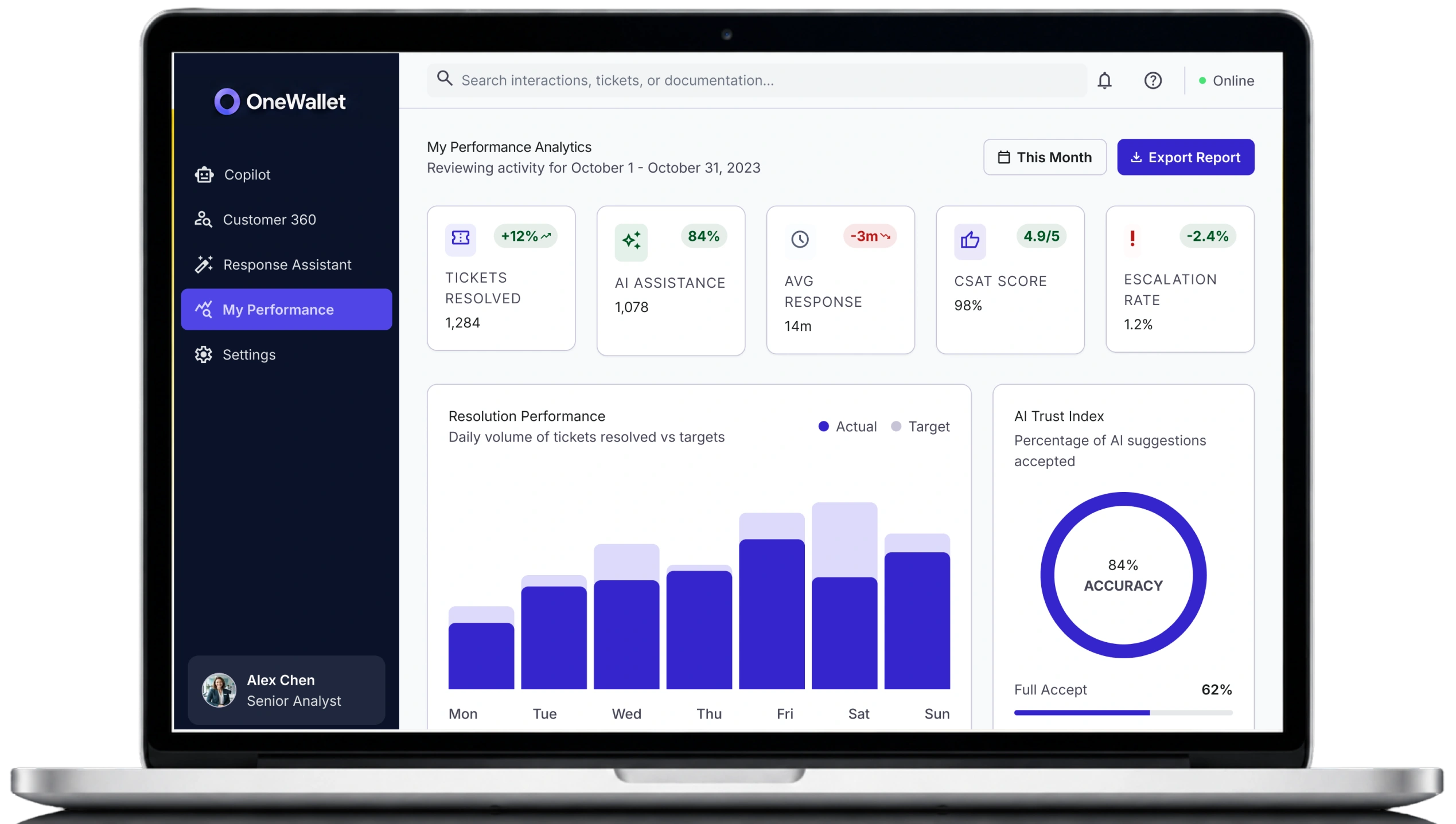
One Wallet, a digital payments platform with 1.8M+ users, was handling 60K+ support requests a month across 10+ disconnected systems. SoluLab built an AI support and operations copilot with a LangChain agent on live backend data, RAG over 50K+ support documents, PII masking before any data reaches the LLM, and full audit logging.
 Banking
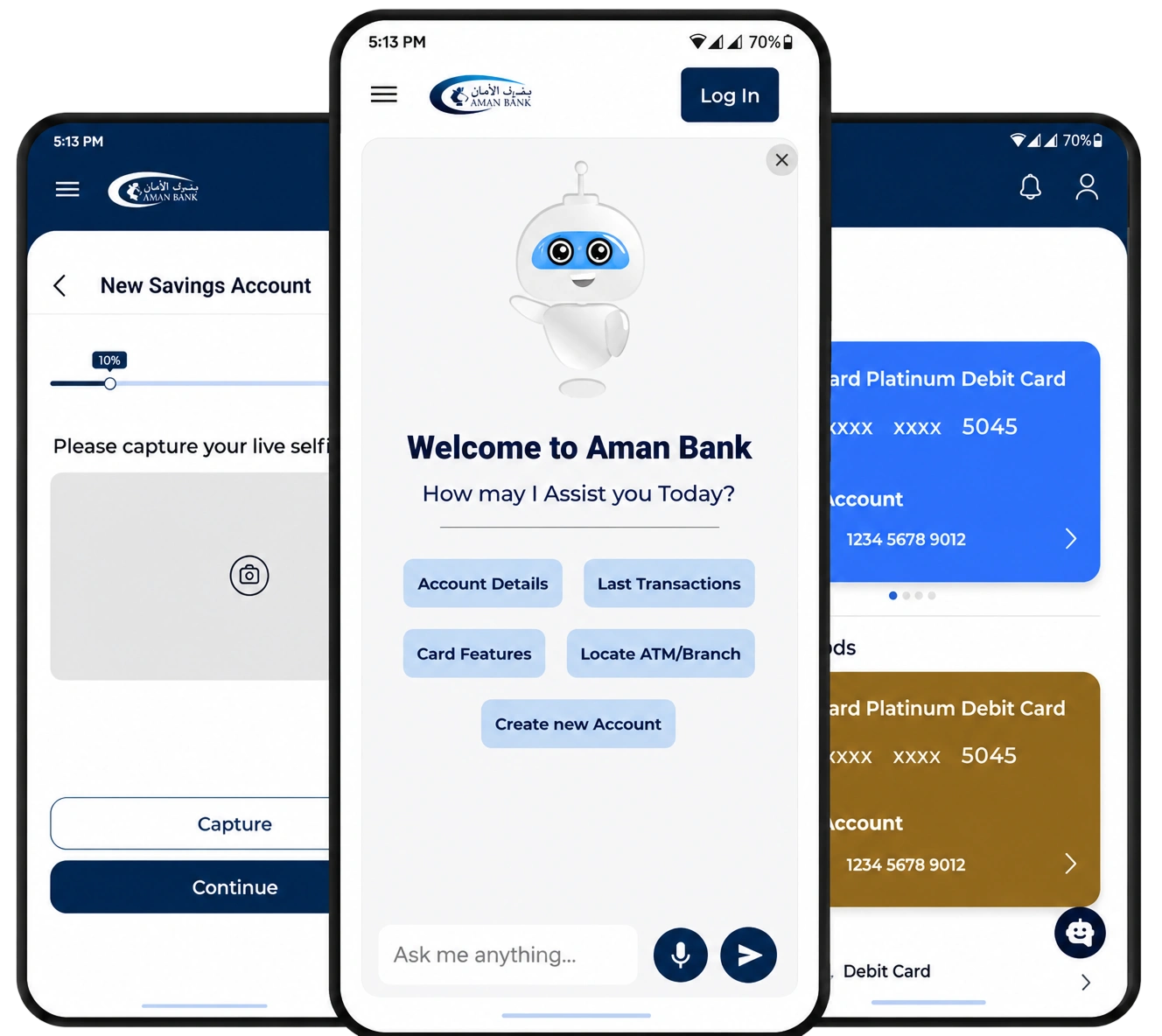
Amanbank, which serves about 750,000 customers, lost applicants to slow manual onboarding and could only offer support during set hours. SoluLab rebuilt its iOS and Android apps with a generative AI chatbot, a voice AI assistant, and AI-powered onboarding with digital KYC and OCR document checks.
 Aviation
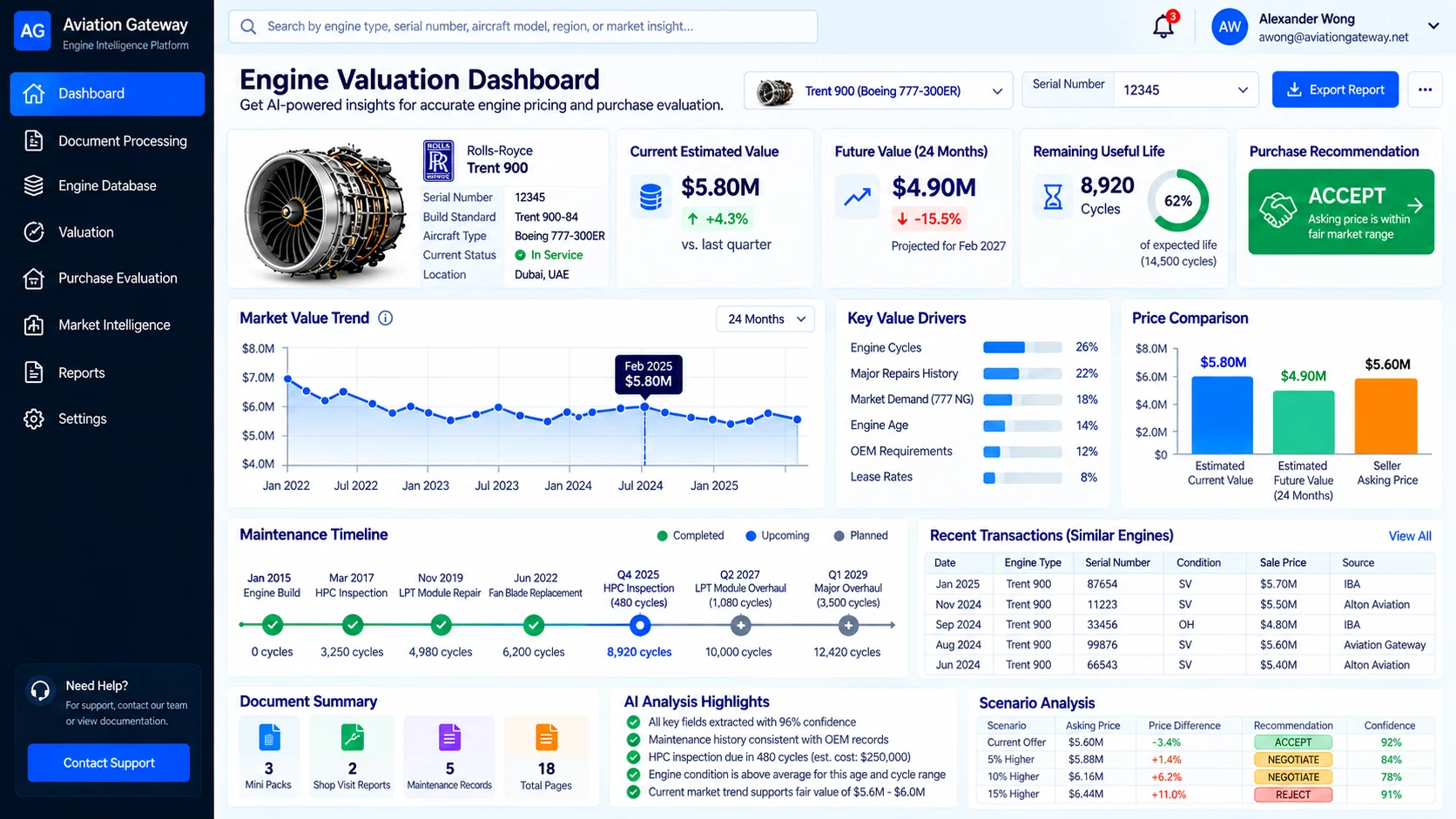
Engine buyers were valuing assets from scanned maintenance records that vary by manufacturer and repair shop. SoluLab built a single AI product combining OCR and NLP extraction, machine learning valuation models, value forecasting, and explainable purchase recommendations.
 Enterprise AI
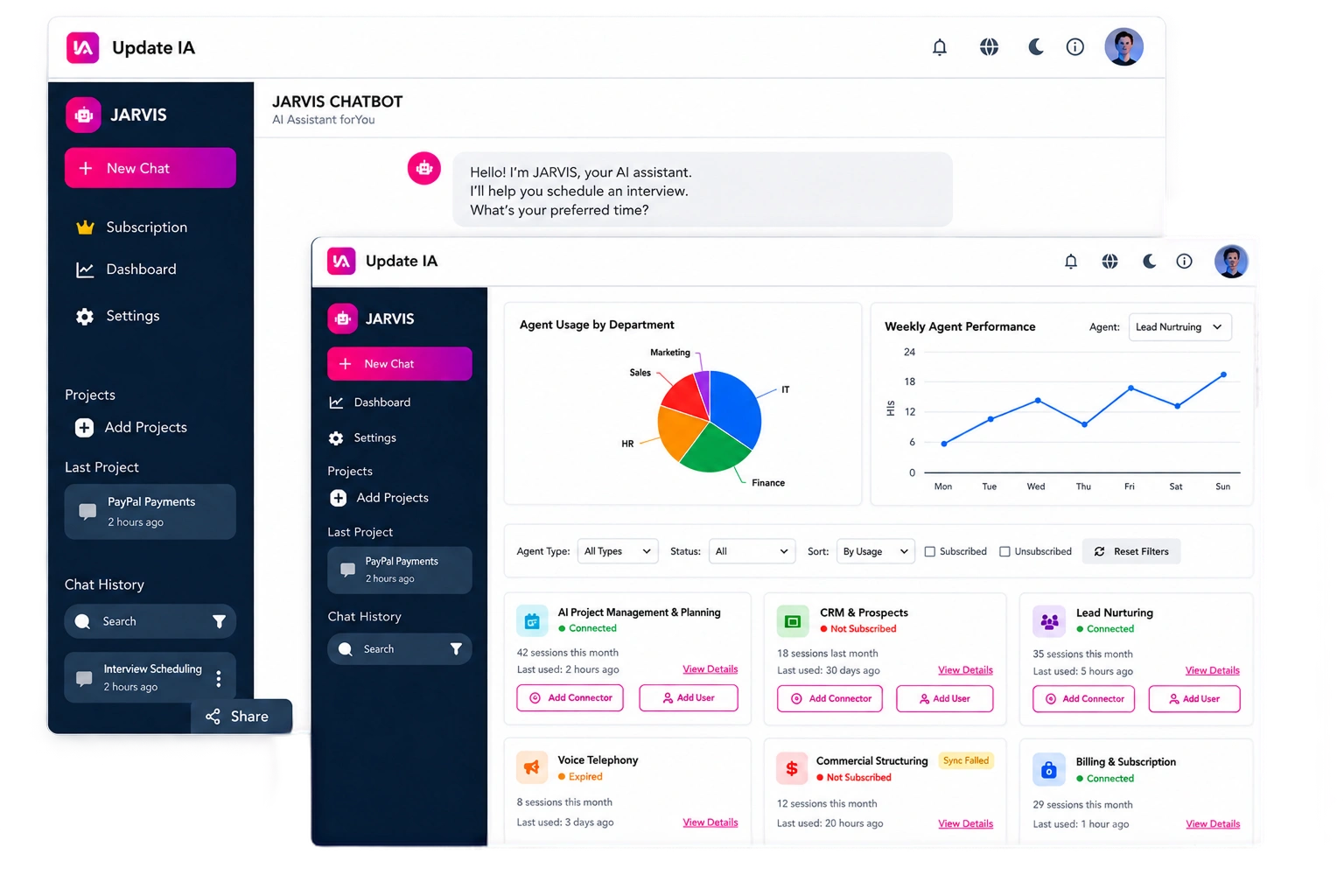
UpdateIA needed repetitive, multi-step work taken off its teams without losing control over execution. SoluLab scoped the workflows worth automating, then designed and deployed a coordinated system of autonomous AI agents with people reviewing outcomes instead of doing each step.
As an AI product development company, SoluLab gives enterprise product and technology leaders one team for AI strategy, compliance, integration, engineering, and MLOps, with published price ranges and a fixed-price MVP scope in 48 hours. Our AI products run in production for fintech, banking, and enterprise clients, and we're rated 4.9 on Clutch from 55 reviews.
We test accuracy, latency and cost on your data first, so you never fund an MVP the data can't support.
One Wallet's copilot cut ticket load by 72%; Amanbank's onboarding is 60% faster.

Product strategists, AI UX designers, ML engineers and DevOps work together, so nothing gets lost between agencies.
We use AI tools to move faster and pair them with code review and automated tests to keep bug rates down.

We model cost per request during the proof of concept, so your AI feature makes money at scale.
.svg)
NDA plus an MSA assigning IP from the first commit, including models, prompts and evaluation sets.

"Chintan spent about a decade at Goldman Sachs as a Vice President before co-founding SoluLab, where he leads AI and blockchain product programs for startups and enterprises. He reviews every AI product scope for feasibility, unit economics, and time to market before it reaches a client."
SoluLab helped us bring AI directly into the banking experience. From customer onboarding and account assistance to money transfers and card requests, the AI chatbot and voice agents gave customers a much faster way to complete everyday banking tasks. The solution helped us reduce onboarding time while taking significant pressure off our support teams.

SoluLab successfully delivered the AI automation system we needed for our FinTech platform. Their team understood how to translate complex business workflows into practical AI agents and worked closely with us throughout development. The result was a much more streamlined approach to automating tasks that previously required significant manual effort.

SoluLab brought together document intelligence, predictive analytics, and a practical decision workflow. The solution gave our team a structured way to evaluate engine condition, value, and purchase risk.

With SoluLab, an AI proof of concept typically costs $15,000 to $50,000, an AI MVP $25,000 to $50,000, a mid-complexity AI product $50,000 to $150,000, and an enterprise AI platform $150,000 to $500,000 or more. Budget separately for running costs, since model API or GPU spend grows with usage. You get a fixed-price MVP estimate within 48 hours.
Most AI products take 3 to 6 months from discovery to MVP launch: 2 to 4 weeks of discovery, 4 to 8 weeks for a proof of concept on real data, and 8 to 16 weeks to build the MVP. Enterprise AI platforms usually take 6 to 12 months, depending on integrations, data quality, and compliance.
We design compliance in from the first sprint: PII masking before any prompt reaches a model, role-based access to AI features, audit logging of every response and retrieval source, and red-team testing before each release. We build to GDPR, CCPA, HIPAA, and SOC 2 requirements where they apply. We provide engineering controls, not legal advice.
Yes. We integrate AI into existing SaaS, mobile, and enterprise systems through APIs, connectors, and microservices, including CRMs, ERPs, data warehouses, and document stores, without rewriting the platform. The AI layer respects your existing access permissions. Projects typically start from $25,000 and begin with a short assessment of your architecture and data.
Yes. After launch we monitor model quality, latency, and cost per request, run evaluation pipelines, and retrain or upgrade models as data and usage change. AI products drift as real-world data shifts, so we set up monitoring and cost controls before go-live instead of treating launch as the finish line.
AI consulting helps you decide which AI features are worth building, whether your data can support them, and which models and architecture fit your budget. It turns a vague idea into a prioritized, cost plan, which prevents expensive rebuilds later. SoluLab\'s AI consulting feeds directly into product discovery.
AI products behave probabilistically, so the process adds a data feasibility proof of concept, evaluation sets alongside unit tests, design for confidence levels and error correction, per-request cost modeling, and post-launch drift monitoring. Traditional products mainly need to prove market demand; AI products must also prove the data and model can deliver reliably.
Use AI in three places. In discovery, summarize interviews and market research. In design and specs, generate user stories, test cases and prototype variations. In engineering, use coding assistants with code review and automated testing. Then consider adding AI features to the product itself, where the bigger revenue gains usually sit.
A proof of concept tests the core AI capability on your real data before anything else is built, measuring accuracy, latency, and cost per request against a bar you set upfront. It typically runs 4 to 8 weeks. If the numbers don\'t clear the bar, you\'ve spent weeks, not quarters, finding out.
You need data that is accessible, reasonably clean, and relevant to the task, such as documents, tickets, transactions, or records, plus clarity on who owns it and who may see it. Labeling and volume needs depend on the approach. Our discovery phase checks data readiness and flags gaps before any build budget is committed.
Ask for AI products running in production with published metrics, a fixed-price proof of concept before the full build, named people on your team, a clear IP assignment, and a plan for running costs and MLOps after launch. Firms that can\'t show live AI products or won\'t price the first stage are a risk.