Key Takeaways
- AI readiness assessment helps mid-market enterprises understand whether their data, systems, teams, workflows, and governance can support AI adoption.
- Choosing an AI readiness assessment framework enterprises can shortlist high-value AI use cases and save money they might spend on fragmented AI tools.
- Investing in an AI readiness strategy can help analyse the risk, improve adoption, and deliver measurable ROI.
- SoluLab helps companies move from assessment to execution through AI consulting services, strategy, development, integration, automation, and implementation support.
An enterprise AI pilot can look successful and still fail the business, and this is a major rationale behind AI development services. Managing complex operations could be a cumbersome task, but a structured AI readiness assessment can help businesses to evaluate their goals, data technology, and governance requirements. It helps the mid-market enterprises to figure out a practical way of execution under a controlled risk environment by bringing clarity into business processes, which creates measurable ROI outcomes.
In this guide, explore how to create an AI transformation roadmap using a practical 6-step framework.
What Is an AI Readiness Assessment?
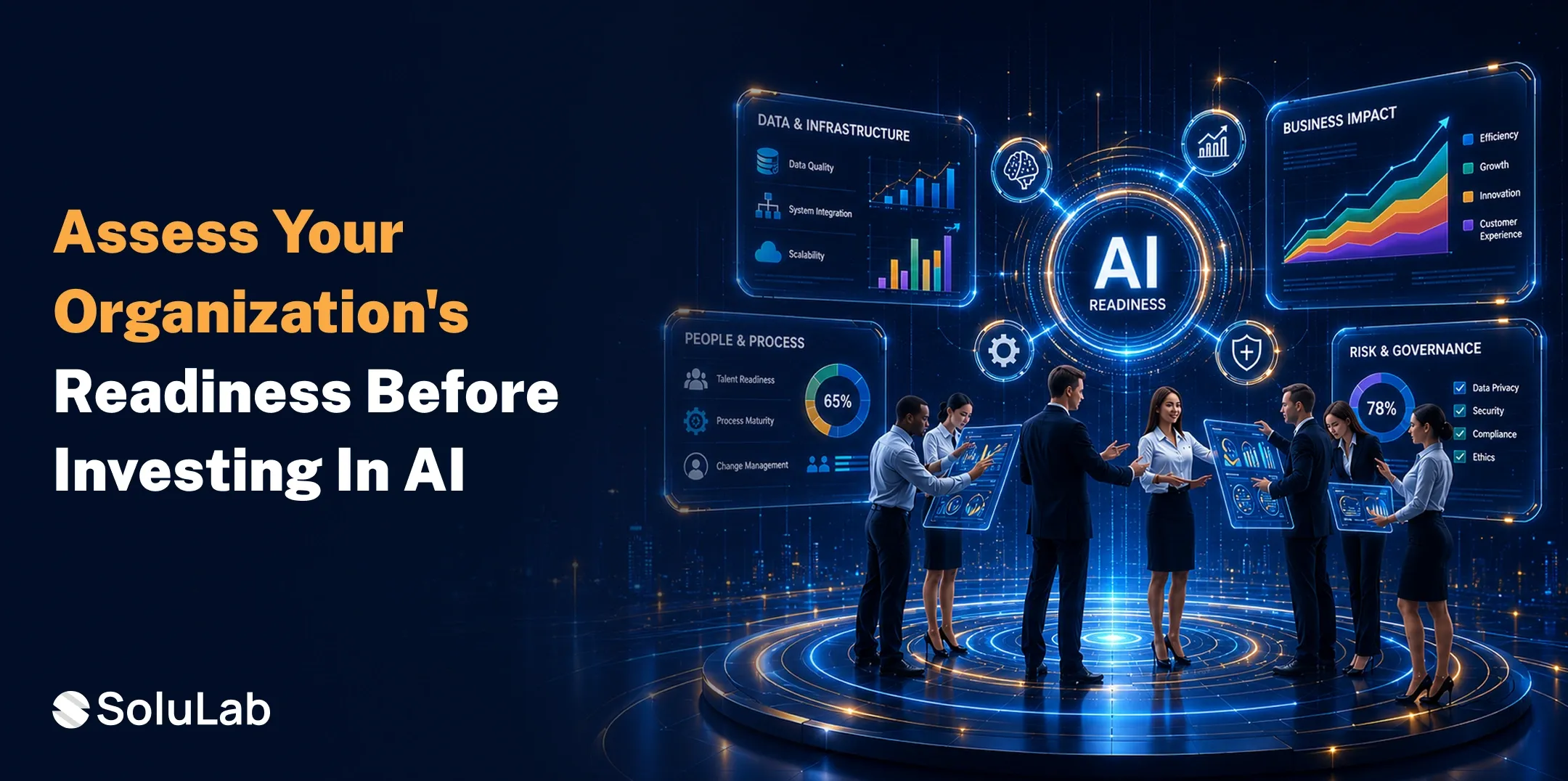
An AI readiness assessment is a structured evaluation of how prepared a business is to adopt AI across its operations, systems, people, and decision-making processes.
With AI Readiness Consulting, mid-market leaders can see the real condition of their business before they commit budget to AI development. The process involves assessing goals, team readiness, security needs, governance controls, and expected ROI. It also analyzes whether the enterprise has chosen the appropriate first AI use case for execution.
With an AI readiness assessment, businesses can incorporate Artificial Intelligence into their processes as a planned capability tied to a clear commercial outcome.
Let’s understand with an example: A logistics company looking forward to AI-powered route optimization can unlock accurate delivery records, vehicle data, order history, customer locations, and system connectivity with an AI readiness assessment, even with fragmented data.
Why Mid-Market Enterprises Need an AI Readiness Assessment Framework?
Mid-market companies often operate with the complexity of larger enterprises. While they require artificial intelligence to improve speed, cost control, customer experience, and productivity, at the same time, they cannot afford long experiments that fail quietly.
An AI readiness assessment framework helps these companies make sharper decisions. It shows which ideas deserve investment, which systems need integration, which data gaps must close first, and which workflows can support automation.
A readiness framework prevents data gaps, unstructured and isolated AI products, quality issues, and unapproved AI tools for businesses.
How Do You Assess AI Readiness: Easy Step-By-Step Process
The question “How do you assess AI readiness?” matters because AI readiness is the connection between strategy, data, systems, workflows, people, and governance.
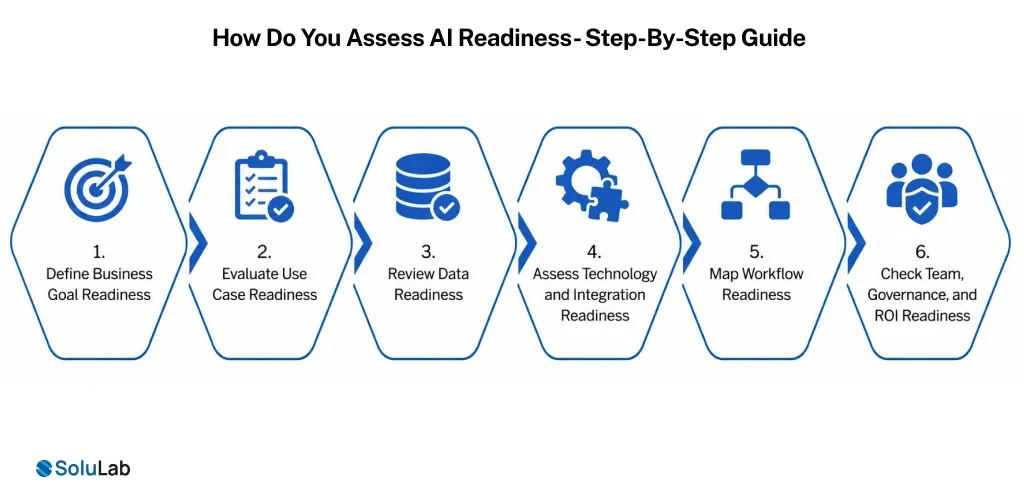
A business should assess AI readiness by reviewing six core areas of business. This will help the company focus on business value before technical design.
The company should know what it wants AI to improve. It should check whether relevant data exists and review how current systems work together. Building an AI implementation roadmap during this stage gives the business a practical AI readiness strategy rather than a loose AI wish list.
1. Define Business Goal Readiness
Start by defining the business goal readiness. The best first AI projects usually have three qualities:
- They solve a visible problem.
- They use accessible data.
- They create a result that leadership can measure.
Here, the AI strategy consulting can help the companies connect business pain points to practical AI opportunities. The team reviews cost drivers, workflow delays, data availability, and expected ROI before recommending where AI should begin.
2. Evaluate Use Case Readiness
Use case readiness helps leaders compare AI opportunities before they choose the first project.
A strong assessment looks at business impact, data availability, workflow fit, integration needs, adoption potential, risk level, expected ROI, and time to value.
Reviewing the use cases of AI across departments helps. Finance, sales, HR, operations, customer service, legal, and supply chain teams may all have AI opportunities, but the first project should match business priority and readiness.
An AI readiness assessment can help mid-market companies rank use cases by value and feasibility. This prevents random AI adoption and keeps investment tied to measurable business results.
3. Review Data Readiness
Many mid-market enterprises already hold valuable data. Volume is there, but issues often come from data quality, ownership, structure, and access.
A strong AI readiness assessment checks where data lives, who owns it, how clean it looks, how often teams update it, and whether systems can share it securely.
This step also identifies which data matters for the selected use case. With AI integration services, businesses can connect scattered systems and prepare usable data pipelines. This step gives AI applications the right foundation instead of forcing them to work with incomplete or unreliable inputs. Better data readiness leads to better AI decisions.
4. Assess Technology and Integration Readiness
AI must fit the tools employees already use. If an AI system sits outside the daily workflow, employees may avoid it. They may return to spreadsheets, manual notes, or old processes because those tools feel easier.
Technology readiness checks whether current systems can support AI adoption. This includes CRM platforms, ERP systems, finance software, HR tools, ticketing platforms, cloud infrastructure, APIs, data warehouses, dashboards, security tools, and reporting systems.
This review helps the business decide whether AI can connect with existing platforms or whether it needs custom development.
With AI development companies, businesses can build AI solutions that fit real business environments. Choosing the right partner is crucial as AI should support the company’s operating model, not force the company to rebuild every process around a disconnected tool.
5. Map Workflow Readiness
Workflow readiness reviews the daily steps employees follow and identifies where AI can remove friction. It looks for repetitive tasks, approval delays, manual data entry, recurring errors, handoff issues, and time-consuming decisions.
This step helps the business decide what AI should automate, what AI should assist, and what should still require human judgment. AI workflow automation services help companies turn slow, rule-heavy processes into faster AI-assisted workflows.
Good AI adoption does not replace business judgment. It gives teams better speed, accuracy, and visibility where manual processes limit growth.
6. Check Team, Governance, and ROI Readiness
AI adoption needs people who trust the system, leaders who support the change, and governance rules that protect the business.
- Team readiness reviews leadership alignment, department ownership, employee awareness, training needs, process documentation, and possible resistance.
- Governance readiness reviews data privacy, access controls, human approval checkpoints, AI usage policies, audit trails, output review, security requirements, vendor risk, compliance duties, and model monitoring.
- ROI readiness defines how the company will measure value. The metric may include cost savings, faster processing time, better conversion, improved forecast accuracy, lower risk, higher productivity, or stronger customer experience.
This part of the AI readiness assessment framework keeps AI grounded in business accountability. It prevents vague success claims and helps leadership track whether AI produces the expected outcome. AI implementation services can support this stage by helping companies deploy, test, monitor, optimize, and improve AI systems after development.
How Can Businesses Prepare for AI Adoption?
Businesses should prepare their foundations before they prepare the technology. AI adoption works best when leaders know the business problem, data condition, workflow impact, team role, and success metric.
1. Define a Clear AI Readiness Strategy
Before choosing tools, leadership should define the business outcome, owner, budget, timeline, and success metric. A clear AI native strategy keeps AI adoption focused on value, not assumptions.
2. Choose Practical Use Cases of AI
The business should select use cases of AI that solve real problems, such as slow reporting, poor lead scoring, delayed support, invoice errors, or repetitive manual work.
3. Review Data Through an AI Readiness Assessment
An AI readiness assessment helps the company check whether its data is accurate, accessible, complete, secure, and useful enough to support the selected AI use case.
4. Connect Systems With AI Integration Services
Strong AI integration services help the business connect CRMs, ERPs, dashboards, finance tools, and support platforms so AI works inside existing workflows, not outside them.
5. Train Teams Before AI Implementation Services Begin
Before using AI implementation services, the company should train teams, assign process owners, set governance rules, and explain how AI will improve daily work.
Read more – AI Proof of Concept Development
What Are the Stages of AI Readiness?
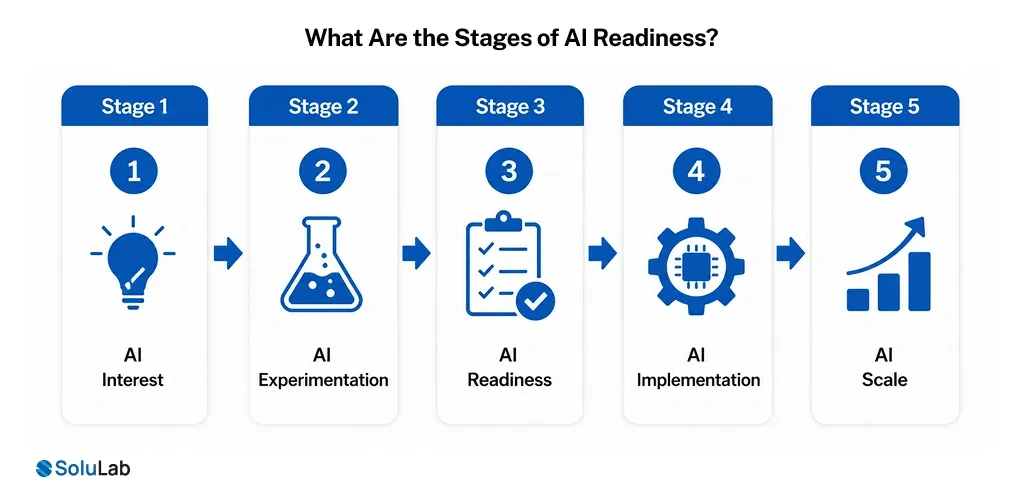
An AI maturity assessment usually places a company into one of five stages.
Stage 1: AI Interest
The company understands AI’s potential, but it has no formal plan. Leaders may follow competitors, attend industry events, or explore AI tools. At this stage, the business needs education, goal setting, and early use case discovery.
Stage 2: AI Experimentation
Different teams test AI tools on their own. Marketing may use writing tools, support may test chatbots, and operations may explore automation. At this stage, leadership needs structure, ownership, and a clear review of data readiness.
Stage 3: AI Readiness
The company starts building a formal roadmap. Leadership reviews goals, use cases, data, systems, workflows, governance, and ROI together. Here, an AI readiness assessment framework creates the strongest value.
Stage 4: AI Implementation
The company starts building and deploying AI solutions. These may include AI assistants, automation systems, predictive models, intelligent search tools, or custom AI applications. Strong implementation planning reduces delays and adoption risk.
Stage 5: AI Scale
The company expands successful AI use cases across departments. Governance improves, reusable components emerge, and teams start using AI inside daily operations. At this stage, leadership focuses on performance, adoption, cost control, and optimization.
Where an AI Readiness Calculator Fits In?
An AI readiness calculator gives leaders a quick starting point, but it should guide decisions, not replace expert review. SoluLab uses it to frame deeper AI readiness consulting conversations clearly.
| Readiness Area | What the AI Readiness Calculator Checks? | Why It Matters for Mid-Market Enterprises? |
|---|---|---|
| AI Readiness Strategy | It checks whether leadership has clear goals, priority use cases, budget direction, and measurable outcomes before moving into AI planning. | This helps the business avoid random AI experiments and focus on problems that can improve cost, speed, revenue, or customer experience. |
| Data Readiness | It reviews whether the company has clean, accessible, secure, and relevant data for the selected AI use case. | Strong data helps AI systems produce better results. Weak data can create poor recommendations, low trust, and expensive rework later. |
| System Readiness | It checks whether CRMs, ERPs, finance tools, support platforms, and dashboards can connect with future AI solutions. | This shows whether the business needs AI integration services before development starts, especially when important data sits across disconnected platforms. |
| Team Readiness | It reviews whether employees understand AI’s role, trust the planned workflow, and know how their daily responsibilities may change. | AI adoption works better when teams know why the change matters and how it will reduce effort instead of adding confusion. |
| Governance Readiness | It checks whether the company has rules for privacy, access control, human review, compliance, security, and AI output monitoring. | Governance protects the business from avoidable risk and helps leadership use AI with more confidence across sensitive workflows. |
| Implementation Readiness | It reviews whether the company has a practical roadmap, owners, timelines, success metrics, and support for deployment. | This helps SoluLab turn calculator insights into a clear plan through AI implementation services and structured execution. |
How AI Readiness Improves ROI?
AI readiness assessment improves ROI by helping mid-market enterprises spend on the right use cases, reduce rework, improve adoption, and track business value clearly.
- Lower Development Cost: An AI readiness assessment framework finds gaps early, so businesses do not need to repsend in rebuilt.
- Faster Time to Value: With an AI readiness strategy, teams can shortlist the practical use cases that match current business priorities.
- Better Use Case ROI: Readiness ranks AI opportunities by impact, feasibility, risk, and return. This helps to generate the measurable business outcomes.
- Higher Team Adoption: AI readiness can help employees trust the system and use it consistently.
- Cleaner AI Output: Strong data readiness improves accuracy, reduces errors, and shares recommendations across business functions.
- Clearer Performance Tracking: Readiness can define ROI metrics for higher accuracy and improved productivity.
When Should a Business Bring in an AI Readiness Consulting Partner?
A mid-market enterprise should bring in an AI readiness consulting partner when leadership wants AI but lacks clarity on use cases, data readiness, system integration, governance, cost, or expected ROI.
The right AI consulting partner helps the company assess current maturity, identify practical opportunities, prioritize use cases, define the roadmap, plan integrations, set governance controls, and support adoption.
The partner must connect consulting, strategy, development, integration, automation, and implementation under one process. This gives mid-market enterprises a clearer path from assessment to production.
Build AI Readiness Before Building AI
AI can help mid-market enterprises reduce costs, improve productivity, accelerate decisions, and improve customer experience. It creates this value only when the business prepares for it.
An AI readiness assessment framework gives leadership a clear view before development starts. It identifies the right use cases, data gaps, system needs, workflow opportunities, team requirements, governance controls, and ROI metrics. Define an AI readiness strategy, and build scalable AI-powered solutions designed for measurable ROI and long-term growth.

Build an AI Readiness Framework With SoluLab Before You Invest in AI
At SoluLab, we help mid-market enterprises move from AI interest to AI execution with clarity. Our team assesses business goals, data readiness, workflows, systems, governance needs, and ROI potential before development begins. Through our AI development services in USA, we help businesses choose the right AI use cases and build solutions that fit real operations. We do not push AI for the sake of adoption. We help companies build practical, scalable, and measurable AI solutions that support growth with confidence.
FAQs
Shipra Garg is a tech-focused content strategist and copywriter specializing in Web3, blockchain, and artificial intelligence. She has worked with startups and enterprise teams to craft high-conversion content that bridges deep tech with business impact. Her work translates complex innovations into clear, credible, and engaging narratives that drive growth and build trust in emerging tech markets.