Key Takeaways
- What it is
AI-powered data extraction uses OCR, NLP, and large language models inside AI-Powered Intelligent Document Processing pipelines to read, understand, and structure data from messy sources like PDFs, scans, and emails. - Real-world ROI
In the wild, well-implemented AI data extraction solutions routinely chop processing times by 50 – 80%, reduce manual effort 30 – 50%, and push accuracy for key fields up into the 95 – 99% range. That’s not theoretical; that’s how ops teams get their evenings back. - Competitive edge
Enterprises using AI-powered data extraction for enterprises are already winning on turnaround time, customer experience, and audit readiness. The gap isn’t just “AI vs non-AI” anymore. It’s “deeply embedded AI vs manual patchwork.” - Where it shines
- Finance: KYC, loan packs, trade finance, regulatory reports.
- Healthcare: claims, clinical documentation, lab reports, referrals.
- Legal: contracts, case bundles, due diligence, compliance docs.
- Why SoluLab: SoluLab works as an AI-native software development company, not a generic dev shop. The team builds end-to-end AI data extraction and AI document processing platforms that are designed for regulated environments from day one: secure, auditable, and tuned around real business metrics, not demo wow-factor.
If you’re still handling documents in 2026 the way you did a decade ago, you’re probably feeling it already. Volumes are through the roof, regulations have only got tougher, and yet your teams are still copying data out of PDFs and scans into old systems while the “AI-first” players quietly sprint ahead.
In the last couple of years, AI-powered solutions for data extraction and intelligent document processing have quietly shifted from “innovation pilot” to “plumbing.” Not glamorous. Absolutely critical. Especially if you work in finance, healthcare, or legal, where every typo can become a compliance issue.
What I keep seeing in banks, hospital groups, and legal teams is the same pattern: you either learn how AI document processing fits into your stack, or you watch competitors onboard customers, process claims, and review contracts at speeds your current ops just can’t match.
Why AI-Powered Data Extraction is Suddenly Everywhere?
Let’s be blunt. Finance, healthcare, and legal have never suffered from a lack of data. Your problem has always been too much of the wrong kind of data.
A typical day looks like:
- Loan files with 25 supporting documents, all slightly different.
- Insurance claims with attachments coming in from portals, email, and scanners.
- Contracts, addendums, emails, and policy updates scattered across folders and systems.
Meanwhile:
- Regulators are tightening reporting timelines and detail.
- Customers and patients expect near-instant responses.
- Leadership wants cost control and “more automation” without quality dropping.
You already know how this plays out without artificial intelligence: more people, more manual checks, more spreadsheets, and still a nagging feeling that something will slip through.
This is exactly why AI-powered data extraction has jumped from pilot slides into production. It doesn’t make your documents disappear. It just makes them usable.
What Exactly Is AI-Powered Data Extraction?
Forget the buzzwords for a second.
Traditional tools gave you OCR that could read text from an image. That’s it. They didn’t know the difference between a birthdate, a maturity date, or a random number in a footer. The moment a template changed, half your rules broke.
AI data extraction and AI-powered document extraction turn that on its head. Now you have systems that:
- Read the document.
- Understand which kind of document it is.
- Pick out the bits that matter.
- Check whether those bits make sense.
Underneath, you’ve got AI-Powered Intelligent Document Processing, which is really just a fancy way of saying:
- OCR + layout detection for “what’s where.”
- NLP and LLMs for “what does this mean.”
- Machine learning for “how do these patterns usually look.”
- Rules and validations for “does this pass our checks.”
You’re not aiming for perfection on day one. You’re aiming for “good enough that humans now handle edge cases, not everything.”
How AI Handles Actual Unstructured Documents (Not Just Pretty Samples)
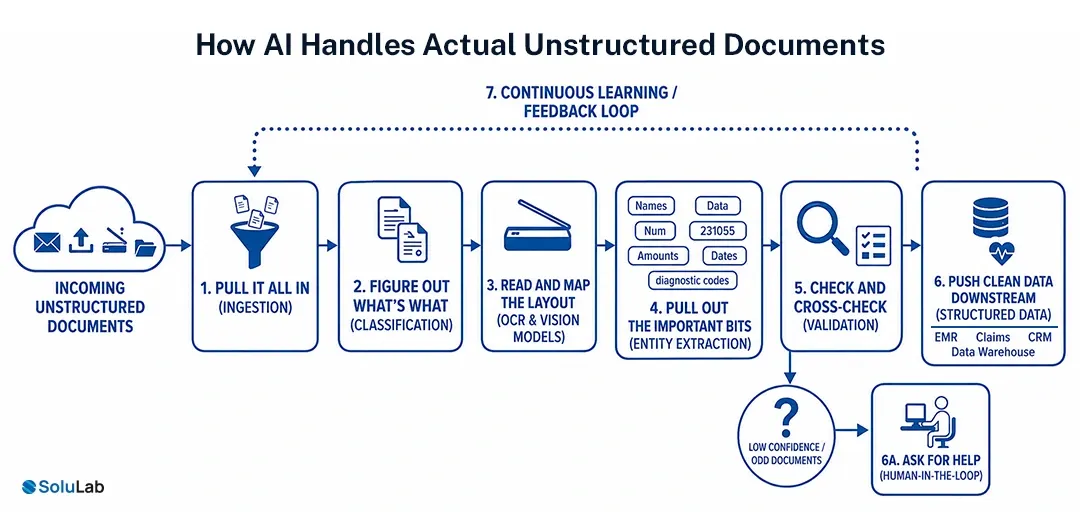
In theory, everything sounds neat. In reality, your inbox is a mess. Here’s what a good AI document processing pipeline does with that mess.
- Pull it all in
Documents arrive from email, uploads, scanners, old shared folders. The system doesn’t care; it just ingests. - Figure out what’s what
A claim vs a contract vs a KYC pack vs a pathology report. Classification sounds simple until you see how many “almost similar” templates you actually have. - Read and map the layout
Modern OCR and vision models don’t just spit out text. They understand tables, sections, headers, and footers, even in slightly crooked scans. - Pull out the important bits
Names, addresses, amounts, dates, policy numbers, diagnostic codes, clause types. This is where AI for unstructured data really earns its keep. - Check and cross-check
Rules and models validate against patterns and, when possible, cross-reference other systems. Does the date make sense? Does the amount match what we expect? Does the contract reference the right entity? - Push clean data downstream
Once the system is confident enough, it pushes structured data into core banking, EMR, claims, CRM, or your data warehouse. - Ask for help when unsure
Low-confidence fields or odd documents get routed to humans. Their corrections aren’t wasted; they feed back into the model over time.
A real-world example: one European bank I heard about had three teams keying variations of the same customer data into different systems. After rolling out AI-powered data extraction on their onboarding packs, they didn’t magically eliminate all errors but they did eliminate three parallel streams of copy-paste work. That’s the kind of “boring win” you’re aiming for.

A Simple View of the Architecture
You can easily explain this to a non-technical stakeholder as:
- We pull documents in.
- The system figures out what they are and reads them.
- It pulls out the key data, checks it, and stores it cleanly.
- Our systems and people then use that data for decisions and reporting.
That’s it. Everything else is an implementation detail.
Finance: Where AI Data Extraction Pays for Itself Fast
Finance is usually the first arena where AI data extraction solutions get a hard ROI calculation.
You’re staring at:
- KYC and AML documentation.
- Loan and mortgage files with full supporting packs.
- Trade finance stacks.
- End-of-quarter and end-of-year regulatory reporting.
A couple of practical spots where AI in financial data extraction and AI for banking document processing actually change the game:
- Onboarding & KYC
Instead of a team retyping IDs and utility bills, the system reads them, extracts fields, flags mismatches, and only pushes edge cases to humans. - Loan underwriting
Income, liabilities, and collateral info get pulled into a structured view, so underwriters stop wasting time hunting through PDFs just to assemble a basic picture. - Reg reporting
When regulators ask for a new breakdown, you don’t start from zero. You’re tapping into a structured layer built off your documents.
Banks that do this well quietly:
- Cut per-file processing times.
- Reduce FTE load on manual tasks.
- Drop the number of “we missed that field” moments in audits.
It’s not glamorous, but it is the kind of improvement CFOs and COOs remember.
Healthcare: Turning Clinical and Claims Paperwork Into Usable Data
Healthcare has its own flavor of chaos: clinical notes, lab results, imaging reports, handwritten referrals, plus all the insurance forms on top.
If you’ve ever watched a clinician double-chart the same information in two systems, you know exactly how much waste is baked into the current model.
With AI in healthcare data extraction and AI medical data processing, you can:
- Extract structured fields from lab reports, discharge summaries, and referrals.
- Automate large parts of claims validation and pre-authorizations.
- Enrich patient records without forcing staff to retype everything.
A hospital network in the US, for example, might start by auto-extracting key lab values and diagnosis codes from incoming PDFs into its EHR and analytics platforms. Claims teams then work off cleaner, more complete data instead of juggling three windows at once.
The benefits stack up as:
- Faster claims decision-making.
- Better data for outcome tracking and population health.
- Clinicians and admins spend less time as typists.
Is it perfect? No. Does it move you away from “copy/paste + hope for the best”? Absolutely.
Legal: From Wall of Text to Structured Insight
Legal and compliance teams drown in text: contracts, case files, regulatory updates, policies, and email trails.
Historically, the answer has been “throw more lawyers and paralegals at it.” You probably don’t need me to tell you why that doesn’t scale.
With AI-powered legal document processing and AI in legal document analysis, you can:
- Pull out clauses and key terms across contract portfolios.
- Tag risky language and non-standard terms.
- Summarize giant case bundles into navigable briefs.
- Pre-structure documents for e-discovery.
The point is not to replace legal judgment. It’s to make it easier to find the needle in the haystack, so lawyers can focus on the parts that actually require a brain.
For firms and in-house teams, that usually translates into:
- More work is handled per lawyer.
- Faster turnaround on reviews.
- Less “we missed that clause on page 42” in high-pressure deals.
Benefits of AI in Document Processing (In Plain Language)
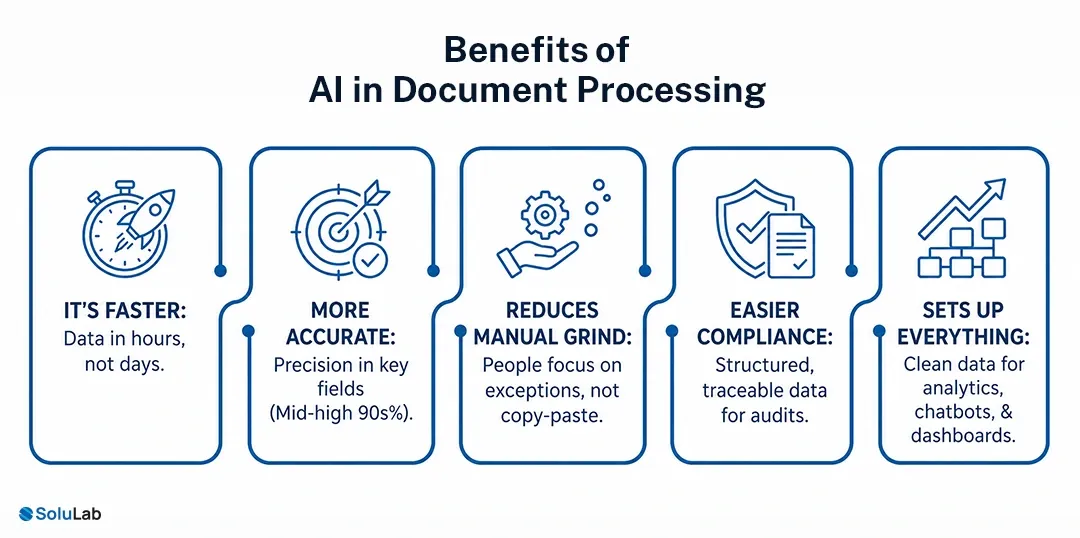
If someone on your leadership team asks “What do we actually get from intelligent document processing?”, here’s how I’d answer.
- It’s faster
You stop waiting days for someone to key in data and start talking about hours or minutes in the processes you target. - It’s more accurate where it counts
For the well-defined fields you care about, you can push accuracy into the mid-to-high 90s and track exactly where the system is unsure. - It reduces manual grind
People who were doing pure copy-paste aren’t suddenly unemployed; they’re moved to dealing with exceptions, escalations, and customers. - It makes compliance less of a fire drill
Because you have structured, traceable data, responding to audits and regulatory questions becomes a lot less painful. - It sets up everything else
Analytics, AI chatbots, better dashboards all depend on good underlying data. AI-powered data extraction is how you stop feeding garbage into those layers.
You’re not buying “AI.” You’re buying back time, reducing errors, and creating a cleaner foundation for everything else you want to do.
The Stack Underneath AI Data Extraction Solutions
You don’t have to love the plumbing, but you should know roughly what’s under the floorboards.
Most AI data extraction solutions will involve:
- OCR and layout detection that can cope with real-world scans.
- NLP models and LLMs tuned to your industry’s language.
- Classifiers that know a claim from a contract from a KYC pack.
- Rule engines that layer your business logic and compliance on top.
- APIs and connectors into your core systems and data platforms.
That whole assembly is what people market as AI-Powered Intelligent Document Processing. Underneath the label, it’s just a smart pipeline.
How to Actually Start (Without Creating a Monster Project)
Here’s where most organizations get stuck: they try to boil the ocean.
My advice is much simpler.
- Pick one process that really hurts
KYC, claims, or contracts are usually good candidates. High volume plus clear pain plus clear benefit. - List the key document types and fields
Don’t aim for every possible field. Focus on the ones that drive decisions and reporting. - Decide whether you want generic or tailored
Off-the-shelf tools are fine for simple use cases. For regulated industries where compliance and integration are gnarly, working with an AI software development company to build something tailored often ends up cleaner. - Design a simple human review loop
Don’t trust the system blindly on day one. Give your team a way to correct it and make sure those corrections go back into improving the models. - Measure before and after
Track time per case, error rates, and FTE effort. Without that, you’re guessing on ROI.
If you keep the first project tight, you’ll have an easier time convincing people to expand it later.
Why the Partner Choice Matters (And Where SoluLab Fits)
You could try to stitch this all together yourself. Some organizations do. Most end up with a fragile system that only one internal team understands.
A better pattern is to work with an AI app development company that:
- Knows AI and ML beyond buzzwords.
- Understands your industry’s data and regulatory quirks.
- Has actually delivered AI document processing projects into production.
This is where SoluLab plays.
As an AI-led development company, SoluLab doesn’t treat AI as a sidecar. The team designs architectures where AI, security, and integrations are all first-class concerns, not “we’ll patch it later” items.nick0blog.
That means, in practice:
- You get an AI-powered data extraction stack that can stand up to an audit.
- It plays nicely with your existing systems.
- And it’s built with a roadmap in mind, not just a proof of concept.
The Risks You Should Still Respect
Let me be very clear: this isn’t risk-free.
- If you ignore privacy and security, you’re asking for trouble.
- If you assume the model is always right, you’ll get burned on edge cases.
- If you skip change management, your teams will quietly route around the new system.
But with clear scope, good governance, and an experienced partner, these risks are manageable. The bigger risk, in my view, is pretending the current manual status quo is sustainable for another five years.
The Direction of Travel: 2026–2027
Looking a year or two ahead, a few things seem almost inevitable:
- Agent-style document flows where LLMs coordinate multiple steps instead of rigid pipelines.
- Near-real-time extraction instead of overnight batches for high-value processes.
- Stronger regulator guidance in the US and Europe, which will actually make it easier for well-architected solutions and harder for duct-taped ones.
In other words, AI-powered data extraction will stop being “the new thing” and just become how regulated organizations handle documents.
Conclusion
If you strip away all the AI branding, AI-powered data extraction is about one simple idea: your documents should feed your business, not choke it.
In finance, healthcare, and legal, the volume and stakes around documents are only going one way. Manual data entry and patchy automation just don’t keep up anymore.
You don’t have to transform everything at once. You do, however, have to start. Pick the process that hurts the most, define what “better” looks like, and bring in an AI-native partner who knows how to ship, not just present slides.
If you want that partner to be someone who lives at the intersection of AI, software engineering, and regulated industries, SoluLab is set up for exactly that kind of work. The tech is ready. The question is whether your team is ready to stop treating documents as a necessary evil and start treating them as an asset you can actually use.
FAQs
Shipra Garg is a tech-focused content strategist and copywriter specializing in Web3, blockchain, and artificial intelligence. She has worked with startups and enterprise teams to craft high-conversion content that bridges deep tech with business impact. Her work translates complex innovations into clear, credible, and engaging narratives that drive growth and build trust in emerging tech markets.