AI for IT Operations: Benefits, Use Cases, and Best Practices
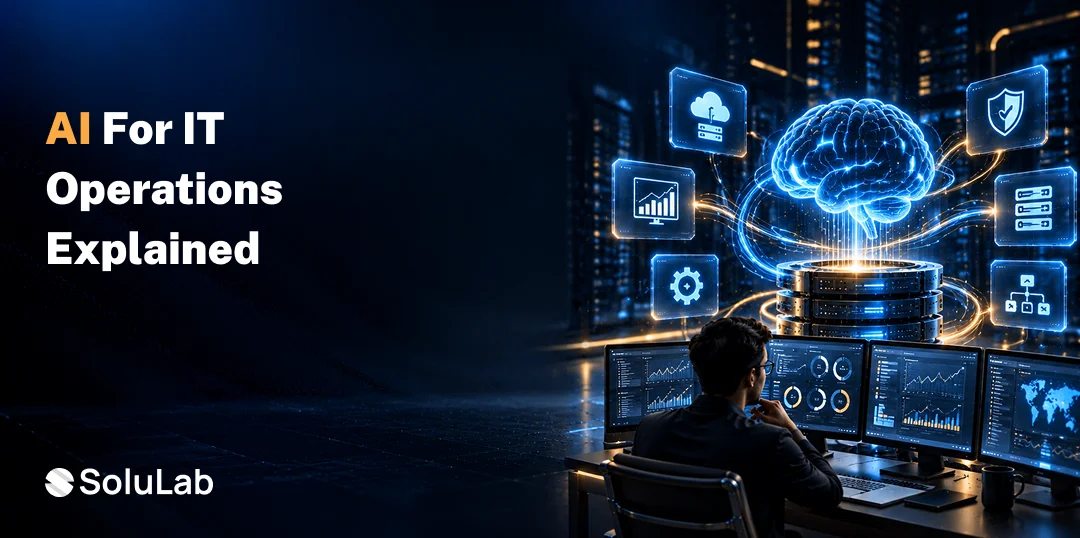
Understand how AI for IT operations helps businesses automate tasks, detect issues early, optimize performance, and improve IT service management.
AI MVP development services turn an AI product idea into a working minimum viable product built around one high-value use case, so you can test technical feasibility, user demand, and business value with real users before funding a full build. SoluLab scopes, builds, and launches AI MVPs for startups, SMBs, and enterprise teams.
SoluLab provides end-to-end AI MVP development services for businesses launching a new AI-powered MVP solution, testing a workflow automation idea, or adding an AI layer to an existing platform. We combine product strategy, AI engineering, design thinking, and agile delivery to help you go from concept to usable MVP with a clear execution plan.
SoluLab helps you take that step with a delivery model built around speed, product clarity, and execution discipline. Our team works with startups and enterprise teams to shape the right AI use case, build a usable MVP, and create a practical roadmap for what comes next.

SoluLab provides end-to-end AI MVP development services for businesses that want to launch a new AI product, test a workflow automation concept, or add an AI layer to an existing platform. We combine product strategy, AI engineering, design thinking, and agile delivery to help you go from concept to usable MVP with a clear execution plan.
We begin with strategic AI consulting to identify the use case worth building first. This includes defining the business problem, expected outcomes, user journeys, success metrics, and the level of AI complexity required to develop a meaningful MVP that aligns with your business goals.

Before AI development starts, we map how the AI experience should work for users and how the supporting system should be structured. This helps ensure the MVP is useful, testable, and built on an architecture that can evolve after validation.
We build AI-powered MVPs using the right approach for each use case, whether it's AI app development, AI agent development, conversational interfaces, retrieval-augmented systems, intelligent copilots, workflow assistants, or autonomous task-driven agents.
If you already have a platform, SaaS product, or internal system, SoluLab can implement custom AI integration solutions that enhance how users search, automate, and interact with data. We help validate real-world AI value without the cost and complexity of rebuilding.
The first MVP release is only the beginning. After launch, our AI MVP development team helps you measure performance, validate user adoption, identify improvement opportunities, and define a roadmap for scaling your AI MVP into a market-ready product or enterprise-grade platform.
Launch a scalable AI MVP in weeks with SoluLab's AI MVP development services and turn your concept into a market-ready product.
Get a Free AI MVP ConsultationWe build AI-driven MVP solutions around specific business outcomes, not vague innovation goals. Whether you're launching an AI-first product or testing one capability inside an existing one, we help you pick the use case that proves value fastest.
Help employees complete recurring tasks faster with AI assistants built for research, analysis, documentation, reporting, or decision support. These MVPs are useful when teams lose time to repetitive knowledge work.
Launch AI-powered support experiences that answer common questions, guide users, and reduce operational load while improving response speed. This is often a strong first use case for companies looking to introduce AI into customer-facing workflows.
Turn large volumes of contracts, reports, forms, or internal files into searchable, summarizable, and action-ready workflows. These MVPs are especially useful when teams need faster access to information and less manual processing.
Build smarter search experiences that help users find the right answer, not just a list of files or links. This is a strong fit for products that sit on top of fragmented internal knowledge or content-heavy systems.
Create focused AI agents that trigger actions, move tasks forward, and reduce repetitive work across business processes. These MVPs work well when there is a clear sequence of actions that can be streamlined through AI-supported decision-making.
Add AI functionality to your current software, SaaS platform, or enterprise application to improve the user experience without rebuilding the core system. This is ideal when the product already has traction, and the next opportunity is to make it smarter and more efficient.
An AI MVP should contain the one AI capability you're testing, plus the smallest workflow around it that lets a real user complete a real task. Everything else waits. We make that call in discovery by ranking every proposed feature against one question: does the MVP fail to prove its hypothesis without it?
Users forgive a narrow product. They don't forgive one that's confidently wrong. So we design the MVP around five expectations that decide whether people keep using an AI feature:
Answers show sources, or the product says when it isn't sure.
Responses are fast enough that users don't abandon the task.
Escalation to a person, or an easy way to edit the AI's output.
Clear rules on what data the model sees and whether it's stored.
The same question gets a similar answer tomorrow.
AI adoption looks different in every industry. That's why we develop AI MVPs tailored to specific business challenges, regulatory requirements, operational workflows, and customer expectations.
Develop AI MVPs for medical data analysis, patient engagement, clinical documentation, diagnostics support, healthcare assistants, and operational automation. Improve efficiency while enhancing patient outcomes.
Build AI-powered solutions for fraud detection, risk assessment, customer support, investment insights, credit scoring, and financial automation. Validate intelligent financial products while ensuring compliance and security from day one.
Build an AI MVP that optimizes route planning, demand forecasting, inventory management, warehouse operations, fleet tracking, and supply chain risk monitoring for greater operational efficiency.
Launch AI MVPs for property valuation, investment analysis, tenant screening, virtual property assistants, market intelligence, and real estate tokenization platforms that simplify decision-making.
Develop intelligent learning platforms, AI tutors, assessment automation systems, personalized learning experiences, and student engagement solutions that enhance educational outcomes.
Implement AI solutions for predictive maintenance, quality control, production optimization, supply chain visibility, and operational intelligence to improve productivity and reduce downtime.
Create AI-powered claims processing, underwriting automation, fraud detection, customer support assistants, and risk assessment platforms that streamline insurance operations and improve customer experiences.
Create AI-driven recommendation engines, shopping assistants, demand forecasting tools, inventory optimization systems, and customer analytics platforms that help brands increase conversions and customer retention.
Build AI MVPs for content generation, audience analytics, personalized recommendations, game intelligence, content moderation, and digital asset management to drive engagement and monetization.
Develop AI solutions for talent acquisition, resume screening, employee onboarding, workforce analytics, performance management, and HR automation that help organizations build stronger teams.
Launch AI-powered travel assistants, dynamic pricing engines, customer support bots, itinerary planners, and guest experience platforms that deliver personalized and seamless customer journeys.
The value of an AI MVP partner is not just in technical capability. It is in helping teams move from uncertainty to a working product direction with more confidence, less wasted effort, and a clearer path to scale. Proof matters because buyers need to know the partner can translate AI ambition into real delivery.
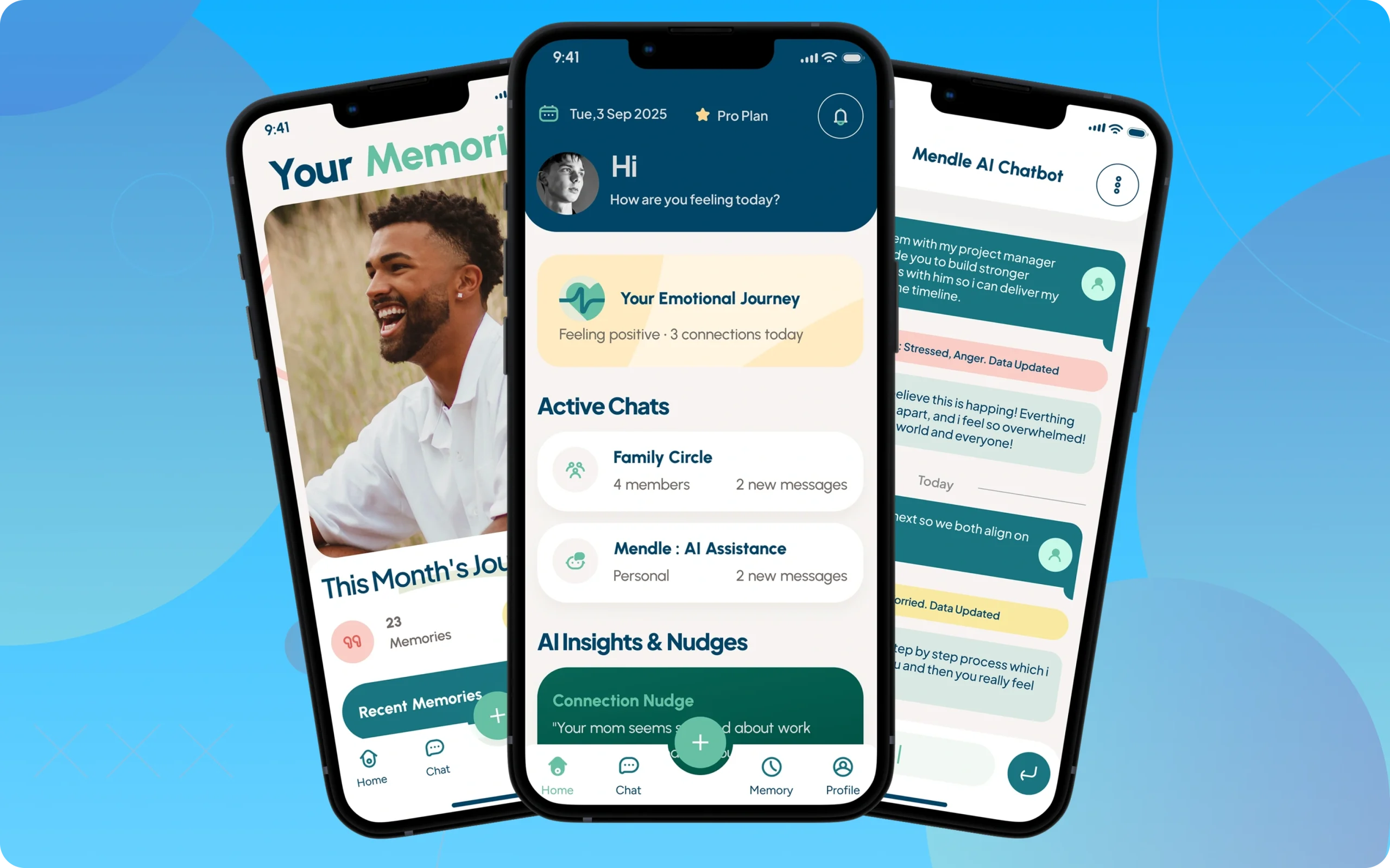
We transformed an innovative AI concept into a scalable emotional wellness platform with emotion-aware conversations, personalized insights, and enterprise-grade security. Built as a market-ready AI product, Mendle demonstrates how a focused MVP can validate user engagement before large-scale expansion.
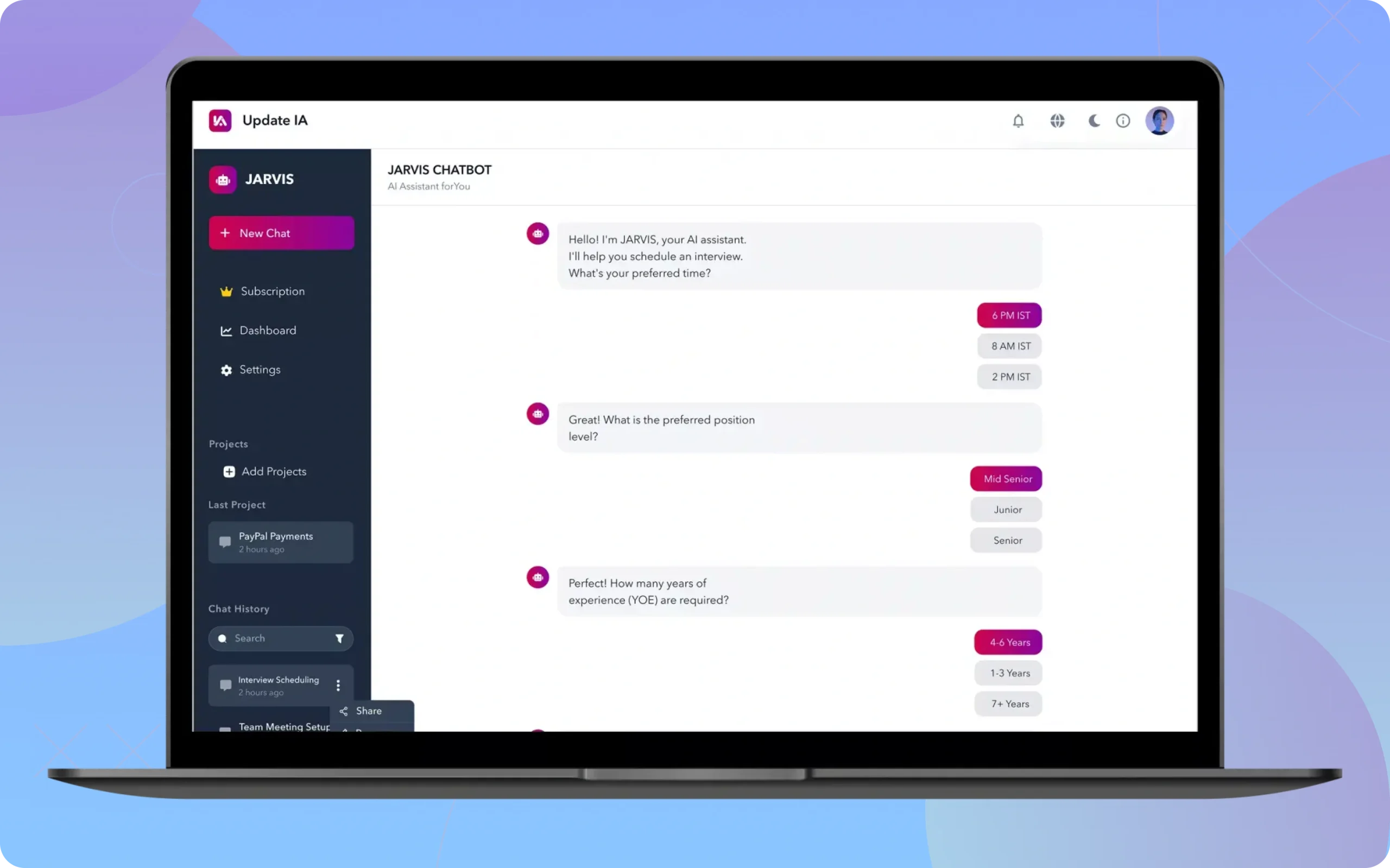
Discover how SoluLab transformed an enterprise AI vision into a production-ready MVP powered by Jarvis, a central AI orchestrator managing autonomous agents across HR, CRM, Finance, Legal, and Customer Support.
Whether you're building an AI SaaS platform, chatbot, AI agent, or enterprise automation solution, our AI MVP development team helps you validate your concept before full-scale investment.
Talk to Our AI ExpertsOur AI MVP development process is designed to move quickly without sacrificing product clarity or technical discipline. Each phase is focused on helping you make the right decisions early, reduce waste, and launch an MVP that is usable in the real world.
We start by understanding the business problem, users, workflows, and expected outcomes. This phase helps identify the best AI opportunity to validate first and ensures the MVP is tied to a real use case, not just an idea.
Next, we assess data sources, integration requirements, model fit, workflow constraints, and implementation risks. This creates a more realistic path to development and avoids building something that looks good in theory but breaks in practice.
We define the product flow, user experience, AI logic, and architecture needed for the MVP. The goal is to make the experience simple for users while making the underlying system scalable enough for future growth.
SoluLab builds the MVP in structured sprints, validating key workflows and improving usability as the product takes shape. This approach keeps progress visible and allows the team to adapt based on product goals and implementation realities.
The first release is where learning starts. Our AI MVP launch services cover deployment, usage tracking, model and prompt tuning, and a roadmap for turning the validated MVP into a market-ready product or enterprise platform.
AI MVP development typically costs $3,000–$20,000 for an API-based build and $8,000–$60,000 for a RAG product that answers from your own data. Custom-model and agentic MVPs run $50,000–$300,000+. Architecture choice drives most of the difference.
| Build type | What it is | Typical cost | Timeline |
|---|---|---|---|
| AI proof of concept | Tests technical feasibility internally, no real users | $5,000–$20,000 | 1–3 weeks |
| API-based MVP | Calls an LLM API (OpenAI, Anthropic, Gemini) with structured prompts | $3,000–$20,000 | 2–6 weeks |
| RAG MVP | Answers questions from your own documents via a vector database | $8,000–$60,000 | 4–10 weeks |
| Custom or fine-tuned model MVP | Adds model training, data labeling, and retraining loops | $50,000–$150,000+ | 10–20 weeks |
| Agentic or multi-step workflow MVP | Coordinated AI actions and tool use across systems | $100,000–$300,000+ | 12–24 weeks |
Any MVP AI solution builder can ship a working demo. An AI MVP that proves something, and can grow into a real product, takes product judgment as much as engineering.
AI products shipped across banking, wellness, enterprise automation, and supply chain, with published results.
As an MVP AI product developer, we staff teams that work daily with LLMs, RAG, and agent frameworks, not a general dev shop learning AI on your budget.
API-based and RAG MVPs typically reach real users in 2–10 weeks, ensuring fast validation and time-to-market.
Every MVP starts with a success metric agreed before development begins, ensuring alignment with your core business goals.
Data access rules, human fallback mechanisms, and comprehensive output logging are built directly into the first release.
"Taher scopes agentic AI engagements around what should actually be autonomous versus human-reviewed, since that boundary determines whether an AI agent is trustworthy in production or just a demo."
An MVP, or minimum viable product, is the smallest working version of a product that real users can use, built to test whether it solves a real problem before you invest in the full build. In app or product development, the idea is the same: ship the core value first, measure, then expand.
An AI MVP is a minimum viable product where the core value comes from an AI capability, such as answering questions, automating a task, or making a prediction. It includes that one AI feature, the minimum workflow around it, and real users whose behavior you can measure against a defined goal.
AI MVP development services cover everything needed to take an AI idea to a working product with real users: discovery, use-case selection, data review, architecture, design, AI and application development, testing, launch, and post-launch tuning. SoluLab delivers all of these in one team, so scope decisions and engineering stay aligned.
A proof of concept tests whether the AI can work at all, internally, with no users. A prototype tests the experience and design, often with limited functionality. An MVP is a real working product with real users and real data, measured against KPIs. Our guide to PoC vs prototype vs MVP goes deeper.
We rank every proposed feature against one question: does the MVP fail to prove its hypothesis without it? The core AI feature, minimum data input, clear output, a feedback button, and a human fallback usually make the cut. Dashboards, extra AI features, fine-tuning, and multi-language support usually wait for version two.
An API-based AI MVP typically costs $3,000–$20,000 and a RAG MVP $8,000–$60,000. Custom-model builds run $50,000–$150,000+, and agentic workflow MVPs $100,000–$300,000+. Data readiness, integrations, and compliance move the number the most. Our AI MVP cost guide breaks it down by tier.
An API-based MVP typically takes 2–6 weeks and a RAG MVP 4–10 weeks. Custom-model MVPs take 10–20 weeks and agentic workflows 12–24 weeks. Discovery comes first, and a clear first use case with ready data is what keeps a project at the short end of its range.
Pick one use case with a measurable goal, check that your data can support it, design the smallest workflow around the AI feature, build it in short sprints, then launch to real users and measure. Start on an API model before investing in custom training. Our step-by-step AI MVP roadmap covers each stage.
It depends on the use case. A RAG assistant needs the documents or knowledge base it will answer from. A prediction MVP needs historical, labeled records. Many API-based MVPs can start with little proprietary data and improve as usage data builds up. We review your data during discovery, before any build commitment.
Yes. We add a focused AI capability, such as search, a support assistant, or document processing, to an existing platform, SaaS product, or internal system. It's often the fastest way to validate AI value, because you already have users, data, and a workflow to plug into.
Yes. We build conversational agents, task automation agents, and multi-agent systems when the use case needs them. For a first MVP, we usually recommend one agent with tightly scoped permissions and a human approval step, then expand once it performs reliably.
Yes. We design the MVP's architecture so the validated parts carry forward: data pipelines, integrations, and the core AI logic. Scaling usually adds evaluation depth, security hardening, monitoring, and the features you deliberately left out of version one.
We agree on success metrics before development starts, typically one business metric (time saved, tickets deflected, conversion) plus AI quality measures such as answer accuracy, task completion rate, and user feedback. Results then point to one of three decisions: scale, change direction, or stop.
Yes. AI product ideas, workflows, and datasets are often sensitive, so we're happy to sign an NDA before the first detailed discovery conversation.
Yes. We review the existing architecture, model performance, and user experience, then fix what's holding it back, whether that's accuracy, response speed, scalability, or missing guardrails. Sometimes the right answer is targeted fixes; sometimes it's rebuilding one layer while keeping the rest.
Understand how AI for IT operations helps businesses automate tasks, detect issues early, optimize performance, and improve IT service management.
Learn how AI helps ecommerce businesses improve customer experience, automate operations, and deliver personalized shopping experiences.
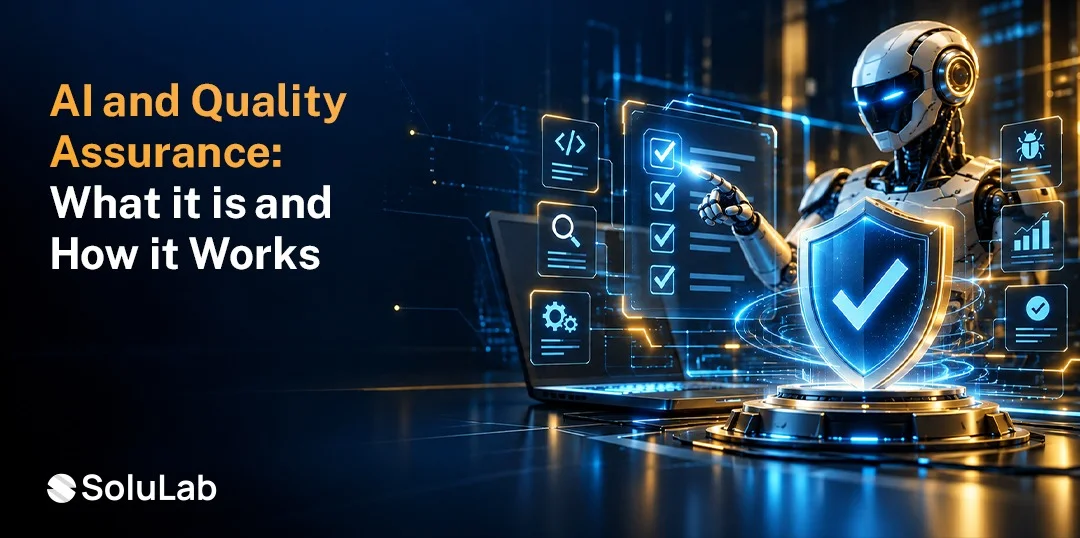
See how AI and quality assurance work together to automate testing, identify defects earlier, improve test coverage, and accelerate software delivery.