Key Takeaways
- An AI assistant is an AI-powered system that interprets user input, reasons over context, and executes actions through integrated services.
- Modern assistants are built on large language models (LLMs), retrieval, tools/agents, and orchestration layers.
- Enterprises use them for customer service, IT support, sales enablement, analytics, and internal productivity, often achieving significant efficiency and satisfaction gains.
- Building an effective assistant requires solid architecture: intent understanding, policy and workflow engines, connectors, observability, and strong security.
- The future is multimodal, agentic, and customized LLMs, with assistants that coordinate complex workflows across organizations.
AI assistants are software systems that use artificial intelligence to understand user intent, reason over data, and take actions on behalf of people or other systems. They combine natural language understanding, dialogue management, and AI integrations with enterprise tools to deliver outcomes, not just answers.
Used correctly, AI assistants for business become a durable capability layer: they reduce costs, unlock new revenue, and standardize decision-making across teams. Generative AI adoption is projected to reach around three‑quarters of companies by 2026, and virtual assistants and chatbots are among the most common enterprise use cases.
What is an AI Assistant?
An AI assistant is an artificial intelligence-powered assistant. It is a software system that can understand natural language or multimodal input, maintain context across interactions, and perform tasks or provide information by orchestrating backend services or tools. It differs from a simple bot by using machine learning and reasoning, not just fixed scripts.
92% of C-suite leaders are building an “AI elite” workforce, per 2026 AI Adoption findings. Employees broadly welcome AI, with 2-3 times more support than opposition across ages, viewing it as a tool for creativity and efficiency. Europe’s business AI adoption hit 54% (up from 42%), though transformation lags behind
At a minimum, most AI assistants include these core components of AI assistants:
- Interface layer – channels like web chat, mobile apps, voice, email, or embedded widgets.
- Natural language understanding (NLU) – models that convert user input into machine‑readable intents, entities, and semantic representations, now often powered by large language models.
- Dialogue & task management – logic that maintains state, handles clarifications, and orchestrates multi‑step workflows.
- Knowledge and tools – retrieval from documents or databases plus connectors to business systems (CRM, ITSM, ERP, etc.).
- Security, monitoring, and governance – access control, logging, analytics, and evaluation to keep the assistant compliant and reliable.
In practice, an AI assistant is a conversational AI front end over a set of enterprise capabilities: data, APIs, and workflows.
Types of AI Assistants
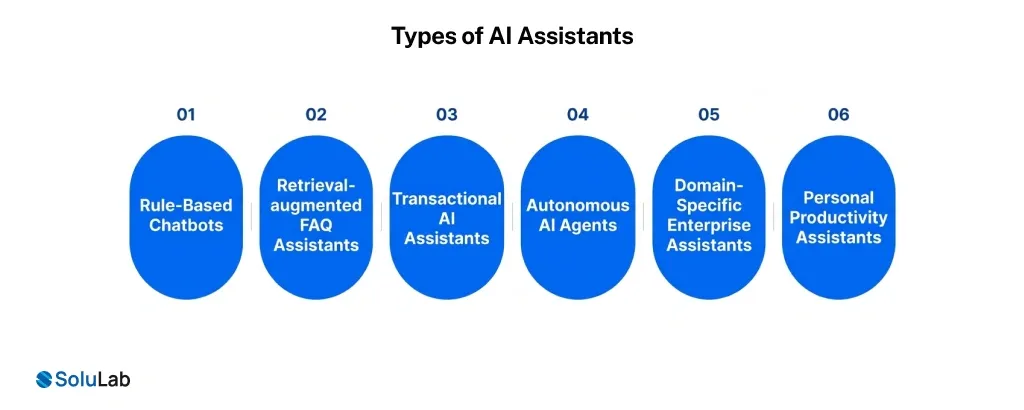
Different types of AI assistants emerge based on channels, intelligence level, and business scope. Understanding these helps select the right architecture and AI development services for AI assistants.
1. Rule-Based Chatbots
Rule-based chatbots follow deterministic flows defined by if/else logic or decision trees. They are inexpensive and predictable but brittle when users deviate from expected patterns.
- Typical use: FAQ widgets, lead capture forms.
- Technology: intent classification with keyword matching, scripted responses.
- Limitations: poor handling of ambiguous queries, no deep reasoning or generalization.
2. Retrieval-augmented FAQ Assistants
These assistants index large document sets and use semantic search or retrieval‑augmented generation (RAG) to answer questions in natural language.
- Typical use: policy Q&A, product documentation, HR handbooks.
- Technology: vector databases, embedding models, LLMs for answer synthesis.
- Benefits: fast deployment, good coverage across knowledge bases.
3. Transactional AI Assistants
Transactional assistants can perform actions, not just answer questions. They integrate with CRM, IT service management, HRIS, billing, or other systems.
- Typical use: reset passwords, open tickets, update customer records, schedule appointments.
- Technology: LLM-based planners that call APIs via tool‑calling interfaces, workflow engines, and strict guardrails.
- Often implemented as AI‑powered assistants embedded into existing enterprise portals.
4. Autonomous AI Agents
An AI agent is an assistant extended with goal‑directed autonomy: it can decompose high‑level goals, plan multi‑step sequences, call tools iteratively, and self‑reflect on results.
- Typical use: data research, report generation, marketing campaign orchestration.
- Technology: agent frameworks (e.g., planning, memory, tool‑use loops) on top of LLMs with strong monitoring.
5. Domain-Specific Enterprise Assistants
These are virtual AI assistants narrowly tuned to a function or industry:
- IT helpdesk co‑pilots.
- Sales enablement assistants that summarize accounts and suggest next best actions.
- Healthcare assistants who triage symptoms or help clinicians find guidelines (with strict compliance).
They often rely on custom LLM development for enterprises to capture domain terminology, workflows, and safety rules.
6. Personal Productivity Assistants
Examples include calendar schedulers, email drafting tools, and note‑taking assistants. They focus on individual productivity rather than organization‑wide workflows.
AI Agent vs AI Assistant
AI agents and AI assistants overlap, but they are not identical. An AI assistant focuses on user interaction and task execution within well‑defined boundaries, while an AI agent emphasizes autonomy, environment interaction, and long‑horizon planning.
Conceptual Differences
- An AI assistant is usually user‑initiated, with each session tied to explicit prompts.
- An AI agent can be goal‑initiated and run in the background, choosing which tools to call and when to stop.
- Assistants often have strong UX, brand voice, and compliance constraints; agents prioritize optimization of objectives.
AI Agent vs AI Assistant: Overview
| Dimension | AI Assistant | AI Agent |
| Primary focus | User interaction and task completion | Goal pursuit and autonomous decision-making |
| Initiation | Triggered by user requests | Triggered by goals, schedules, or events |
| Autonomy level | Medium – works within predefined flows and policies | High – plans multi-step actions, may explore options iteratively |
| Memory | Session-based, sometimes short‑term profile | Longer-term memory of environment, tasks, and results |
| Tool usage | Calls tools/APIs mostly in response to explicit user intents | Actively selects tools to achieve objectives, may chain them |
| Risk & governance | Easier to constrain via UX and policy | Requires strong oversight, sandboxing, and safety checks |
| Typical examples | Customer support chatbot, IT helpdesk assistant | Research agent generating reports, autonomous data quality remediation bot |
In many enterprise systems, AI agent vs AI assistant is a design spectrum: you may start with an assistant and gradually introduce agentic behaviors behind the scenes.
Core Technologies Powering AI Assistants
Modern AI assistant technologies blend classical NLP components with powerful foundation models and enterprise integration stacks.
Natural Language Processing and LLMs
AI assistants rely on natural language processing (NLP) to interpret and generate human language. Today, this typically means large language models trained on massive corpora,fine‑tuned for instruction following and safety.
Key capabilities include:
- Intent detection and slot filling – mapping utterances to actions and parameters.
- Semantic parsing – translating queries into structured forms (SQL, DSLs, API calls).
- Generation – producing fluent, contextually relevant responses or summaries.
Custom LLMs allow enterprises to further tune base models using domain data or instruction sets, improving precision and privacy.ezeiatech+1
Retrieval and Knowledge Management
For enterprise AI assistants, grounding answers in organizational knowledge is essential:
- Vector search – encodes documents as embeddings to retrieve semantically similar passages.
- RAG pipelines – retrieve relevant snippets, then feed them to the LLM to craft grounded responses.
- Knowledge graphs – structured relationships between entities for reasoning over products, policies, or people.
Automatic Speech Recognition (ASR) and Text-to-Speech (TTS)
Voice‑based AI assistants use:
- ASR to convert audio into text.
- TTS to synthesize natural‑sounding responses.
Modern systems achieve low word error rates even in noisy environments, enabling call‑center automation and in‑car assistants.
Tool Calling and Orchestration
To go beyond chat, AI assistants must execute actions:
- Tool calling/APIs – functions exposed to the LLM that trigger microservices (e.g., create_ticket, search_orders).
- Workflow engines – orchestrate long‑running processes and approvals.
- Orchestration platforms – route requests to the right models, retrieve data, enforce policies, and manage fallbacks.
Observability, Evaluation, and Safety
Enterprises require:
- Telemetry and logs for prompts, tool calls, and responses.
- Automated evaluation against golden test sets to track quality.
- Guardrails for PII redaction, toxicity filtering, and policy enforcement.
These services are often provided by specialized AI development companies or internal platform teams.
Architecture of Modern AI Assistants
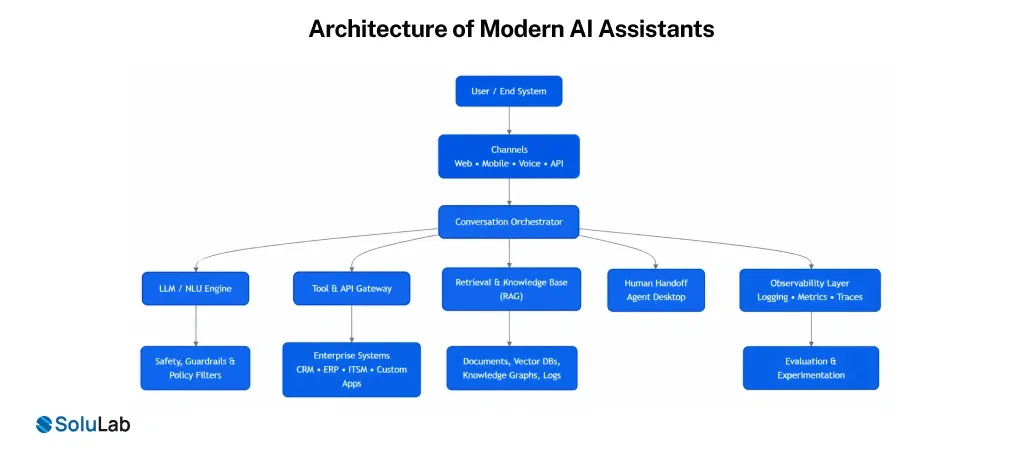
A robust AI assistant architecture organizes capabilities into clear layers. At a high level, we can describe the system as follows.
Layered Architecture Overview
- Channel & Experience Layer
- Web chat, mobile, contact center IVR, Slack/Teams, email, and API.
- Handles authentication, localization, and UX elements.
- Conversation Orchestration Layer
- Session management, routing, and dialogue state.
- Decides when to invoke LLMs, retrieval, tools, or human escalation.
- Intelligence Layer
- LLMs, NLU models, ranking, and policy engines.
- Includes prompt templates, tool schemas, and safety filters.
- Knowledge & Tools Layer
- Vector databases, document stores, and knowledge graphs.
- Business APIs, RPA bots, and external services.
- Platform & Governance Layer
- Monitoring, analytics, evaluation harness, CI/CD, and feature flags.
- Identity, access management, data security, and compliance.
In enterprise settings, this architecture is often deployed as a central conversational AI platform that multiple teams consume as a service.
Benefits of AI Assistants for Business
Well‑implemented AI assistants for business deliver quantifiable value across cost, revenue, and employee experience.
Efficiency and Cost Reduction
Virtual assistants and AI-powered chatbots can handle high volumes of routine inquiries 24/7.
- A telecom company’s chatbot can handle thousands of password resets and plan upgrades daily without human agents, reducing wait times and contact center load.
- Generative AI adoption helped increase the proportion of companies using AI‑modernized processes from 9% in 2023 to 16% in 2024, reflecting growing operational efficiency gains.
Typical outcomes seen in case studies:
- 20–40% deflection of Tier‑1 support contacts.
- 30–60% faster resolution for IT helpdesk and HR requests.
- Reduced average handling time for remaining agent‑handled contacts.
Revenue Growth and Customer Experience
AI assistants enable:
- Personalized recommendations by reasoning over user history and product catalogues.
- Instant self‑service that improves customer satisfaction scores and reduces churn.
Generative AI is part of a global AI market projected to grow from around 391 billion USD in 2025 to significantly higher levels by the early 2030s, driven by such high‑value use cases.
Employee Productivity and Knowledge Sharing
Internal AI assistants act as always‑on subject‑matter experts:
- Moveworks, for example, provides a conversational AI platform that answers employee questions and automates routine IT tasks, leading to measurable productivity gains.
- Small businesses using generative AI have seen workforce expansion rather than contraction: in one survey, 82% of AI‑using SMBs increased their workforce over a year while using AI to augment productivity.
Strategic and Competitive Advantages
Enterprises that adopt AI at scale are more likely to become performance leaders. In one 2024 survey, AI adoption rates reached around 72% of organizations, with leaders clustering in fintech, software, and banking.
AI assistants, as a visible and high‑impact application of AI solutions development, help companies experiment quickly and build the internal capabilities needed for broader transformation.
Real-World AI Assistant Examples (2024–2026)
Recent years have produced a rich ecosystem of AI assistant examples across industries.
- Enterprise employee assistants – Platforms like Moveworks provide a conversational interface for IT, HR, and finance questions, integrated with systems like Azure and popular SaaS tools, and have demonstrated substantial efficiency gains.
- Customer service virtual agents – Telecom and banking organizations deploy chatbots that handle billing questions, plan changes, and dispute initiation, often becoming one of the top digital channels by volume.
- Domain‑tuned LLM chatbots – Companies fine‑tune LLMs for regulatory or technical domains (healthcare, legal, engineering) to provide high‑accuracy answers and workflow guidance, enabled by better fine‑tuning and customization capabilities.
- Custom LLM assistants for SMEs – SMEs increasingly adopt custom LLM development, which can be scaled to smaller budgets while delivering tailored solutions.
These AI assistant implementations often start as pilots in one function and then expand into organization‑wide platforms.
How to Build an AI Assistant: Step by Step
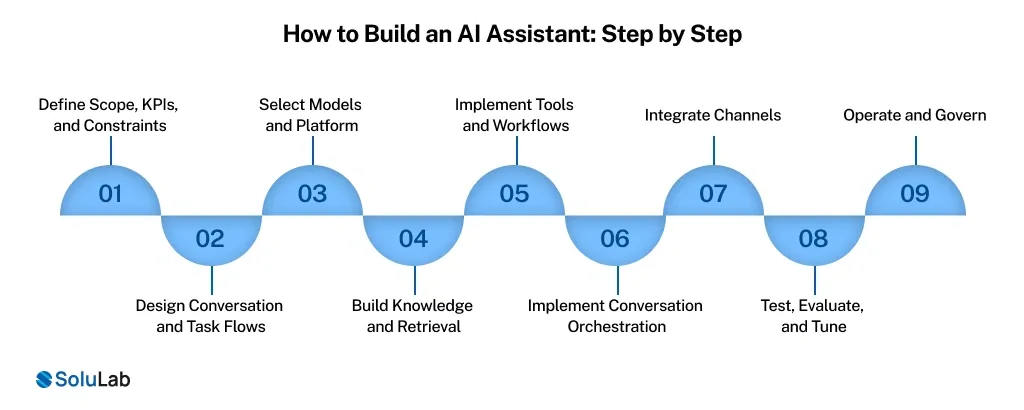
How to build an AI assistant? The process combines product thinking, data engineering, and MLOps services. Below is a step‑by‑step view suitable for technical teams.
Step 1. Define Scope, KPIs, and Constraints
- Choose the primary use case: customer support, IT helpdesk, sales, analytics co‑pilot, etc.
- Define success metrics: containment rate, CSAT, resolution time, task success, and guardrail thresholds.
- Identify compliance constraints (PII, PHI, financial data) and security requirements.
Step 2. Design Conversation and Task Flows
- Map top intents and user journeys.
- Decide where free‑form generative answers are allowed vs where structured flows are required.
- Define escalation paths to humans and fallbacks when confidence is low.
Step 3. Select Models and Platform
- Choose base LLM(s) depending on latency, cost, language coverage, and data governance needs.
- Decide whether to pursue custom LLM development for enterprises using fine‑tuning or adapters.
- Pick or build an orchestration platform that supports prompt management, routing, and tool calling.
Step 4. Build Knowledge and Retrieval
- Ingest documents into a pipeline that performs chunking, metadata enrichment, and embedding.
- Store vectors in a scalable database with hybrid (keyword + semantic) search.
- Implement RAG prompts that cite sources and avoid hallucination.
Step 5. Implement Tools and Workflows
Explain business operations as tools to the assistant. A simple example in pseudocode:
python
tools = [
  {
    "name": "create_ticket",
    "description": "Open an IT support ticket",
    "parameters": {
      "type": "object",
      "properties": {
        "category": {"type": "string"},
        "description": {"type": "string"}
      },
      "required": ["category", "description"]
    }
  }
]

# In the orchestrator:
if llm_output.tool_call:
    result = call_tool(llm_output.tool_name, llm_output.args)
    reply = llm_followup(user_message, tool_result=result)
Key steps:
- Standardize API schemas and error handling.
- Implement idempotency and logging for every action.
Step 6. Implement Conversation Orchestration
- Maintain session state (user profile, previous turns, intermediate tool results).
- Use routing policies to decide when to use retrieval, when to call tools, and when to transfer to a human.
- Implement configurable prompts for different intents or domains.
Step 7. Integrate Channels
- Add web and mobile widgets, Slack/Teams bots, or contact center integrations.
- Reuse the same backend orchestration across channels to avoid logic duplication.
Step 8. Test, Evaluate, and Tune
- Create evaluation sets from real transcripts and edge cases.
- Automate offline evaluation (accuracy, groundedness, toxicity) alongside A/B testing in production.
- Tune prompts, retrieval parameters, and tool policies iteratively.
Step 9. Operate and Govern
- Monitor metrics like containment, tool error rates, and latency.
- Implement role‑based access control and data retention policies.
- Establish a governance council for content updates, safety, and model versioning.
An experienced AI app development company like SoluLab can accelerate these steps with reusable components.
Best Practices & Implementation Challenges
Best Practices
- Start narrow, then expand – Focus on a single high‑value domain before scaling.
- Ground everything – Use retrieval and tool outputs to anchor answers in authoritative data.
- Design for human‑in‑the‑loop – Enable agents to review, override, and teach the assistant.
- Instrument deeply – Collect rich logs and feedback labels to drive continuous improvement.
- Invest in prompt and policy design – Clearly define system behavior, persona, and compliance rules.
Common Challenges
- Data quality and fragmentation – Inconsistent documentation or siloed systems reduce accuracy; RAG helps, but can’t fix missing data.
- Hallucinations and trust – Ungrounded responses erode confidence; mitigation requires strong retrieval and citation strategies.
- Change management – Employees may resist AI assistants; success stories show that productivity gains often coexist with workforce growth.
- Scaling across use cases – Without a platform approach, organizations end up with fragmented bots instead of a coherent conversational layer.

Future Trends in AI Assistants
The AI assistant landscape is evolving quickly, driven by breakthroughs in models and tooling.
Custom and Domain-Specific LLMs
Custom LLM development lets enterprises optimize for precision, privacy, and cost by tailoring models to their data and tasks.
Benefits include:
- Higher answer accuracy for specialized domains.
- Stronger control over data residency and governance.
- Ability to embed proprietary reasoning and workflows into the model itself.
Multimodal and Embodied Assistants
New assistants will understand and generate not just text and speech but also images, diagrams, and possibly video. This enables:
- IT assistants who parse screenshots or logs.
- Field service assistants who analyze photos of equipment.
- Design and analytics co‑pilots that create charts and visualizations.
Agentic Workflows and Tool Ecosystems
As agent frameworks mature, assistants will increasingly behave like orchestrators of other agents and tools:
- Decomposing complex goals into sub‑tasks.
- Coordinating across analytics engines, RPA bots, and external APIs.
- Managing long‑running workflows with minimal human intervention.
Standardization and Platforms
With AI adoption growing across industries and more than half of large enterprises already leveraging AI in some capacity, we can expect:
- Standard APIs for tool schemas and conversation handoff.
- Enterprise platforms that expose AI assistant capabilities as reusable services.
- A clearer distinction between AI Chatbot development, AI solutions development, and Custom LLM platforms.
FAQs
Conclusion
AI assistants have evolved from simple chatbots into sophisticated, AI-powered assistants that combine large language models, retrieval systems, and action‑oriented agents. They sit at the intersection of conversational AI, enterprise integration, and AI solutions development, delivering tangible benefits in customer experience, operational efficiency, and employee productivity.
For enterprises, the question is no longer “What is an AI assistant?” but “How do we design our AI assistant architecture and governance so that it becomes a durable competitive advantage?” Organizations that move now, investing in platforms, custom LLM development, and best‑practice implementation, will be better positioned as AI becomes a core part of every business process.
If you’re looking for an experienced partner to design, build, and scale production‑grade AI assistants, SoluLab can help. As a leading AI agent development company, SoluLab delivers end‑to‑end services across conversational AI, AI development, and custom LLM solutions, with 1500+ projects delivered for global enterprises.
From strategy and architecture to integration, MLOps, and ongoing optimization, our team can turn your AI assistant vision into a secure, scalable reality.
Shipra Garg is a tech-focused content strategist and copywriter specializing in Web3, blockchain, and artificial intelligence. She has worked with startups and enterprise teams to craft high-conversion content that bridges deep tech with business impact. Her work translates complex innovations into clear, credible, and engaging narratives that drive growth and build trust in emerging tech markets.