Key Takeaways
- The benefits of AI in ecommerce show up as higher conversion, better search, leaner inventory and cheaper support, not as a single headline number.
- Personalization needs data. Stores with small catalogues or low traffic see far less lift than the case studies suggest.
- Search and discovery is the most underrated win. Most shoppers who use site search and fail to find anything leave.
- Dynamic pricing works, but personalised pricing carries disclosure obligations and real customer trust risk.
- A chatbot that invents a refund policy can create a binding obligation. Ground it in your actual policies.
- Measure with holdout groups. Without a control group, you are crediting AI for seasonality.
- Agentic commerce is coming fast, and it changes who your product pages need to convince.
The benefits of AI in ecommerce come from fixing leaks that have existed since online retail began: shoppers who cannot find the product, carts abandoned at checkout, stock in the wrong warehouse, and support queues nobody staffs at 2 am. AI applies personalization, better search, demand forecasting and automated service to each of those, and the gains compound.
The market context explains the urgency. Grand View Research values the global e-commerce market at $39.7 trillion in 2026, projecting $156.0 trillion by 2033 at a compound annual growth rate of 21.6%. More shoppers are arriving every year, but conversion rates have barely moved in a decade.
That gap is the opportunity. This guide covers what AI genuinely delivers, which benefits apply to which kind of store, what returns to expect, what it costs and where it goes wrong.

What Does AI Do in Ecommerce?
Artificial intelligence in ecommerce analyses shopper behaviour, product data, and operational signals to make decisions that previously needed a person or a fixed rule. It personalises what each visitor sees, interprets what they are searching for, forecasts what will sell, and answers questions without a queue.
1. The Four Places AI Operates
On the storefront, shaping what each shopper sees and finds. In the back office, forecasting demand and managing stock. In customer service, handling routine questions. And in marketing, deciding who sees which message and when.
2. What Changed Recently
Recommendation engines and demand forecasting have existed for years. What changed is language and vision. Shoppers can now describe what they want in their own words or upload a photo, and generative models can write product descriptions at catalogue scale. That shift is covered in depth in our look at generative AI in the ecommerce industry.
3. What It Does Not Do
AI does not fix a weak product range, slow shipping or a confusing checkout. It amplifies what already works. Stores that expect AI to compensate for a poor fundamental offer are consistently disappointed.
Where Are the Leaks AI Actually Fixes?
Online retail loses most of its potential revenue in three places: shoppers who never find the right product, carts abandoned before payment, and stock that sits in the wrong place. Each has a measurable size.
Industry benchmarks put the global average ecommerce conversion rate between roughly 2.5% and 3%, and Baymard Institute’s long-running research puts average cart abandonment near 70%, rising further on mobile. In other words, around 97 of every 100 visitors leave without buying, and seven in ten who do add something abandon it.
1. The Discovery Leak
Shoppers who use site search convert at a much higher rate than those who browse, which makes a failed search unusually expensive. Keyword matching breaks on synonyms, misspellings, and descriptive queries. Semantic search understands intent rather than exact words, which is why a RAG platform approach to product discovery outperforms traditional search on long queries.
2. The Checkout Leak
Abandonment is driven by cost surprises, forced account creation, and slow checkout. AI helps at the margins: predicting which carts are likely to be abandoned, triggering timely recovery, and personalising incentives rather than discounting everyone.
3. The Inventory Leak
Stockouts lose sales, overstock ties up capital and ends in markdown. Forecasting models using seasonality, promotions, weather and local demand signals beat rule-based reordering, particularly across multiple locations.
What Are the Key Benefits of AI in Ecommerce?
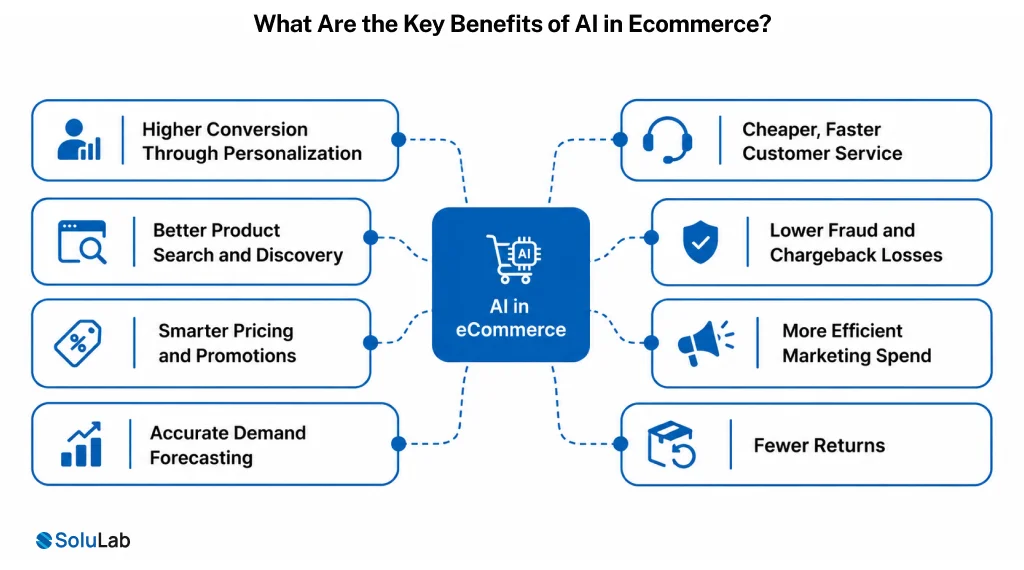
They differ by store size and catalogue, so the order in which you pursue them matters more than the list itself.
1. Higher Conversion Through Personalization
Product recommendations, personalised homepages and tailored merchandising raise the chance that a visitor sees something they want. This is the most cited benefit and the one most dependent on having enough behavioural data to learn from.
2. Better Product Search and Discovery
Semantic and visual search let shoppers search by description or photo and still find the right item. Fewer dead-end searches means fewer exits, and it disproportionately helps large catalogues.
3. Smarter Pricing and Promotions
Models adjust prices and offers based on demand, competitor movement, margin targets and inventory position. Handled well, this protects margin instead of defaulting to blanket discounts.
4. Accurate Demand Forecasting
Better forecasts mean less stockout and less dead stock. The benefit grows with the number of SKUs and locations, and it compounds once fulfilment planning uses the same signals.
5. Cheaper, Faster Customer Service
Automated answers to order status, returns and product questions cut queue times and cost per contact. Well-designed AI-powered retail chatbots handle routine volume and escalate anything unusual, following the patterns in our guide to AI in customer service.
6. Lower Fraud and Chargeback Losses
Machine learning scores transactions in real time, catching patterns rules miss while approving more legitimate orders. False declines cost retailers real revenue, and better models reduce both sides of the problem.
7. More Efficient Marketing Spend
Predicting which customers are likely to buy, churn or respond to a campaign means budget goes where it converts. Generative models also produce ad and email variants at a volume manual teams cannot match.
8. Fewer Returns
Size and fit recommendations, better imagery and more accurate product descriptions reduce the returns that quietly destroy margin in apparel and footwear. This benefit is often ignored and frequently the largest.
What Are the Top Use Cases of AI in Ecommerce?
Benefits describe outcomes. These are the concrete applications that produce them, in rough order of how commonly stores deploy them today.
1. Visual and Image Search
Shoppers upload a photo or tap an image and find matching or similar products. It works especially well in fashion, furniture, and home decor, where people know what they want visually but cannot describe it in search terms.
2. Conversational Shopping Assistants
AI Assistants that answer product questions, narrow options and guide shoppers toward a choice in natural language. The difference between a useful one and an annoying one is grounding: it must answer from your actual catalogue and policies, not from general knowledge.
3. Automated Product Content Generation
Generative models write product descriptions, titles, meta tags and alt text at catalogue scale, then adapt them per channel and language. For retailers with tens of thousands of SKUs this replaces work nobody was ever going to finish manually.
4. Size and Fit Recommendations
Models predict the right size from a shopper’s purchase and return history plus garment measurements. This is the highest-value use case in apparel and footwear, because returns are the single largest margin drain in those categories.
5. Review Summarisation and Product Q&A
AI condenses hundreds of reviews into the points shoppers actually care about and answers specific questions from review content. It shortens research time on considered purchases and reduces pre-sale support contacts.
6. Dynamic Bundling and Cross-Sell
Instead of fixed bundles set by a merchandiser, models assemble combinations based on what this shopper is likely to want together and what inventory needs moving. It lifts average order value without the blunt discounting that usually accompanies bundles.
7. Predictive Replenishment and Reordering
Forecasting which SKUs each location will need, and when, then triggering reorders automatically within limits merchandisers set. Multi-location retailers gain most, and it connects directly to AI agents in supply chain and logistics on the fulfilment side.
8. Real-Time Fraud and Risk Scoring
Every order scored at checkout against behavioural and transactional patterns, approving more good orders while catching more bad ones. The value is on both sides: fewer chargebacks and fewer false declines that turn genuine customers away.
How Does AI Ecommerce Personalization Actually Work?
Personalization works by learning from behaviour: what shoppers view, search, add to basket and buy, then predicting what they are likely to want next. The technique matters less than the data underneath it.
1. The Main Approaches
Collaborative filtering recommends what similar shoppers bought. Content-based filtering recommends items with similar attributes. Modern systems combine both and add real-time session signals, so what you clicked two minutes ago influences what you see now. Our walkthrough on how to implement an AI-based recommendation system covers the architecture.
2. The Cold Start Problem
New shoppers have no history, and new products have no interactions. Systems handle this with popularity defaults, attribute-based matching and rapid session learning. If most of your traffic is first-time visitors, expect weaker results and plan for it.
3. Where Personalization Appears
Homepage layout, category sorting, product page recommendations, cart add-ons, email content and paid retargeting. The highest-value placements are usually the ones closest to the decision, particularly product page and cart.
4. Why Data Quality Decides the Outcome
Clean product attributes, consistent categories and accurate inventory status matter more than the algorithm. A recommendation for an out-of-stock item is worse than no recommendation, and messy catalogue data is the most common reason personalization underperforms.
What Returns Can You Realistically Expect?
Meaningful but uneven, and much smaller than vendor case studies imply unless you measure properly. The gap between experimenting with AI and running it in production is where most of the disappointment lives.
Deloitte’s State of AI in the Enterprise research found two-thirds of organisations reported productivity and efficiency gains from AI, while only 25% had moved 40% or more of their AI experiments into production. Most companies have tried AI. Far fewer have it running where it matters.
1. Use Holdout Groups or You Are Guessing
Compare a group that sees AI-driven experiences against a control group that does not. Without a holdout, seasonality, promotions, and traffic mix will be credited to the model. This single discipline separates teams who know their AI works from teams who believe it does.
2. Measure the Right Metrics
Conversion rate, average order value, revenue per visitor, search exit rate, return rate, contact deflection, and forecast accuracy. Avoid vanity metrics such as recommendations served, which tell you nothing about whether anyone bought.
3. Expect Different Returns by Store Profile
Large catalogues with high traffic gain most from search and personalization. Smaller stores often see more from customer service automation, content generation, and forecasting. Match the use case to your actual constraints rather than copying an enterprise playbook.
4. Allow Time to Learn
Models need data before they perform. A recommendation engine judged after two weeks will look worse than it is. Set a review window that matches how quickly your store generates behavioural data.
How Do You Implement AI in Your Ecommerce Business?
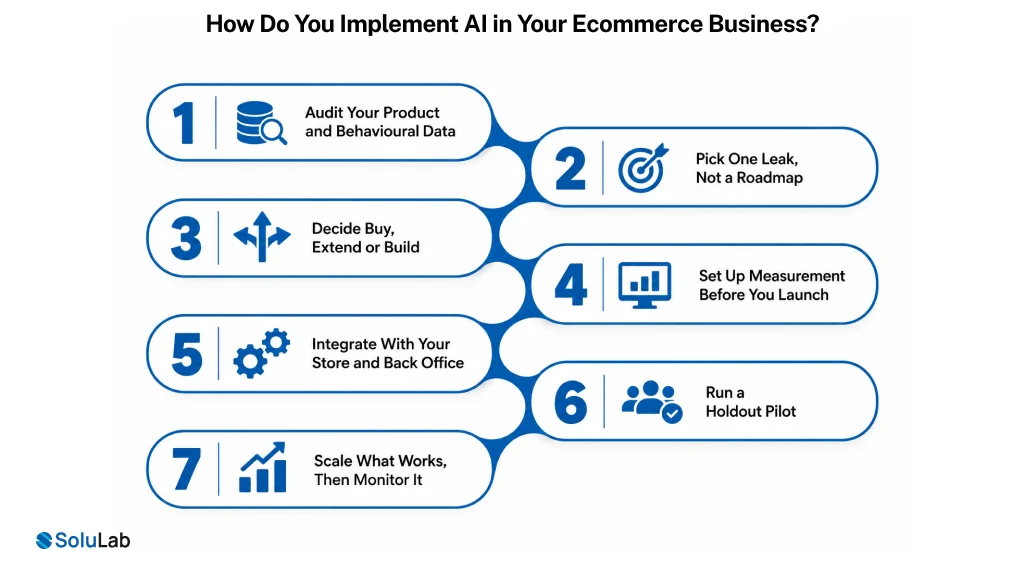
Implementation works best as a sequence, not a shopping list. The first two steps involve no AI at all, and skipping them is why most ecommerce AI projects underdeliver.
1. Audit Your Product and Behavioural Data
Check attribute consistency, duplicate SKUs, category structure, image coverage and stock accuracy. Then check whether you capture enough behavioural signal, meaning views, searches, add-to-carts and purchases tied to identifiable sessions. This audit determines what is realistic.
2. Pick One Leak, Not a Roadmap
Choose the single problem costing you most: failed searches, abandoned carts, stockouts, returns or support volume. A store trying six use cases at once cannot tell which one moved the numbers.
3. Decide Buy, Extend or Build
Check what your ecommerce platform already includes, since a great deal ships natively now. Then look at specialist tools. Build custom only where your data or merchandising logic is genuinely different from everyone else’s.
4. Set Up Measurement Before You Launch
Define the metric, capture the baseline and design the holdout group first. Retrofitting measurement after launch produces numbers nobody trusts, including your own finance team.
5. Integrate With Your Store and Back Office
Connect the tool to your storefront, ERP, CRM, warehouse and support systems so recommendations reflect live stock and service agents see the same data. This plumbing is usually the largest line item, and it is where AI integration services work concentrates.
6. Run a Holdout Pilot
Launch to a portion of traffic, hold back a control group, and let it run long enough for the model to learn and for seasonality to wash out. Two to six weeks is typical, longer for lower-traffic stores.
7. Scale What Works, Then Monitor It
Roll out to full traffic only once the lift holds. Then keep watching, because ranges change, seasons turn and shopper behaviour shifts. Performance decays quietly without someone owning it.
What Are the Risks and Limits of AI in Ecommerce?
Real, and mostly about trust rather than technology. Six are worth planning for before launch.
1. Personalised Pricing Carries Legal and Trust Risk
Adjusting prices by demand is normal. Adjusting them per individual is different. Under EU consumer rules, traders must inform consumers when a price has been personalised based on automated decision-making. Beyond compliance, shoppers who discover they paid more than a neighbour rarely return.
2. Chatbots That Invent Policies
If an assistant states a refund or shipping policy that does not exist, a customer may reasonably rely on it, and tribunals have held retailers responsible for what their chatbots said. Ground every answer in your actual policy documents and escalate anything outside them.
3. Privacy and Consent
Personalization runs on behavioural data. Consent, transparency and retention limits are legal requirements in most markets, and increasingly a purchase consideration for shoppers.
4. Over-Personalization
Filtering too aggressively narrows what shoppers see and reduces discovery. Recommending an item someone just bought, or following them with an ad for it, damages the experience. Leave room for browsing.
5. Bias in Recommendations
Models amplify what already sells, which buries new and niche products. If merchandising strategy depends on promoting new ranges, build that into ranking rather than fighting the model later.
6. Model Drift
Shopper behaviour, catalogues and seasons change constantly. Performance decays without monitoring and retraining, which is standard MLOps work applied to retail data.
What Comes Next: Agentic Commerce
The next shift is shoppers delegating purchases to AI agents that compare, decide and buy on their behalf. It is early, and it is growing quickly.
Grand View Research values the agentic commerce market at $7.7 billion in 2026, projecting $65.5 billion by 2033 at a compound annual growth rate of 35.7%, with consumer-to-agent interactions the largest segment at 53.1% in 2025.
1. Your Buyer May Be a Machine
If an agent shortlists products, your page has to be readable and comparable by software: clean structured data, accurate specifications, clear pricing and availability. Persuasive copy aimed at humans is not enough on its own.
2. Conversational Storefronts
Shoppers describing needs in natural language rather than filtering by category. This is the direction behind AI agents for online shopping and the broader move toward AI agents in retail and e-commerce.
3. Autonomous Merchandising and Replenishment
Agents adjusting ranges, pricing and stock within guardrails set by merchandisers, as explored in our piece on agentic AI in retail merchandising.
4. What to Do Now
Fix your structured data, keep availability accurate and make sure your catalogue is machine-readable. That work pays back immediately in search and again when agents arrive.

Conclusion
The benefits of AI in ecommerce are real and specific: shoppers find products faster, carts convert more often, stock sits in the right place, support costs less and returns fall. The gains come from applying AI to known leaks rather than adding it as a feature.
The path that works is unglamorous. Clean your catalogue data, pick the single leak costing you most, run it against a holdout group, and expand only once the numbers hold. Stores that do this consistently outperform stores that adopt six tools at once and cannot tell which one helped.
SoluLab, an AI development company, can help your business identify which AI use case will move your numbers first, get your product and behavioural data into shape, and integrate AI with the platform and systems you already run.
FAQs
Neha is a curious content writer with a knack for breaking down complex technologies into meaningful, reader-friendly insights. With experience in blockchain, digital assets, and enterprise tech, she focuses on creating content that informs, connects, and supports strategic decision-making.