Key Takeaways
- Companies that launch a narrowly scoped AI MVP within 90 days gather real user insights faster and reduce the risk of building unnecessary features.
- Clean, structured, and accessible business data often has a greater impact on AI performance than investing in advanced models from day one.
- Successful founders prioritize solving a single high-value operational challenge before expanding into additional AI workflows, integrations, or automation layers.
- A scalable technical foundation with secure APIs, monitoring, and modular architecture helps avoid expensive redevelopment during future growth stages.
- Measurable KPIs, continuous feedback collection, and rapid iteration cycles enable businesses to convert AI MVP experiments into revenue-generating products.
AI products are attracting record levels of investment in 2026, but funding alone does not guarantee adoption. Gartner projects global AI spending to exceed $2.5 trillion this year, while enterprise leaders are increasingly measuring AI initiatives through operational outcomes instead of experimentation. Startups face a similar challenge.
Building a complete platform before validating demand often increases development costs and delays market entry. This is why AI development has become the preferred approach for founders.
A focused MVP helps teams test assumptions, collect user feedback, and prove business value before scaling. For companies exploring an AI MVP for startups, a structured 90-day roadmap offers the fastest path from idea to product validation.
What is an AI MVP?
An AI MVP is the smallest functional version of an AI product that solves a specific business problem while delivering measurable value to users. Unlike traditional MVPs that focus primarily on application functionality, AI MVPs include artificial intelligence layers such as machine learning models, large language models, recommendation engines, or predictive analytics.
- An AI-native MVP is designed around AI capabilities from the beginning rather than adding AI features later.
- This approach allows us to validate whether AI genuinely improves user outcomes before committing larger budgets.
- For developers, an AI MVP provides an opportunity to test model performance, data quality, system architecture, and scalability.
- For founders, it reduces risk by validating demand before investing in a full-scale product.
The objective is simple: prove the business case with the minimum amount of AI-led development effort.
If you want more clarity on POC vs MVP vs Prototype, then check our blog now!
Why Is an AI MVP the Fastest Way to Validate an AI Product Idea?
Building a complete AI platform often requires significant investment in infrastructure, integrations, security, and ongoing maintenance. An MVP focuses only on the features required to validate the core value proposition.
An AI startup MVP helps you answer critical questions early:
- Will customers use the solution?
- Does AI improve the existing workflow?
- Is the problem important enough to pay for?
- Can the business scale profitably?
Early validation also strengthens investor conversations. Instead of presenting assumptions, you can demonstrate real usage metrics, customer feedback, and operational improvements.
From a technical perspective, MVP development exposes challenges related to data availability, model accuracy, latency, and security before they become expensive problems.
Companies that validate quickly typically make better product decisions than teams that spend months building features without market feedback.

AI MVP vs No-Code AI Tools: Which Is Right for Your Business?
Choosing between a custom AI MVP and a no-code platform depends on your business objectives, technical requirements, and growth strategy. While both approaches help validate ideas, they serve different stages of AI product development.
| AI MVP | No-Code AI Tools |
| Custom workflows | Template-based workflows |
| Full ownership of IP | Platform dependency |
| Flexible AI model selection | Limited model choices |
| Enterprise-grade security controls | Standard security settings |
| Scalable architecture | Scaling limitations |
| Custom integrations | Restricted integrations |
1. When No-Code AI Tools Make Sense
No-code platforms are suitable for early experimentation, internal process automation, and proof-of-concept validation. You can test user demand, gather feedback, and launch basic workflows without investing heavily in engineering resources.
These tools are particularly useful when the objective is to validate a business idea quickly or automate a non-critical process with minimal customization.
2. When a Custom AI MVP Becomes the Better Choice
Businesses planning to build an MVP with AI for customers often require greater control over functionality, user experience, security, and integrations. A custom MVP allows teams to design workflows around actual business requirements instead of adapting operations to fit platform limitations.
Custom development also provides flexibility in selecting AI models, managing proprietary data, and building differentiated features that competitors cannot easily replicate.
3. Scalability and Long-Term Product Growth
As adoption grows, technical requirements become more complex. Products may require advanced analytics, custom APIs, role-based permissions, monitoring systems, and industry-specific compliance controls.
Most no-code platforms are not designed to support extensive customization or high-volume usage. As a result, businesses frequently migrate to custom AI-powered solutions after reaching product-market fit.
4. Making the Right Decision for Your Business
While AI tools for building MVPs can accelerate validation, you should evaluate their long-term vision before choosing a development approach. If the goal is to launch a scalable AI product, create proprietary intellectual property, or serve enterprise customers, a custom AI MVP often provides a stronger foundation for future growth.
How Do You Build an AI MVP in 90 Days Without Wasting Budget?
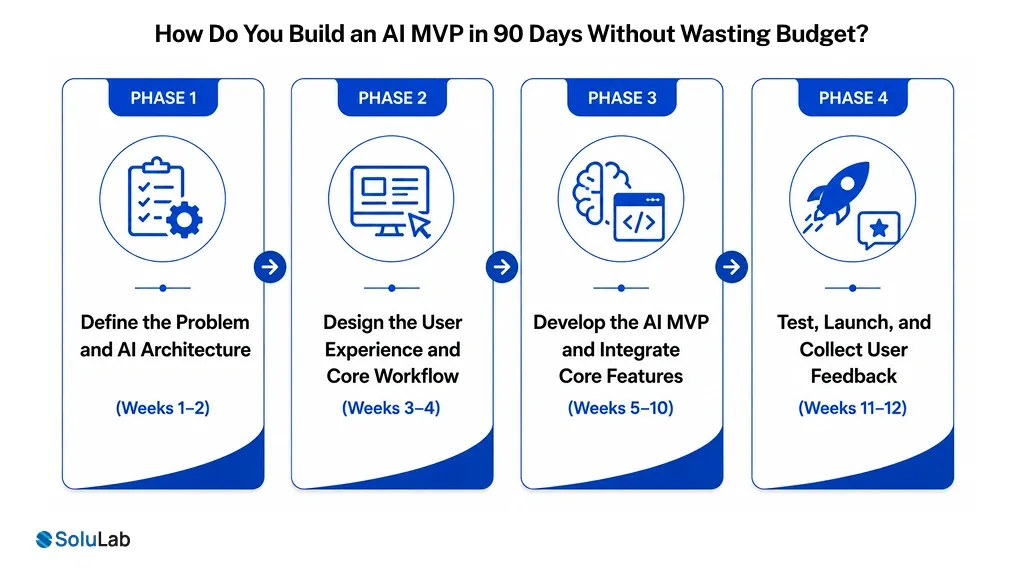
Successful AI MVP projects follow a structured roadmap focused on solving one business problem at a time.
Phase 1: Define the Problem and AI Architecture (Weeks 1–2)
Every successful project begins with problem validation.
You should identify a measurable operational bottleneck, customer pain point, or revenue opportunity. The goal is to define success metrics before writing a single line of code.
During this stage, AI developers evaluate:
- Available datasets
- AI model requirements
- Cloud infrastructure
- Compliance requirements
- Security controls
- API dependencies
This stage forms the foundation of effective AI solution development.
Teams should also determine whether the solution requires LLMs, Retrieval-Augmented Generation (RAG), computer vision, forecasting models, or recommendation systems.
Phase 2: Design the User Experience and Core Workflow (Weeks 3–4)
User adoption depends heavily on usability.
While building an AI product MVP, teams should focus on creating intuitive workflows that minimize friction. Every screen should support a specific business objective.
Important design considerations include:
- User journey mapping
- Prompt design
- Approval workflows
- Error handling
- Response visibility
- Human review checkpoints
Businesses often underestimate the importance of user experience. Even highly accurate AI systems fail when users struggle to interact with them efficiently.
Phase 3: Develop the AI MVP and Integrate Core Features (Weeks 5–10)
This is the longest phase of AI app development.
The AI MVP development process typically includes:
- Frontend development
- Backend APIs
- Authentication systems
- Vector databases
- Model integration
- Monitoring tools
- Analytics tracking
- Security implementation
Developers should prioritize reliability over feature volume.
Organizations frequently leverage AI application development services during this stage to accelerate development and avoid architecture mistakes that create scaling challenges later.
Continuous testing should occur throughout development rather than waiting until launch.
Phase 4: Test, Launch, and Collect User Feedback (Weeks 11–12)
The final stage focuses on validation.
An effective AI MVP development roadmap includes structured testing before public release.
Key evaluation areas include:
- Response accuracy
- Model hallucinations
- System latency
- User engagement
- Feature adoption
- Business KPIs
Beta users provide insights that internal teams often overlook.
The objective is not perfection. The objective is to learn which features generate measurable value and which require improvement.
Common Mistakes That Delay AI MVP Development
AI MVPs are designed to reduce risk and accelerate validation, yet several avoidable mistakes continue to increase development costs, extend timelines, and limit business outcomes. Understanding these challenges early helps founders and product teams make better decisions throughout the development cycle.
1. Trying to Solve Multiple Problems at Once
One of the most common mistakes is attempting to address several business challenges within a single MVP. People often add extra features, user segments, and AI capabilities in an effort to maximize value.
This approach usually creates development bottlenecks and makes it difficult to measure success.
Common signs:
- Multiple use cases in the initial roadmap
- Several AI models are planned for the first release
- Expanding requirements during development
- Undefined primary business objective
Recommended approach:
- Focus on one measurable problem
- Define one primary success metric
- Launch with a single user persona
- Add features only after validation
2. Starting Development Without High-Quality Data
Even the most advanced AI models cannot consistently deliver accurate outputs when trained or prompted with poor-quality data.
Many projects underestimate the effort required to clean, organize, and structure business data before development begins.
Common issues:
- Duplicate records
- Missing information
- Outdated documentation
- Inconsistent formatting
- Siloed data sources
Recommended approach:
- Conduct a data audit before development
- Identify data gaps early
- Establish governance policies
- Create standardized data structures
- Validate datasets before model integration
A well-prepared dataset often improves outcomes more effectively than switching to a larger AI model.
3. Overbuilding Features Before Validation
Teams frequently spend months building advanced functionality before understanding what users actually need.
Every additional feature increases development effort, testing requirements, maintenance costs, and user complexity.
Examples of unnecessary early features:
- Advanced analytics dashboards
- Multi-language support
- Complex workflow automation
- Extensive third-party integrations
- Enterprise administration modules
Recommended approach:
- Build only the features required to validate demand
- Prioritize core workflows
- Use feedback to guide future development
- Maintain a lean release cycle
A successful MVP proves value first and expands later.
4. Ignoring AI Monitoring and Performance Tracking
Many teams focus heavily on launch activities while overlooking post-deployment monitoring.
Unlike traditional software, AI agent systems can experience performance degradation over time due to changing user behavior, evolving datasets, and model drift.
Risks of poor monitoring:
- Declining response quality
- Increased hallucinations
- Latency issues
- Unexpected API costs
- Reduced user satisfaction
Key metrics to track:
- Response accuracy
- User engagement rates
- Token consumption
- System latency
- Error rates
- Feedback scores
Continuous monitoring helps teams identify issues before they impact business performance.
5. Skipping Human Review and Governance Controls
AI systems should not operate without oversight in high-impact workflows. Industries such as healthcare, finance, insurance, legal services, and compliance require human validation for critical decisions.
Organizations that remove human review too early often face trust, compliance, and operational risks.
Areas requiring oversight:
- Financial recommendations
- Compliance decisions
- Medical guidance
- Fraud investigations
- Legal document generation
Recommended approach:
- Implement approval workflows
- Define escalation paths
- Maintain audit trails
- Use confidence scoring systems
- Keep humans involved in sensitive decisions
Human-in-the-loop processes improve reliability while building user trust.
6. Choosing Technology Before Defining Business Goals
A common mistake is selecting AI models, frameworks, or vendors before identifying the actual business problem.
Teams become focused on AI technology trends instead of measurable outcomes.
Typical consequences:
- Unnecessary infrastructure costs
- Complex architecture
- Longer development cycles
- Misaligned product capabilities
Recommended approach:
- Define business KPIs first
- Identify user pain points
- Select technology based on requirements
- Validate ROI before expanding infrastructure
Technology should support the business objective, not drive it.
7. Underestimating Security and Compliance Requirements
Security is often treated as a scaling concern rather than an MVP requirement. This creates expensive rework when organizations need to meet customer or regulatory expectations.
Frequently overlooked areas:
- Data encryption
- User authentication
- Access controls
- Compliance documentation
- Data retention policies
Recommended approach:
- Include security planning from day one
- Conduct risk assessments early
- Implement role-based access controls
- Document compliance requirements before launch
Building security into the MVP is significantly easier than retrofitting it later.
8. Failing to Define Success Metrics
Without clear KPIs, teams struggle to determine whether the MVP is successful.
Many AI development projects launch with vague objectives such as improving efficiency or enhancing user experience.
Metrics worth tracking:
- Cost reduction percentage
- Response time improvements
- Customer satisfaction scores
- User adoption rates
- Revenue impact
- Operational efficiency gains
Recommended approach:
- Establish baseline metrics before development
- Define measurable targets
- Review KPIs regularly after launch
- Use results to guide future iterations
Organizations that focus on one problem, build lean solutions, monitor performance continuously, and measure outcomes rigorously are far more likely to launch successfully within a 90-day timeline.
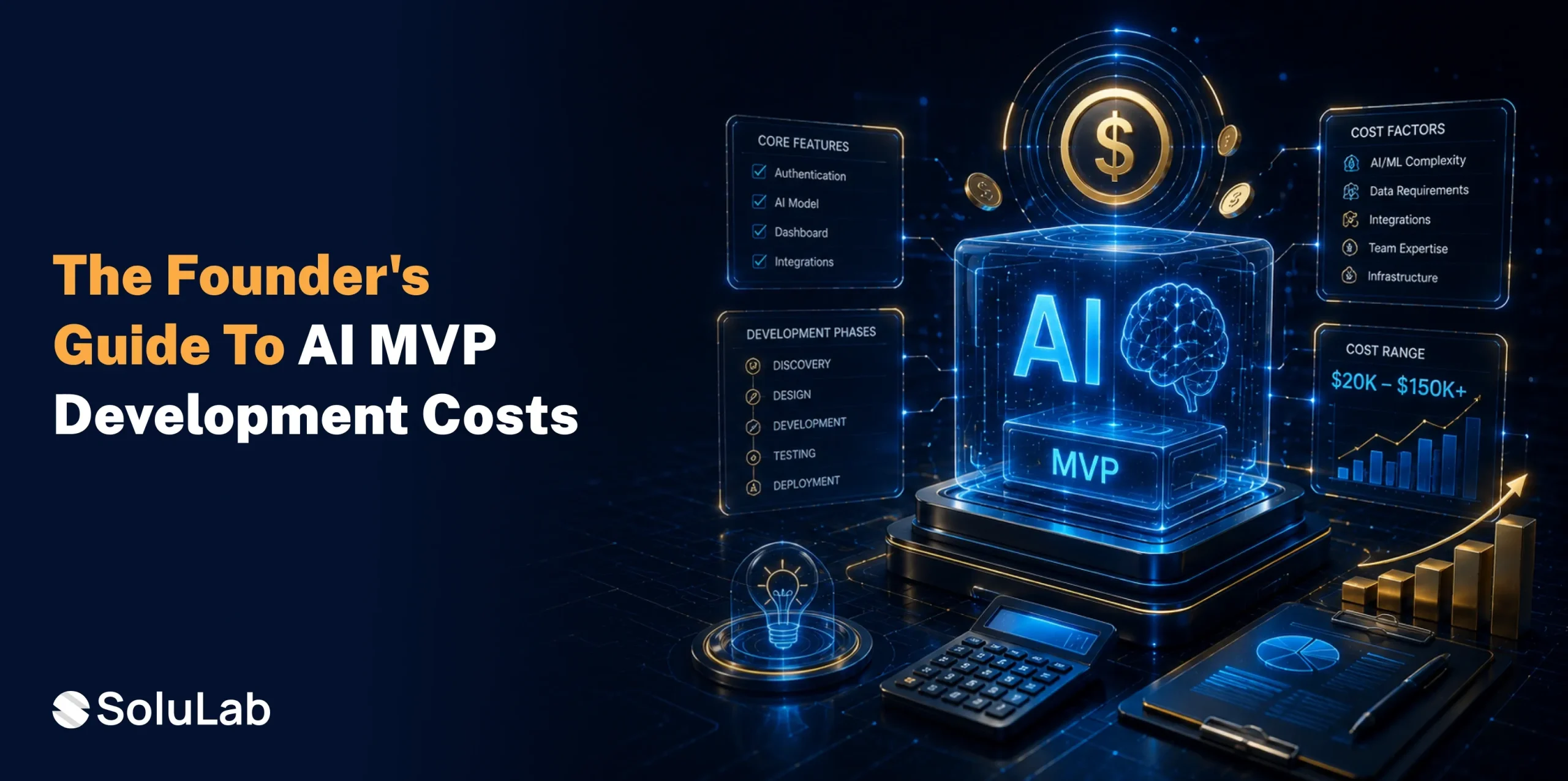
How Much Does It Cost to Build an AI MVP in 2026?
AI MVP costs vary depending on complexity, integrations, compliance requirements, and AI infrastructure.
| Component | Typical Cost Range |
| Discovery & Planning | $3,000–$8,000 |
| UX/UI Design | $3,000–$7,000 |
| AI Development | $10,000–$25,000 |
| Backend & APIs | $5,000–$12,000 |
| Testing & Deployment | $4,000–$8,000 |
Most enterprise AI-based MVPs fall between $25,000 and $60,000.
Industry research indicates that companies successfully moving AI pilots into operational workflows achieve an average 1.7x return on investment.
Operational cost reductions typically range between 26% and 31% across finance, supply chain, and customer operations teams.
A focused MVP generally delivers measurable business outcomes significantly faster than traditional software initiatives.
What Are the Essential AI MVP Features to Build First For a Successful Project?
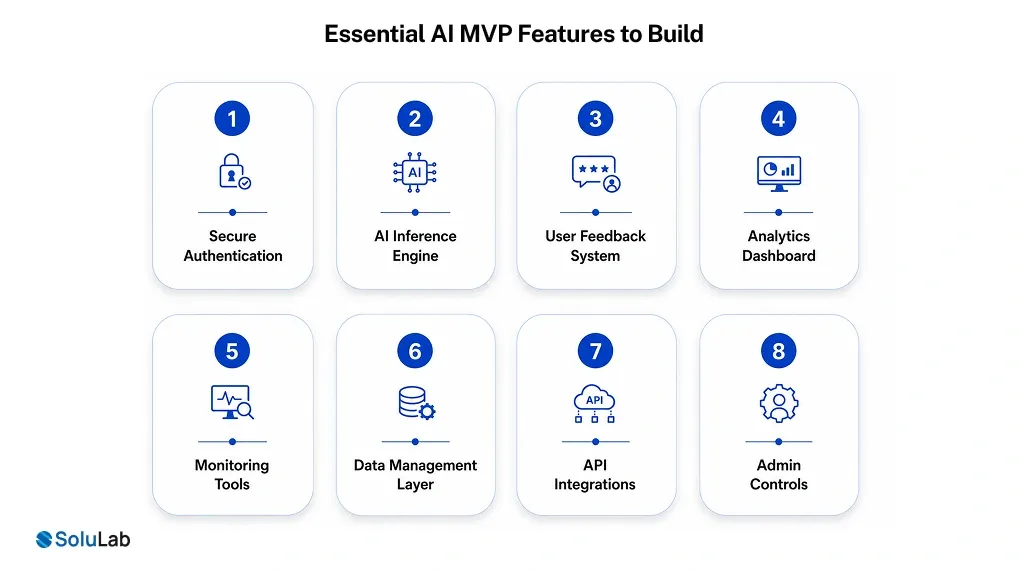
Successful AI MVP product development focuses on building features that validate business value quickly rather than expanding functionality too early.
- Secure Authentication: Around 80% of data breaches involve compromised credentials. Secure login, role-based access, and user verification help protect sensitive business and customer data from day one.
- AI Inference Engine: This is the core of the product. A reliable inference engine ensures users receive accurate responses within seconds, directly impacting adoption and retention rates.
- User Feedback System: AI development companies that collect user feedback during the MVP stage identify product improvements faster. Simple rating systems help teams refine AI performance based on real usage.
- Analytics Dashboard: Employees/managers need visibility into user activity, feature adoption, and engagement trends. Analytics provides measurable insights that support future product decisions.
- Monitoring Tools: AI models require continuous monitoring for latency, accuracy, and failures. Early monitoring reduces downtime and helps maintain consistent performance.
- Data Management Layer: Nearly 70% of AI project challenges stem from data-related issues. Structured data pipelines improve output quality and support long-term scalability.
- API Integrations: When building an AI product MVP, connecting CRMs, ERPs, or internal databases helps deliver real business value instead of isolated AI outputs.
- Admin Controls: User management, audit logs, and permission settings provide operational control and support future enterprise deployments.
Which Real-World AI MVP Examples Generated Measurable Business ROI?
The success of an AI MVP is measured by business outcomes, not model complexity. The following examples show how organizations launched focused AI initiatives, validated results quickly, and expanded adoption after proving value.
1. Klarna’s AI Customer Support MVP
Klarna deployed an AI-powered support assistant to handle refunds, cancellations, payment inquiries, and customer service requests.
Business Results:
- Processed over 2.3 million customer conversations within the first month.
- Delivered work equivalent to approximately 700 support agents.
- Reduced average resolution times from 11 minutes to under 2 minutes.
- Contributed to nearly $40 million in profit improvements through operational efficiency gains.
- Maintained customer satisfaction levels while handling large support volumes.
2. Walmart’s AI Procurement Assistant
As part of its internal AI MVP development, Walmart launched a procurement negotiation assistant connected to historical purchasing data, supplier contracts, and pricing benchmarks.
Business Results:
- Successfully negotiated agreements with 20% of targeted suppliers during the pilot.
- Reduced procurement cycles from weeks to days.
- Achieved acceptance rates exceeding 65% among participating suppliers.
- Improved procurement efficiency without expanding operational teams.
- Reduced manual effort associated with repetitive supplier negotiations.
3. HSBC & Mastercard’s Fraud Detection MVP
Instead of replacing existing compliance infrastructure, both organizations, HSBC and Mastercard, focused on a targeted AI MVP for startups and enterprises by enhancing transaction screening and anomaly detection processes.
Business Results:
- Improved fraud detection effectiveness by 2x to 4x.
- Reduced false-positive alerts by approximately 60%.
- Freed thousands of analyst hours previously spent reviewing legitimate transactions.
- Improved compliance investigation efficiency.
- Increased detection accuracy without disrupting existing banking workflows.
4. Shell & BP’s Knowledge Management AI
These energy companies, like Shell, implemented a RAG-powered knowledge assistant as part of a focused AI MVP development process. Engineers could retrieve operational data, maintenance records, geological information, and safety reports using natural language queries.
Business Results:
- Improved operational production by approximately 4%.
- Reduced engineering research time significantly.
- Prevented nearly 10% more equipment failures and unplanned shutdowns.
- Improved access to decades of historical documentation.
- Enhanced decision-making during field operations and maintenance planning.
These examples demonstrate that successful AI MVPs typically focus on a single operational challenge, measurable business metrics, and rapid validation before expanding into broader deployments.
What Lessons Can Businesses Learn From These AI MVP Success Stories?
The biggest takeaway from these AI MVP examples is that successful companies did not begin with ambitious AI roadmaps. They started with a specific business problem that was already costing time, money, or productivity.
If you are planning an AI MVP, focus on identifying a workflow with measurable impact before discussing models, frameworks, or infrastructure. Klarna targeted customer support costs. Walmart focused on procurement efficiency. HSBC and Mastercard improved fraud detection. Shell and BP streamlined access to critical engineering knowledge.
Here are a few practical lessons founders should consider:
- Start with a single use case. A focused solution is easier to build, test, and improve than a platform designed to solve multiple problems simultaneously.
- Measure business outcomes from day one. Track metrics such as response times, operational costs, productivity gains, revenue impact, or customer satisfaction improvements.
- Use existing business data whenever possible. Most successful AI MVPs create value by utilizing data already available within the organization rather than waiting for perfect datasets.
- Support teams instead of replacing them. AI adoption is often faster when the technology assists employees in making decisions rather than attempting full automation immediately.
- Validate before scaling. Invest in broader features, integrations, and infrastructure only after users consistently engage with the core workflow.
- Build with future expansion in mind. Even a lean MVP should have a flexible architecture that supports additional AI capabilities when business demand increases.
The companies highlighted above generated measurable ROI because they treated AI as a business solution first and a technology project second. Founders who follow the same approach are more likely to achieve faster validation, lower development risk, and stronger long-term adoption.
AI MVP Checklist You Must Know in 2026
Before investing in development, you should evaluate whether their MVP is prepared for real-world deployment. A strong AI MVP Development Framework is not measured by the number of features launched but by how effectively it validates a business objective.
Use this checklist before moving from planning to development:
- A clearly defined business problem with measurable impact on revenue, costs, productivity, or customer experience.
- A specific target user group identified through customer interviews, surveys, or market validation.
- Success metrics and KPIs are established before development begins, including adoption, efficiency, accuracy, or cost-saving targets.
- Reliable data sources are available to support model training, retrieval, recommendations, or AI-powered decision-making.
- The right AI approach is selected, whether LLMs, RAG, predictive analytics, computer vision, or machine learning models.
- Security and compliance requirements documented, especially for finance, healthcare, legal, or enterprise applications.
- Core workflows are prioritized to prevent unnecessary feature expansion during the MVP stage.
- User feedback mechanisms are integrated to capture insights immediately after launch.
- Performance monitoring is configured for accuracy, latency, usage, and operational reliability.
- Scalability considerations are documented so future growth does not require rebuilding the entire product.
- Deployment and maintenance plans prepared for updates, model improvements, and infrastructure management.
- A clear ROI measurement strategy is established to determine whether the MVP justifies further investment.
If most of these boxes are checked, your AI MVP is positioned to move beyond experimentation and generate meaningful business outcomes after launch.
How SoluLab Can Help You in Custom AI MVP Development?
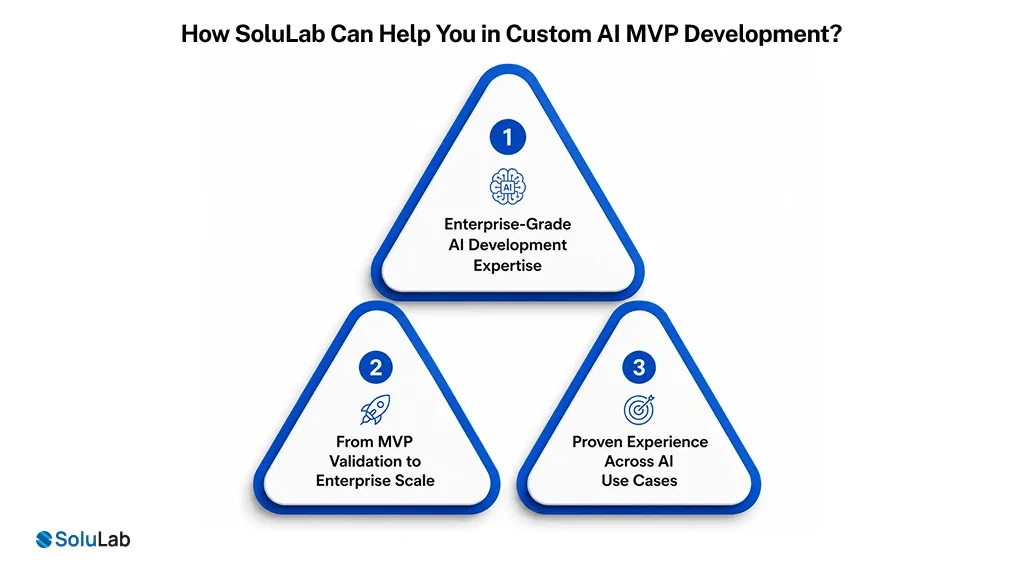
Building an AI MVP is not just about integrating a model and launching a product. It requires the right architecture, scalable infrastructure, secure integrations, and a roadmap that supports future growth. As a leading AI development company, SoluLab helps startups and enterprises move from idea validation to production-ready AI solutions without unnecessary development cycles.
Our team combines expertise in Generative AI, Machine Learning, AI Agents, RAG systems, Computer Vision, Predictive Analytics, and enterprise automation to build MVPs that solve real business challenges. With 300+ AI solutions delivered, we bring proven execution frameworks to every engagement.
1. Enterprise-Grade AI Development Expertise
As a trusted custom AI POC development company, SoluLab follows industry-recognized development standards and engineering practices to ensure security, reliability, and scalability from day one.
Our capabilities include:
- AI Agent Development
- Generative AI Solutions
- RAG Application Development
- Enterprise AI Copilots
- Workflow Automation Platforms
- Predictive Analytics Systems
- Custom Machine Learning Models
- AI-Powered SaaS Platforms
2. From MVP Validation to Enterprise Scale
Most successful enterprises begin with a focused MVP before expanding across departments and business units. SoluLab designs AI architectures that support this journey from the beginning.
Our development process includes:
- Business and AI strategy workshops
- Data readiness assessments
- AI model selection and optimization
- Secure API and third-party integrations
- Cloud deployment and monitoring
- Scalability planning
- Performance optimization and maintenance
This approach helps businesses avoid costly redevelopment as adoption grows.
3. Proven Experience Across AI Use Cases
One example is our AI-powered recruitment platform, Smarter Job Search, designed to simplify and accelerate the hiring process through intelligent automation.
The platform includes:
- AI-powered job matching
- ATS-friendly resume optimization
- Automated opportunity discovery
- Personalized job recommendations
- Intelligent candidate screening
- Professional networking support
By combining AI-driven recommendations with workflow automation, the platform helps users identify relevant opportunities faster while reducing manual effort throughout the job search journey.

Why Businesses Choose SoluLab for AI MVP Development?
According to recent industry reports, more than 70% of enterprises are actively investing in AI initiatives, yet a significant percentage struggle to move from pilot projects to production deployments. The challenge is rarely the technology itself. It is execution, integration, scalability, and measurable business outcomes.
As an experienced provider of AI integration services, SoluLab helps organizations bridge this gap through:
- Faster MVP launch cycles
- Production-ready architecture
- Enterprise-grade security practices
- Scalable cloud infrastructure
- Continuous monitoring and optimization
- Dedicated AI engineering teams
For businesses seeking reliable AI development services in USA and global markets, SoluLab provides the technical expertise, strategic guidance, and implementation support required to turn promising AI ideas into validated products with measurable business impact.
FAQs
Deepika is a content writer who blends storytelling with strategic thinking. She explores topics across digital innovation, emerging tech, and the evolving blockchain industry. She enjoys breaking down complex ideas into simple, engaging narratives in the growing global markets.