Key Takeaways
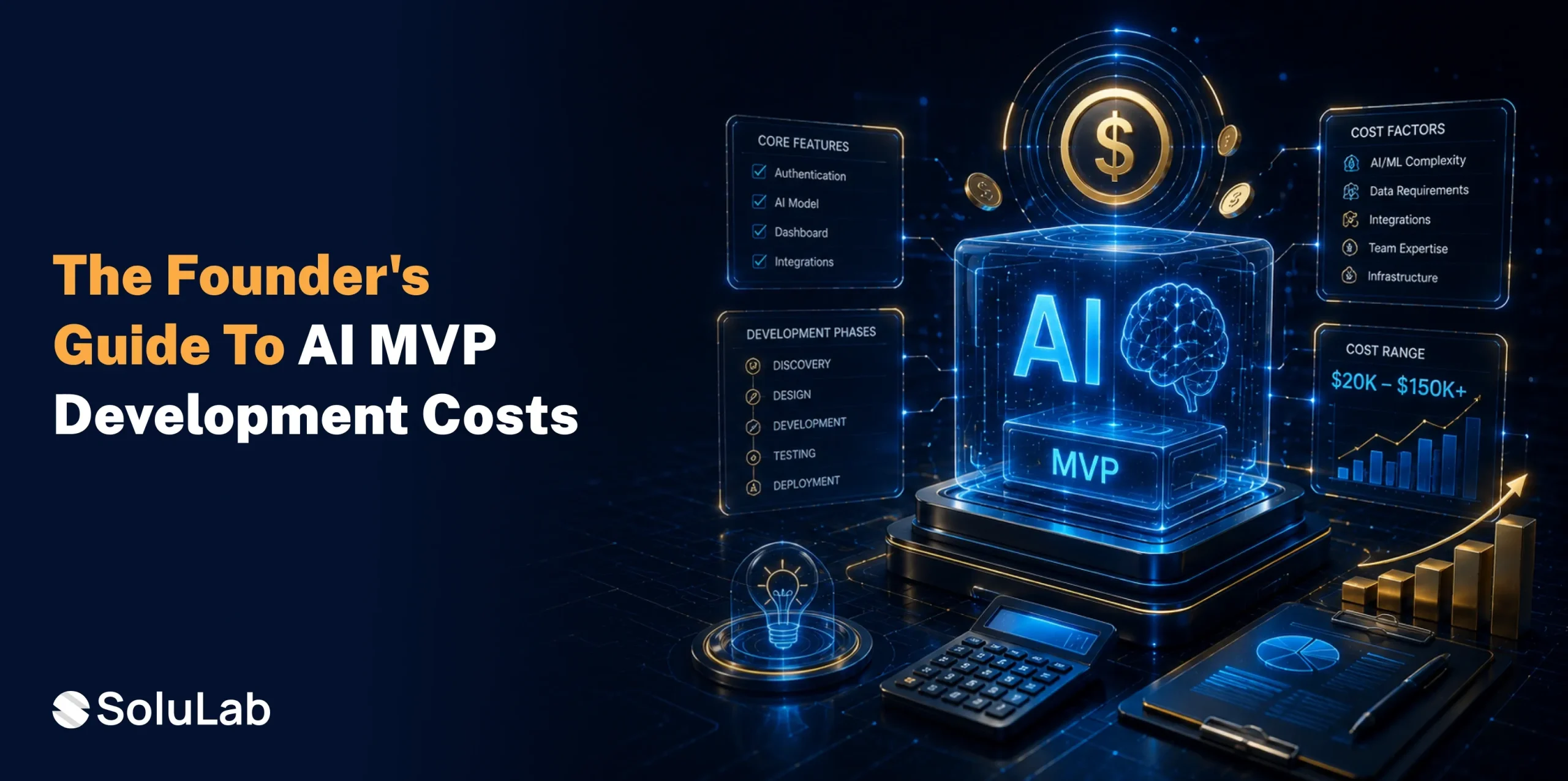
- Typical AI MVP cost: $10,000–$35,000 for an API-based MVP; $80,000–$300,000+ for a custom, compliance-heavy, or agentic build.
- The model is the cheap part. LLM API pricing has dropped sharply over the past two years. Most of an AI MVP budget goes to data pipelines, evaluation, prompt engineering, and infrastructure, not the model itself.
- Ongoing cost matters as much as the build cost. A standard MVP costs money once. An AI MVP costs money twice: once to build, and continuously to run inference, monitor accuracy, and retrain.
- Enterprise data backs this up. Gartner reports that over 40% of agentic AI projects will be canceled by the end of 2027, largely due to escalating costs and unclear business value, not failed technology.
Most AI MVPs cost between $10,000 and $150,000, depending on whether you’re wiring up an existing AI API or building custom retrieval and agent infrastructure. A simple chatbot-style MVP built on an LLM API can cost as low as $10,000 to $35,000. A production-ready MVP with retrieval-augmented generation (RAG), custom data pipelines, or compliance requirements (healthcare, finance) typically runs $80,000 to $300,000+.
That range is wide on purpose. AI MVP pricing depends less on the idea itself and more on four things: which architecture you choose, how much data preparation is needed, whether you’re subject to regulatory compliance, and who builds it. This guide breaks down the real numbers by tier, what actually drives the cost of AI MVP development, and how enterprise AI spending data from Gartner, Deloitte, and KPMG explains why so many AI budgets go sideways before an MVP ever ships.
What Counts as an “AI MVP” (And What Doesn’t)?
An AI MVP is a working version of your product that includes only the core AI feature you need to validate, real users interacting with it, and real usage you can measure against a defined goal. It is not a demo, and it is not a slide deck with a mocked-up screenshot.
That distinction matters for budgeting, because vendors quote very different things under the same label:
- Proof of Concept (PoC): Tests whether the underlying idea is technically feasible. Internal only, no real users. Typically $5,000–$20,000 and 1–3 weeks.
- Prototype: A clickable or partially functional draft used to test the user experience and design direction. Typically $5,000–$40,000 and 2–6 weeks.
- MVP: A real, working product with authentication, a real backend, and real user data, built to be measured against defined KPIs. Typically $10,000–$150,000+ and 6–24 weeks.
Want to know in detail? Read the blog—POC vs Prototype vs MVP
Enterprise-focused AI projects rarely stay under $30,000–$40,000 once they’re genuinely at the MVP stage rather than the PoC stage. If a vendor quotes a low number for a “full MVP,” it’s worth asking exactly what’s included, because a scoped-down PoC dressed up as an MVP is one of the most common sources of budget disputes mid-project. SoluLab’s breakdown of how to build an MVP with blockchain or generative AI walks through this exact staging question in more depth, including how timelines shift between a GenAI MVP and a blockchain-based one.

AI MVP Cost by Architecture Tier
The architecture you choose accounts for most of the swing in AI MVP development cost. Here’s how the tiers typically break down:
| Tier | What it is | Typical cost | Timeline |
|---|---|---|---|
| API wrapper | Calls an LLM API (OpenAI, Anthropic, Gemini) directly with a structured prompt, no custom retrieval | $3,000–$20,000 | 2–6 weeks |
| RAG (retrieval-augmented) | LLM answers questions using your own documents or knowledge base via a vector database | $8,000–$60,000 | 4–10 weeks |
| Custom/fine-tuned model | Includes model training, data labeling, and retraining loops on top of the base architecture | $50,000–$150,000+ | 10–20 weeks |
| Agentic/multi-step workflow | Multiple coordinated AI actions, tool use, and orchestration across systems | $100,000–$300,000+ | 12–24 weeks |
These figures are a synthesis of publicly available 2026 industry pricing guides from AI development firms rather than a single fixed quote, and your actual number will depend on your specific integrations and compliance needs. Treat this table as a starting point for conversations with a development partner, not a final invoice. For a closer look at how these tiers play out over an actual build calendar, SoluLab’s 90-day AI MVP roadmap maps the architecture decision to a week-by-week delivery plan.
What Actually Drives AI MVP Development Cost?
Founders often assume the AI model is the expensive part. It usually isn’t. API pricing from the major model providers has fallen sharply over the past two years, and Stanford’s HAI research has tracked roughly a 280-fold decline in inference cost for a given level of performance over that period. What actually moves your AI development cost is everything wrapped around the model:
- Data readiness. Cleaning, labeling, and structuring your data typically adds 20–30% to the total build cost. If your data lives in scattered spreadsheets or unstructured documents, budget for this before anything else.
- Integration complexity. Connecting the AI feature to your existing systems, CRM, ERP, and internal databases often costs more than the AI feature itself.
- Compliance requirements. Healthcare (HIPAA), finance (SOC 2, PCI), or EU-facing products (GDPR) typically add a 20–40% premium for the compliance architecture alone. SoluLab’s AI consulting cost guide breaks this premium down further if you’re weighing a consulting engagement alongside the build itself.
- Evaluation and guardrails. A production-credible MVP needs an evaluation harness to catch hallucinations and drift, not just a working demo. Skipping this is the single most common reason pilots stall before scaling.
- Team location and structure. A senior offshore team can deliver a custom build for $50,000–$120,000; a comparable US-based team often starts near $150,000.
Why 2026 Enterprise Budgets Keep Missing the Mark?
If you’re budgeting for an AI MVP inside a larger organization, it helps to understand the environment you’re building in. Three major 2026 research programs point to the same underlying pattern: AI spending is accelerating faster than organizations’ ability to plan for it accurately.
Gartner forecasts worldwide AI spending will reach $2.59 trillion in 2026, a 47% jump year over year, with 2026 named the inflection year for mainstream enterprise adoption. But Gartner’s own data carries a warning alongside that growth: more than 40% of agentic AI projects will be canceled by the end of 2027, driven by escalating costs, unclear business value, and inadequate risk controls. That’s not a technology failure. It’s a scoping and budgeting failure, and it’s the exact trap an honestly-costed AI MVP is designed to avoid.
Deloitte’s State of AI in the Enterprise 2026 report, based on a survey of 3,235 business and IT leaders, documents what it calls the “proof-of-concept trap”: pilots estimated to take three months routinely stretch to eighteen months once integration complexities surface. Talent readiness compounds the problem. Deloitte found organizational talent preparedness for AI is the weakest dimension measured, at only 20% of leaders reporting high preparedness, and that figure declined year over year rather than improved.
KPMG’s Global AI Pulse survey for Q2 2026 puts a number on the visibility gap: organizations now plan to invest an average of $202 million in AI over the next 12 months, yet only 26% have real-time visibility into what running their AI actually costs. That gap between spend and cost visibility is precisely where MVP budgets balloon after launch, when inference, monitoring, and retraining costs arrive as a surprise rather than a planned line item.
The common thread across all three: the money is there, but the discipline to scope, budget, and track an AI build accurately is still catching up. A well-scoped AI MVP, built with a clear cost breakdown from day one, is the cheapest insurance against becoming one of Gartner’s canceled statistics.
The Ongoing Costs Most Estimates Leave Out
A standard software MVP costs money once: the build. An AI MVP costs money twice, the build and the ongoing operation, and the second number is the one founders most often underbudget. Plan for:
- Inference costs that scale with usage, not with seats. A pilot with 50 test users can look ten times more expensive once it reaches a few thousand active users.
- Monitoring and evaluation infrastructure to catch model drift, hallucinations, or degraded outputs before users notice them.
- Retraining or prompt-tuning cycles as your data and use cases evolve after launch.
- Human-in-the-loop review for any high-stakes decision the AI makes, which is a real, ongoing labor cost, not a one-time engineering line item.
Budgeting for these after the fact is how a “$30,000 MVP” quietly turns into a $90,000 annual run rate. Ask any AI MVP development partner to show you a 12-month cost projection, not just a build quote, before you sign. SoluLab’s AI automation cost guide for small businesses is a useful reference if your MVP is really an automation workflow wearing an MVP label, since the run-cost math works differently there.
How to Reduce AI MVP Cost Without Cutting the Wrong Corners?
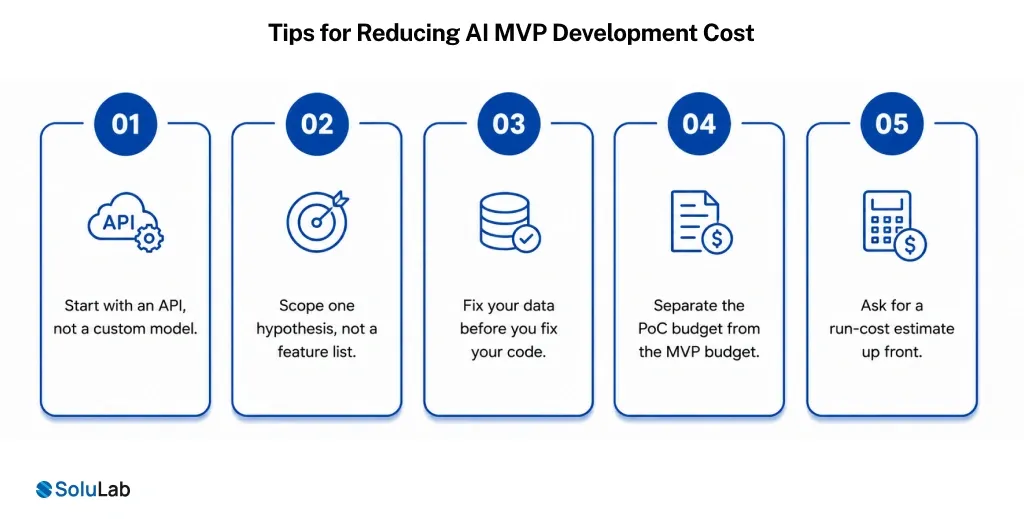
- Start with an API, not a custom model. Validate demand with GPT, Gemini, or Claude before investing in fine-tuning or custom training.
- Scope one hypothesis, not a feature list. The fastest way to inflate cost to build an AI MVP is to quietly turn it into a v1.0 product during the build.
- Fix your data before you fix your code. Data cleanup is cheaper before the build starts than after a model is already underperforming on messy inputs.
- Separate the PoC budget from the MVP budget. Don’t let a vendor collapse both into
- one number. You want to know what you’re paying to prove feasibility versus what you’re paying to build something real users can touch.
- Ask for a run-cost estimate up front. A credible AI MVP development company will model your first-year operating cost alongside the build cost, not just the build cost alone.
Choosing an AI MVP Development Partner
Not every AI MVP development company is scoped for the same job. Before you commit to a budget, it helps to separate a few distinct types of AI MVP development services:
- No-code and low-code builders (Bubble, Glide) are a reasonable fit for simple data-transformation or internal tools, but tend to hit a wall at the first custom integration, compliance requirement, or investor due diligence question.
- Boutique AI development studios are usually the right fit for a first custom AI MVP: they specialize in exactly this build (API integration, RAG, evaluation harnesses) and can move faster than a generalist agency.
- Full-scale custom AI MVP development solutions from enterprise-grade AI development companies make sense once compliance, scale, or agentic orchestration are genuinely part of the MVP, not aspirational future features.
Whichever route you choose, ask any potential AI MVP development partner three questions before signing anything: what exactly counts as “done” for this MVP, what happens to the cost if your data isn’t as clean as expected, and what the estimated monthly run cost looks like once real users show up.
A partner who can answer all three clearly, with real numbers rather than a range they can’t defend, is one worth trusting with your budget. SoluLab, for instance, scopes AI PoC development and that for MVP work separately and has run over 1,500 projects across AI, blockchain, and software development, which is the kind of track record worth asking any custom AI MVP development solutions provider to show you before you commit a budget.
Common Mistakes That Blow Up AI MVP Budgets
- Treating a PoC quote as an MVP quote. These are different deliverables at different price points, and confusing them is the single most common source of mid-project budget disputes.
- Skipping the evaluation harness. A model that looks accurate in a demo and hallucinates in production isn’t an MVP; it’s a liability with a UI.
- Under-scoping data preparation. Teams that treat data cleanup as an afterthought routinely see it consume the budget they’d set aside for the AI feature itself.
- Ignoring compliance until late in the build. Retrofitting HIPAA, SOC 2, or GDPR requirements after the architecture is set costs far more than designing for them from day one.
- Budgeting only for the build, not the run. As the KPMG data above shows, most organizations still can’t see their real-time AI running costs. Don’t join that majority.
Getting an Accurate Number for Your Project
Every figure in this guide is a range, because your actual AI MVP budget depends on your data, your existing systems, your compliance obligations, and the specific architecture your use case actually needs. None of that becomes clear from a blog post, it becomes clear from a scoping conversation with a team that builds these regularly.
If you’re weighing whether your idea needs a PoC, a prototype, or a full MVP, and what it will realistically cost to get there, SoluLab’s AI development team can walk you through it on a free discovery call. As an AI-native product development partner with over a decade of delivery experience and 1,500+ completed projects, SoluLab will tell you honestly which stage you’re actually at, what a realistic build and run-cost estimate looks like for your specific use case, and where you can safely cut scope without cutting the parts that make the MVP worth building at all.
FAQs
Tanmay is focused on building brand authority through narrative-driven marketing. With 19+ years in tech branding, he has positioned SoluLab as a thought leader in the Blockchain and AI sectors. He regularly shares insights on AI-driven brand storytelling and content strategy. He is open to connecting with startups and enterprise teams to help them overcome their challenges.