
Key Takeaways
- Land subdivision is the use case competitors skip. Setbacks, easements and access are rules an engine can check; lot yield is an objective it can optimise.
- Three data pipelines unlock everything else: geospatial, zoning text, and market transactions. Clean those and most use cases become tractable.
- AI-parsed zoning is a first pass, not a legal opinion. Accuracy varies by jurisdiction, and a model tuned on one municipality degrades in the next.
- Generative design pays back fastest in subdivision by cutting the redesign cycles that stall entitlement.
- Treat AVM output as an estimate with a confidence band. Accuracy drops in thin markets and models can inherit bias from historical sales data.
- Post-development AI is table stakes. The edge sits upstream in site selection, zoning and parcel design.
- Most teams should go hybrid: license mature AVM and GIS tooling, build the layer that reflects how your firm works.
- Valuation is where AI and blockchain meet. The AVM sets the number, tokenization gives raw land the liquidity it usually lacks.
AI supports real estate development and land subdivision across the full lifecycle: site selection, zoning and entitlement analysis, generative parcel and plat design, valuation and underwriting, and post-development operations. Machine learning models score sites and forecast value, while computer vision reads aerial and survey imagery to speed feasibility work that used to run manually for weeks.
Most proptech coverage treats “real estate” as one blob and skips the development side. This guide isolates the develop-and-subdivide workflow, names the specific models and data each step needs, and shows where AI outputs can feed tokenized land ownership. SoluLab builds these systems as an AI development company for developers, land planners, and proptech teams.
What is AI’s role in real estate development and land subdivision?
AI adds three things to a development pipeline that is still largely manual: prediction, automation, and generative design. Prediction scores which sites and layouts will perform. Automation reads documents, imagery, and survey data faster than a human team. Generative design produces and ranks many parcel and building options against your constraints instead of one hand-drawn scheme.
Land subdivision is where this matters most and where competitors stay vague. Subdivision is the act of splitting a parcel into buildable lots subject to zoning, setbacks, easements, utility routing, and access rules. Every one of those constraints is a rule an AI system can check, and lot yield is an objective a model can optimize. The rest of this guide walks the lifecycle stage by stage.
Across all stages, three data types recur: geospatial data (GIS parcel boundaries, elevation, flood zones), zoning and entitlement text, and market and transaction data for valuation. Get those pipelines clean and most AI use cases below become tractable.
Which AI use cases matter most in site selection and feasibility?
The highest-value early use cases are predictive site scoring, demand forecasting, and aerial imagery analysis. A model ranks candidate parcels on the factors that drive a project, then a human shortlists. This compresses a research phase that often takes a small team days into a repeatable scoring run.
Specific models and methods in this stage:
- Predictive site scoring. Gradient-boosted models (XGBoost, LightGBM) rank parcels on comparable sales, demographics, traffic counts, and zoning fit.
- Demand forecasting. Time-series and regression models project absorption and rent for a submarket.
- Computer vision on aerial and satellite imagery. Segmentation models read land cover, existing structures, vegetation, and access from imagery, which feeds early feasibility. Public sector research and Esri’s GeoAI tooling show deep learning extracting parcels and features directly from aerial data ([Esri GeoAI](https://www.esri.com/arcgis-blog/products/arcgis-pro/geoai/vision-language-models-geospatial-analysis)).
- Constraint screening. Automated checks flag flood zones, slope, and protected land before you spend on due diligence.
The output is a ranked shortlist with reasons, not a black box. Keep a human in the loop for the final call, because local knowledge still beats the model on edge cases.
How does AI help with zoning, entitlements, and buildable envelope analysis?
AI reads zoning code with natural language processing (NLP), then a rules engine estimates the buildable envelope and scores entitlement risk. Zoning ordinances are long, inconsistent, and written for lawyers. NLP models parse them into structured parameters: use permissions, height limits, floor area ratio, setbacks, and parking minimums.
This is an active research area, not vendor hype. Academic and civic-tech projects have tested large language models on extracting zoning parameters from municipal by-laws, with mixed but improving accuracy that depends heavily on document quality Yale Urban, Code Shift; arXiv zoning NLP study. Accuracy varies by jurisdiction, so treat AI-parsed zoning as a first pass a planner reviews, not a legal opinion.
Once the parameters are structured, a deterministic rules engine computes the buildable envelope for a parcel and flags where a design would breach code. Entitlement risk scoring layers on historical approval data to estimate how contentious a variance might be. Both outputs are auditable, which matters when you defend a scheme to a planning board.
How is AI used in land subdivision and parcel/plat design?
This is the core differentiator. Generative design produces many candidate lot layouts, then optimizes for lot yield while respecting setbacks, easements, access, and utility routing. Instead of an engineer drawing one plat, the system searches thousands of configurations and returns the few that best fit your objective.
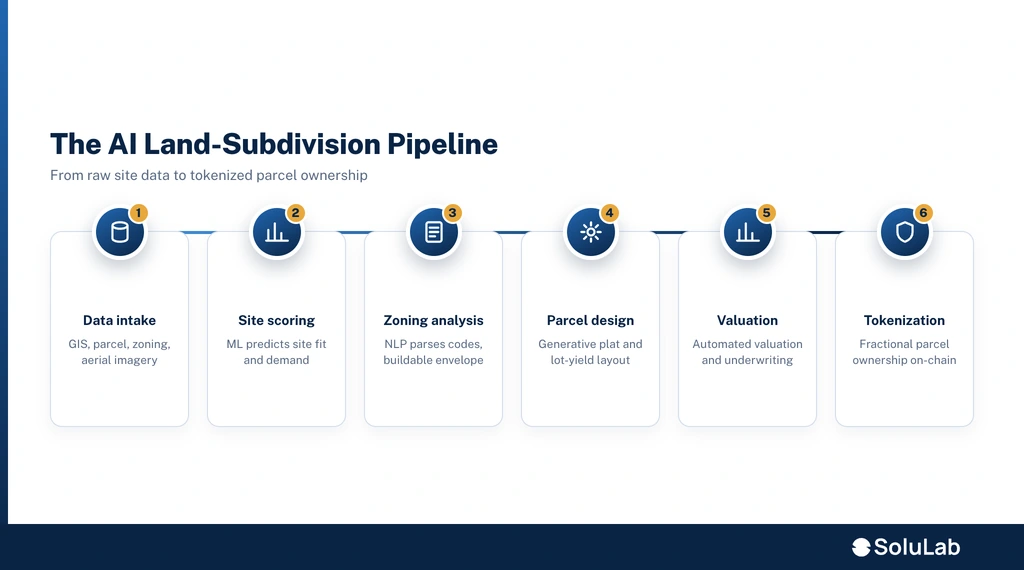
How the pipeline works in practice:
- Ingest constraints. Parcel boundary, topography, zoning parameters, and required rights of way.
- Generate layouts. A generative or optimization engine proposes lot arrangements, road networks, and block structures.
- Score and rank. Each layout is scored on lot yield, average lot size, road length, and cut/fill balance.
- Check compliance. Setback, easement, frontage, and access rules are validated on every candidate.
- Export. The chosen plat exports to CAD and GIS for engineering.
Commercial generative-design tools already do a version of this for building massing and site plans; TestFit is one named example that generates and optimizes site layouts against constraints TestFit generative design. For raw land subdivision specifically, lot-yield optimization and automated setback checks are the two use cases with the clearest payback, because they cut the redesign cycles that stall entitlement.
How does AI improve property valuation and underwriting for development sites?
AI valuation runs on automated valuation models (AVMs): machine learning models that estimate value from comparable sales, property attributes, and location features. For development sites, the same approach forecasts finished-product value and feeds a pro forma, so underwriting starts from a data-driven number instead of a broker’s guess.
The evidence base here is real and growing. Peer-reviewed work shows machine learning methods (random forests, gradient boosting, and neural networks) improving valuation accuracy over traditional hedonic regression, with the caveat that data quality and local coverage drive results ScienceDirect, ML in valuation. Independent research also flags that AVMs can reproduce bias in the underlying data, which is a fairness and liability issue to manage, not ignore Urban Institute on AVM disparities.
Practical guardrails for development underwriting:
- Use the AVM as a starting estimate with a confidence band, not a single point.
- Keep an appraiser or analyst in the loop for anything financed or contested.
- Audit inputs for gaps in thin markets, where models are least reliable.
- Track model drift as market conditions move.
Do not publish a valuation-accuracy percentage you cannot cite to your own tested model.
What AI use cases apply after development (marketing, operations, energy)?
After delivery, AI shifts to demand-based pricing, marketing, and building operations. Pricing models set and adjust rents or list prices from live demand. Marketing uses virtual staging and generative imagery to show finished units before they exist. Building operations use sensor data and forecasting to cut energy use and predict maintenance.
Named use cases at this stage:
- Dynamic pricing. Demand models adjust pricing by unit, season, and comparable supply.
- Virtual staging and generative visuals. Image models stage empty units and produce marketing renders.
- Energy optimization. Forecasting models and controls reduce HVAC load; industry analysis points to meaningful operational gains from AI in building management JLL on AI in real estate.
- Predictive maintenance. Sensor data flags equipment issues before failure.
These are useful but table stakes across proptech. The development and subdivision use cases above are where an owner-builder gains a real edge.
Build vs buy vs hybrid: how should you deliver AI for real estate development?
Choose based on how specific your workflow is, who must own the data, and how much control you need over the models. Off-the-shelf proptech is fastest for common tasks. A custom build wins when your subdivision logic, data, or integrations are your advantage. A hybrid buys the commodity parts and builds the differentiators.
| Approach | Best for | Time to value | Cost driver | Control / customization | Data ownership |
| Off-the-shelf proptech | Standard valuation, listing, and CRM tasks | Fastest | Per-seat or per-transaction subscription | Low; you fit the tool | Vendor-hosted; check terms |
| Custom build | Proprietary subdivision, zoning, or valuation logic | Slowest | Engineering and data pipeline effort | Full; you own the models | You own it end to end |
| Hybrid | Buy commodity, build the edge | Middle | Mix of license plus build | Targeted where it matters | Split by component |
Most development teams land on hybrid: license mature AVM and GIS tooling, then build the parcel-design, zoning-parsing, or underwriting layer that reflects how your firm actually works. SoluLab typically scopes builds this way so you are not paying to rebuild solved problems.
How do AI and blockchain combine for tokenized land and parcel ownership?
AI and blockchain combine cleanly at the point of valuation. AI produces the underwriting and valuation output; blockchain records fractional ownership of the underlying land or parcel as tokens. The AI answers “what is this worth and what will it yield,” and tokenization answers “how do many investors hold a share of it with a clear, transferable record.
The pattern in practice: an AVM and pro forma set the asset value, that value backs a token issuance, and smart contracts govern ownership splits, transfers, and distributions. Fractional real estate ownership on-chain is a documented and growing model in both research and industry ([Chainlink on fractional ownership](https://chain.link/article/fractional-ownership-blockchain)). Pairing a defensible AI valuation with tokenized ownership gives investors both a number they can trust and liquidity they usually cannot get with raw land.
This is the honest angle SoluLab can own, because it already ships both halves. SoluLab works as a real estate tokenization development company and maintains a rundown of the top real estate tokenization platforms so you can compare approaches before you build. Its machine learning development company team builds the valuation and forecasting models that feed the token layer.
What does it cost and how long does it take to build an AI real estate module?
Cost and timeline depend on which module you build, not a single sticker price. The honest answer is a set of drivers, each of which you can estimate once scope is fixed. Do not trust a fixed quote before the data audit.
The main cost and timeline drivers:
- Scope of the module. A single AVM is far cheaper than a full subdivision-design engine with zoning parsing.
- Data readiness. Clean GIS, parcel, and transaction data cuts cost; messy or missing data dominates the budget.
- Model complexity. A gradient-boosted valuation model is quicker to ship than a generative layout optimizer.
- Integrations. Each connection to CAD, GIS, BIM, or an existing system adds engineering time.
- Compliance and review. Valuation liability and jurisdiction coverage add legal and QA effort.

What are the main challenges and how do you mitigate them?
The recurring blockers are data quality, valuation-model bias, zoning variance by jurisdiction, and integration with existing GIS and CAD tools. None is a reason to avoid AI; each has a known mitigation.
- Data quality. Thin or dirty data breaks every downstream model. Mitigate with a data audit up front and confidence bands on outputs.
- Model bias in valuation. AVMs can reproduce bias in historical sales data. Mitigate with fairness testing, human review on financed deals, and input audits Urban Institute.
- Jurisdiction variance. Zoning differs by municipality, so a model tuned on one city degrades elsewhere. Mitigate by treating AI-parsed zoning as a reviewed first pass and scoping coverage explicitly.
- Tool integration. Development teams already run GIS, CAD, and BIM. Mitigate by building to open export formats and existing APIs rather than replacing tools wholesale.
FAQs
Chintan leads SoluLab's highest-level AI consulting conversations, assessing whether a client's business problem actually justifies an AI investment before any solutioning begins.