Key Takeaways
- Tokenized real estate platforms are transforming traditional property investment by enabling fractional ownership, improved liquidity, and broader access to real estate assets through blockchain technology.
- Hong Kong’s emerging tokenization models demonstrate how digital asset infrastructure can modernize real estate markets, making property investments more transparent, efficient, and accessible to global investors.
- Fractional ownership is one of the biggest advantages of tokenized real estate, allowing investors to purchase smaller shares of high-value properties while reducing capital barriers.
- Partnering with an experienced real estate tokenization development company like SoluLab can accelerate platform deployment, reduce technical complexities, and ensure long-term scalability in the rapidly growing tokenized asset market.
Real estate tokenization is no longer a niche experiment. You are now looking at a market shaped by institutional pilots, regulator-backed infrastructure, and increasingly clear rules in hubs like Hong Kong, Singapore, Dubai, and the US. If you want to build a serious tokenized real estate platform in 2026, you need more than a flashy investor dashboard. You need a legal structure, a compliant token design, settlement logic, investor operations, and a go-to-market model that works even if secondary liquidity develops slowly.
Hong Kong matters because it is moving from policy talk to operational infrastructure. The HKMA’s Project Ensemble and EnsembleTX demonstrate how tokenized deposits, digital assets, and regulated financial workflows can be integrated within a supervised environment through 2026. That makes Hong Kong one of the most instructive blueprints if you plan for real estate tokenization platform development that can survive due diligence from regulators, banks, fund managers, and enterprise clients.
If your goal is to enter this space with speed and credibility, this guide gives you the roadmap. You will learn what a real estate tokenization platform actually is, how Hong Kong’s emerging models work, what features and compliance controls you need, how much development can cost, and how to choose the right partner to launch responsibly in 2026.
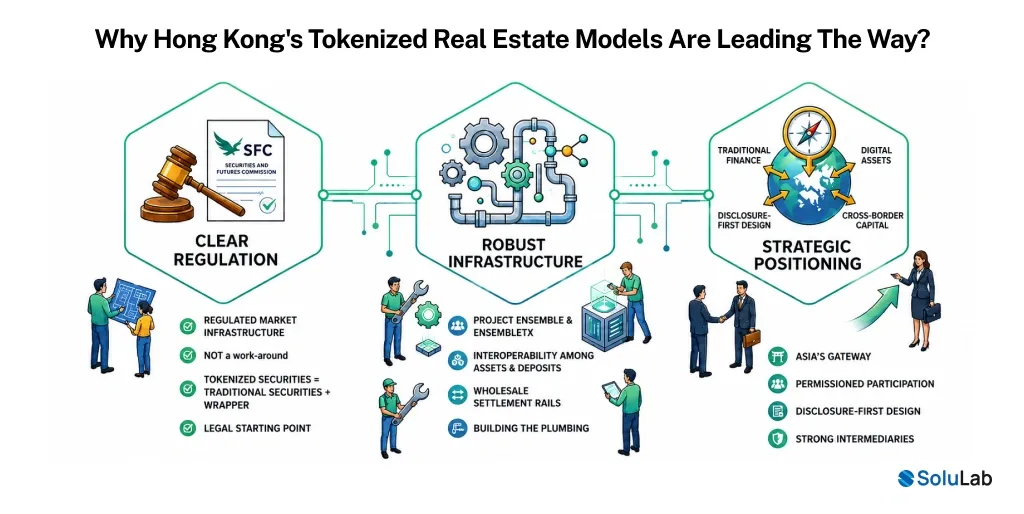
Why Hong Kong’s Tokenized Real Estate Models Are Leading the Way?
Hong Kong is leading because it is treating asset tokenization as a regulated market infrastructure, not as a workaround to regulation. The SFC has made it clear that tokenized securities are fundamentally traditional securities with a tokenization wrapper, which gives builders a clearer legal starting point than in markets that still frame every project as an exception. That clarity matters when you are structuring digital real estate assets, investor rights, transfer restrictions, and disclosures.
The second reason is infrastructure. Project Ensemble was launched to test interoperability among tokenized assets, tokenized deposits, and wholesale settlement rails, and EnsembleTX continues that work through 2026 with real-value transaction pilots. In practical terms, Hong Kong is not just discussing real estate asset tokenization but building the structure that the best RWA real estate tokenization platforms need if they want institutional capital to trust the system.
The third reason is market positioning. Hong Kong is intentionally trying to become a gateway between traditional finance, digital assets, and cross-border capital formation in Asia. If you study Hong Kong’s real estate tokenization platform direction carefully, you will notice a consistent pattern: permissioned participation, strong intermediaries, controlled settlement, and disclosure-first product design.
What you should learn from Hong Kong?
- Treat tokenization as a compliance product first, and a blockchain product second.
- Design for regulated intermediaries, custodians, and transfer controls from day one.
- Build with permissioned or tightly controlled token rails when investor protection and ownership certainty matter.
- Expect operations, reporting, and settlement to matter as much as smart contracts.

What is a Tokenized Real Estate Platform?
A tokenized real estate platform is software and legal infrastructure that lets you issue, manage, distribute, track, and sometimes trade blockchain-based tokens representing rights tied to real estate. In most serious projects, the token does not represent direct land-title ownership on-chain. It usually represents equity in an SPV, units in a fund, or contractual claims tied to rental income, profit share, or other property cash flows.
That distinction is critical. If you misunderstand it, you will build the wrong product. A white-label real estate tokenization platform is not just a wallet-connected listing portal. It is an end-to-end operating system for structuring digital real estate assets, onboarding investors, enforcing eligibility rules, managing subscriptions, recording ownership, distributing returns, and maintaining audit-ready records.
Core components of a real estate tokenization platform
- Asset layer: The property, portfolio, or underlying real estate exposure being offered to investors.
- Legal layer: The SPV, trust, fund, or issuer structure that defines investor rights.
- Token layer: The compliant digital representation of those rights on a blockchain or controlled ledger.
- Compliance layer: KYC, AML, accreditation or suitability checks, sanctions screening, transfer restrictions, and disclosures.
- Operations layer: Cap tables, subscriptions, redemptions, distributions, reporting, tax workflows, and exception handling.
- Marketplace layer: Primary issuance and, where allowed, secondary transfer or trading rails.
If you are exploring tokenized real estate investing, this is the model that separates real platforms from basic token launch experiments.
Key Benefits of Building a Real Estate Tokenization Platform
The biggest benefit is capital access. A well-designed tokenized real estate platform can lower minimum investment sizes, make fractional exposure easier to package, and open property-backed offerings to a broader range of qualified investors. That is why real estate tokenization solutions keep attracting developers, sponsors, and fund managers who want more efficient capital formation.
The second benefit is operational efficiency. Tokenized records can improve ownership tracking, investor communications, transfer controls, and distribution workflows when they are connected to the right legal and compliance stack. This does not magically remove complexity, but it can reduce reconciliation friction and create cleaner digital workflows.
The third benefit is product innovation. You can create new real estate asset tokenization models around income-sharing, portfolio baskets, geography-specific SPVs, or themed private-market access products. In 2026, the winners are not the teams that tokenize one building. They are the teams that build repeatable issuance and servicing infrastructure.
Benefits that actually matter in practice
- Lower ticket sizes for fractional participation.
- More structured investor onboarding and eligibility checks.
- Better audit trails and ownership records.
- Faster issuance workflows once your templates and controls are standardized.
- Stronger product differentiation for developers and fund sponsors entering the RWA market.
Step-by-Step Guide to Building a Tokenized Real Estate Platform
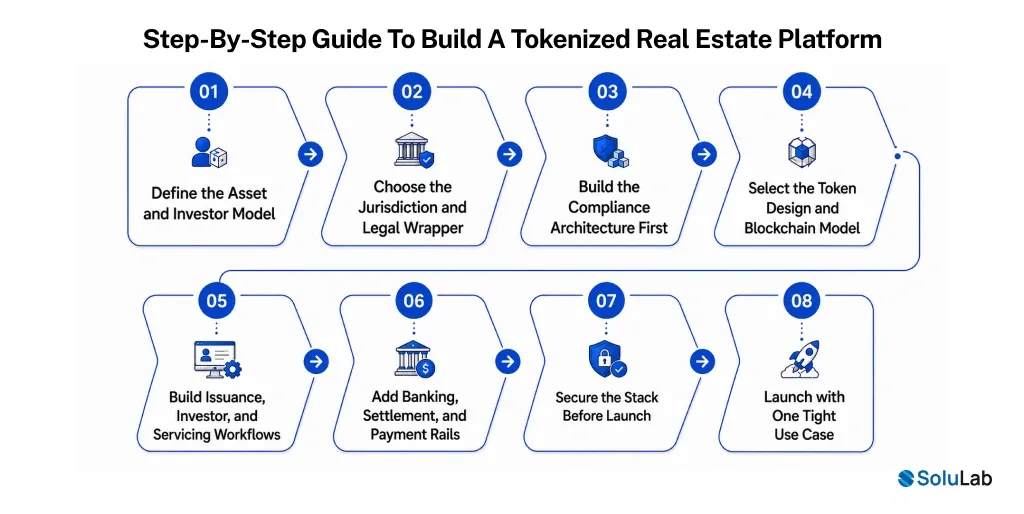
This is where most founders fail. They start with blockchain selection and UI mockups when they should start with asset structure, jurisdiction, and distribution rules. If you want to build a tokenized real estate platform that lasts, use this sequence.
Step 1: Define the asset and investor model
Start with a simple sentence: What exactly does one token represent? In the US and many other jurisdictions, the workable answer is usually equity in a property-holding SPV or a note tied to property cash flows. Avoid vague promises like “fractional ownership on blockchain” unless your legal documents map that phrase into enforceable rights.
You should also define:
- Single asset or multi-asset portfolio
- Residential, commercial, hospitality, industrial, or mixed-use exposure
- Yield product, growth product, or hybrid
- Retail, accredited, professional, or institutional investor target
- Hold-to-maturity, redemption model, or secondary-trading-enabled model
Step 2: Choose the jurisdiction and legal wrapper
Jurisdiction is product strategy. Hong Kong offers a strong regulated-finance framework, Singapore offers institutional tokenization momentum through Project Guardian, Dubai is moving fast with VARA and DLD-linked real estate pilots, and the US remains deep but highly securities-driven. Your legal wrapper will usually be an SPV, trust, fund vehicle, or issuer entity that owns or controls the underlying property rights.
This is the stage where a serious Tokenization as a Service (TaaS) partner becomes valuable because your platform architecture should follow your regulatory design, not the other way around.
Step 3: Build the compliance architecture first
This is non-negotiable. Your real estate tokenization development plan should include KYC, AML, sanctions screening, wallet screening where relevant, investor classification, jurisdictional gating, disclosures, consent capture, and transfer-rule enforcement before you write production smart contracts. Hong Kong guidance specifically emphasizes disclosures around settlement finality, transfer limitations, custody, smart contract audit status, and business continuity controls.
Create a compliance checklist that covers:
- Investor identity verification
- Source-of-funds and AML review
- Accreditation or suitability testing
- Geographic selling restrictions
- Tax forms and reporting fields
- Ongoing monitoring and suspicious activity workflows
- Record retention and audit trails
Step 4: Select the token design and blockchain model
For serious RWA platform development, permissionless-by-default is usually the wrong answer. Hong Kong guidance has explicitly warned against using public-permissionless blockchain networks for tokenized investment products without proper controls, and compliance-oriented standards like ERC-3643 have gained traction because they embed transfer restrictions and identity-aware logic. That does not mean public chains are unusable. It means your controls must be stronger than your marketing hype.
A practical design choice often looks like this:
Step 5: Build issuance, investor, and servicing workflows
This is the heart of your tokenized real estate platform. You need software that handles onboarding, subscriptions, allocations, cap table logic, token minting, lockups, distributions, redemptions if applicable, reporting, and investor communications. Too many teams obsess over launch day and ignore year-two servicing. That is a mistake because real estate tokenization companies win on lifecycle operations, not only issuance.
Your workflow should support:
- Deal setup and document room creation
- Investor onboarding and eligibility approval
- Subscription collection and payment reconciliation
- Token issuance or allocation recording
- Distribution scheduling and payout tracking
- Corporate actions, updates, and reporting
- Transfer approvals, denials, or queue-based review
Step 6: Add banking, settlement, and payment rails
One of Hong Kong’s biggest lessons is that tokenization without settlement integration stays theoretical. EnsembleTX is focused on real-value transactions involving tokenized deposits and digital assets, which shows why the next generation of platforms needs better links between assets, cash, and institutional settlement processes. Your platform should be designed for fiat rails, stable settlement options where legal, and bank-grade reconciliation logic.
Step 7: Secure the stack before launch
Security audits are not optional marketing badges. The SEC’s 2025 disclosure guidance for crypto asset-related securities offerings highlighted the importance of disclosing smart contract audits and technical specifications, and Hong Kong guidance also asks whether smart contract audits have been conducted. You should run contract audits, penetration testing, role-based access reviews, key-management reviews, disaster recovery drills, and legal-document consistency checks before going live.
Step 8: Launch with one tight use case
Do not launch with five jurisdictions, three property types, and a promised secondary market in month one. Start with one asset class, one offering structure, one investor segment, and a clear servicing model. The best way to launch a tokenization platform is to prove one compliant operating loop first, then scale issuance templates, distribution channels, and jurisdictions after you have evidence that the model works.

Essential Features Your Real Estate Tokenization Platform Must Have
A real estate tokenization platform in 2026 needs much more than token minting. You need features that satisfy investors, operators, legal teams, and regulators at the same time.
Investor-facing features
- Secure onboarding with KYC and document upload.
- Deal discovery pages with offering documents and risk disclosures.
- Subscription workflows and payment tracking.
- Portfolio dashboard with holdings, distributions, and updates.
- Support center for tax documents, statements, and notices.
Admin and issuer features
- Asset and SPV setup module
- Cap table and token allocation controls
- Transfer restriction engine
- Distribution and payout engine
- Investor communication center
- Audit logs and compliance reporting
- Exception handling for failed payments, blocked wallets, or off-chain corrections
Advanced features that create real differentiation
- Rules-based secondary transfer approvals are permitted where legally permitted.
- Multi-entity support for developers, brokers, fund managers, and administrators.
- AI-assisted document classification, risk monitoring, and investor support workflows are built into an
- Banking and treasury integrations for reconciliation and payouts are inspired by institutional tokenization models.
Regulatory Considerations for Real Estate Tokenization in 2026
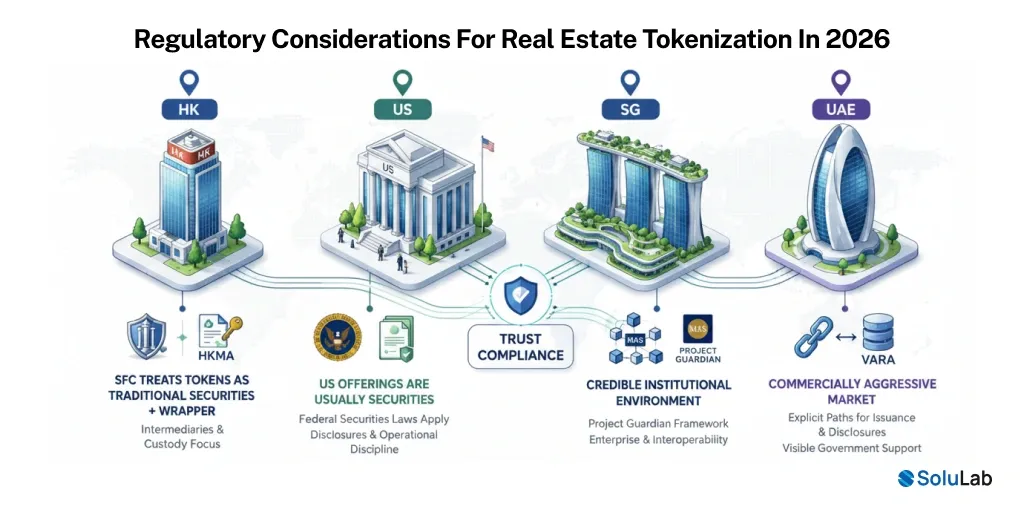
You should assume your tokenized real estate platform is operating inside securities, property, AML, and data-governance rules at the same time. The idea that tokenization lets you bypass regulation is one of the fastest ways to destroy a project.
Hong Kong
Hong Kong’s framework is attractive because the SFC treats tokenized securities as traditional securities with a tokenization wrapper, while requiring intermediaries and product providers to address technology, custody, disclosure, and transfer-risk issues directly. The HKMA’s tokenized settlement initiatives add another important signal: market infrastructure is evolving alongside supervisory expectations.
United States
In the US, tokenized real estate offerings are usually still securities offerings. The SEC’s 2026 statement on tokenized securities says the token format does not remove instruments from federal securities laws, and its 2025 staff guidance emphasized disclosures about rights, technical design, transfer restrictions, supply rules, and smart contracts. If you are building for the US, assume your success depends on offering exemptions, transfer compliance, investor records, and operational discipline.
Singapore
Singapore remains one of the most credible institutional tokenization environments because MAS has continued to expand Project Guardian as a framework for tokenized asset infrastructure and interoperability. It is especially relevant if you want to build enterprise real estate tokenization solutions for fund managers or cross-border financial products rather than purely retail property offerings.
UAE
Dubai has become one of the most commercially aggressive markets for real estate tokenization. VARA’s approach to asset-referenced virtual assets, plus DLD-linked real estate initiatives, shows a more explicit path for issuance, backing, disclosure, and licensed secondary trading than many markets currently offer. That makes the UAE highly relevant if you want a faster-moving sandbox for real estate tokenization services in Dubai with visible government support.
What Regulation mean for your Roadmap?
- You need jurisdiction-specific issuance logic, not one global smart contract template.
- You need legal documents synchronized with token behavior.
- You need controls for transferability, not vague promises of instant liquidity.
- You need compliance operations after launch, not only pre-launch approvals.
Technology Stack and Development Approaches
The right technology stack depends on whether you are building for a fund manager, a property sponsor, a bank-linked consortium, or a startup testing one market. Still, the best real estate tokenization development architectures in 2026 share the same design philosophy: compliance-aware smart contracts, modular services, API-first integrations, and strong auditability.
Blockchain selection
Choose your blockchain based on control requirements, ecosystem maturity, privacy expectations, and integration needs. If you need stricter compliance and permissioning, a private or permissioned stack may be preferable. If you want broader composability, a public chain with strong transfer controls may still work.
Smart contracts
Your smart contracts should manage issuance, whitelisting, transfer restrictions, lockups, redemptions if applicable, and corporate actions. They should never be the only source of truth for investor rights. Those rights must also be reflected in your legal agreements and operational recordkeeping.
Security and compliance tools
Your stack should include identity verification, sanctions screening, wallet analytics where relevant, audit logging, key management, role-based permissions, and monitoring for unusual transactions. If a vendor cannot explain how transfer rules, legal documents, and admin overrides work together, that vendor is not ready for enterprise real estate tokenization solutions.
AI-led opportunities
The biggest near-term AI opportunity is not auto-generating whitepapers. It is reducing operational drag across onboarding, document review, investor support, anomaly detection, and portfolio reporting. This is where an AI-Led Tokenization Platform can create a measurable advantage if it is used to improve control workflows rather than to decorate the front end.
If you are evaluating vendors, review these resources alongside your architecture plan:
- Tokenization Platform Development Company
- Real Estate Tokenization Companies
Development Options: Custom vs White Label Real Estate Tokenization Platforms
This choice affects your timeline, budget, compliance flexibility, and long-term defensibility. There is no universal winner.
| Approach | Best for | Advantages | Risks |
| Custom real estate tokenization software | Enterprises, regulated issuers, unique workflows | Maximum control, better integration depth, flexible compliance design | Higher cost, longer delivery, heavier product management burden |
| White label real estate tokenization platform | Faster pilots, sponsors testing market demand | Faster launch, lower upfront cost, reusable modules | Generic workflows, weaker differentiation, vendor lock-in |
White label works when you are validating demand, entering one jurisdiction, or launching one standardized offering model. Custom works when your business depends on unique servicing logic, multi-jurisdiction compliance, banking integrations, or proprietary investor workflows. If you want to evaluate White Label Real Estate Tokenization Platforms, insist on clarity about extensibility, upgrade rights, code ownership, and compliance rule customization.
Cost to Build a Tokenized Real Estate Platform
The honest answer is that tokenization development cost depends more on compliance scope and workflow complexity than on blockchain choice. A basic MVP for one issuer, one jurisdiction, and one offering flow is very different from a multi-entity enterprise platform with transfer controls, reporting, banking integrations, and secondary-market readiness.
Practical cost ranges for 2026
| Build scope | Estimated timeline | Indicative cost range |
| MVP white label or lightly customized pilot | 8 to 14 weeks | $40,000 to $120,000 |
| Mid-market custom issuance and investor portal | 4 to 7 months | $120,000 to $350,000 |
| Enterprise-grade multi-role tokenized real estate platform | 6 to 12 months | $350,000 to $1M+ |
These ranges are market-based implementation estimates rather than regulator-published figures, and they usually exclude legal structuring, licensing costs, audits, and ongoing compliance staffing. In other words, if a vendor promises to build a compliant global real estate tokenization platform for the price of a brochure website, walk away.
Main cost drivers
- Jurisdictions covered
- Type of investor onboarding required
- Smart contract complexity and audit depth
- Number of user roles and admin workflows
- Banking, custody, and payment integrations
- Reporting, tax, and compliance automation needs
- Secondary transfer functionality
- White label versus custom codebase
How to Choose the Right Real Estate Tokenization Development Company?
You should treat vendor selection like risk management. A strong tokenization platform development company should understand securities workflows, property structures, investor operations, and blockchain architecture in one integrated delivery model.
Questions you should ask before signing?
- Have you built tokenized asset platforms with investor onboarding, transfer restrictions, and distribution workflows, not just token issuance pages?
- How do you map legal rights to token logic and off-chain records?
- Which jurisdictions have you designed for, and what assumptions change across Hong Kong, the US, Singapore, and the UAE?
- What token standard and custody model do you recommend, and why?
- How do you handle audits, admin overrides, failed transactions, and business continuity?
- Can your platform start as white label and evolve into custom modules?
A credible real estate tokenization platform development company should also be willing to challenge your assumptions. If a team says yes to every idea without discussing investor rights, distribution rules, settlement constraints, and jurisdictional limits, that is a red flag.
Read more: Top RWA Tokenization Questions Answered for Enterprises Ask in 2026
Future Trends in Real Estate Asset Tokenization and RWA Platforms
The next phase of real estate tokenization will be less about hype and more about operational maturity. Hong Kong’s settlement experiments, Singapore’s interoperability work, Dubai’s explicit licensing route, and US disclosure-focused supervision all point in the same direction: compliant tokenization infrastructure is becoming a real product category. Expert legal RWA consultants can be your path to success in the case.
Here is what is most likely to matter next:
- Tokenized deposits and better cash-leg settlement for property transactions and distributions.
- Compliance-native token standards becoming the default for serious issuers.
- More enterprise demand for portfolio tokenization, not just single-asset deals.
- AI-assisted investor operations, reporting, and surveillance becoming standard platform features.
- Gradual expansion of licensed secondary trading for certain compliant structures.
The strongest opportunity is not launching a token for publicity. It is building repeatable infrastructure that property developers, fund managers, and enterprise issuers can use again and again. That is the difference between a short-lived campaign and a durable real estate RWA platform development business.
Conclusion
If you want to build a Tokenized Real Estate Platform Like Hong Kong’s Models, copy the principles, not the headlines. Start with legal clarity, compliance controls, disciplined token design, investor operations, and settlement-ready infrastructure. That is what separates credible real estate tokenization development from speculative product theater.
The success of emerging tokenized real estate models highlights the growing demand for digital asset infrastructure. If you’re exploring real estate tokenization, SoluLab can help transform your vision into a robust tokenization platform built for investor trust, liquidity, and long-term growth.
FAQs
Shipra Garg is a tech-focused content strategist and copywriter specializing in Web3, blockchain, and artificial intelligence. She has worked with startups and enterprise teams to craft high-conversion content that bridges deep tech with business impact. Her work translates complex innovations into clear, credible, and engaging narratives that drive growth and build trust in emerging tech markets.