Key Takeaways
- Industry fragmentation locks trillion-dollar value; tokenization injects instant liquidity, enabling secondary markets and global access.
- Smart contracts convert physical rooms into digital tokens, automating ownership, settlements, and cross-border payment flows.
- Moving from legacy trapped capital to programmable revenue models that maximize occupancy and institutional ROI.
- A transparent ecosystem where every booking is verifiable, fraud is eliminated, and global reinvestment is seamless.
The global travel industry in 2026 is operating at an entirely different scale, with 1.6 billion international arrivals contributing over $11.1 trillion to global GDP.
However, the real story is not just demand; it’s the infrastructure that powers it. Payment networks like Visa now process over $14 trillion annually, with $7 billion in stablecoin settlements growing at 50% quarter-over-quarter.
At the same time, governments in South Korea and Brazil are formally integrating blockchain development solutions into financial systems.
This is where travel tokenization development becomes critical, enabling hospitality assets to function as liquid, tradable, and programmable financial instruments.
What is Travel Asset Tokenization?
Travel asset tokenization is the process of converting real-world hospitality and travel assets into blockchain-based digital tokens. Through asset tokenization, assets such as hotels, resorts, vacation properties, airline memberships, or travel loyalty programs can be digitally represented and fractionally owned on a blockchain network.
This approach allows investors to buy, sell, or trade fractional ownership of travel assets with greater transparency, liquidity, and accessibility.
Types of Tokenized Travel Assets
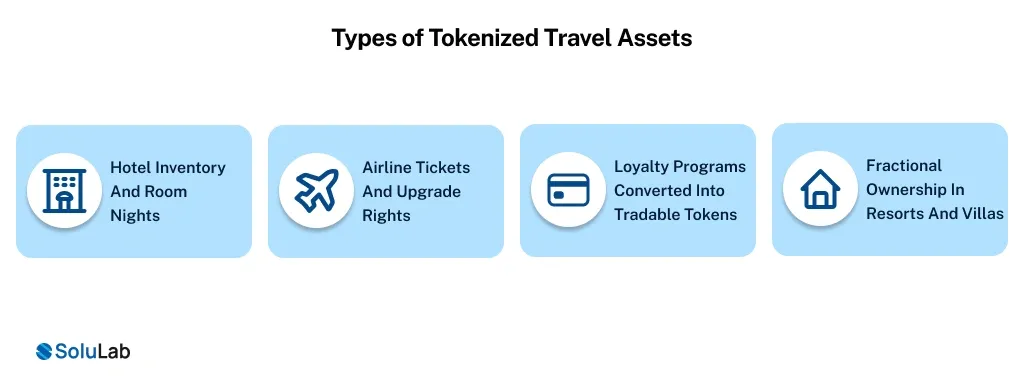
- Hotel inventory and room nights
- Airline tickets and upgrade rights
- Loyalty programs converted into tradable tokens
- Fractional ownership in resorts and villas
These are collectively referred to as tokenized travel assets, forming a new investment class.
Core Mechanism in Travel Tokenization Services
At the foundation of travel tokenization works is smart contract logic:
- A hotel room, airline seat, or villa is represented as a token
- Ownership and usage rights are embedded in code
- Transactions are executed automatically without intermediaries
This aligns closely with Real-world asset tokenization, where physical assets gain digital liquidity.
Advanced Token Standards for Compliance
Institutional adoption depends on compliance-ready tokens:
- ERC-3643 → Permissioned tokens with built-in KYC checks
- ERC-7518 → Advanced compliance and identity-linked tokens
These standards ensure alignment with:
- MiCA regulations (Europe)
- SEC frameworks (United States)
This makes Tokenized travel assets legally viable investment instruments.

Reasons Tourism Brands Are Moving Toward Tokenization Development
- Faster Cross-Border Transactions
Traditional cross-border payments can take days. With tokenized systems, transactions are completed instantly.
This is supported by RWA development services that integrate blockchain with financial systems.
- Reducing Dependency on Intermediaries
Traditional booking systems rely heavily on Global Distribution Systems (GDS), which take a large cut. Through blockchain in the travel industry, smart contracts automate transactions, reducing commissions and delays.
This creates better margins for businesses and better pricing for customers.
- Cost Efficiency via Smart Contracts
Using blockchain in the travel industry, enterprises automate:
- Booking flows
- Commission settlements
- Payment reconciliation
This removes reliance on intermediaries like GDS systems.
- Preventing Fraud and Enhancing Trust
Fake listings and ticket fraud are still common.
When companies adopt Travel tokenization models, every booking becomes verifiable on-chain.
This creates permanent proof of ownership and removes disputes around authenticity.
- The “Trapped Value” Problem
Traditional systems lock value:
- Non-refundable bookings result in lost capital
- Loyalty points expire without utility
- Assets remain illiquid for years
Through tokenizing travel assets, these inefficiencies are removed by enabling resale, transferability, and fractional ownership.
- Inventory Arbitrage (BedSwap Model)
Large hospitality groups like TUI use blockchain technology to trade room inventory internally.
This system allows:
- Real-time room allocation between regions
- Elimination of unsold inventory
- Instant internal settlements
This creates efficiency across global hotel networks.
Read more – Private Equity Tokenization
How Tokenized Payments Improve Tourist Spending Experiences?
Local businesses are heavily impacted by payment delays, currency conversion costs, and a lack of access to capital.
With Travel tokens, these challenges are being addressed at scale. Travel trends are increasingly influenced by entertainment.
Around 34% of luxury bookings are driven by “set-jetting,” where travelers visit film locations.
With Hotel tokenization development, users can own fractional shares of these destinations. This creates a direct connection between experience and investment.
1. Brazil’s Drex and Atomic Settlement
Brazil’s CBDC, Drex, introduces Delivery versus Payment (DvP) mechanisms.
- Payment and asset transfer happen simultaneously
- If the token is not delivered, funds are not released
- Settlement risk is eliminated
This is a major advancement in Real-world asset tokenization for tourism economies.
2. Tokenized Identity (SSI) for Travelers
A major innovation is Self-Sovereign Identity (SSI).
Instead of sharing passports multiple times:
- Travelers use cryptographic identity tokens
- Hotels verify credentials without storing sensitive data
This reduces data breaches and liability.
3. Empowering Local Economies
Token ecosystems allow local vendors to:
- Accept
- mglobal payments
- Participate in loyalty ecosystems
- Access micro-investment opportunities
Through Travel asset tokenization services, small businesses gain financial inclusion.
4. Legacy vs Tokenized Hospitality Investment
| Feature | Traditional Hospitality | Tokenized Hospitality (2026) |
| Liquidity | Locked for 5–10 years | Real-time trading |
| Settlement | 3–5 days | Instant (Atomic via DvP) |
| Investment Entry | High capital | Fractional ownership |
| Fraud Risk | High | Minimal with on-chain proof |
| Revenue Model | One-time | Recurring via royalties |
Dominating Factors of The Leading Tokenization Development Firms
The market for travel tokenization is led by firms that focus on enterprise-grade infrastructure and compliance.
When selecting a tokenization platform development company, businesses prioritize scalability and regulatory alignment.
Key Capabilities
- Development of Tokenized hospitality assets backed by real revenue
- Integration with legacy booking systems
- Multi-chain interoperability across networks
Multi-Chain Infrastructure
Modern tokenization platforms operate across 9 blockchains, including Polygon, Base, and Canton. Enterprises are not looking for generic tools. They need deployable systems.
A strong Token platform development company delivers:
- White-label dashboards for hospitality brands
- Integration with PMS (Property Management Systems)
- Compatibility with legacy GDS infrastructure
At the backend, a Token development partner ensures:
- Multi-chain deployment across 9+ networks
- Interoperability via CCIP
- Scalability for global user bases
Read more – Commodity Tokenization
How do the Global Governments Leverage Tokenized Luxury Villas for National Tourism Growth?
Governments are using tokenization as a tool to fund infrastructure and attract global investors. Through hotel tokenization, they are opening new channels for capital inflow.
1. Maldives: Fractional Resort Ownership
Projects like Trump International Maldives (via Dar Global) allow investors to purchase fractional ownership in luxury villas.
This is a direct application of hospitality asset tokenization, enabling early-stage funding.
2. South Korea: Regulated Token Markets (2026)
South Korea has introduced strict frameworks under its Financial Services Commission (FSC). Through travel tokenization, blockchain is recognized as a legal securities registry.
Key requirement:
- Issuer Account Management standards
- Internal control and compliance mechanisms
3. Singapore: Digital Twin Infrastructure
Singapore’s Project Guardian enables assets to exist both physically and digitally. This aligns with real estate tokenization development, ensuring seamless integration with global markets.
4. Brazil: Tourism Payments with Drex
Brazil’s CBDC ensures instant settlement for tourism services. This supports scalable travel tokenization platform development across regions.
5. Visa Multi-Chain Settlement (April 2026)
Visa supports 9 blockchain networks and processes over $14T annually, with $7B in stablecoin settlements.
Growth has reached 50% in a single quarter, indicating rapid adoption.
6. Canton Network and Configurable Privacy
The Canton Network allows enterprises to maintain privacy while using blockchain.
This is critical for real-world asset tokenization in travel, where sensitive data must remain confidential.
7. AI Agentic Commerce
Visa’s Intelligent Commerce Connect enables AI agents to:
- Search for travel options
- Book and pay autonomously
- Use FIDO-certified passkeys for secure transactions
This integrates with AI model tokenization platform development for automated workflows.
8. US Sports Case: Tokenized Tickets
Sports teams in the US are using tokenized tickets to:
- Prevent fraud
- Enable resale tracking
- Earn royalties on secondary sales
This model is directly applicable to hospitality bookings.
Read more – Tokenization Consulting in the USA
How do Enterprises Calculate the ROI for Travel Tokenization Platform Development?
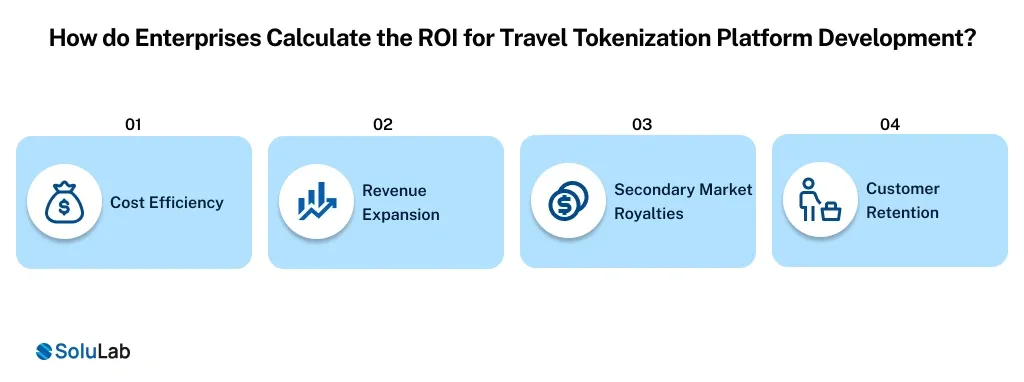
ROI is measured across cost savings, revenue generation, and operational efficiency.
Through travel tokenization development services, enterprises achieve measurable outcomes.
1. Cost Efficiency
Automation reduces:
- Intermediary fees
- Payment processing costs
- Administrative overhead
This aligns with the benefits seen in RWA development services.
2. Revenue Expansion
Tokenization introduces:
- Fractional ownership sales
- Subscription-based travel models
- Tokenized loyalty ecosystems
3. Secondary Market Royalties
Every resale generates revenue for the issuer. With tokenized assets, businesses earn continuously from secondary markets.
4. Customer Retention
Token-based loyalty systems provide more flexibility than traditional programs. This increases engagement and lifetime value.
Final Thoughts
With travel tokenization development, hospitality businesses gain liquidity, investors access new asset classes, and governments unlock scalable funding models.
As AI-driven commerce, multi-chain infrastructure, and regulatory frameworks mature, this model is becoming the standard for institutional hospitality investment.
The companies that adopt it early will build stronger, more scalable travel ecosystems with long-term revenue potential. And SoluLab is here to make that vision come true. Our tokenization platform development company excels in delivering fast tokenization services and custom integrations.
Our experts can help you build regulatory-friendly tokenization platforms and customize your existing platform with AI and smart contract models.
Contact us today to discuss your tokenization service requirement.
FAQs
Deepika is a content writer who blends storytelling with strategic thinking. She explores topics across digital innovation, emerging tech, and the evolving blockchain industry. She enjoys breaking down complex ideas into simple, engaging narratives in the growing global markets.