Key Takeaways
- Unclear cost expectations lead enterprises to underbudget or choose low-quality builds by causing delays, security gaps, and poor scalability.
- A well-scoped enterprise tokenization platform accounts for compliance, security, interoperability, liquidity design, and scalable architecture.
- SoluLab delivers enterprise tokenization platforms with transparent costing, modular design, and compliance-ready infrastructure by helping businesses build scalable, secure platforms that maximize ROI and minimize hidden development costs.
- Phase the budget: pay for architecture and compliance first, add liquidity features later, and decide early whether to build, buy or mix both.
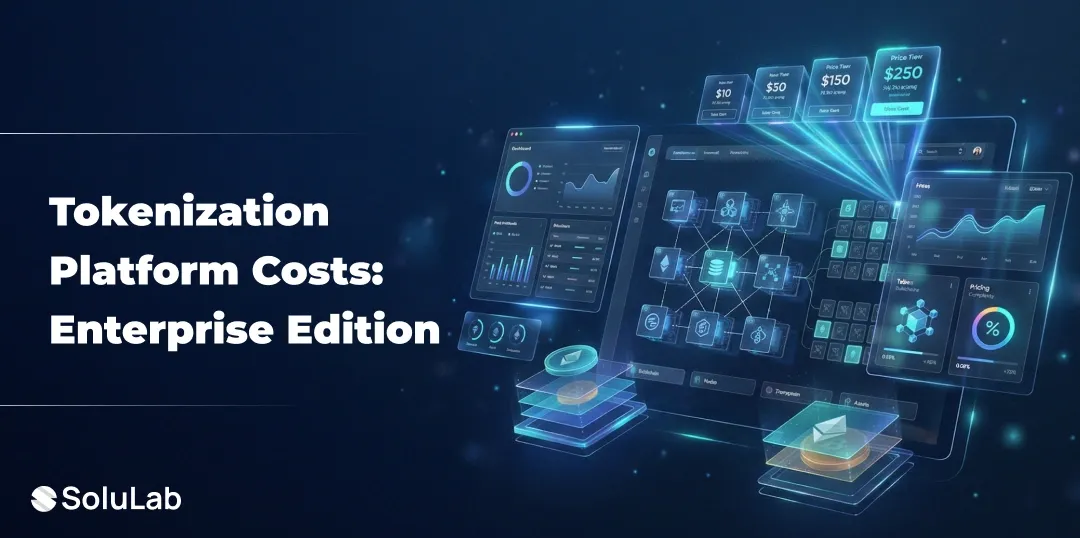
An enterprise tokenization platform typically costs $80,000 to $600,000 or more to build in 2026, depending on asset class, jurisdictions, compliance scope, and integrations. Tokenization platform development is cheapest as a phased MVP and most expensive as a multi-asset, cross-border system. This guide covers cost drivers, budget sequencing and build vs buy for enterprise asset tokenization.
Enterprise tokenization is moving from concept to core infrastructure. Major financial institutions, private equity firms, and asset managers are actively evaluating digital asset strategies. Market research firms estimate that tokenized real-world assets could represent $4–16 trillion in value by 2030. The top of that range comes from the BCG and ADDX study, which models on-chain asset tokenization growing 50x to US$16 trillion by 2030.
This is not a retail experiment anymore. It is an enterprise transformation.
If you are considering building an Enterprise Tokenization Platform, one question drives every board discussion: What will it actually cost, and what drives that cost?
The answer depends on architecture, compliance scope, asset complexity, and long-term scalability goals. In this blog, we break down the real components behind enterprise tokenization platform cost, practical insights, and service inclusions leaders must evaluate.

What Is an Enterprise Tokenization Platform?
An enterprise tokenization platform is the software and legal infrastructure that lets a bank, asset manager or corporate issue, manage and trade digital tokens that represent real assets. It covers token issuance, investor onboarding, compliance rules, custody, reporting and, where needed, secondary trading.
Enterprise asset tokenization differs from a small token launch because it must meet institutional standards for security, audit and regulation, and connect to existing core banking, ERP and custody systems. Enterprise tokenization solutions can be built from scratch, bought as a white-label product or delivered through a mix of both, which is why the cost range is so wide. For a step-by-step view, see our tokenization platform development checklist for enterprises, and for services, our tokenization platform development company page.
What Drives Tokenization Platform Development Cost in 2026?
| Tier | What it typically covers | Proposed build range |
| MVP enterprise platform | One asset class, one jurisdiction, token contracts, basic KYC onboarding, issuer admin panel, one audit | $80,000 to $180,000 |
| Scalable institutional infrastructure | Compliance modules, accreditation and reporting, MPC custody, banking or ERP integrations, investor dashboard, full security testing | $250,000 to $600,000 |
| Multi-asset, cross-border enterprise ecosystem | Several asset classes and jurisdictions, secondary trading, fiat ramps, yield distribution, advanced reporting | $600,000 to $1,500,000+ |
| Annual run cost (all tiers) | Maintenance at 15 to 25% of build cost, plus cloud hosting of $40,000 to $150,000 | Added every year |
When enterprises explore the tokenization platform development checklist, the budget is shaped by four primary variables.

1. Asset Class Complexity
Tokenizing private equity, real estate, debt instruments, or structured products requires different smart contract logic and legal structuring.
- Real estate platforms with fractional ownership modules can increase development costs by 20–30%.
- Private equity tokenization requires compliance layers for accredited investors, increasing compliance spend by 15–25%.
The more regulated and structured the asset, the higher the engineering and legal alignment effort.
2. Jurisdiction and Regulatory Scope
Launching in the US, EU, UAE, or Singapore changes the compliance burden significantly.
- Multi-jurisdiction platforms can increase costs by 30–40% due to legal adaptation and reporting automation.
- Platforms built for sandbox-only pilots are 40% cheaper but lack enterprise scalability.
For an institutional-grade Enterprise Tokenization Platform for Digital Assets, regulatory architecture must be embedded from day one.
3. Infrastructure Architecture
Enterprises typically choose between:
- Public blockchain with compliance overlays
- Permissioned blockchain (like Hyperledger-based systems)
- Hybrid architecture
Permissioned systems often cost 25–35% more upfront, but they reduce operational and governance risks for banks.
4. Security and Institutional Standards
Security is not optional.
- Smart contract audits: $15,000 – $60,000 depending on complexity
- Penetration testing: $10,000 – $30,000
- MPC custody integration: $40,000 – $120,000
Security alone can represent 15–20% of total platform cost.
Estimated Enterprise Cost Range (2026)
- MVP enterprise platform: $20,000 -five digits
- Scalable institutional infrastructure: $30,000 -five digits
- Multi-asset, cross-border enterprise ecosystem: $50k+
Budget and Sequencing: How to Phase the Spend
The biggest budgeting mistake in enterprise asset tokenization is spending on the wrong things first. Teams often fund a trading marketplace before the legal structure and compliance layer are settled, then pay again to rework them. A phased plan keeps cost under control and gives leadership clear go or no-go points.
| Phase | What gets built | Share of build budget | Typical timing | Gate before the next phase |
| 0. Discovery and legal | Business model, jurisdiction analysis, regulatory roadmap, architecture and security blueprint | 10 to 15% | 4 to 6 weeks | Signed-off legal structure and architecture |
| 1. Core build (MVP) | Token contracts, issuer admin, KYC onboarding, first audit | 30 to 35% | 3 to 4 months | Audited contracts and a working pilot |
| 2. Compliance and integrations | Accreditation, reporting, custody, banking and ERP APIs, penetration testing | 25 to 30% | 2 to 3 months | Compliance review passed, one live integration |
| 3. Liquidity and scale | Secondary trading, fiat ramps, yield distribution, investor dashboards | 20 to 25% | 3 to 4 months | Steady issuance volume and investor demand |
| 4. Run and improve | Maintenance, repeat audits, new asset classes | 15 to 25% of build cost per year | Ongoing | Annual budget review |
Three rules keep the budget honest:
- Pay for compliance before features. Skipping it early can raise long-term cost by around 50% through re-engineering, as noted below.
- Add secondary trading last. It is the most expensive module, and it only pays off once primary issuance works and investors are on board.
- Budget for year two on day one. Maintenance, cloud hosting and repeat audits recur every year, so total cost of ownership is higher than the build quote.
How Do Compliance and Regulatory Architecture Impact Budget?
Compliance is now the highest hidden cost in enterprise asset tokenization solutions.
1. Regulatory Clarity Is Increasing, But Requirements Are Stricter
Global frameworks are tightening around:
- Reserve transparency
- Investor protection
- Custody segregation
- AML and transaction monitoring
Compliance modules can account for 20–35% of overall development investment.
2. KYC/AML Integration
Enterprise-grade onboarding requires integration with global verification providers.
Estimated cost: $25,000 – $75,000 depending on geography and user volume.
3. Investor Accreditation & Reporting
Automated eligibility checks, regulatory reporting, and audit trails are mandatory for institutional investors.
Estimated cost: $40,000 – $120,000.
4. Data Protection Alignment
GDPR, CCPA, and DPDP Act compliance may require an encrypted storage architecture and regional hosting.
Failure to embed compliance early often increases long-term cost by 50% due to re-engineering.
For leaders, compliance-first design is a strategic investment, not overhead.
What Technology Stack Choices Influence Enterprise Investment?

Technology decisions directly affect scalability and long-term ROI.
1. Blockchain Layer
Blockchain technology platforms and choices include Ethereum, Polygon, Avalanche, or enterprise-grade permissioned frameworks.
- Public chain-based infrastructure: lower initial cost but higher compliance overlays.
- Permissioned blockchain: higher upfront cost, better control, and governance.
Infrastructure decisions impact long-term operational costs by 20–30% annually.
2. Smart Contract Standards
Security token standards like ERC-1400 or regulated token frameworks require additional customization. ERC-1400 is still a draft security token proposal rather than a finalised EIP, while ERC-3643 (T-REX) reached Final status, so the two carry different amounts of audit and integration work.
Custom token logic development: $30,000 – $150,000 depending on complexity.
3. Cloud and Infrastructure Hosting
Enterprise deployments often rely on AWS, Azure, or GCP.
- Cloud infrastructure (annual): $40,000 – $150,000
- DevOps automation: $25,000 – $60,000 initial setup
4. Interoperability and API Integration
Integrating with:
- Core banking systems
- ERP platforms
- Payment gateways
- Custody solutions
API integration can add $50,000 – $200,000, depending on legacy complexity.
When evaluating enterprise-ready tokenization solutions, scalability should be prioritized over short-term savings.
Read More – RWA Tokenization: 80 Questions Answered for Enterprises
What Features Increase the Enterprise Tokenization Platform Cost?
Enterprise clients expect full lifecycle digital asset management.
Here are the features that significantly influence cost.
- Fractional Ownership Engine: Enables token splitting and cap table management. Development impact: $40,000 – $120,000
- Secondary Trading Module: Marketplace development and order matching engine. Cost addition: $100,000 – $300,000
- Automated Dividend / Yield Distribution: Smart contract-based payout automation. Cost addition: $25,000 – $80,000
- Investor Dashboard & Reporting: Institutional investors require real-time reporting.Cost addition: $30,000 – $90,000
- Fiat On/Off Ramp Integration: Banking and payment provider integration. Cost addition: $50,000 – $150,000
Adding advanced features can increase total platform cost by 25–50%, but they improve investor adoption and liquidity potential.
Build vs Buy: Which Route Fits Your Budget?
Before fixing a budget, decide how you will get the platform. There are three routes, and each changes both the upfront cost and the long-term cost.
| Build custom | Buy (white-label or Tokenization as a Service) | Hybrid | |
| Upfront cost | Highest | Lowest | Medium |
| Time to market | Longest | Fastest | Medium |
| Control and IP | Full ownership | Vendor owns the core | You own custom modules, vendor owns the base |
| Customization | Unlimited | Limited to what the product allows | High on the parts that matter |
| Compliance ownership | You design and carry it | Shared, depends on the vendor’s coverage | Shared, with custom rules where needed |
| Long-term cost | Maintenance and upgrades on you | Recurring licence or usage fees, possible lock-in | Mix of both |
| Best for | Proprietary workflows, strict data residency, multi-jurisdiction scale | One asset class, standard workflow, launch within a quarter | Speed to launch with room to differentiate |
A simple way to decide:
- Buy if you tokenize one asset class, your workflow is standard and you need to launch fast.
- Build if your process is proprietary, you must keep data in specific regions, or you need deep links into core banking systems.
- Go hybrid if you want to launch on a proven base and customize investor flows, reporting or compliance rules on top.
Whatever you choose, ask vendors about exit terms, data export, per-transaction fees and customization limits, because these hidden costs show up in year two. Our guide to red flags when hiring an asset tokenization development company is a useful checklist. To explore the buy route, read about Tokenization as a Service and white-label tokenization partners.
What Services Should Be Included in Enterprise Tokenization Platform Development?
Choosing the right tokenization platform development company is as important as defining the budget. Whether you build or buy, the best enterprise tokenization solutions bundle consulting, engineering, security and support so no cost is left out of the quote.
A complete enterprise project should include:
1. Strategic Consulting
- Business model validation
- Jurisdiction analysis
- Regulatory roadmap
Estimated allocation: 10–15% of total budget
2. Architecture & Technical Design
- Blockchain selection
- Infrastructure planning
- Security blueprint
3. Smart Contract Development & Audit
- Token logic
- Distribution logic
- Compliance logic
4. Frontend & Admin Panel Development
- Investor onboarding interface
- Issuer dashboard
- Reporting modules
5. Security Testing & DevOps
- Smart contract audits
- Penetration testing
- Infrastructure hardening
6. Post-Launch Maintenance
Annual maintenance cost: 15–25% of initial development investment
When evaluating tokenization platform development services, enterprises should ask:
- Does the provider understand financial compliance?
- Can they scale beyond MVP?
- Do they provide long-term infrastructure support?
True tokenization Solutions go beyond coding. They align legal, technology, and enterprise scalability.

Conclusion
As you can see, tokenization becomes a new revenue infrastructure layer inside your financial ecosystem.
If you are planning on asset tokenization development, the right architecture and compliance strategy from day one can prevent 30–50% future re-engineering costs. Phase your budget, choose the build, buy or hybrid route early, and plan for the yearly run cost, and enterprise asset tokenization becomes a predictable investment instead of a moving target.
At SoluLab, our team of 250+ developers works closely with enterprises, banks, and asset managers to deliver scalable enterprise tokenization solutions. These are aligned with regulatory and institutional standards.
Whether you need cost estimation, architecture consulting, or complete tokenization platform development services, we are here to support your roadmap.
Let’s define your budget the right way and build infrastructure that scales.
FAQs
Deepika is a content writer who blends storytelling with strategic thinking. She explores topics across digital innovation, emerging tech, and the evolving blockchain industry. She enjoys breaking down complex ideas into simple, engaging narratives in the growing global markets.