Key Takeaways
- Hotel tokenization is the process of turning hotel equity, revenue‑sharing rights, or debt into digital tokens on a blockchain, enabling fractional ownership and global investor access.
- You can use hotel ownership tokenization to sell small slices of a hotel or resort to hundreds or thousands of investors, with smart contracts handling cap tables, payouts, and compliance rules.
- Tokenized hotel investments work best when they’re built on a compliant RWA architecture: KYC/AML, investor accreditation, local securities regulation, and integration with regulated custodians and transfer agents.
- A serious hospitality asset tokenization platform needs more than NFTs: it needs permissioned token standards, whitelisting, secondary trading controls, revenue‑sharing logic, and strong investor UX.
- If you’re a hotel group, developer, or fund, working with a specialized tokenization platform development company like SoluLab lets you focus on deal structure and distribution while the team handles blockchain architecture, compliance workflows, and real estate tokenization development services end‑to‑end.
If you’re in hospitality in 2026 and still raising capital the way you did in 2014, you’re already behind. Hotel tokenization has moved from “interesting pilot” to a real capital markets strategy that serious hotel owners, family offices, and real estate funds are now using to unlock liquidity and global investor participation.
RWA tokenization as a whole has crossed the “proof of concept” phase. Tokenized real‑world assets have grown into the tens of billions of dollars in value, with 2025 seeing triple‑digit percentage growth and 2026 shaping up to be the year where liquidity and secondary markets determine who survives. In parallel, high‑profile hospitality projects from Aspen ski resorts to Maldives luxury villas have shown that hotel asset tokenization isn’t just a whitepaper idea; it’s achievable, regulated, and increasingly demanded by sophisticated investors.
From our experience advising hotel groups and real estate funds across India, the Gulf, the United States, and Europe, the pattern is clear: you either learn how hotel tokenization works and integrate it into your capital stack… or you end up competing with properties that can raise capital faster, from more investors, on better terms.
What is Hotel Tokenization?
At its core, hotel tokenization is the process of converting economic rights related to a hotel (or portfolio of hotels) into digital tokens issued and managed on blockchain technology. These rights could represent:
- Equity in the property SPV
- Revenue‑sharing or profit‑sharing rights
- Tokenized debt instruments (e.g., revenue‑backed notes)
- Hybrid structures (e.g., tokens that convert or have performance‑based triggers)
You’re essentially creating asset‑backed tokens in real estate, where each token corresponds to a defined, legally enforceable claim on the hotel’s cash flows or ownership structure. Unlike the old “timeshare brochure” model, tokenization uses blockchain rails to:
- Encode ownership logic and restrictions via smart contracts.
- Maintain a transparent, immutable cap table.
- Automate distributions (revenues, yields, buybacks).
- Support compliant secondary trading on tokenized real estate platforms.
Why Hotel Tokenization is Gaining Momentum in 2026?
You’re seeing hotel tokenization everywhere in 2026 for one simple reason: traditional hospitality capital stacks are under pressure, while digital capital is hungry for yield and real assets.
Globally, RWA tokenization has become one of the fastest‑growing narratives in crypto and fintech, with multiple sources tracking billions of dollars of tokenized RWAs outstanding and strong year‑over‑year growth. Industry commentators now call 2026 the year real estate tokenization moves from experimental pilots to a real economic force, with success measured by secondary‑market liquidity and consistent distributions rather than token hype.
In hospitality specifically, you’re seeing:
- High‑profile tokenized resort deals: For example, a Trump‑branded resort in the Maldives and similar hospitality projects are being structured with tokenized revenue rights and digital securities from the ground up, often in partnership with specialist RWA platforms.
- Government openness to tokenization: Places like Dubai have moved into phase 2 of government‑backed RWA tokenization programs, making jurisdictions such as the UAE extremely attractive for hospitality tokenization structures.
- Investor fatigue with pure‑play crypto: After multiple cycles of DeFi experimentation, there’s demand for asset‑backed tokens in real estate with clear underlying value, audited cash flows, and legal recourse.
From Solulab’s perspective, what is seen is that hotel developers in markets like Goa, Rajasthan, the Maldives, and even Tier-2 leisure hubs are starting to explore tokenized hotel investments as an alternative or complement to traditional HNIs and structured debt. They’re not going “fully on‑chain” on day one. However, they are asking smarter questions about fractional ownership, RWA compliance, and how blockchain can be integrated into their next project in the hospitality industry.
Read more – Maldives Tokenized Hotels: The Next Big Opportunity for Real Estate
How Hotel Tokenization Works?
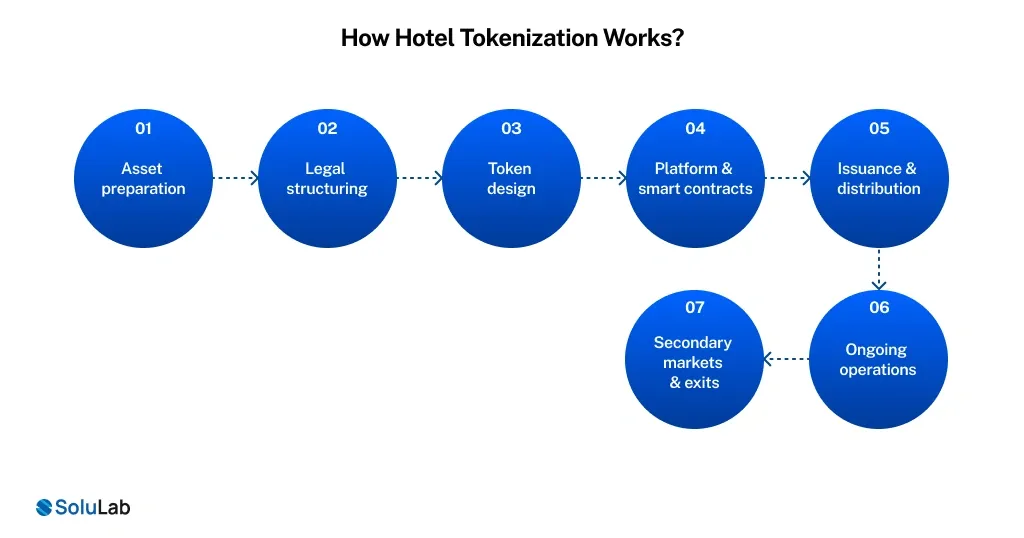
Here’s the simplified lifecycle if you’re a hotel owner or fund:
- Asset preparation – You set up or use an SPV that legally owns the hotel or the rights being tokenized, with proper title, valuation, and due diligence.
- Legal structuring – Your legal team defines whether tokens are equity, debt, or revenue‑sharing instruments and drafts offering documents accordingly (often under securities exemptions).
- Token design – You work with an RWA tokenization development company to pick the blockchain, token standard (e.g., permissioned ERC‑1400 variants), compliance logic, and investor rights.
- Platform & smart contracts – A hospitality asset tokenization platform is customized or developed to handle KYC/AML, investor onboarding, token issuance, payment rails, and secondary trading rules.
- Issuance & distribution – Tokens are offered to investors, HNIs, family offices, retail (where allowed), or institutional investors through a compliant offering process.
- Ongoing operations – Hotel operations continue; net revenues or other defined metrics are calculated and distributed to token holders via on‑chain or off‑chain settlement flows.
- Secondary markets & exits – Investors may trade their tokens on permissioned marketplaces, or tokens may be redeemed/bought back as part of an exit event.
That’s the 10,000‑foot view. The real nuance is in how you structure the rights and how your tech stack enforces them.
How Hotel Tokenization Redefines Ownership in Hospitality?
Here’s where things get interesting. Hotel tokenization doesn’t just digitize a cap table. It changes what “ownership” means in your asset.
Traditionally, hospitality ownership meant:
- A handful of large equity owners or a fund.
- Complex shareholder agreements and restrictive transfer clauses.
- Minimal involvement from smaller investors beyond “we wrote a cheque”.
With hotel ownership tokenization, you can rethink that model:
- Ownership can be fractional: Investors can participate at much smaller ticket sizes while still having clearly defined rights.
- Ownership can be programmable: Smart contracts can embed lock‑ups, drag‑along/tag‑along logic, revenue‑sharing thresholds, and even dynamic pricing into your token.
- Ownership can be liquidity‑aware: Instead of investors being locked for 5–7 years, you can enable a controlled secondary market where investors exit earlier, subject to your jurisdiction’s regulations.
From an owner’s perspective, you’re still controlling the strategy and operations. But you’re no longer limited to a few capital sources. You’re potentially tapping:
- Global investors who want to gain exposure to hospitality.
- Crypto‑native investors seeking stable RWA yields.
- Diaspora investors who want a slice of a Goa or Dubai resort without buying a whole villa.
From an investor’s perspective, they’re getting a blockchain‑based hotel investment with verifiable rights and (ideally) transparent performance tracking instead of opaque hospitality flyers.
Read more – Private Equity Tokenization
Benefits of Tokenized Hotel Investments
If you strip away the jargon, hotel tokenization gives you four big benefits.
1. Lower Investment Ticket Sizes
You can break a large hospitality asset into thousands of tokens. That means a $ 20 million minimum cheque in a traditional Dubai hotel deal can become a few hundred thousand dollars equivalent or even less, depending on your structure. The same is happening globally with tokenized hotel investments, where smaller investors can access flagship properties they’d never touch otherwise.
2. Global Investor Access
Because tokens exist on blockchain infrastructure, you can design your hospitality tokenization model to target investors across multiple jurisdictions, subject to local securities law, of course. In practice, that means:
- NRIs investing in Indian or GCC hotels.
- European investors are getting exposure to Asian resort yields.
- Crypto‑native investors are diversifying into real assets via white-labeled wallets.
Read more – Countries to Launch a Real Estate Tokenization Platform
3. Transparent Ownership & Cash Flows
Blockchain ledgers excel at transparent recording of ownership and transfers. Combined with proper reporting and oracles, token holders can see:
- How many tokens exist
- Who holds what (subject to privacy design).
- How distributions are calculated and executed.
In my experience, once investors get used to seeing an on‑chain record of their rights, they become far more trusting than with PDF statements emailed once a quarter.
4. Potential Liquidity via Secondary Markets
The biggest promise and risk of tokenized assets is secondary‑market liquidity. Done right, your tokenized real estate platforms and alternative trading systems can give investors a structured way to sell their positions without waiting for a big exit.
The catch is that not every jurisdiction allows frictionless trading. You’ll likely need:
- Whitelisted investors and counterparties.
- Transfer restrictions based on lock‑ups and accreditation.
- Marketplace approvals, depending on your region.
But if you design this well, you’re no longer offering a “black box 7‑year lock‑in”; you’re offering a more flexible exposure to hospitality yields.
Core Technologies Powering Hospitality Tokenization
Let’s get technical for a bit. Under the hood, hotel tokenization development relies on a stack of blockchain and Web3 primitives that your tokenization partner must understand.
1. Blockchain Layer
Most serious hotel tokenization projects use EVM‑compatible chains (Ethereum mainnet, L2s, or permissioned chains) because they offer:
- Mature token standards for security tokens and RWAs.
- Ecosystem support (wallets, custody, compliance tools).
- Integration paths with institutional infrastructure.
For India‑focused deals, you often see a mix of blockchain layers, including public EVM chains (for global investor familiarity) and permissioned or consortium chains (for compliance needs of local partners and regulators).
2. Token Standards
You’re typically not using a simple ERC‑20 or NFT here. You need tokenized assets with built‑in compliance controls:
- Permissioned ERC‑20 variants with transfer hooks.
- ERC‑1400 / ERC‑3643 style securities token standards that allow whitelisting and partitioning.
- Custom RWA token contracts with pausing, freezing, and legal enforcement hooks.
3. Smart Contracts & Oracles
Your smart contracts encode:
- Issuance and burning logic.
- Whitelisting and residency rules.
- Distribution logic (revenue share, coupon payments, buyback formulas).
Oracles connect off‑chain hotel data revenues, occupancy, and FX rates into your on‑chain logic, even if settlement itself stays fiat for now.
4. Compliance & Identity Layer
Any serious hospitality blockchain solution has integrated:
- KYC/AML flows.
- Investor suitability checks.
- Sanctions and PEP screening.
You’ll either integrate third‑party KYC providers via APIs or work with a top white label tokenization platform that already has these baked into its offering.
5. Custody, Wallets & UX
Investors won’t tolerate clunky UX. In practice, you’ll support:
- Custodial wallets for less technical investors.
- Non‑custodial options for crypto‑native investors.
- Institutional custody integrations for larger tickets.
This is where a seasoned RWA tokenization development company like SoluLab brings a lot of value by designing UX flows that work for both a hotel owner in Dubai and an investor in Singapore.
Architecture & Process of Hotel Tokenization
Here’s a high‑level view of the architecture you’ll typically use-
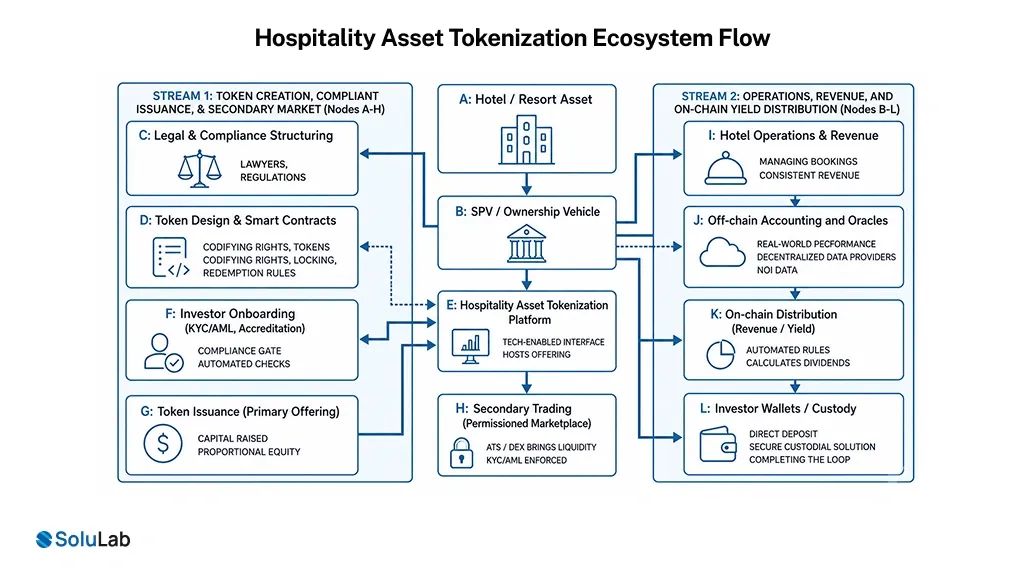
You can think of this as three integrated layers:
- Asset & legal layer – SPV, ownership, contracts, compliance.
- Blockchain & tokenization layer – smart contracts, tokens, oracles.
- Platform & market layer – onboarding, dashboards, offers, secondary trading.
If any of these is weak, your project will struggle. This is where most “whitepaper‑only” attempts fall apart.
Real-World Examples & Top Tokenized Hotel Projects in 2026
You don’t want theory; you want proof. A few relevant examples:
- St. Regis Aspen Resort – One of the early flagbearers of hotel tokenization, where nearly 19% of a luxury resort was tokenized and sold as digital securities, demonstrating that premium hospitality assets can be fractionalized for qualified investors.
- Trump International Hotel & Resort, Maldives – A headline‑grabbing project where loan revenue interests in a $300M resort are being tokenized, with tokens designed to offer fixed yields, loan revenue streams, and potential profit‑sharing or sale proceeds in the future.
- Multiple tokenized hotel portfolios – Various RWA and real estate tokenization platforms now list hotel and hospitality properties among their tokenized assets, with some platforms reporting tens of millions of dollars tokenized across hotels and related hospitality assets.
The trend line is clear. Tokenized hotel investments have moved from “one odd US deal” to a global pattern spanning Europe, the Middle East, and Asia.
How to Develop a Hospitality Asset Tokenization Platform
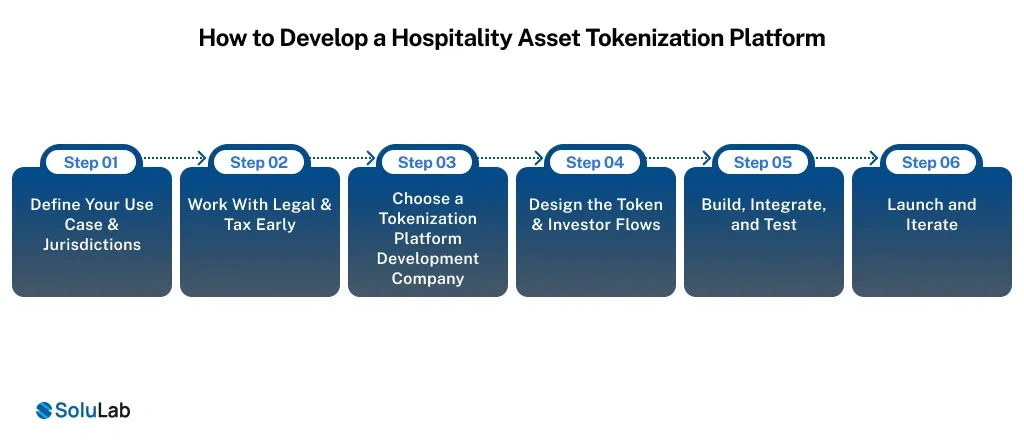
If you’re serious about this, you’re not just doing a one‑off token. You’re building (or white‑labeling) a hospitality asset tokenization platform.
Here’s the practical roadmap SoluLab recommends to hotel groups and funds.
1. Define Your Use Case & Jurisdictions
Are you tokenizing:
- A single flagship hotel?
- A portfolio of city business hotels?
- A pipeline of resorts under development?
Your structure and regulatory approach will differ. You also need to decide whether you’re targeting Indian investors only, cross‑border investors (e.g., India + GCC + Singapore), or fully global. An expert tokenization consultant can help you with the details.
2. Work With Legal & Tax Early
This is where most projects mess up. They call the tokenization company before the law firm. You need:
- Clear classification of tokens as equity, debt, or hybrid.
- Regulatory assessment in each investor jurisdiction.
- Tax treatment for both SPV and investors.
In India, for example, you’ll juggle SEBI, RBI, FDI limits, and sometimes state‑level real estate norms. It can be done, but you need specialist counsel.
3. Choose a Tokenization Platform Development Company
Once you have the legal framework, you find a tokenization platform development company that understands both real estate tokenization development services and the specificities of hospitality. You should be looking for:
- Experience with RWA tokenization in hospitality or at least commercial real estate.
- Knowledge of securities token standards and compliance workflows.
- Ability to integrate KYC providers, custodians, and potential marketplaces.
4. Design the Token & Investor Flows
This is where you define:
- Minimum ticket sizes.
- Lock‑up periods and transfer restrictions.
- Distribution logic (monthly, quarterly, performance‑based).
- Investor UX (dashboard, performance metrics, statements).
From a technology side, your hotel tokenization development team translates this into smart contracts, APIs, and front‑end flows.
5. Build, Integrate, and Test
You then:
- Stand up your blockchain infrastructure and smart contracts.
- Integrate KYC, payment rails (fiat/crypto), and custody.
- Run end‑to‑end testing, including simulated distributions.
You want to see full lifecycle flows from investor onboarding through to receiving distributions and, ideally, a secondary trade before you invite real money in.
6. Launch and Iterate
The first issuance is not the last. You’ll gather feedback on:
- Investor onboarding friction.
- Reporting clarity.
- Liquidity expectations.
You then refine your hospitality tokenization platform for the next asset or fund.
Working with Professional Tokenization Companies: The SoluLab Approach
Frankly, if you’re a hotel chain, developer, or real estate fund, your edge isn’t writing Solidity or picking token standards. Your edge is sourcing deals, running operations, and managing investor relationships. That’s why working with a professional tokenization platform development company matters.
SoluLab’s approach (and this is where you should benchmark any partner) typically includes:
- End‑to‑end advisory – From early discovery and feasibility to technical architecture and go‑live, combining both blockchain in the hospitality industry expertise and RWA structuring knowledge.
- Customizable tokenization stack – Not just “one chain, one token”. You get tailored choices on chains, standards, custody, and compliance integrations suitable for your markets.
- Sector‑aware design – Hotel tokenization has quirks: seasonality, RevPAR volatility, brand flags, and management contracts. Your tokenization platform should accommodate those realities, not ignore them.
- Scalable architecture – Whether you issue one tokenized resort or an entire franchise portfolio, the platform architecture should handle multi‑asset, multi‑jurisdiction scaling.
If you think of tokenization as a one‑off “launch my token” exercise, you’ll end up with a stranded project. If you treat it as a long‑term digital infrastructure investment and work with the right partner, it becomes a repeatable capital formation engine for your entire hospitality pipeline.
Challenges & Risks in Hotel Tokenization
Let’s be honest: this isn’t trivial. There are real risks.
1. Regulatory Uncertainty
Securities, real estate, and cross‑border investments are some of the most heavily regulated domains in the world. Hotel tokenization sits at the intersection of all three. You have to manage:
- Classification of tokens as securities.
- Cross‑border marketing rules.
- Restrictions on who can invest and where they can trade.
2. Illiquidity Risk
Just because your asset is tokenized doesn’t mean it’s liquid. Industry leaders explicitly warn that in 2026, the real measure of RWA success is sustainable liquidity, not flashy issuance numbers. If you don’t build:
- A credible secondary trading strategy.
- Market‑making or liquidity programs.
- Investor education around holding periods.
…you may end up with disgruntled token holders expecting daily liquidity from a fundamentally illiquid asset class.
3. Operational Complexity
Hotels are operationally intensive. You’re adding on‑chain complexity on top of that. You need:
- Clean data flows from hotel PMS/ERP systems to your tokenization platform.
- Accurate and timely financial reporting.
- Coordinated communication between hotel ops, asset managers, and token holders.
4. Technology & Security Risks
Smart contract bugs, wallet mismanagement, and custody issues can all hurt your project. Working with tested platforms and experienced real estate tokenization development companies reduces this risk significantly, but doesn’t remove it altogether.

2026–2027 Future Trends in RWA Tokenization for Hospitality
Looking out over 2026–2027, here’s where our experts see Tokenization in Hospitality heading.
- Pre‑construction tokenization – Instead of tokenizing stabilized assets only, more projects (like the Maldives resort example) are tokenizing during development, with tokens tied to project milestones and future revenue rights.
- Regulator‑backed pilots – Jurisdictions like Dubai are already running government‑backed RWA tokenization programs. Expect more “regulator in the loop” pilots for hotels and tourism assets in Asia and the Middle East.
- Integrated RWA marketplaces – Top RWA platforms are adding hospitality and real estate tokenization as core verticals, with curated deals and integrated KYC/custody, not just DIY tools.
- Data‑driven pricing and analytics – As more tokenized hotel deals go live, you’ll see better benchmarks, risk models, and yield curves making tokenized hotel investments easier to price and compare.
- Blended structures with REITs and funds – Expect hybrid models where tokenized hotel SPVs sit alongside traditional REIT structures, giving investors a choice of regulated wrappers and liquidity profiles.
If you’re planning a 2 – 3 year hotel development cycle today, it’s almost irresponsible not to at least explore how RWA tokenization in hospitality can fit into your funding and exit strategy.
FAQs
Conclusion
Hotel tokenization is no longer a buzzword. In 2026, it’s a serious capital formation tool that lets you fractionalize hotel ownership, reach global investors, and design programmable, transparent, and potentially more liquid investment structures for hospitality assets.
If you’re a hotel owner, developer, or fund manager, your real decision isn’t “Should we do hotel tokenization or not?” The smarter question is: “Which parts of my portfolio and capital stack should be tokenized first, and with which partner?”
A specialized tokenization platform development company like SoluLab gives you the technical and RWA execution layer smart contracts, compliance workflows, investor UX, and integration with tokenized real estate platforms so you can focus on doing what you do best: sourcing great hotel assets, operating them well, and delivering sustainable returns. If you want to explore hotel tokenization development for your next hospitality project, this is the year to move from “exploration call” to a concrete roadmap.
Ready to explore hotel tokenization for your next hotel or resort?
You can outline your asset, investor target, and jurisdictions, and then engage SoluLab to design a custom hospitality tokenization architecture, from legal‑tech alignment to a live, investor‑ready platform.
Shipra Garg is a tech-focused content strategist and copywriter specializing in Web3, blockchain, and artificial intelligence. She has worked with startups and enterprise teams to craft high-conversion content that bridges deep tech with business impact. Her work translates complex innovations into clear, credible, and engaging narratives that drive growth and build trust in emerging tech markets.