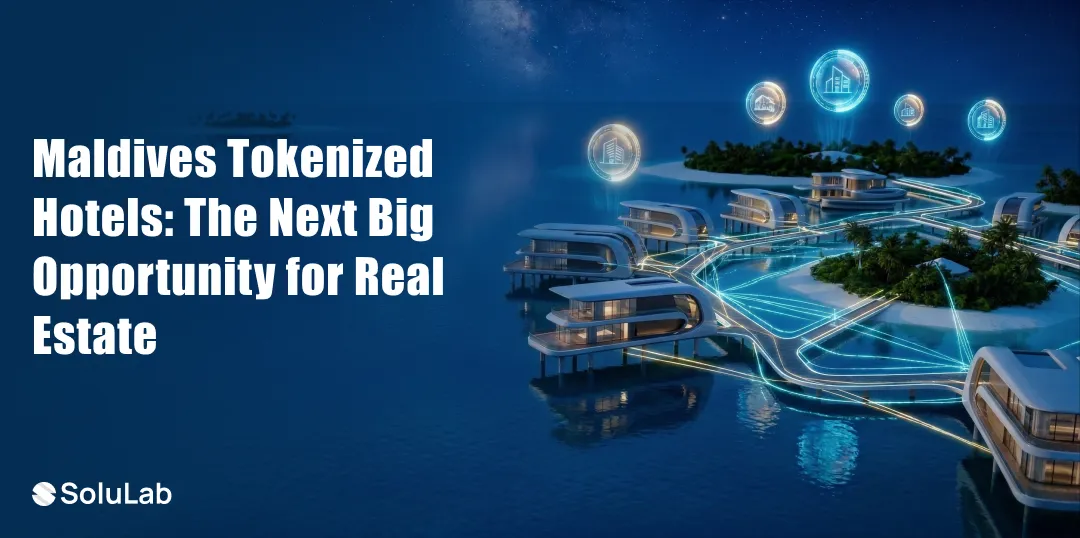
Luxury tourism is no longer just about beachfront villas and five-star service. It is about structured capital, yield visibility, and global investor access. That shift is exactly why Real estate firms are closely watching Tokenized Hotel Maldives Projects.
The Maldives remains one of the highest-value resort markets in the world. Tourism contributes roughly 25–30% of GDP directly, and significantly more indirectly. Average Daily Rates (ADR) in premium resorts often exceed $800–$1,500 per night, with ultra-luxury properties commanding even higher rates.
At the same time, global capital markets are evolving. Real estate tokenization is no longer experimental. Institutional players have acknowledged tokenized real-world assets as part of future capital infrastructure. For developers exploring tokenizing luxury Maldivian resorts, the timing is strategic.
This blog breaks down the opportunity from a business-first lens.
Key Takeaways
- Maldives hospitality assets combine scarcity-driven pricing power with strong global luxury demand, creating stable yield potential for tokenized structures.
- Early movers gain a competitive advantage in a fast-growing luxury tourism market while benefiting from blockchain-backed transparency and streamlined ownership structures.
- Hotel tokenization improves 60% capital efficiency by diversifying funding sources, lowering capital friction, and expanding access to global accredited investors.
- Compliance-first structuring and disciplined execution are critical to successfully Tokenizing Luxury Hotels in the Maldives at an institutional level.
What Makes the Maldives a Premium Global Hospitality Market?
Unlike urban markets, the Maldives operates on a one-island-one-resort model. Each property functions as an independent hospitality asset. Land supply is naturally limited. That creates scarcity, which protects pricing power.
| Limited inventory + global luxury demand = margin stability. |
- High Revenue Per Key
Luxury Maldivian resorts consistently outperform regional averages:
- ADR frequently 2–3x Southeast Asian beach destinations
- Strong occupancy resilience in premium segments
- High ancillary revenue from F&B, spa, and marine activities
This structure makes the Maldives’ hospitality assets more predictable compared to mixed-use city hotels.
- Global Brand Appeal
The Maldives is positioned as a honeymoon, ultra-luxury, and privacy destination. Demand flows from Europe, India, the Middle East, and China. High-net-worth travelers dominate bookings.
For firms investing in real estate in the Maldives, this global visibility supports premium valuation narratives.
| Key Facts: Real estate tokenization is projected to become a $4 trillion market by 2035,The resort, about 25 minutes by speedboat from the island nation’s capital Malé, will include 80 beach and overwater villas and is slated to open by the end of 2028,”This development set a new benchmark for innovation in real estate investment through tokenization,” said Eric Trump, the Trump Organization’s executive vice president. |
How Does Tokenization Improve Capital Efficiency for Resort Developers?
Developing a luxury island resort often requires $80M–$200M, depending on scale and positioning. Traditional funding involves private equity, bank debt, and family offices. That model works, but it is slow and capital-intensive.
Hotel tokenization introduces an additional capital layer.

- Fractional Capital Access
By launching a Tokenized Maldives Hotel structure, developers can:
- Lower minimum ticket sizes
- Attract global accredited investors
- Diversify funding sources
- Reduce overdependence on a few large equity partners
Instead of waiting for one $40M equity check, capital can be structured in tranches.
- Reduced Weighted Average Cost of Capital
Structured token offerings can blend revenue-sharing models with traditional equity. This helps optimize capital stack design.
For asset tokenization solutions for Maldives resorts, even a 1–2% improvement in capital efficiency significantly improves long-term IRR.
- Digital Investor Onboarding
Modern Tokenization Platforms for Hotels integrate:
- KYC and AML automation
- Smart contract-based revenue distribution
- Transparent reporting dashboards
For Real estate firms, this reduces administrative overhead compared to managing hundreds of direct shareholders.
- Potential Secondary Liquidity
While secondary markets for real estate tokens are still maturing, regulated crypto exchanges are emerging. This gives investors optional exit paths earlier than traditional 7–10 year hospitality holds.
That flexibility increases investor appetite.

What Risks and Execution Challenges Must Be Managed in Hotel Projects?
Tokenizing Maldives resorts does not eliminate risk. It changes how risk is structured.
- Regulatory Compliance
Tokenized offerings often qualify as securities. Jurisdiction selection is critical. Cross-border compliance must align with EU, US, or Asia-Pacific frameworks.
Poor structuring can result in legal exposure.
- Revenue Transparency
Smart contracts must mirror real-world accounting. If token holders receive a revenue share, audited reporting becomes non-negotiable.
Luxury positioning demands institutional governance.
- Liquidity Misalignment
Overpromising liquidity is a common mistake. Secondary markets for hospitality tokens are still developing.
Real estate firms must position white label tokenization platforms as capital efficiency, not speculative trading.
- Brand Sensitivity
Luxury operators are cautious. Positioning Tokenizing Luxury Hotels in the Maldives must remain institutional and compliant, not crypto-driven hype.
Disciplined execution separates credible developers from opportunistic issuers.
What Is the Right Structure for a Tokenized Hotel Project in the Maldives?
Structuring determines long-term success.
- Special Purpose Vehicle (SPV) Model
Each island typically operates under a lease agreement. The resort can be ring-fenced into an SPV for asset tokenization. Tokens represent structured participation in that SPV.
This isolation reduces cross-project risk.
- Revenue or Equity Token Design
Developers must define:
- Pure equity tokens
- Revenue participation tokens
- Hybrid instruments
- Fixed-yield digital notes
The choice impacts investor profile and compliance strategy.
- Compliance-First Architecture
A credible real estate tokenization platform in the Maldives should include:
- Legal opinion documentation
- Regulated issuance framework
- Transparent investor rights
Working with a strong real estate tokenization development company ensures smart contracts reflect legal documentation accurately.
- Technology Stack
An effective Asset Tokenization Platform should support:
- Multi-jurisdiction investor onboarding
- Automated revenue calculation
- Secure custody integration
- Reporting dashboards
Technology is infrastructure, not marketing.
How Should Real Estate Firms Execute a Tokenized Resort Strategy?
Execution requires sequencing. This needs an experienced company to guide for investing in real estate tokenization. Let’s see what you need to focus on.

Phase 1: Feasibility Validation
- Stress-test ADR and occupancy assumptions
- Confirm construction logistics and cost projections
- Define total capital requirement
Hospitality feasibility must come first. Tokenization cannot fix weak fundamentals.
Phase 2: Capital Stack Design
Blend:
- Traditional bank debt
- Institutional equity
- Tokenized tranches
This reduces risk concentration.
Phase 3: Legal + Platform Integration
Engage securities counsel and a reliable provider offering real estate tokenization development services. Ensure:
- Smart contracts align with legal agreements
- Revenue flows are auditable
- Investor rights are enforceable
Phase 4: Institutional-First Positioning
Target family offices, hospitality-focused funds, and accredited investors first. Avoid a retail-first strategy in early stages.
Enterprise investors anchor credibility.
Phase 5: Long-Term Governance
- Annual third-party audits
- Clear revenue distribution policies
- Transparent operational updates
Tokenization enhances transparency expectations. Governance must scale accordingly.
The convergence is clear:
- Luxury tourism demand remains strong
- Scarcity protects Maldivian resort economics
- Digital capital infrastructure is maturing
- Investors want yield-backed assets
For Real estate firms, Tokenized Hotel Maldives Projects represent more than digital innovation. They represent capital modernization applied to one of the world’s strongest hospitality markets.
The opportunity is not about replacing traditional finance. It is about expanding it. Developers who move early in Tokenizing Maldives resorts can:
- Define valuation benchmarks
- Build regulatory familiarity
- Establish investor trust
- Lower long-term capital friction
The question is no longer whether real estate tokenization will impact hospitality; the real question is which firms will structure responsibly, execute carefully, and position themselves ahead of the next capital cycle in the Maldives.

Conclusion
Tokenized hotel projects in the Maldives are integrating with feasibility, struture and capital clarity. If you are planning to launch a Tokenized Maldives Hotel, the foundation matters more than the token model.
To have them, a strong tokenization platform development company’s help is a must. Therefore, Solulab is here to bring the latest infrastructure and adoptions to your platform.
- Strong hospitality fundamentals with realistic ADR and occupancy assumptions
- Clear SPV structuring to ring-fence risk
- Compliance-first real estate tokenization architecture
- Transparent investor rights and audited revenue reporting
- A scalable Asset Tokenization Platform aligned with institutional standards
Contact us today to explore how we can support your Maldives resort tokenization strategy.
FAQs
Deepika is a content writer who blends storytelling with strategic thinking. She explores topics across digital innovation, emerging tech, and the evolving blockchain industry. She enjoys breaking down complex ideas into simple, engaging narratives in the growing global markets.