Key Takeaways
- Development costs typically range from $20,000 to $50,000+, depending on AI capabilities and compliance scope.
- MVP platforms help validate demand before major infrastructure investments.
- AI reduces onboarding, compliance, and asset administration costs by up to 40%.
- Smart contracts, security audits, and regulatory controls account for a significant share of budgets.
- Modular architecture helps businesses reduce upfront spending and accelerate launches.
- White-label and Tokenization-as-a-Service options provide faster market entry
Public blockchain networks currently hold more than $23.6 billion in tokenized assets, while industry forecasts project a multi-trillion-dollar opportunity before 2033.
Investors and users now expect faster settlements, automated compliance, and round-the-clock liquidity. This demand is driving interest in the AI-powered asset tokenization platform model.
AI strengthens
- valuation accuracy,
- investor onboarding,
- fraud detection, and
- liquidity management.
For businesses planning digital securities, real estate tokenization, private credit markets, or commodity-backed offerings, knowing development costs is critical.
Your 80% of your budget depends on AI automation, blockchain infrastructure, compliance requirements, and marketplace complexity.
How Is an AI-Powered Asset Tokenization Platform Different From Traditional Asset Management Systems?
Traditional systems were designed for centralized ownership records and manual operations. Today’s investors expect faster access, greater transparency, and automated execution.
1. Traditional Asset Management Challenges
Legacy asset platforms often rely on fragmented systems and manual coordination. Teams spend weeks validating ownership records, processing paperwork, and updating investor databases.
This creates operational friction and increases administrative expenses.
2. Manual Compliance and Investor Onboarding Bottlenecks
Compliance teams frequently review documents manually. KYC and AML checks can delay investor onboarding for days.
An intelligent platform uses AI to verify identities, flag risks, and process applications within minutes.
This is where AI asset tokenization delivers measurable operational value.
3. AI-Powered Tokenization vs Traditional Asset Administration
AI acts as the decision layer while blockchain acts as the execution layer. Think of traditional administration as driving with a paper map. AI-driven tokenization works like real-time GPS guidance.
| Operational Area | Traditional Asset Administration | AI-Powered Tokenization |
| Investor Onboarding | 2-7 days for verification and approvals | 5-30 minutes with AI-assisted KYC and AML screening |
| Compliance Monitoring | Manual reviews performed periodically | Continuous monitoring with real-time risk alerts |
| Asset Valuation | Quarterly or monthly updates | Dynamic valuation using live market and asset data |
| Liquidity Management | Reactive decision-making | Predictive liquidity forecasting using AI models |
| Fraud Detection | Investigated after suspicious activity occurs | Behavioral analytics identify anomalies before losses escalate |
| Ownership Records | Multiple databases and reconciliations | Single source of truth through blockchain records |
| Operational Costs | Higher staffing requirements | Up to 30%-40% lower administrative overhead |
| Settlement Speed | Hours or days depending on intermediaries | Near-instant execution through smart contracts |
| Investor Experience | Limited visibility into asset performance | Real-time dashboards and portfolio insights |
| Scalability | Additional assets require additional manpower | Infrastructure scales without proportional headcount growth |
4. ROI Comparison: Traditional Infrastructure vs AI-Enabled Tokenization
Organizations adopting intelligent tokenization platforms often report:
- Up to 40% lower operational costs
- Investor onboarding completed 80% faster
- Settlement times reduced from days to seconds
- Improved liquidity visibility across asset classes
For enterprises evaluating the AI asset tokenization platform, these gains often justify development investments.
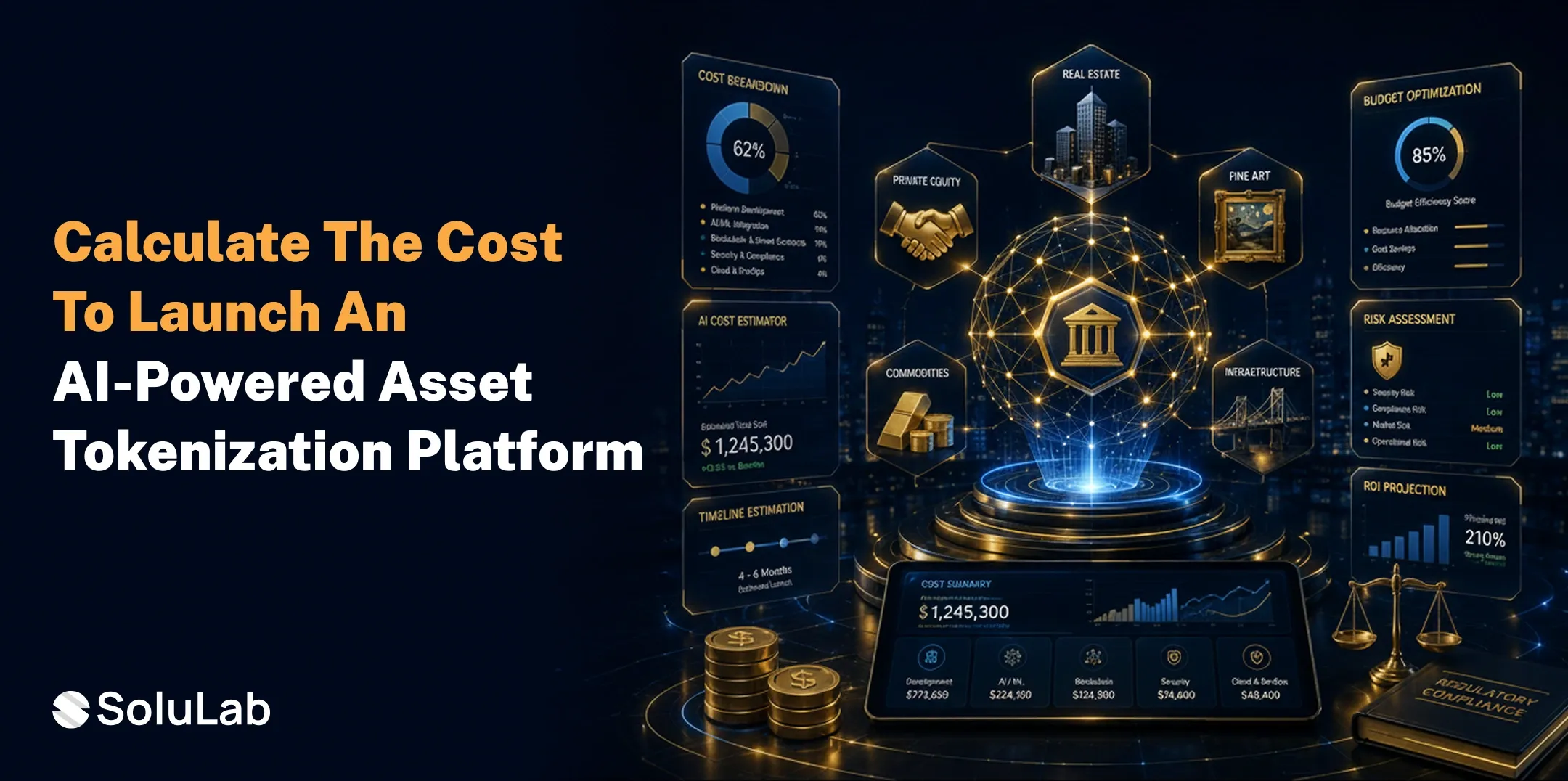
What Is the Cost to Develop an AI-Powered Asset Tokenization Platform?
The answer depends on platform scope, regulatory requirements, and automation depth.
Businesses pursuing asset tokenization platform development generally fall into two categories:
- MVP-focused startups
- Enterprise-scale institutions
1. Cost Breakdown by Core Platform Components
Core platform development typically includes:
| Component | Estimated Cost |
| Investor Portal | $10K-$40K |
| Asset Management Dashboard | $15K-$50K |
| Marketplace Engine | $20K-$80K |
| Wallet Integration | $10K-$30K |
| Admin Panel | $8K-$25K |
These modules form the foundation of a tokenized asset platform.
2. Cost of AI Features and Automation Layers
AI development costs vary significantly.
Features may include:
- Automated KYC verification
- Predictive risk modeling
- AI-powered valuation engines
- Compliance monitoring
- Investor recommendation systems
Organizations evaluating AI in asset tokenization development cost should expect budgets between $25K and $100K for advanced AI layers.
3. Blockchain Infrastructure and Smart Contract Development Costs
Smart contracts govern ownership, transfers, dividends, and governance rights.
Development expenses include:
- Token standards
- Asset issuance contracts
- Transfer restrictions
- Governance logic
- Oracle integrations
The cost of building a tokenized asset platform infrastructure generally ranges from $20K to $60K.
4. Compliance, Security, and Regulatory Implementation Costs
Security cannot be treated as an afterthought.
Critical investments include:
- Smart contract audits
- AML monitoring
- GDPR compliance
- Identity verification
- Access controls
For institutions handling regulated assets, compliance costs may reach $50K or more.
5. Enterprise Integration and Marketplace Development Costs
Many enterprises need integration with:
- Banking systems
- ERP software
- Custody providers
- Payment gateways
- CRM platforms
These integrations significantly impact the real-world asset tokenization platform cost.
Should You Start With an MVP Asset Tokenization Platform or Build a Full Enterprise Solution?
This is one of the most common questions buyers ask.
1. When an MVP Makes Strategic Sense
An MVP works well when you need:
- Market validation
- Investor feedback
- Regulatory testing
- Early traction
For most businesses, starting small prevents expensive mistakes. As the proverb says, “Measure twice and cut once.”
2. Essential Features for an AI-Powered Tokenization MVP
Your MVP should focus on:
- Asset onboarding
- Investor registration
- Wallet integration
- Basic compliance
- Token issuance
These capabilities support initial AI tokenization for asset ownership workflows without excessive spending.
3. Scaling From MVP to Enterprise Platform
After validation, enterprises can add:
- Secondary marketplaces
- Automated liquidity management
- AI-powered analytics
- Cross-chain functionality
- Institutional custody support
This is where AI agents in asset tokenization begin delivering operational efficiencies.
4. Estimated Budget Comparison: MVP vs Enterprise Development
| Platform Type | Estimated Cost |
| MVP | $60K-$120K |
| Growth Stage | $120K-$250K |
| Enterprise Platform | $250K-$500K+ |
Businesses looking to build an AI-powered asset tokenisation platform often start with the MVP route.
5. Common Mistakes That Increase Development Costs
Avoid these expensive errors:
- Building unnecessary features first
- Ignoring compliance planning
- Choosing unsuitable blockchain networks
- Delaying security audits
- Creating monolithic architectures
Going full feature mode on day one can be a little delulu.
What Does the Asset Tokenization Platform Development Process Look Like?
Successful projects follow a phased roadmap. If you are going to build an asset tokenization platform, then you must know the following to ensure your development process is on track.
Phase 1: Discovery, Compliance Assessment, and Architecture Planning
This phase defines:
- Asset classes
- Ownership structures
- Regulatory requirements
- Technical architecture
Companies seeking asset tokenization solutions should never skip this stage.
Phase 2: Blockchain and Smart Contract Development
Blockchain development teams create:
- Token contracts
- Ownership frameworks
- Governance modules
- Settlement logic
This forms the foundation of the platform.
Phase 3: AI Engine Development and Data Integration
AI systems process:
- Market data
- Compliance signals
- Risk indicators
- Valuation inputs
Advanced institutions increasingly explore AI model tokenization platform development to monetize proprietary intelligence.
Phase 4: Investor Portal and Marketplace Development
User-facing components include:
- Dashboards
- Portfolio management
- Asset listings
- Trading functionality
The experience should feel simple, even when complexity exists underneath.
Phase 5: Security Testing, Smart Contract Audits, and Compliance Validation
Before launch, teams perform:
- Penetration testing
- Contract audits
- Load testing
- Regulatory validation
This protects both investors and platform operators.
Phase 6: Deployment, Monitoring, and Continuous Optimization
Launch is only the beginning.
Continuous monitoring helps maintain uptime, security, and compliance performance.
Development Timeline and Cost by Phase
| Development Phase | Timeline | Estimated Cost |
| Discovery & Planning | 2-4 Weeks | $10K-$25K |
| Tokenization Infrastructure | 4-8 Weeks | $20K-$60K |
| AI Development | 4-10 Weeks | $25K-$100K |
| Marketplace & Dashboard | 4-8 Weeks | $20K-$80K |
| Security & Compliance | 2-6 Weeks | $15K-$50K |
| Deployment & Support | Ongoing | Variable |
Organizations evaluating AI asset tokenization platform development should budget according to long-term business objectives rather than launch requirements alone.
How Can Businesses Reduce AI-Powered Asset Tokenization Platform Development Costs?
Cost optimization works best when planned early. The early bird gets more benefits in the asset market.
Launching With Modular Architecture Instead of Full-Scale Development
Modular systems allow incremental upgrades. You only pay for capabilities when business demand requires them.
Leveraging Existing Blockchain Ecosystems
Established networks already provide security, liquidity, and developer tooling. This reduces infrastructure spending and accelerates deployment.
Using Pre-Built Compliance and KYC Infrastructure
Third-party KYC providers can cut implementation timelines dramatically. This approach supports tokenization-as-a-service strategies for faster market entry.
Prioritizing High-Impact AI Features First
Focus first on:
- Compliance automation
- Fraud detection
- Asset valuation
These functions typically generate the highest ROI.
Building in Phases to Minimize Upfront Investment
A phased approach helps preserve capital while reducing implementation risk. Remember, you do not need a Ferrari to validate a road.
What Are the Fastest Alternatives to Building an Asset Tokenization Platform From Scratch?
Not every business requires custom development. You can go with an already built platform and add your custom requirements with the help of a tokenization development company.
White-Label Asset Tokenization Platforms
White-label platforms offer:
- Faster launches
- Lower costs
- Proven frameworks
This option appeals to businesses entering the market quickly.
Tokenization-as-a-Service (TaaS) Models
TaaS providers handle infrastructure while you focus on asset growth and investor acquisition.
Blockchain Infrastructure Providers
Solutions from firms such as Canton Network and Securitize reduce development complexity.
Hybrid Build-and-Customize Approaches
This model combines white-label infrastructure with custom functionality.
Many enterprises view it as the ideal balance between speed and flexibility.
Build vs Buy vs White Label Comparison
| Approach | Cost | Time to Market |
| Build | High | Long |
| Buy | Medium | Medium |
| White Label | Low | Fast |
How Did SoluLab Cut Its Clients’ Development Costs by 80%?
While platforms like Securitize, Tokeny, and Ondo Finance demonstrate what successful tokenization looks like, enterprises often face a different challenge: controlling development costs while accelerating market entry.
At SoluLab, we addressed this challenge through a GenAI-enhanced tokenized RWA platform designed for faster deployment, intelligent automation, and regulatory readiness.
What Helped Reduce Costs by 80%?
Instead of creating every module from scratch, our team implemented a modular AI-powered asset tokenization platform architecture with:
- GenAI-assisted investor onboarding and compliance workflows
- Automated asset issuance and ownership management
- AI-powered market intelligence and liquidity monitoring
- Smart contract-driven secondary trading controls
- Real-time risk monitoring and fraud detection
- Intelligent portfolio analytics dashboards
This approach helped the client achieve:
- 80% reduction in operational overhead
- 2.1x growth in active investors
- 35% faster secondary settlements
- 3.2x increase in secondary market participation
Key Lesson for Businesses Planning Asset Tokenization
Before investing heavily in asset tokenization platform development, prioritize automation, liquidity, and compliance capabilities. Enterprises that focus on these areas early often reduce long-term costs while improving investor engagement.
If you are evaluating RWA tokenization development services, start with a scalable MVP, validate demand, and expand functionality in phases. This strategy lowers the overall AI asset tokenization development cost while creating a stronger foundation for growth.
FAQs
Deepika is a content writer who blends storytelling with strategic thinking. She explores topics across digital innovation, emerging tech, and the evolving blockchain industry. She enjoys breaking down complex ideas into simple, engaging narratives in the growing global markets.