Technology has always shaped financial regulation. From electronic trading to online brokerages, every innovation forced regulators and market participants to evolve. Real World Asset (RWA) tokenization is no different.
In 2026, US enterprises are no longer asking whether to tokenize assets. They are asking how to launch RWA Tokenization Platforms that are SEC-Compliant and can operate with clarity, investor confidence, and regulatory alignment.
- Regulatory discussions and crypto roundtables at the U.S. Securities and Exchange Commission (SEC) signal something important.
- Policymakers are actively seeking input from market participants. There is a push toward transparency, predictability, and a workable crypto rulebook.
- Under leadership voices like Hester Peirce, the conversation has shifted from uncertainty to structured engagement.
This guide walks you through how to build 100% SEC-compliant Real World Asset (RWA) tokenization platforms in the USA.
Key Takeaways
- Limited liquidity and manual compliance processes continue to slow private market capital formation across asset classes.
- A structured SEC-compliant RWA tokenization approach strengthens transparency while protecting long-term investor confidence.
- Embedding KYC, custody, and reporting controls directly into platform architecture reduces ongoing regulatory exposure.
Why Are US Enterprises Accelerating SEC-Compliant RWA Tokenization in 2026?
Enterprise adoption is no longer experimental. It is strategic.
1. Institutional Capital Is Moving On-chain
A new report from Sentora and DL Research found that tokenized stocks reached roughly $963 million in market value as of January 2026. This represents a year-on-year increase of nearly 2,878% from just $32 million a year earlier. Why this growth in RWA tokenization:
- Reduced reconciliation costs
- Faster settlement cycles
- Automated compliance via smart contracts
- Expanded investor reach
2. Regulatory Engagement Is Increasing
The SEC has held public roundtables to discuss custody, tokenized securities, and on-chain market structure. These discussions matter. They show regulators want structured feedback from issuers and investors.
The message is clear: Market participants should not be left guessing how to comply.
That creates an opportunity for enterprises to build SEC-regulated asset tokenization platforms aligned with evolving guidance instead of operating in gray areas.
3. Operational Efficiency Gains
Tokenization impacts core financial processes:
- Issuance
- Trading
- Transfer
- Settlement
- Record of ownership
Blockchain’s transparent ledger reduces intermediation delays. Smart contracts can automate dividend distribution, transfer restrictions, and reporting requirements.
For enterprises exploring RWA tokenization platform development in the USA, the upside includes:
- 20–40% reduction in post-trade processing costs (in pilot environments)
- Faster investor onboarding
- Improved cap table accuracy
In short, tokenization is becoming basic infrastructure in all industries.
What SEC, FINRA, and U.S. Regulatory Frameworks Must Be Addressed Before Tokenizing Real-World Assets?
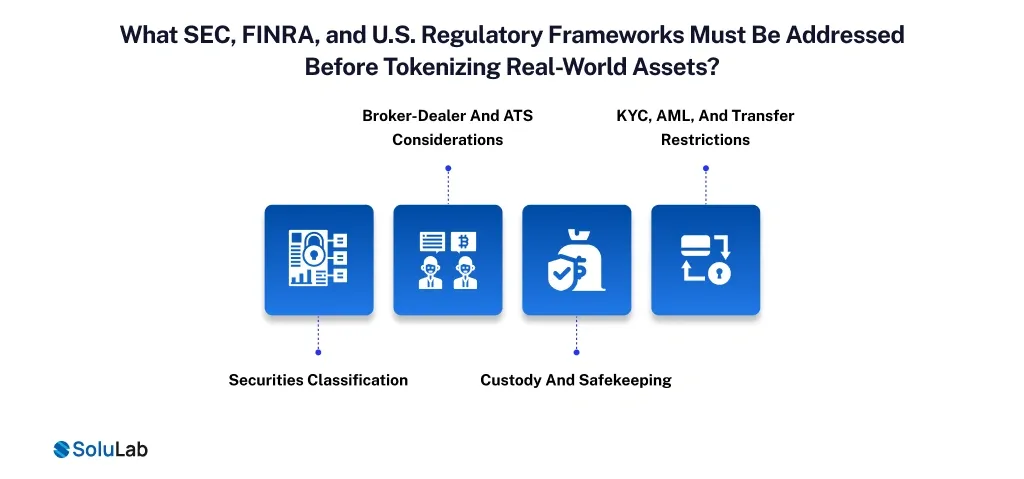
Before you launch your own compliant RWA platform, regulation must come first.
1. Securities Classification
Most tokenized RWAs will qualify as securities under U.S. law. That means compliance with the Securities Act of 1933 and the Securities Exchange Act of 1934.
Enterprises must determine:
- Is the token a security under the Howey Test?
- Does it require registration or exemption?
Common pathways include:
- Regulation D (private placements)
- Regulation A+ (mini public offerings)
- Regulation S (offshore investors)
Choosing the wrong structure can delay or derail a Compliant RWA Platform Development initiative.
2. Broker-Dealer and ATS Considerations
If secondary trading is enabled, involvement of:
- Registered broker-dealers
- Alternative Trading Systems (ATS)
may be required.
A fully compliant SEC-compliant RWA tokenization model must evaluate whether the platform:
- Facilitates securities transactions
- Matches orders
- Provides custody
These decisions impact licensing obligations.
3. Custody and Safekeeping
If tokens represent ownership of real estate, private equity, or intellectual property rights, custody arrangements must align with SEC and FINRA expectations.
A strong SEC-compliant real-world asset tokenization framework includes:
- Qualified custodians
- Multi-signature wallet controls
- Clear segregation of client assets
4. KYC, AML, and Transfer Restrictions
Compliance does not stop at issuance. Ongoing monitoring is critical.
Your Compliant tokenization strategy must integrate:
- Accredited investor verification
- OFAC screening
- AML monitoring
- Transfer restriction enforcement via smart contracts
Smart contracts can automate compliance logic, but legal design must come first.
What Enterprise-Grade Technology Stack Is Required to Build a Secure and Compliant RWA Tokenization Platform?
A Real World Asset (RWA) tokenization platform is not just a blockchain application, but is a regulated financial infrastructure.
1. Blockchain Architecture
Enterprises must decide:
- Public blockchain
- Permissioned blockchain
- Hybrid model
Permissioned environments provide controlled access and privacy. Public chains provide broader liquidity and interoperability.
The decision affects scalability, governance, and compliance monitoring.
2. Smart Contract Infrastructure
Smart contracts must:
- Embed transfer restrictions
- Automate dividend distributions
- Support regulatory reporting
- Enable upgrade mechanisms
Independent smart contract audits are mandatory for enterprise-level SEC-regulated tokenization platform development.
3. Identity and Compliance Layer
A compliant stack includes:
- Digital identity verification
- Onchain/offchain KYC sync
- Real-time compliance screening
This layer ensures that secondary transfers remain compliant.
4. Core Banking and ERP Integration
Enterprises launching RWA tokenization platform USA must connect:
- Payment rails
- Core accounting systems
- Cap table management tools
- Reporting dashboards
Tokenization should integrate into existing financial systems, not replace them overnight.
5. Cloud and Infrastructure Compliance
Enterprise deployments often rely on secure cloud environments. Infrastructure must align with:
- SOC 2
- ISO 27001
- Data residency requirements
Cybersecurity risk management is non-negotiable.
How Should US Companies Structure Token Issuance, Investor Onboarding, and Secondary Liquidity Under SEC Oversight?
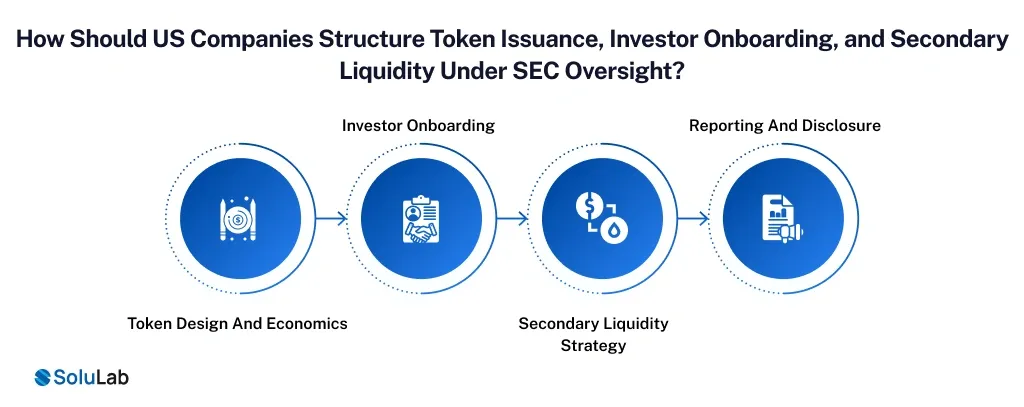
Execution determines whether your SEC-Compliant RWA Tokenization Platforms gain traction.
1. Token Design and Economics
Each token must clearly represent:
- Ownership rights
- Voting rights
- Cash flow entitlements
- Redemption mechanics
Legal documentation and smart contracts must align perfectly.
2. Investor Onboarding
Enterprise-grade onboarding includes:
- Digital KYC workflows
- Accredited investor verification
- Automated subscription agreements
A well-structured RWA tokenization platform launch services framework reduces onboarding time while maintaining compliance rigor.
3. Secondary Liquidity Strategy
Liquidity improves investor appeal but increases regulatory complexity.
Enterprises must decide:
- Closed-loop internal marketplace
- Integration with a regulated ATS
- Time-based liquidity windows
Smart contracts can enforce holding periods under Regulation D. That ensures compliance while enabling structured liquidity.
4. Reporting and Disclosure
We are in a full-disclosure business.
Transparency builds trust. Enterprises should:
- Provide periodic financial reports
- Offer asset-level performance data
- Maintain accessible ownership records
Blockchain technology can reduce compliance costs if implemented correctly.
What Ongoing Compliance, Risk Management, and Governance Controls Ensure Long-Term Regulatory Alignment?
Launching an SEC-compliant RWA tokenization platform is only the beginning. To maintain regulatory alignment in the long term, companies must implement strong compliance monitoring, governance frameworks, and proactive risk management practices:
1. Continuous Regulatory Monitoring
Regulatory frameworks evolve. A compliant RWA platform must:
- Track SEC guidance updates
- Adapt to new crypto task force recommendations
- Update smart contracts when required
Governance processes should allow controlled upgrades.
2. Risk Management Framework
Risk categories include:
- Smart contract vulnerabilities
- Cybersecurity threats
- Liquidity risks
- Regulatory enforcement exposure
Periodic audits and penetration testing should be standard in Compliant RWA Platform Development.
3. Asset Transparency and Valuation Controls
Tokenized assets require:
- Independent valuation processes
- Clear reserve disclosures
- Defined audit trails
Transparency reduces both investor uncertainty and regulatory friction.
4. Governance Structure
Enterprises must define:
- Who controls contract upgrades
- How disputes are resolved
- What happens in default scenarios
A strong governance model strengthens SEC-compliant RWA tokenization credibility.
Conclusion
As discussed, launching SEC-Compliant RWA Tokenization Platforms is no longer just about digitizing assets. It is about redesigning how ownership, liquidity, and compliance operate inside US capital markets.
For enterprises planning to launch your own compliant RWA platform in the USA, SoluLab is here to help you.
With 250+ experienced developers and deep expertise in SEC-regulated tokenization platform development, we help enterprises move from concept to compliant deployment with confidence.
Our experts offer:
- Increase secondary liquidity potential by 30–50% through structured, regulator-aligned trading models.
- Reduce post-trade reconciliation and settlement timelines by up to 40% using smart contract automation.
If you are ready to build a secure, future-ready tokenization platform, let’s talk today...
FAQs
Deepika is a content writer who blends storytelling with strategic thinking. She explores topics across digital innovation, emerging tech, and the evolving blockchain industry. She enjoys breaking down complex ideas into simple, engaging narratives in the growing global markets.