Key Takeaways
- Tax form tokenization helps enterprises protect sensitive tax records while improving compliance visibility. Instead of leaving forms, IDs, transaction details, and investor information exposed across systems.
- Companies can convert tax data into secure tokens linked to verified records. This supports digital tax document management, faster audits, stronger access control, and better reporting accuracy.
- For businesses dealing with tokenized assets, real-world asset tokenization, funds, securities, or blockchain transactions, tokenized tax workflows make recordkeeping more reliable.
- SoluLab helps enterprises build custom tax form tokenization services and secure platforms for tax compliance automation.
Tax teams are under pressure from two sides. Regulators expect cleaner reporting, while businesses are handling more digital records, tokenized assets, cross-border transactions, and investor documents than ever before. Spreadsheets, email trails, and scattered folders are no longer enough when auditors ask for proof.
Asset tokenization gives enterprises a safer way to manage sensitive tax records by replacing exposed information with controlled digital references. With the right tax tokenization platform, companies can protect data, organize evidence, automate compliance workflows, and prepare for audits without chasing documents across departments.
Deciphering Tax Form Tokenization
Tax form tokenization is the process of replacing sensitive tax form data with secure digital tokens. These tokens act as references to the original information without exposing the full record every time a system needs to use it.
For example, a company may tokenize:
- Taxpayer identification numbers
- Investor details
- Income records
- Cost basis information
- Capital gains data
- Form 1099 details
- K-1 statements
- W-8 and W-9 forms
- Transaction IDs
- Wallet-linked tax records
- Audit evidence
The original data remains protected in a secure vault or controlled environment. The token can be used across workflows, reports, dashboards, and compliance systems without unnecessarily exposing sensitive information. This is different from simple document storage. A traditional document system stores files.
Why Tax Form Tokenization Is Crucial in 2026?
Tax compliance has become more data-heavy. Companies no longer manage only invoices, payroll records, and annual filings. Many now deal with digital assets, investor statements, wallet records, tokenized funds, private credit instruments, treasury assets, and cross-border ownership data. This creates a problem most teams already feel: the tax record is spread everywhere.
Some data sits in accounting software. Some live in investor portals. Some comes from exchanges or custodians. Some is stored in spreadsheets. Some is buried inside PDFs, emails, and approval trails.
When everything is scattered, compliance becomes slower, audit preparation becomes stressful, and data exposure risk increases. Tax Form Tokenization helps solve this by turning sensitive tax information into controlled digital references. The original record stays protected, while authorized systems can still verify, retrieve, or use the needed information. This matters most for businesses already deep into real-world asset tokenization, where every new fund, security, or on-chain transaction adds another tax record that has to be tracked and defended.
This is especially useful for companies managing:
- Digital asset transactions
- Tokenized investment products
- Investor tax documents
- KYC and ownership records
- Fund distributions
- Real-world asset reporting
- Crypto or blockchain-based income
- Multi-entity tax documentation
A tokenization for tax compliance gives teams a clearer view of what data exists, who accessed it, where it moved, and how it supports a filing position.
Tax Data Tokenization vs Traditional Tax Document Management
Traditional tax document management software typically focuses on storage, search, version control, and folder organization. That is useful, but it does not fully solve the security and audit-readiness problem. A document folder can still contain exposed taxpayer IDs, account details, investor records, and transaction history. If permissions are weak, too many users may access information they do not need.
Tax data tokenization takes a more controlled approach. Instead of moving raw tax data across workflows, it allows teams to work with tokenized references. Sensitive data remains protected, while the business process continues.
The difference is important:
- Traditional document management: Stores tax files and helps users retrieve them.
- Tax form tokenization: Protects sensitive data and controls how records are accessed, used, verified, and audited.
This is why enterprises are looking beyond storage tools. They need secure tax data management, not just digital folders.
Tokenization helps with:
- Data minimization
- Access control
- Audit trails
- Record verification
- Secure sharing
- Regulatory review
- Workflow automation
- Evidence tracking
For companies handling tokenized assets, digital securities, or fund structures, this becomes even more valuable. Tax records are not static. They are linked to transactions, investors, wallets, issuances, redemptions, and distributions.
A tokenized record model can keep those connections cleaner.
How Tax Form Tokenization Improves Compliance?
Compliance problems often begin with small gaps. A missing document. A mismatched investor record. An outdated form. A cost basis value that no one can trace. A spreadsheet that was changed without a clean audit trail. These are not always fraud issues. Often, they are process issues.
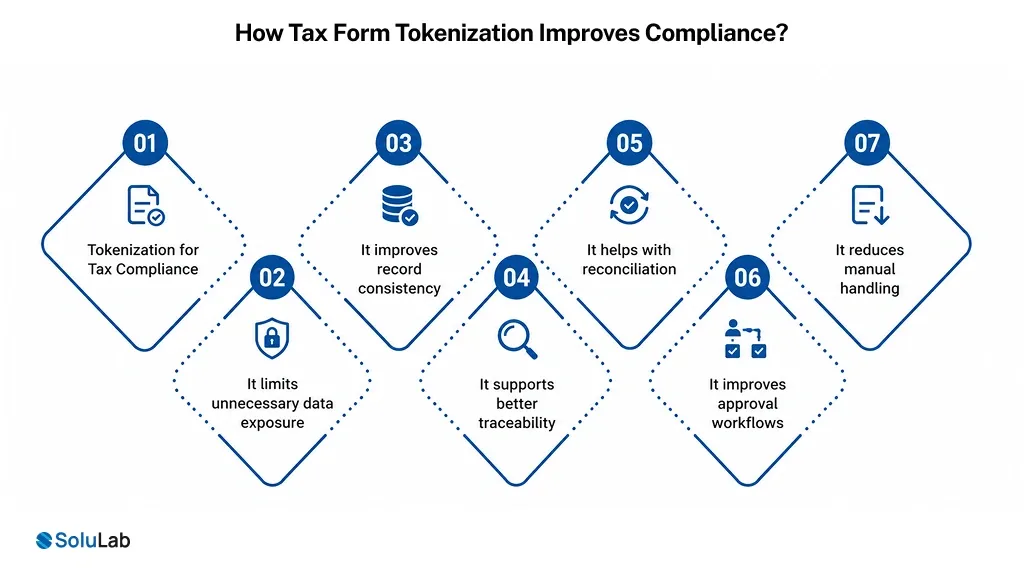
- Tokenization for tax compliance helps reduce these gaps by making tax records easier to control and verify. Here is how it supports compliance teams:
- It limits unnecessary data exposure. Sensitive fields can be tokenized so users only see what they need for their role.
- It improves record consistency. Tokenized references reduce duplicate versions of the same tax data across systems.
- It supports better traceability. Teams can track when a tax record was created, updated, accessed, or used in a filing workflow.
- It helps with reconciliation. Tokenized tax records can link forms, transactions, ownership details, and supporting documents.
- It improves approval workflows. Tax teams can define review steps before records are finalized, shared, or submitted.
- It reduces manual handling. A well-designed platform can automate parts of collection, validation, classification, and retrieval.
With tax compliance automation, enterprises can reduce the repetitive manual work that slows them down and increases risk.
Why Audit Readiness Depends on Better Tax Records?
Audit readiness is not something a company fixes at the end of the year. It is built during the year, transaction by transaction, record by record. When auditors ask for proof, teams need more than a final number. They need the story behind that number.
For example:
- Where did the record come from?
- Who approved it?
- Has it changed?
- Which transaction does it support?
- Which tax form was used?
- Was the source verified?
- Who accessed the file?
- Is the supporting evidence complete?
Tax record tokenization helps answer these questions faster because each token can be linked to the underlying data. For businesses managing taxation of tokenized assets, audit readiness becomes even more important. A weak record system can make those events difficult to defend later. A tokenized tax environment gives teams a better way to prove what happened and why it was reported that way.
How Blockchain-Based Tax Form Tokenization Works?
Blockchain-based tokenization can add another layer of trust when tax records need tamper-evident proof, timestamping, and controlled verification. A common architecture may include:
- Secure off-chain storage for tax documents
- Tokenized references for sensitive fields
- Hashing for document integrity
- Smart contracts for workflow rules
- Role-based access for users
- Audit logs for every important action
- APIs for tax, accounting, and compliance systems
This approach is useful when businesses need proof that a document existed at a certain time, was not changed after approval, or is linked to a specific transaction or investor event. Tax tokens become useful as controlled references, not public copies of sensitive records. A strong design keeps private information private and uses blockchain where verification matters.
Tax Form Tokenization and Tokenized Assets
The rise of asset tokenization trends and adoption is changing how enterprises think about tax records. When ownership, transfers, distributions, or redemptions happen digitally, tax documentation must keep up. Companies working with blockchain asset tokenization need cleaner tax data from the beginning. The issue is simple. Tokenized assets can create many small, fast-moving, and data-rich events. Each event may have tax implications.
A business may need to track:
- Acquisition date
- Disposal date
- Holding period
- Cost basis
- Fair market value
- Investor ownership
- Income allocation
- Distribution records
- Jurisdictional rules
- Withholding status
- Reporting forms
- Supporting evidence
Manual tracking becomes fragile. Tax data tokenization can help by linking tax forms and transaction records through secure tokenized references. This creates a more connected tax infrastructure for digital asset businesses, funds, issuers, platforms, and custodians.
For companies building an asset tokenization business, tax compliance should not be added later. It should be part of the platform design.
Where Solana Tax Tokenization Fits?
Solana Tax Tokenization may be relevant for businesses building high-throughput tax or asset workflows where speed, low transaction costs, and token-based records matter. Solana’s architecture is already a common choice for asset ownership events that need to settle fast, and the same properties apply when connecting those events to tax recordkeeping.
For example, a platform may use Solana for asset ownership events while maintaining sensitive tax forms off-chain. The tax token or blockchain reference can help connect an investor event to a protected tax record without exposing confidential information publicly. This model can support:
- Tokenized fund records
- Real estate ownership events
- Investor distributions
- Transaction verification
- Digital tax document references
- Audit evidence trails
- Platform-level compliance workflows
The important point is design discipline. Tax documents should not be casually pushed to a public chain. A better approach is to combine secure off-chain storage, tokenized identifiers, permissioned access, and selective blockchain proofs.
How Enterprises Benefit From Tax Form Tokenization?
The business case for tax form tokenization services is not only about technology. It is about reducing compliance pressure and making tax data easier to manage.
- Stronger tax information security: Tokenization reduces exposure of taxpayer IDs, investor records, financial data, and transaction details across internal systems.
- Faster audit preparation: Teams can retrieve token-linked records, access logs, approvals, and supporting documents without searching across folders and emails.
- Cleaner compliance workflows: Tax forms, transaction records, and evidence can be organized through structured digital workflows.
- Reduced manual errors: Automated validation and record linkage help reduce mistakes caused by duplicate files or inconsistent data entry.
- Better investor reporting: Funds and asset platforms can manage investor documents, distributions, and tax records more consistently.
- Scalable tax operations: As transaction volume grows, tokenized records make tax operations easier to manage across entities, regions, or asset classes.
- Improved regulatory confidence: A structured record environment helps teams respond to audits, reviews, and internal compliance checks with stronger evidence.
These benefits matter most for enterprises dealing with complex ownership, tokenized investment products, or high-volume tax reporting.
Tax Compliance Automation: What Should Be Automated?
Not every part of tax work should be automated. Tax judgment still matters. But many supporting tasks are repetitive, rules-based, and time-consuming. A strong tax compliance automation platform can help with:
- Document collection
- Form validation
- Record classification
- Tax data tokenization
- Access control
- Approval routing
- Evidence tracking
- Report generation
- Audit log creation
- Investor document management
- Exception flagging
- Data reconciliation
If a tokenized asset creates a taxable distribution event, the platform can link the event to ownership records, tax form status, withholding rules, and reporting documents. Here, enterprise tax compliance solutions can save time. The value is not just automation for its own sake. It is fewer gaps, clearer ownership, and better evidence when the company needs to prove its position.
Secure Tax Data Management Architecture
A strong, secure tax data management system needs more than encrypted storage. It should be designed around access, auditability, and workflow control. A practical architecture may include:
- Tokenization vault: Stores the mapping between tokens and sensitive tax data.
- Secure document repository: Keeps original tax forms protected with encryption, access rules, and retention policies.
- Blockchain proof layer: Stores hashes, timestamps, or token references when tamper-evident verification is needed.
- Workflow engine: Handles approvals, reviews, exception routing, and tax team tasks.
- API integration layer: Connects accounting systems, investor portals, asset tokenization platforms, custodians, and reporting tools.
- Audit log system: Tracks who accessed, changed, approved, or exported tax records.
- Role-based access control: Ensures legal, finance, compliance, investor relations, and external advisors see only what they need.
- Reporting dashboard: Gives teams visibility into missing forms, pending approvals, audit requests, and compliance status.
This architecture helps enterprises move from document storage to controlled tax intelligence.
Use Cases for Tax Form Tokenization
Tax form tokenization applies across industries where sensitive tax documents and digital records need stronger control.
- Tokenized Fund Platforms: A tokenized fund platform may need to manage investor tax forms, distribution records, capital activity, and ownership changes. Tokenization helps link investor records with reporting events while protecting sensitive details.
- Real World Asset Tokenization: Companies offering RWA tokenization services need tax-ready records for asset ownership, income events, investor transfers, and jurisdictional reporting. Tokenized tax forms can support cleaner compliance.
- Real Estate Tokenization: Real estate tokenization platforms can use tokenized tax records for investor onboarding, property income distributions, ownership changes, and audit evidence.
- Treasury and Fixed-Income Assets: Businesses managing US treasury tokenization, bond & equity tokenization, or tokenized treasury assets need accurate income, basis, and investor reporting records.
- Private Credit and Debt Instruments: Private credit tokenization and debt tokens can involve interest payments, repayment schedules, investor allocations, and tax reporting obligations that benefit from structured record control.
- Intellectual Property Tokenization: Intellectual property tokenization may involve royalties, rights ownership, payments, withholding rules, and jurisdiction-specific tax records.
- Asset Tokenization Platforms: Asset tokenization platforms can embed tax form tokenization into onboarding, reporting, investor management, and compliance workflows from the start.
These use cases show why tax architecture should not be an afterthought in tokenized finance.
Common Mistakes Enterprises Should Avoid for Tax Form Tokenization
- Storing sensitive tax data everywhere: When tax data is copied across tools, spreadsheets, emails, and folders, security risk and audit confusion increase.
- Treating tokenization as simple masking: Masking hides data visually. Tokenization should create controlled references with proper vaulting, access, and governance.
- Putting sensitive tax forms directly on-chain: Blockchain can support verification, but private tax details should usually remain protected off-chain.
- Ignoring audit trails: A tax platform should show who accessed, changed, approved, or exported records.
- Separating tax from tokenization architecture: Companies building tokenized assets should design tax workflows early, not after launch.
- Over-automating tax judgment: Automation can support workflows, but tax professionals still need review authority for complex positions.
- Using weak access controls: Finance, legal, investor relations, auditors, and external advisors should not all see the same level of detail.
Avoiding these mistakes makes tax data security solutions stronger and more useful in practice.

Conclusion
Tax form tokenization gives enterprises a more secure and organized way to manage sensitive tax records. It helps companies protect taxpayer information, connect forms with transaction data, prepare audit evidence, and automate repetitive compliance tasks. For businesses working with tokenized real-world assets, funds, digital securities, private credit, real estate, or blockchain-based platforms, tax records can become complex quickly. Tokenization helps bring structure to that complexity.
How SoluLab Helps With Tax Form Tokenization Platform Development?
SoluLab helps enterprises build secure, scalable, and compliance-focused tokenization systems. For companies exploring tax form tokenization services, the real challenge is not only creating tokens. It is designing the full workflow around data protection, reporting, audit readiness, and platform integration.
SoluLab can support:
- Tax tokenization strategy
- Secure document tokenization
- Custom tax platform architecture
- Blockchain proof-of-record design
- Tokenization vault development
- API integration with accounting systems
- Investor tax document workflows
- Compliance automation modules
- Audit dashboard development
- Role-based access control
- Smart contract integration
- Solana-based tokenization workflows
- RWA tax record infrastructure
- Platform testing and deployment
As a leading real-world asset tokenization development company, we also understand how tax workflows connect with broader asset tokenization services, investor portals, tokenized funds, and blockchain-based ownership systems. Whether the goal is tax document management software, a digital tax compliance platform, or a broader tokenization ecosystem, our experts can help design the right architecture.
FAQs
Shipra Garg is a tech-focused content strategist and copywriter specializing in Web3, blockchain, and artificial intelligence. She has worked with startups and enterprise teams to craft high-conversion content that bridges deep tech with business impact. Her work translates complex innovations into clear, credible, and engaging narratives that drive growth and build trust in emerging tech markets.