Cars are changing. Not the sheet metal so much as what sits behind it. AI agents have quietly moved from a nice-to-have feature into something that carmakers now count on, both for talking to buyers and for running the shop floor.
You have probably talked to one already. These artificial intelligence (AI) agents, the chatbots and phone bots you meet on dealership sites and car marketplaces, are trained to answer you the second you ask. They read what you type, figure out what you actually meant, and reply fast. That speed comes from natural language processing doing the heavy lifting underneath.
And they never clock off. Ask a simple question about a model at midnight, or book a test drive on a Sunday. The assistant handles it, tailored to you, right then.
So what does this look like in practice? In this blog we will walk through some of the applications of AI agents working in the automotive industry, and where they actually move the needle on business goals.
What are AI Agents in the Automotive Industry?
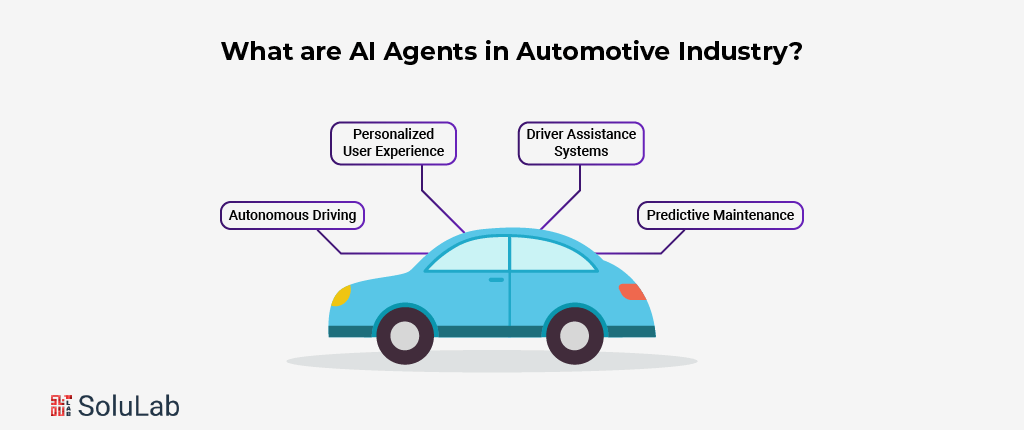
Strip away the jargon and an AI agent in a car is just a system that senses what is around it, decides what to do, and then acts on that decision to hit a goal. Some run on their own. Others sit beside a human driver and help. Either way, they are reshaping how a vehicle behaves and how it reads the road.
- Autonomous Driving: This is the big one. AI agents are the brain behind self-driving tech, letting a car move without a person at the wheel. They pull in feeds from cameras, LiDAR, and radar all at once, build a picture of what is happening, and make calls in the moment.
- Driver Assistance Systems: You have likely used these without thinking about it. Adaptive cruise control, lane-keeping assist, automatic emergency braking. All AI-powered, all built to keep you from making the small mistakes that turn into crashes.
- Predictive Maintenance: Here the agent reads the car’s own data and flags a part that is about to give out, before it strands you. Fewer surprise breakdowns. Less time off the road.
- Personalized User Experience: Over time the system learns how you drive and what you like, then tunes directions, entertainment, and cabin settings to match.
Get your head around these agents and you start to see why they matter so much for the future of getting around, and for what happens on the road.
The Historical Evolution of AI in Automotive
None of this appeared overnight. AI in cars has a long, winding backstory, with a handful of moments that really pushed things forward.
- Early Days: Go back to the 1950s and 60s. Researchers were just starting to poke at machine learning and automation. The experiments were basic: simple algorithms for guidance and control, nothing you would recognize as a car brain today.
- Expert Systems: The 1980s brought expert systems into the industry. These leaned on rule-based logic to support decisions, mostly around diagnostics and maintenance, and they set the stage for the smarter automotive AI that followed. The real turning point came in the 1990s with self-driving research. Carnegie Mellon’s Navlab, and then the DARPA Grand Challenge in the early 2000s, showed the world that a computer could actually drive. Those projects put computer vision, sensor fusion, and real-time processing on the map, and paved the road for AI in the automotive industry.
- Machine Learning and Big Data: Then came the 2010s, and with them a flood of data. Machine learning and big data analytics took off. Automakers started mining the huge volumes of information their vehicles were spitting out to build real AI systems. Modern driver-assistance systems (ADAS) showed up here, sharpening safety and convenience, and putting AI to work in everyday driving.
- Current Trends: Today AI shows up all over the map: predictive maintenance, personalized in-car experiences, fully autonomous driving. Tesla, Waymo, and the legacy automakers are all pouring money into research to stay in the game, much of it centered on AI research in the automotive sector and machine learning for the industry.
Technologies Used for AI in the Automotive Industry
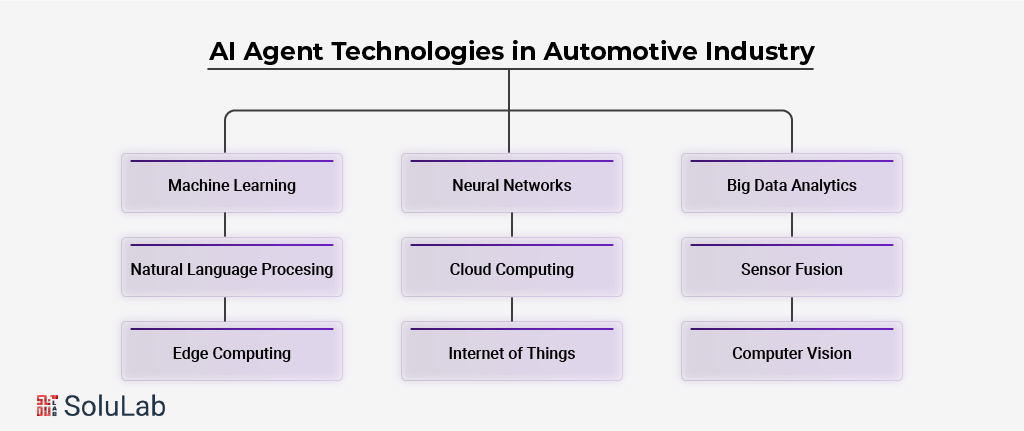
No single trick makes this work. Building and running AI agents for the automotive industry takes a stack of technologies working together. They are what let a vehicle drive itself, spot a failing part before it fails, and tailor the ride to the person behind the wheel, all while getting smarter and safer. Here is what does the actual work behind automotive AI agents:
1. Machine Learning (ML)
Start here, because everything else leans on it. Machine learning chews through the flood of data coming off sensors, cameras, and onboard systems, then makes calls in real time. Reading a traffic sign. Spotting a pedestrian. Machine learning in automotive lets automotive AI agents get better the more they run. Machine learning in transportation also plans smarter routes by studying traffic, so trips run on time, and it stretches battery life in electric vehicles by managing energy more carefully.
2. Computer Vision
This is how a car “sees.” Computer vision takes the images and video from onboard cameras and works out what they mean: the road ahead, an obstacle, the car in the next lane. For self-driving vehicles it is non-negotiable, and it does plenty of quiet work inside driver-assistance systems (ADAS) too, keeping things safe.
3. Natural Language Processing (NLP)
Ever told your car to find the nearest gas station? That is NLP. It powers the voice systems that let you talk to the vehicle in plain speech, from setting a destination to tweaking a setting, all without taking your hands off the wheel.
4. Sensor Fusion
One sensor lies. Two disagree. Sensor fusion blends the feeds from cameras, radar, lidar, and ultrasonic sensors into one coherent read of what surrounds the car. That fuller picture is what lets AI agents for the automotive industry decide well, even when the scene gets messy.
5. Edge Computing
Sometimes there is no time to phone home. Edge computing processes data right inside the vehicle instead of shipping it to the cloud and waiting. For something like collision avoidance, where the answer is needed in a fraction of a second, that difference is everything.
6. Big Data Analytics
A connected car generates a staggering amount of data every second. Big data analytics sorts through it to find patterns, call maintenance before it is needed, and tune how the vehicle performs. Automotive AI agents lean on those insights to keep the drive smooth.
7. Neural Networks
Loosely modeled on the brain, neural networks are good at exactly the thing driving demands: spotting messy patterns and picking an action. That is why they sit at the core of autonomous systems, pulling from many inputs at once to work out the next move.
8. Cloud Computing
The cloud handles the heavy storage and the big number-crunching, which is how AI models keep getting updated and refined over time. It also carries vehicle-to-vehicle (V2V) and vehicle-to-infrastructure (V2I) chatter, which feeds better traffic management and safety.
9. IoT (Internet of Things)
IoT wires the car into a wider web of devices, so automotive AI agents can both gather data and pass it along. That link is what makes smart features possible: predictive traffic management, over-the-air updates that improve the AI without a service visit.
Put all of this together and AI agents for the automotive industry can act intelligently, respond quickly, and hold up when it counts, changing how vehicles run and how they deal with the world around them.

Core Characteristics of Smart AI Agents for Connected Cars
The use of AI in the automotive industry has produced systems that make cars perform better and drive safer. A few traits define what these systems can do:
- Perception: First the agent has to notice things. Sensors and cameras gather the fine detail: obstacles in the way, what a traffic sign says, the state of the road. Good perception means the car reads all of this as it happens and reacts as conditions shift.
- Decision-Making: Then it has to choose. The system runs that gathered data through its algorithms, weighs speed, distance, and what might go wrong, and settles on the safest, most efficient move. Without this, there is no smooth driving and no staying inside the rules.
- Learning and Adaptation: This is the part that sets them apart. Through machine learning, these agents keep improving off past runs and fresh data. Some use multi-agent reinforcement learning, which helps them settle into new environments and work sensibly alongside other systems.
- Communication: A car that talks to its surroundings is a safer car. Through Vehicle-to-Everything (V2X), the vehicle trades real-time information with other cars, with infrastructure, and with pedestrians, so everyone has a better sense of what is going on.
- Autonomy Levels: Not every agent drives itself. The Society of Automotive Engineers (SAE) lays out a scale from Level 0, no automation at all, up to Level 5, full automation. Where a system lands on that scale tells you how much it can actually handle.
- Safety and Reliability: Everything above is worthless if the system is flaky. These agents are built with backup mechanisms and fail-safes to cut risk, then tested hard across all kinds of conditions to prove they hold up.
Taken together, these traits show how smart AI agents are remaking the connected car into something safer, more efficient, and more responsive to whoever is driving.
Read Our Blog Post: Build AI Agents For Logistics
Management and Logistics Optimization for the Automotive Industry
Building cars is only half the job. The industry also runs on tight management and logistics, keeping operations moving, costs down, and customers happy. AI has opened up new methods here, including approaches like agentic RAG (Retrieval-Augmented Generation), which are dragging logistics and supply chain work into a more efficient, more sustainable era.
1. Supply Chain Management
AI-driven tools let automakers watch and tune their supply chains as things happen. Pulling from many sources at once, these systems forecast demand, catch disruptions before they spread, and hand over practical fixes. Parts and materials stay available, without the twin headaches of overstock and shortage.
2. Inventory Optimization
Inventory is where money quietly leaks. Overstock too much or fall behind, and profit takes the hit. AI-powered systems forecast what is actually needed, so production keeps moving without a warehouse full of parts nobody is using yet.
3. Fleet Management
Pair AI with IoT and fleet management gets sharper. You get real-time tracking, smarter route planning, and maintenance predicted before something breaks. The payoff: less downtime, lower fuel bills, and operations that simply run tighter.
Read Also: Retrieval-Augmented Generation (RAG) vs LLM Fine-Tuning
4. Route Optimization
Smart algorithms weigh traffic, weather, and delivery windows to pick the best route for moving goods. Deliveries land sooner, transport costs drop, and the environmental toll shrinks along with them.
5. Predictive Maintenance
AI-based tools keep a constant eye on the vehicles and machinery doing the logistics work. Catch a problem early and you skip the surprise breakdown, and the equipment lasts longer for it.
6. Warehouse Automation
In an AI-run warehouse, storing and retrieving goods gets faster and cleaner. Automation cuts down on mistakes, speeds up how quickly orders go out, and smooths the whole logistics flow.
7. Sustainability Initiatives
AI also backs greener logistics, tuning transport networks to burn less energy and put out fewer emissions. It sharpens recycling and waste handling too, which helps the industry hit its sustainability targets.
Put AI and data analytics behind management and logistics, and the automotive industry gets processes that are smarter, steadier, and kinder to the planet, which keeps costs in check and leaves customers better off.
Improving Road Safety With AI Agents
Bringing responsible AI agents into the automotive industry has done real work on road safety, because it lets vehicles think faster and choose better. They pull together real-time data, sharp algorithms, and communication tech to head off accidents and keep both drivers and pedestrians out of harm’s way.
1. Advanced Driver Assistance Systems (ADAS)
Adaptive cruise control, lane-keeping assist, automatic emergency braking. These AI-powered features do a lot of the safety heavy lifting. Working off sensors and cameras, they let a vehicle catch a hazard and respond to it, cutting down on human error and making the drive less nerve-racking.
2. Real-Time Data Analysis
Smart AI agents in connected cars read the world around them constantly: traffic flow, road conditions, someone stepping off a curb. Many use hybrid AI, which pairs rule-based systems with machine learning, to make split-second calls, whether that means dodging a collision or easing off the throttle to match the cars ahead.
3. Vehicle-to-Everything (V2X) Communication
Through V2X, AI systems keep a running conversation between vehicles, infrastructure, and everyone else on the road. That shared awareness lets a car see trouble coming, a sudden stop up ahead, a patch of bad weather, and react early, in a way that lines up with the ideas behind responsible AI.
4. Driver Monitoring
Some agents watch the driver, not just the road. They check for alertness and flag when attention slips. Fatigue detection and distraction alerts step in before a drowsy or distracted moment turns into a crash. Here hybrid AI helps the system learn one driver’s habits while still holding firm on safety.
5. Enhanced Traffic Management
Look at congestion patterns, suggest a better route, ease the jam. AI systems do this to keep traffic moving. Fold in responsible AI and the priorities shift toward cutting accident risk and keeping traffic solutions fair, which trims the pileups that congestion and sudden bottlenecks tend to cause.
With these hybrid AI methods, the automotive industry is pushing road safety forward, turning vehicles into active safety partners and making the whole business of getting around more secure and dependable for everyone.
Read Also: AI Iot Gasoline Delivery App Development/
Role of AI Agents in Vehicle Design and Manufacturing
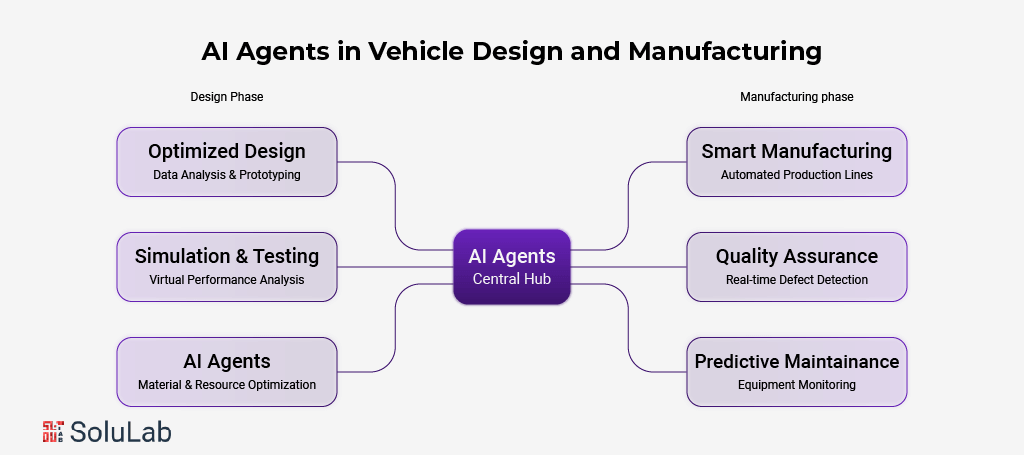
AI agents for the automotive industry are changing how vehicles get designed and built, pushing efficiency, fresh ideas, and lower costs. Bring in advanced tech like Retrieval Augmented Generation, and automakers can tighten up their processes and turn out smarter, greener cars.
1. Optimized Design Processes
Designers hand AI the big datasets, customer preferences, market trends, performance numbers, and get back patterns they might have missed. Those reads let AI agents for automotive enterprises float designs that work on looks and on function. And generative design, run by AI, can spin up many prototypes fast, which shaves real time off development.
2. Simulation and Testing
Why build a flawed prototype when you can find the flaw first? AI systems recreate real-world conditions to test a design before anyone tools up for production. By predicting how it will perform, how long it will last, and how safe it will be, manufacturers catch and fix problems early, which keeps quality high and costs down.
3. Smart Manufacturing
On the floor, smart AI agents for connected cars sharpen the production line through automation and constant monitoring. AI-equipped robots place parts with a precision human hands cannot match, which cuts errors and lifts output. AI also keeps schedules tuned, balancing supply against demand without the usual friction.
4. Quality Assurance
Quality control is where AI agents really earn their keep, reading data from sensors and cameras along the line. Spot a defect or an odd inconsistency the moment it appears, and only the cars that pass muster reach a customer.
5. Predictive Maintenance for Equipment
AI watches the health of the manufacturing gear itself and calls for service before a machine quits mid-shift. Lines keep running, and operating costs stay lower.
6. Sustainability and Material Optimization
AI helps manufacturers pick greener materials and use them wisely, so less goes to waste and the environmental hit shrinks. Study the production process closely enough and the openings appear: places to save energy, places to use fewer resources.
So AI agents in vehicle design and manufacturing do two things at once. They make the work more efficient, and they open the door to genuine innovation, which helps automakers put out high-quality, advanced vehicles the market actually wants.
Use Cases of AI Agents in the Automotive Industry
At bottom, an AI agent is just software that uses artificial intelligence to get things done on its own. More and more industries are folding them in, and the payoff usually shows up as better output and tighter efficiency. Here are a few of the AI applications in automotive industry:
- Virtual Assistants: Think Google Assistant, Alexa, Siri. They juggle tasks, answer questions, and run smart devices by voice. Rapid Innovation can lift engagement further by building personalized assistants shaped around a specific company’s needs.
- Customer Support: AI chatbots field questions and sort out problems around the clock, no human on shift required. Set up well, these support systems help companies spend less on operations while keeping customers happier.
- Personalization: On social platforms, streaming services, and e-commerce sites, AI agents study how you behave and serve up suggestions built for you. Rapid Innovation can apply the same kind of tailoring to push sales and keep customers coming back.
- Autonomous Systems: In manufacturing and logistics, AI agents run robots and drones that automate the work, moving faster and hitting the mark more often. We help clients roll out self-sufficient setups that cut labor costs and lift production.
- Data Analysis: AI can sift mountains of information for the patterns and insights people would never spot in time, which sharpens strategic decisions. Our work in data analytics lets businesses make smarter calls that feed growth and new ideas.
With the global AI market projected to reach $390 billion by 2025, expect the use of AI agents to climb sharply. That kind of growth is a clear sign of how deeply agents are working their way into industry after industry, pushing both efficiency and creativity.
Benefits of AI Agents in the Automotive Industry
Bringing AI into automotive has paid off across the board: more efficiency, more safety, better experiences behind the wheel. With intelligent systems in place, automakers can tackle problems in design, manufacturing, day-to-day operations, and customer interaction all at once, while setting themselves up for greener, more inventive work.
1. Enhanced Safety Features
Safety comes first, and AI-powered systems like ADAS and autonomous driving tech make cars safer for the people inside and out. Lane-keeping assist, adaptive cruise control, automatic emergency braking, all of it cuts accidents by trimming human error. AI agents read camera and sensor data as it comes, so the vehicle reacts fast when the road throws something unexpected at it.
2. Optimized Manufacturing Processes
On the manufacturing side, AI in automotive lifts efficiency through automation and predictive analytics. AI agents keep watch on assembly lines, find the bottlenecks, and smooth out the workflow to raise output. They hold quality steady too, catching defects in real time and cutting the waste and rework that eat into margins.
3. Personalized Customer Experience
Inside the cabin, AI agents make the drive feel like yours. Voice assistants built on natural language processing (NLP) let you handle navigation, music, and climate by talking. AI also learns your maintenance schedule and driving habits and adjusts around them, so the experience fits each person rather than the average one.
4. Efficient Fleet Management
For logistics and transport firms, AI agents tune fleet operations by reading data on fuel use, routes, and vehicle health. AI route planning trims both fuel and delivery times, and predictive maintenance keeps the fleet running when it needs to.
5. Sustainability and Energy Efficiency
AI matters a lot for making the industry greener. Squeeze more range out of an electric vehicle’s battery, cut emissions with smarter routes, and transportation gets cleaner. It also backs the use of recyclable materials and cuts the waste that piles up during manufacturing.
6. Improved Design and Innovation
In design, AI speeds up new ideas by reading consumer preferences, market trends, and engineering limits together. With generative design, engineers can run through many options quickly, so a vehicle ends up both usable and good to look at.
7. Advanced Traffic Management
By reading real-time data off connected vehicles and infrastructure, AI agents smooth out traffic flow. That means less congestion, shorter trips, and less pollution from cars sitting idle in a jam.
8. Cost Savings
All of this adds up to money saved across the vehicle’s whole life. Better manufacturing workflows, predictive maintenance, sharper fuel efficiency, these systems let automakers and drivers alike spend less without giving up quality.
The spread of AI in automotive keeps reshaping the industry, delivering safety, efficiency, sustainability, and happier customers in one package. As the tech moves on, its hand in shaping how we get around is only going to grow.
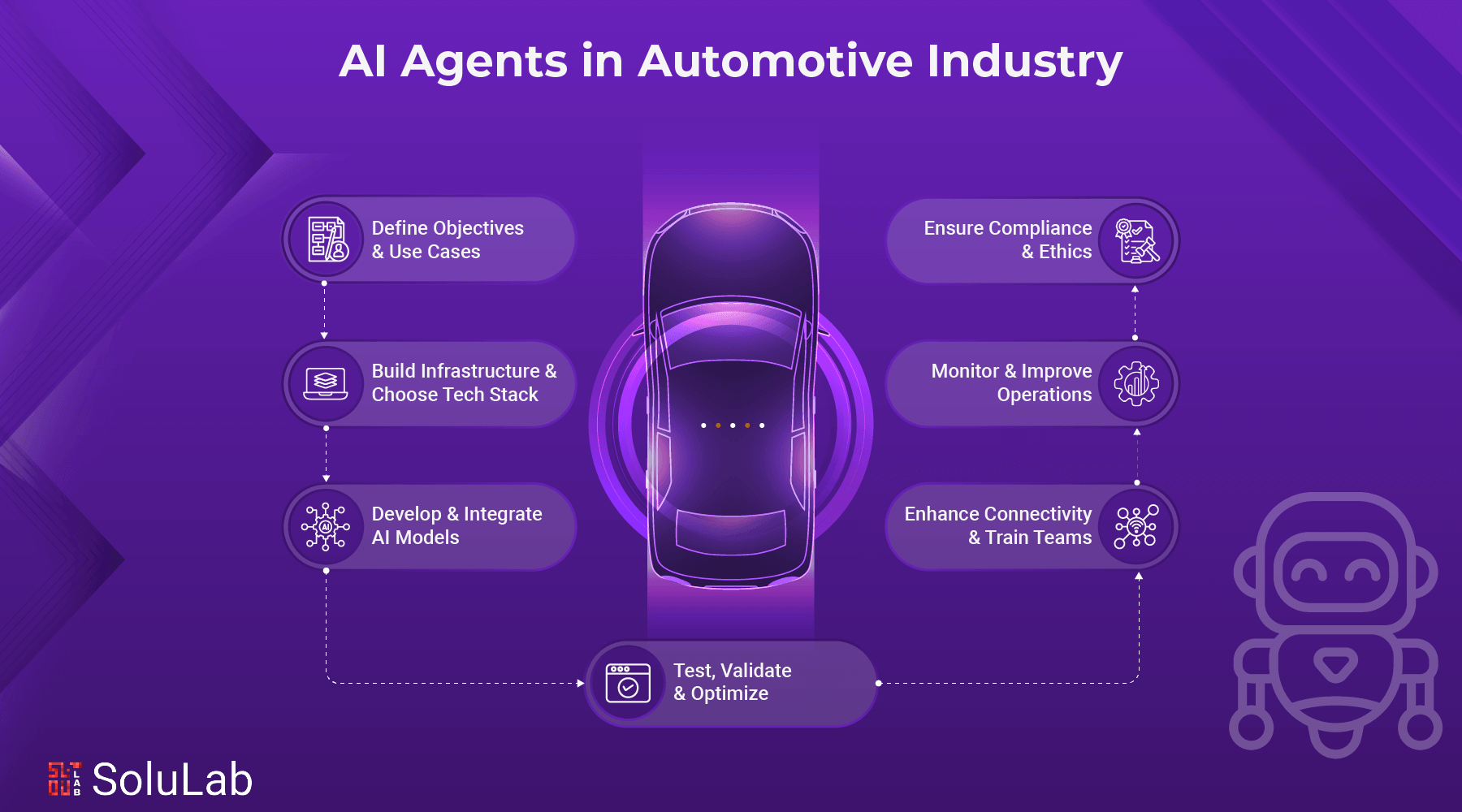
How to Implement AI in the Automotive Industry?
Putting AI agents for the automotive industry to work takes a plan, one that keeps the technology ambitious and the execution grounded. Here is a step-by-step way to bring automotive AI agents in without tripping over yourself:
- Identify Objectives and Use Cases
Get clear on what you are actually after first. Is it safer cars, a faster factory, autonomous driving, or a more personal customer experience? The answer changes everything downstream. As an example, automotive AI agents can be put to work building advanced driver-assistance systems (ADAS) or tightening up supply chain operations.
- Invest in the Right Technology Stack
Pick the tools that fit the goal, not the other way around. That might mean machine learning models for data work, computer vision for spotting objects, and NLP for voice control. Whatever you choose, make sure it plays nicely with what you already run, or you will spend the project fighting your own infrastructure.
- Utilize Data and Build Infrastructure
AI runs on data, full stop. Pull together the relevant datasets from sensors, cameras, and your operational systems, and keep them organized. Then stand up infrastructure that can actually store and process all of it, usually cloud-based, so real-time information does not overwhelm you.
- Develop Custom AI Models
Off-the-shelf only gets you so far. Train AI models built for your specific automotive use, whether that is machine learning for predictive maintenance or reinforcement learning for autonomous navigation. Work shoulder to shoulder with AI experts and engineers here, because generic models rarely handle the industry’s real edge cases.
- Integrate AI Agents into Operations
Now fold automotive AI agents into the way you already work. In practice, that looks like:
- AI-driven robotics on the production line to lift efficiency.
- AI-powered software handling route optimization across logistics.
- In-vehicle AI running safety features like lane detection or adaptive cruise control.
- Test and Validate
Test hard, in simulation and out in the real world, before you trust any of it. For high-stakes uses like autonomous driving, the validation has to go further still, deep enough to satisfy regulators and reassure the people who will actually ride in the thing.
- Enhance Connectivity and Communication
AI agents do better when they are not working alone. Turn on Vehicle-to-Everything (V2X) so vehicles, infrastructure, and other devices swap data in real time. Better inputs mean better decisions, and safer ones.
- Train Employees and Stakeholders
Do not forget the people. Walk employees, technicians, and stakeholders through the new systems, and show them how to use, maintain, and troubleshoot AI-based tools. This is what makes adoption stick and gets you the full value of the technology.
- Monitor and Improve
The work does not end at go-live. Keep watching how AI agents for the automotive industry perform, gather feedback, dig into the results, and refine the systems as needs shift and the tech moves on.
- Prioritize Regulatory Compliance and Ethics
Stay inside the rules, all the way through. Follow industry regulations and ethical standards, and be straight about transparency, data privacy, and safety. That is how you earn trust from customers and stakeholders alike.
Bringing AI into the automotive industry is a real transformation, and it asks for careful planning, real collaboration, and a willingness to innovate. Follow these steps and a business can genuinely use automotive AI agents to reshape how it operates and what it offers.
Challenges and Limitations of AI in the Automotive Industry
None of this comes free of friction. Bringing AI into automotive delivers big gains, but it drags a set of real problems along with it. Cost is the first wall. Building and deploying these systems means serious money in data infrastructure, advanced tech, and skilled people, which is exactly why smaller firms often cannot afford AI agents for automotive enterprises at all. On top of that, AI is only as good as the data feeding it, and any bias or error in that data can produce bad decisions, which is a frightening thought in something like autonomous driving. And the truly hard cases, extreme weather, weird road conditions, still trip up artificial intelligence in vehicles.
Then there is security and regulation. The more connected a vehicle gets, the bigger a target it becomes, so it needs strong defenses to protect sensitive data and the systems themselves. Meanwhile, safety and privacy rules differ from region to region and keep changing, which can drag out any rollout. Ethics pile on more weight: how do you program a car to make a life-or-death call in a split second? Add public doubt, and the plain fact that a lot of people do not yet trust these systems to be safe, and adoption gets harder still. Clearing these hurdles will take automakers, regulators, and technology providers working together to make AI safe, reliable, and within reach for everyone.
Conclusion
The upshot is hard to miss. AI agents are rewriting the automotive industry from every angle, layering in efficiency, safety, and new ideas at once. They tighten up production, they put autonomous driving and personalized experiences into real cars, and in doing so they change how we move and how we deal with the machines that move us. By cutting downtime, raising safety, and squeezing better performance out of every vehicle, these systems are steering transportation toward something more reliable and more connected.
At SoluLab, we help AI development companies across the automotive industry put AI agents to work and stay out in front. One example: SoluLab helped Turboplus sharpen its e-charging app with new features for iOS and Android. We built charging station mapping, live charging status, and remote charger control. That work made the app easier to use and turned EV charging into something more efficient, part of building intelligent, adaptive artificial general intelligence that push the performance and sustainability of electric vehicles. Reach out and we will show you how to clear these hurdles and drive real innovation in the EV space.
FAQs
Shipra Garg is a tech-focused content strategist and copywriter specializing in Web3, blockchain, and artificial intelligence. She has worked with startups and enterprise teams to craft high-conversion content that bridges deep tech with business impact. Her work translates complex innovations into clear, credible, and engaging narratives that drive growth and build trust in emerging tech markets.