Logistics teams take 10–40+ hours of operational time every month to complete manual tasks like quoting and tracking updates to data entry and documentation.
If your team is still manually processing documents, chasing shipment statuses, or juggling spreadsheets and TMS updates, you’re not just losing time — you’re losing competitive edge.
Research shows that around 80% of logistics companies find that AI solutions improve overall operational efficiency. AI agent development solutions for logistics give you an automation engine that handles repetitive workflows, freeing your team to focus on higher-value work.
In this guide, we’ll walk through why businesses need AI agents for logistics, how to build AI agents for logistics and supply chain management, so your business can reduce manual effort and boost efficiency.
Key Takeaways
- The problem: Logistics operations lose up to 15–20% in costs due to manual planning, delays, and poor demand forecasting.
- The status quo: Disconnected systems and rule-based automation can’t handle real-time disruptions or scale efficiently.
- The solution: AI agents automate routing, demand prediction, inventory control, and exception handling in real time.
- How SoluLab helps: SoluLab designs and deploys custom AI agents for logistics, integrating seamlessly with ERP, WMS, and IoT systems to unlock measurable efficiency, cost savings, and scalable growth.
Why Logistics & Supply Chain Businesses Need AI Agents Now?
Supply chain and logistics businesses have never been overloaded as they are today, and the use of AI agents is not an option anymore; this is a necessity to remain efficient, competitive, and resilient in the world today.
- Increasing Operating expenses and lack of labor: Margins are tougher than ever due to high fuel, warehousing, and labor costs, and AI-powered logistics solutions are extremely important in automating repetitive processes, creating better routes, and reducing reliance on limited human resources.
- Complexing Shipment Data and Information: The contemporary supply chains produce gigantic data volumes between the vendors, fleets, and border points,s and AI in logistics management enhances faster processing of this information, anticipates disruptions, and promotes more intelligent and real-time decision-making.
- Consumer Requirement of Live Tracking: Live tracking, precise ETAs, and immediate updates are now expected by the customers, and AI agents allow providing real-time visibility by tracking the packages constantly, alerting early in case the shipment will be delayed, and notifying about the change of status.
Key Technologies Behind AI Agents in Logistics
The LLMs will enable AI agents to hear natural language, read documents, and engage with teams and activities like order requests, report creation, and coordination of vendors become faster and feel more natural.
- Predictive Analytics and Machine Learning: Machine learning helps AI agents to predict demand, route planning, and forecast delays using real-time and historical data to make proactive and data-driven decisions in logistics applications.
- Computer Vision: AI agents are empowered by computer vision to monitor the stock, detect damaged products, and optimize the storage based on real-time analysis of the images and videos of the warehouses.
- Automation of Workflows and API: There is the use of API to interface AI agents with ERP, TMS, WMS, and CRM systems to enable the free flow of data and automated processes that restrict manual handoffs and operational bottlenecks.
Business Benefits of AI Agents for Logistics and Supply Chains
The AI agents are changing logistics and supply chains by automating routine tasks, deciding instantly, and preventing workflow interruptions, enabling companies to save money, increase their speed, and scale effectively. Let’s see in detail:
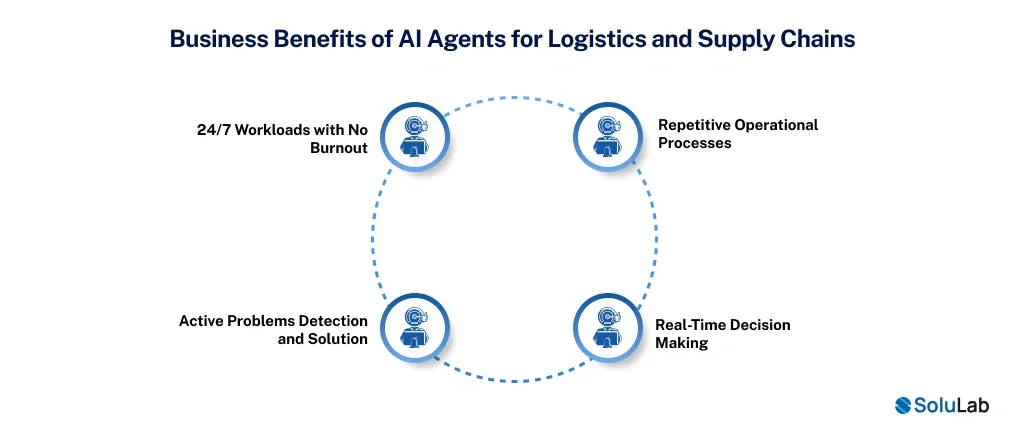
- Repetitive Operational Processes: AI agents are used to automate order processing, inventory updates, shipment tracking, and report generation, offloading team members of manual work and minimizing the number of errors that slow down the daily activities in logistics.
- Real-Time Decision Making: In the absence of a human, AI agents process real-time data on routes, warehouses, and demand signals to automatically optimize schedules, reroute assignments, and inventory adjustments without requiring human authorizations.
- Active Problems Detection and Solution: AI agents track data in real-time and spot delays, stock-outs, or supplier risks before they develop into big problems, which cost the company.
- 24/7 Workloads with No Burnout: AI agents operate 24/7, continue to handle logistics processes outside the business hours – ensuring quicker response times, stability, and zero burnout at peak demand times.
Step-by-Step: How to Build AI Agents for Logistics
The development of AI agents in the logistics industry is not a matter of hype, but rather the ability to reduce manual labor, enhance visibility, and make decisions across the supply chain activities faster by using a stepwise, straightforward method.
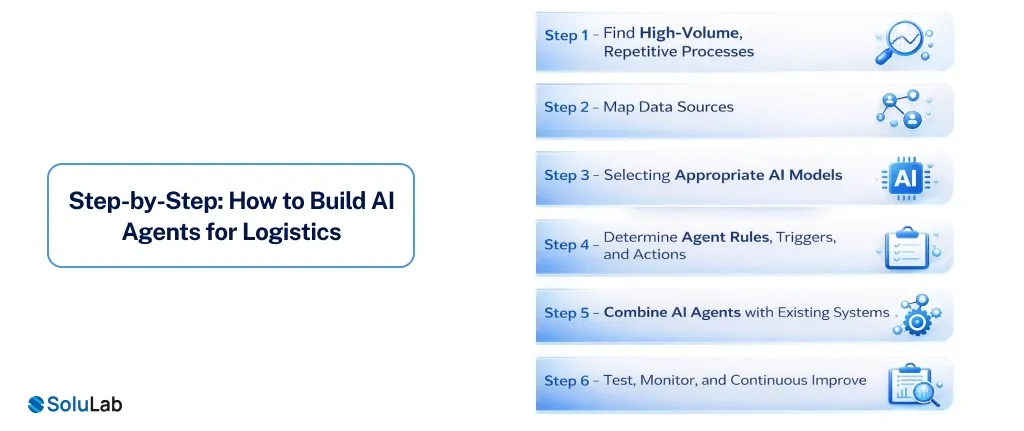
Step 1: Find High-Volume, Repetitive Processes
Begin by identifying those tasks that take the longest amount of time and that are predictable in nature, such as shipment tracking, order status updates, invoice checks, or exception alerts. These are the best AI agents to automate.
Step 2: Map Data Sources
Name all systems of logistics data are ordered, transport, inventory, and tracking. High-quality and properly mapped data will make sure that your AI agents make correct and timely decisions.
Step 3: Selecting appropriate AI Models
Choose models depending on the task, such as LLMs to communicate, predictive models to forecast demand or delays, and rule-based agents to support workflows. Apply agent frameworks that facilitate orchestration, memory, and tool integration.
Step 4: Determine Agent Rules, Triggers, and Actions
An agent needs to know when to take action and what action to perform, what events to respond to. To take an example, late shipment = get notifications to the stakeholders and offer alternative routes or airlines automatically.
Step 5: Combine AI Agents with Existing Systems
Plug agents to your existing tools through APIs, web hooks, or middleware. Easy AI integration means that AI can integrate with your existing logistics stack without interfering with current activity or necessitating a complete replacement of the system.
Step 6: Test, Monitor, and Continuous Improvement
Track performance, monitor agent decision-making, and run pilots. Adjust prompts, rules, and models with feedback loops and real-world data to optimize accuracy and efficiency with time.
Real World Examples of AI Agents for Logistics
AI agents are quickly changing logistics by automating routing, operations, and planning at scale. The following are five practical examples of how intelligent systems and robots are used in companies to enhance efficiency, cost reduction, and delivery performance.
1. UPS – ORION Route Optimization
UPS also has an AI-based agent known as ORION, which has been used to determine the most efficient delivery routes within the fleet. It is a system that analyzes traffic, delivery windows, and fuel information in real-time to decrease fuel consumption and losses. It forms one of the fundamental components of the UPS technology stack of logistics.
2. DHL – Warehouse robots and artificial intelligence agents
DHL uses AI systems and robots to sort and pick in its warehouses and automate work. Thousands of parcels are processed by these agents in a very precise manner,r and they communicate with human workers to increase throughput and minimize errors.
3. Amazon – Automated Fulfillment robots
Amazon combines AI agents to control robots and predictive systems in its fulfillment centers. Such agents control autonomous mobile robots to perform the tasks of sorting, packing, and transportation of goods to reduce operational costs and accelerate delivery.
4. Shippeo – Visibility and Predictive ETA
The AI platform created by Shippeo is a tracking agent that enables real-time tracking of cargo and accurate prediction of the estimated time of arrival. These lessons assist shippers in making proactive changes and enhancing customer satisfaction.
5. Osa Commerce end-to-end supply chain AI
Osa Commerce provides a complete solution of an AI agent that simplifies logistics involving inventory and order management to the last-mile delivery. Its cloud technology coincides with the ERPs and streamlines the processes, cutting down on expenses and accelerating the fulfillment process.
Conclusion
Developing AI agents in logistics is not a distant dream anymore; it is an effective method of saving money, decreasing the number of people in the workforce, and enhancing the decision-making process throughout the supply chain.
AI agents make everyday operations faster, more accurate, and scalable with route optimization and demand forecasting, as well as warehouse automation and customer service. When properly developed, AI agents do not displace the logistics units but enable them to concentrate on value-added labor and long-term development.
SoluLab, an AI agent development company, can help you build an AI agent for logistics from scratch. Book a free discovery call today!
FAQs
Neha is a curious content writer with a knack for breaking down complex technologies into meaningful, reader-friendly insights. With experience in blockchain, digital assets, and enterprise tech, she focuses on creating content that informs, connects, and supports strategic decision-making.