Key Takeaways
- RPA and AI are two purchases, not one. RPA moves and validates data through rule-based tasks. AI decides and predicts. Buying one and expecting the other is the most common scoping error.
- Fix eligibility at the front door first. A wrong plan or expired policy caught at registration costs minutes. The same error caught after submission becomes a denial, an appeal and weeks in accounts receivable.
- Payers automate too. Prior-authorisation denials have risen alongside payer-side AI. Provider automation now has to be good enough to work against it, not just faster than manual processing.
- Run AI in shadow mode before it decides anything. Coding suggestions and denial predictions should run alongside staff and be measured against their decisions before they touch a live claim.
- Every bot handling PHI is a HIPAA system. Scoped service accounts, full audit trails, encryption in transit and at rest, and a BAA with every vendor in the automation path.
- Measure on the metrics finance already tracks. Clean-claim rate, denial rate, days in AR, cost to collect and productivity per FTE. Automation-specific metrics do not survive a CFO conversation.
- Phase by service line, not by department. Pilot one module on one service line, hit the numbers, then expand. Scaling on evidence is what keeps the programme funded.
RPA and AI automate the healthcare revenue cycle end to end, from patient access through to denial management. Rules-based bots handle the repetitive, structured steps — eligibility checks, claim scrubbing, payment posting — while AI adds judgment for coding suggestions, denial prediction and reading unstructured documents. The point of this guide is practical: which revenue cycle steps to automate, in what order, and how to measure whether it worked.
On this page: how RPA and AI split the work, which patient access tasks to automate first, RPA versus AI mapped by stage, how automation prevents denials, a phased rollout that protects patient care, the HIPAA controls that apply to bots, and the metrics finance actually watches.

How Do RPA and AI Automate the Healthcare Revenue Cycle?
RPA and AI automate the revenue cycle by splitting the work into two layers. Robotic process automation runs the deterministic tasks: logging into portals, copying data between the EHR and the clearinghouse, checking eligibility, posting payments. AI runs the judgment tasks: suggesting medical codes, predicting which claims will be denied, and extracting data from unstructured documents like faxed authorizations.
The revenue cycle has clear stages, and automation applies differently at each one:
Patient access: scheduling, registration, insurance eligibility, and out-of-pocket estimates.
Mid-cycle: charge capture, clinical documentation, and medical coding.
Back-end: claim scrubbing and submission, payment posting, denial management, and appeals.
The mistake buyers make is treating RPA and AI as one purchase. They are not. RPA is fast, auditable and cheap for structured steps, but it breaks when a form changes or a document is unstructured. That is where AI takes over. A mature program uses RPA for the bulk of the volume and reserves AI for the steps that actually need a decision. According to AKASA and HFMA Pulse survey data, 46 percent of hospitals and health systems already use AI in revenue cycle management, with 74 percent running some form of automation. (AKASA/HFMA, via industry analysis)
This sits within SoluLab’s wider AI development services, pairing rules-based bots with machine learning models that read payer rules, patient records and claim data.
What Is Patient Access, and Which Parts Can Be Automated?
Patient access is the front door of the revenue cycle: everything that happens before or at the point of care that sets up a clean claim later. It covers scheduling, registration, insurance verification, prior authorization initiation and patient cost estimates. Errors here cause most downstream denials, which is why it pays to automate first.
Four patient-access tasks automate well.
Scheduling and registration. Bots pre-fill demographics, flag missing fields, and validate insurance IDs against payer directories before the visit.
Eligibility verification. RPA runs real-time eligibility checks using the X12 270/271 EDI transaction set and writes the response back to the EHR, so front-desk staff see coverage without logging into each payer portal.
Out-of-pocket estimates. Automation pulls the patient’s benefit details and the contracted rate to generate a good-faith estimate at check-in.
Prior authorization intake. AI reads the order and clinical notes, matches them to payer criteria, and drafts the authorization request for a human to approve.
Fixing eligibility at the front door pays back the most, because a wrong plan or an expired policy caught at registration never becomes a denied claim two months later. Building this into an existing clinical system is healthcare software development work as much as it is automation work.
Which Revenue Cycle Steps Benefit Most From RPA Versus AI?
Most steps benefit from one layer or the other, and several need both. RPA wins where the task is rule-following and the inputs are structured. AI wins where the task needs interpretation, prediction or reading free text. The table below maps each stage to the automation type and the value it adds.
| RCM stage | Best automation | What it does | Value added |
| Eligibility verification | RPA | Runs 270/271 checks, writes coverage back to EHR | Fewer registration errors, fewer downstream denials |
| Prior authorization | AI + RPA | AI matches order to payer criteria; RPA submits and tracks | Faster approvals, less staff rework |
| Charge capture | RPA | Reconciles charges against orders and documentation | Reduced revenue leakage |
| Medical coding | AI | Suggests ICD-10 and CPT codes from clinical notes | Coder productivity, fewer coding denials |
| Claim scrubbing and submission | RPA | Validates the 837 claim against payer edits before send | Higher clean-claim rate |
| Denial prediction | AI | Scores claims likely to be denied before submission | Prevent denials instead of appealing them |
| Payment posting | RPA | Posts 835 remittance data back to the ledger | Faster close, fewer manual entries |
| Denial management and appeals | AI + RPA | AI categorizes the denial reason; RPA assembles the appeal packet | Higher overturn rate, less manual triage |
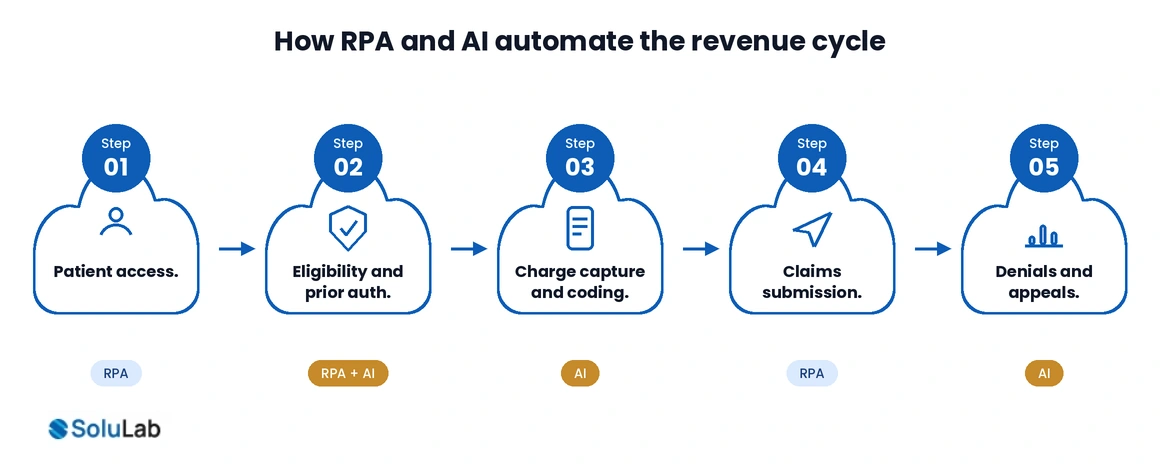
The pattern is consistent: RPA moves and validates data, AI decides and predicts. A program that automates only with RPA hits a ceiling at the coding and denial steps, and a program that jumps straight to AI without RPA underneath spends model budget on work a bot could do for a fraction of the cost.
How Does Automation Reduce Claim Denials and Speed Up Reimbursement?
Automation reduces denials in two ways: it prevents them before submission and it works them faster after. Prevention comes from clean claims. When RPA validates eligibility, checks the claim against payer edits, and confirms the authorization is on file before the 837 goes out, fewer claims come back rejected.
The second mechanism is denial prediction. AI models score each claim against historical denial patterns and flag the risky ones for a human to fix before submission, not after. Automating the prior-authorization step alone shows measurable results in clinical studies: one peer-reviewed analysis of prior authorization integrated into clinical workflows reported per-payer denial decreases ranging from 45.7 percent to 88.6 percent. (PMC/NCBI, 2025)
Faster reimbursement follows from removing manual handoffs. Real-time eligibility, auto-submitted claims and auto-posted 835 remittances shorten days in accounts receivable. Prevention also cuts rework: automating prior authorization is documented to prevent costly claim denials and reduce the staff time spent on resubmission. (Experian Health)
One honest caveat: AI in the revenue cycle is not only a provider tool. Payers use it too, and the American Medical Association has warned that unregulated AI is driving more prior-authorization denials on the payer side. (AMA) A provider program should assume payers are automating against it and build appeals automation accordingly.
How Do You Implement RCM Automation Without Disrupting Patient Care?
You implement RCM automation without disrupting care by starting with back-office and front-desk steps that never touch clinical decisions, and by piloting on one service line before scaling. Nothing in eligibility checks, claim scrubbing or payment posting affects a patient’s treatment, which makes those steps the safe entry point.
A phased rollout that protects care looks like this.
Integration discovery. Map how your EHR, clearinghouse and payer portals actually connect today, including the custom interfaces. This is where most “our integrations are too custom to automate” objections get resolved.
Single-service-line pilot. Run one module on one department, measure clean-claim rate and days in AR against baseline, and keep humans in the loop on every exception.
Shadow mode for AI. Run coding and denial-prediction models alongside staff before letting them act, so you validate accuracy on your own data first.
Scale by evidence. Expand to the next service line only after the pilot hits its numbers.
Keeping a human in the loop at every AI decision point is what keeps the program safe and auditable. RPA follows fixed rules; AI recommends, and a person approves.
A large integrated health system typically rolls out in modules rather than all at once: eligibility and registration first, then claim scrubbing and payment posting, then AI for coding suggestions and denial prediction, then denial management and appeals. Any figure attributed to a named health system, such as a stated denial-rate reduction or dollar recovery, needs a published source before it is used.
How Do You Keep RCM Automation HIPAA Compliant and Auditable?
You keep RCM automation HIPAA compliant by treating every bot and model as a system that handles protected health information, with the same access controls, encryption and audit logging you apply to staff. Automation does not remove HIPAA obligations; it concentrates them, because a single bot may touch thousands of records.
The controls that matter for automated RCM.
Least-privilege access. Each bot gets a scoped service account that can reach only the systems and fields it needs, never a shared admin login.
Audit trails. Every automated action is logged with a timestamp, the identity of the bot and the record touched, so you can reconstruct who did what. This is what makes an automated workflow auditable to a payer or a regulator.
Encryption in transit and at rest. PHI moving between the EHR, the bot and the clearinghouse is encrypted end to end.
Business associate agreements. Any vendor or cloud platform in the automation path signs a BAA.
Generic HIPAA obligations apply to any organization handling PHI. Any claim that SoluLab itself holds a specific certification or signs a BAA should be confirmed against a live SoluLab page before it appears in client-facing material.
What Results Can a Health System Expect, and How Are They Measured?
A health system measures RCM automation on the metrics it already tracks: clean-claim rate, denial rate, days in accounts receivable, cost to collect and staff hours per claim. Automation should move each of these in the right direction, and the only credible way to report the gain is against a documented pre-automation baseline.
The metrics buyers actually watch.
Clean-claim rate: the share of claims accepted on first submission. Higher is better.
Denial rate: the share of claims denied. Automation targets this through prevention.
Days in AR: how long revenue sits uncollected. Faster posting and cleaner claims shorten it.
Cost to collect: total revenue-cycle cost as a share of collections.
Staff productivity: claims or authorizations handled per FTE.
Any specific percentage or dollar figure for a SoluLab client engagement should come from a published SoluLab case study rather than an estimate. The external, sourced benchmarks in this guide come from the cited studies, not from SoluLab engagements.
Where Does SoluLab Fit?
SoluLab approaches RCM automation as an AI engineering problem, not a single off-the-shelf bot. The rules-based layer and the AI layer are built and integrated together. The machine learning development practice builds the coding-suggestion and denial-prediction models, and the enterprise AI development practice handles the integration and scale a health system needs across service lines.
For teams that want automation to act rather than only recommend, SoluLab also builds AI agents that chain multiple RCM steps and call systems directly. If you are still comparing partners, its roundup of the top AI development companies sets out how to evaluate on core expertise, team size and buyer fit.
FAQs
Shipra Garg is a tech-focused content strategist and copywriter specializing in Web3, blockchain, and artificial intelligence. She has worked with startups and enterprise teams to craft high-conversion content that bridges deep tech with business impact. Her work translates complex innovations into clear, credible, and engaging narratives that drive growth and build trust in emerging tech markets.