Key Takeaways
- The first filter is category, not vendor name. Platform vendors, cloud NLU services, voice specialists and custom builders solve different problems. Pick the category before you shortlist names.
- Score vendors against your requirements, not their feature lists. Seven criteria decide it: channels, model support, latency, integration depth, deployment model, compliance and total cost of ownership.
- Buy first, build once you hit the ceiling. That is the honest answer for most mid-market teams. The deciding question is whether an off-the-shelf bot can answer from your data and act in your systems.
- Integration depth and compliance review are the longest poles. Not the model work. Scope those two before you commit to a date.
- A bot is only useful where it connects. Confirm connectors for your CRM, help desk and internal data before anything else in a demo impresses you.
- Voice needs measured latency, not marketed latency. Ask for numbers from a real deployment on your channel mix.
- Human handoff is a requirement, not a feature. A well-built assistant escalates on low confidence or sensitive intents and transfers the full conversation context with it.
Conversational AI companies design, build and deploy systems that hold natural language conversations over chat and voice. They split into platform vendors that sell ready-made bots and consultancies that build custom assistants. The best fit depends on your channels, model needs, deployment model and compliance rules, not on who tops a generic list.
SoluLab sits in the custom-build lane. If you need a conversational AI grounded on your own data, wired into your systems and deployable in a private environment, our conversational AI consulting services scope, build and ship the assistant end to end rather than renting you a fixed platform.
On this page: what these companies actually do, the vendor categories compared, a seven-criteria scoring rubric, the buy-versus-build decision, the model and retrieval stack behind modern assistants, what drives cost and timeline, and which industries get the most value.

What Are Conversational AI Companies?
Conversational AI companies are vendors and consultancies that build software able to understand and respond in natural language across chat and voice channels. The category covers three groups: SaaS platform vendors selling prebuilt bots you configure, cloud NLU providers such as Google Dialogflow and Amazon Lex, and custom development firms that build assistants from your requirements.
What separates them is control. A platform vendor gives you speed and a fixed feature set. A custom builder gives you a system grounded on your data, integrated with your stack, and deployable where your compliance team allows. The conversational AI market itself is large and growing quickly, valued at roughly $14.79 billion in 2025 and projected to reach $17.97 billion in 2026, according to Fortune Business Insights.
In one line: a conversational AI company either sells you a bot platform or builds you a bot. Knowing which you need is the first filter.
Who Are the Top Conversational AI Companies in 2026?
The top conversational AI companies in 2026 span analyst directories, voice AI platforms, enterprise assistant vendors, cloud NLU services and custom builders. There is no single winner. The right one depends on whether you want a prebuilt platform or a custom system, and on your channel and compliance needs. The table below compares the main categories so you can shortlist by fit rather than by ranking position.
How we compiled this shortlist
We grouped vendors by what they are built to do, not by marketing claims. Sources include the analyst directory Gartner Peer Insights, which aggregates verified user ratings, alongside current vendor roundups from Retell AI and Bland AI. Each of those is authored by a vendor, so treat the rankings inside them accordingly.
| Category | Best for | Channels | Model / stack | Deployment | Custom build |
| SoluLab (custom builder) | Custom, regulated, multi-channel builds | Chat + voice | GPT-4, Claude, RAG, custom NLU | Cloud, VPC, on-prem | Yes, end to end |
| Voice AI platform vendor | Voice call automation, receptionists | Voice | Proprietary voice LLM | SaaS | Limited |
| Enterprise assistant vendor | Internal employee copilots | Chat | Proprietary | SaaS | Limited |
| Google Dialogflow / Amazon Lex | Fast prebuilt bots on cloud NLU | Chat + voice | Google / AWS NLU | Cloud | Config-level |
| Rasa | Open-source control, self-hosting | Chat + voice | Open-source NLU | Self-hosted | Yes, DIY |
Use this as a starting filter. Directories like Gartner give you third-party ratings; vendor listicles give you breadth; a custom builder gives you a system shaped to your requirements. Match the category to your need before you shortlist named vendors.
How Do You Choose a Conversational AI Company?
Choose by scoring vendors against your requirements, not their feature lists. Rank each candidate on seven criteria, weight the ones that matter most to your use case, then shortlist the top two or three for a scoped pilot.
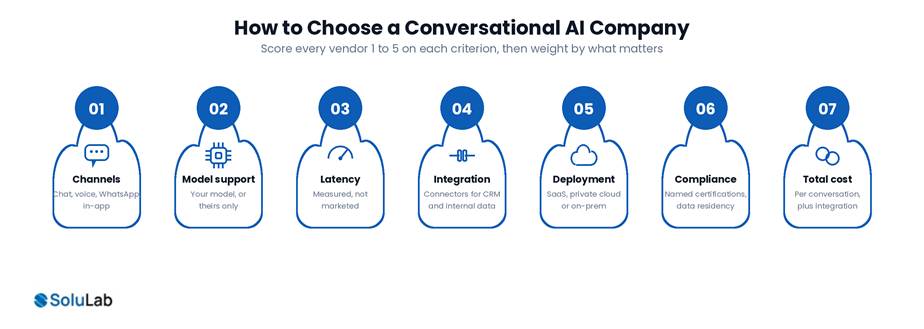
1. Channels. Does the vendor cover the exact channels you serve: chat, voice, WhatsApp, in-app, or all of them?
2. Model support. Can you run the model you want, or are you locked to a proprietary one?
3. Latency. Voice needs sub-second responses. Ask for measured latency, not marketing numbers.
4. Integration depth. The bot is only useful where it connects. Confirm connectors for your CRM, help desk and internal data.
5. Deployment model. SaaS, private cloud or on-premises. Regulated buyers often need VPC or on-prem, which rules out several vendors immediately.
6. Compliance. For healthcare and banking, ask for named certifications and data-residency options before anything else.
7. Total cost of ownership. Include per-conversation fees, integration work and maintenance, not just the sticker price.
Score each vendor 1 to 5 on every criterion, weight by importance, and the shortlist writes itself.
Should You Buy a Conversational AI Platform or Build a Custom Solution?
Buy a platform when your use case is common, your data is simple, and speed matters more than fit. Build custom when the assistant must reason over your proprietary data, integrate deeply with your systems, meet strict compliance rules, or become a differentiator. The honest answer for most mid-market teams is buy first, then build once you hit the platform’s ceiling.
The trade-offs, stated plainly.
Platform (buy). Faster launch, lower upfront cost, vendor handles upkeep. You inherit their model, their data boundary and their roadmap.
Custom (build). Higher upfront cost and a real development timeline. You own the architecture, ground answers on your data, and deploy where compliance allows.
A platform vendor will tell you custom is slow and expensive. That is sometimes true and sometimes a sales line. The deciding question is whether an off-the-shelf bot can actually answer from your data and take actions in your systems. If it cannot, the platform’s speed advantage disappears the moment you try to make it fit.

What Models and Technologies Do These Companies Use?
Modern conversational AI companies build on large language models, retrieval systems and orchestration frameworks rather than hand-scripted rules. The core stack pairs a reasoning model with a retrieval layer that grounds answers on real data, plus connectors to your systems.
The named building blocks.
Language models. OpenAI GPT-4, Anthropic Claude, and open models such as Llama for teams that want to self-host.
Cloud NLU. Google Dialogflow and Amazon Lex for intent-and-entity bots with structured flows.
Open-source NLU. Rasa for teams that need full control and self-hosting.
Retrieval-augmented generation. The standard pattern that connects a model to your documents through a vector database.
Vector databases. Pinecone, Weaviate and Qdrant store the embeddings RAG retrieves.
Orchestration. LangChain and LlamaIndex chain retrieval, model calls and tool use.
The mix is what matters. A bot that answers from your knowledge base needs RAG plus a vector database. A bot that completes tasks needs orchestration and tool access. A regulated bot needs a model and a deployment you control.
What Drives the Cost of a Custom Build?
Cost is driven by scope rather than a licence fee, so a scoped estimate against your actual requirements is the only reliable number. These are the variables that move it.
Complexity of the assistant. A rule-based FAQ bot is cheapest; an LLM-plus-RAG assistant costs more; an agentic assistant that takes actions costs most.
Channels. Each channel adds design and integration work.
Integrations. Every connected system adds effort.
Deployment model. Private cloud or on-prem costs more than shared SaaS.
Compliance. Healthcare and banking builds need extra work for security, auditability and data residency.
Ongoing maintenance. Model updates, monitoring and tuning are recurring, not one-time.
How Long Does a Conversational AI Project Take?
Timelines scale with scope, and the phases below are where the time goes. Confirm dates against a scoped engagement rather than a category average.
1. Discovery and scoping. Define use cases, channels, data sources and success metrics.
2. Architecture and design. Choose models, retrieval approach, guardrails and deployment model.
3. Build and integration. Develop the assistant, wire RAG and connectors, add guardrails and human handoff.
4. Testing and tuning. Evaluate accuracy, latency and safety; reduce hallucinations with grounding and validation.
5. Deployment and monitoring. Ship to your environment, then monitor and retune with real traffic.
The longest poles are usually integration depth and compliance review, not the model work itself.
What Industries Use Conversational AI, and How?
Conversational AI is used most where conversation volume is high or answers must come from private data. Healthcare, banking, retail and customer support lead adoption because the payback on deflected tickets and faster service is direct and measurable.
Healthcare. Patient intake, appointment scheduling and FAQ triage, with strict attention to data handling.
Banking and financial services. Account queries, onboarding help and lead qualification, with authentication and audit requirements.
Retail and e-commerce. Product discovery, order status and post-purchase support across chat and voice.
Customer support, cross-industry. Ticket deflection, 24/7 first-line response, and escalation to human agents.
The common thread is that regulated and high-volume sectors get the most value, and they are also the ones that most often need a custom build over a generic platform.
Where Does SoluLab Fit?
SoluLab builds conversational AI as a scoped engagement: discovery, architecture, build and deployment, with grounding and safety designed in from the start rather than bolted on. We ground answers on your data with RAG, add guardrails to constrain what the assistant can say, and build a clean human handoff so the bot escalates when it is unsure.
The architecture choices we make on most builds.
RAG grounding. Answers are retrieved from your documents through a vector database, so the assistant cites your content rather than improvising.
Guardrails. We constrain prompts, filter retrieved content and validate outputs to reduce hallucinations.
Human handoff. The assistant escalates to a human agent on low confidence or sensitive intents, carrying the full conversation context.
Multi-channel orchestration. One assistant across chat and voice, with consistent context.
Deployment fit. Cloud, private cloud or on-prem depending on your compliance needs.
Because SoluLab builds across the wider AI stack, a conversational assistant can extend into agentic systems that take actions. See our sibling services for AI chatbot development, enterprise AI chatbot development and AI agent development.
Frequently Asked Questions
Shipra Garg is a tech-focused content strategist and copywriter specializing in Web3, blockchain, and artificial intelligence. She has worked with startups and enterprise teams to craft high-conversion content that bridges deep tech with business impact. Her work translates complex innovations into clear, credible, and engaging narratives that drive growth and build trust in emerging tech markets.