Key Takeaways
- The problem: Traditional fuel delivery operations lack real-time visibility, efficient routing, and predictive capabilities. Manual processes increase delays, operational costs, safety risks and limit scalability in a rapidly evolving on-demand ecosystem.
- The solution: AI and IoT enable real-time tracking, predictive demand forecasting, smart routing, and automated safety monitoring. Together, they create a connected, data-driven system that improves efficiency, reduces costs, and enhances delivery reliability.
- How SoluLab helps: SoluLab operates as an AI-native company, embedding AI into development workflows to accelerate delivery cycles, optimize resource utilization, and reduce costs while building scalable, intelligent fuel delivery solutions.
Fuel delivery businesses are under pressure to deliver faster, safer, and more efficiently, yet traditional systems rely heavily on manual processes, limited visibility, and reactive decision-making.
This creates delays, operational risks, and higher costs that directly impact customer satisfaction and scalability. In fact, the global mobile fuel delivery market is expected to reach $7.1 billion by 2030.
The need for on-demand fuel delivery app services grows due to inefficiencies in meeting the gap between demand and supply. It becomes even harder to manage, especially across large fleets and urban environments.
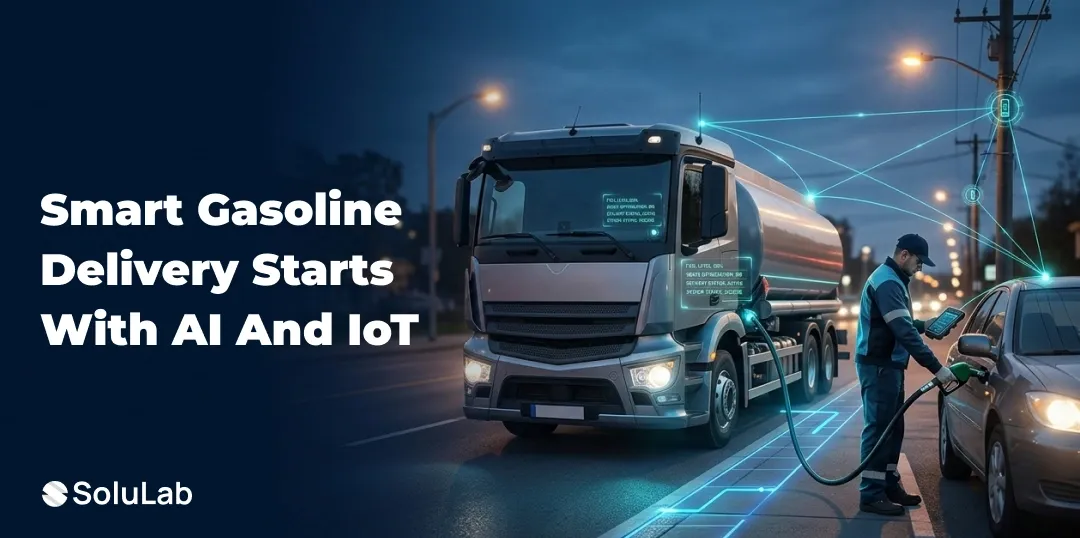
AI and IoT are changing this by automating and adding predictive capabilities to gasoline delivery app development. From smart route optimization to live fuel monitoring and predictive maintenance, these technologies enable businesses to improve their operations and safety.
Market Trends Driving Fuel Delivery Apps
Fuel delivery apps are gaining real traction. Not hype, actual demand. Changing cities, evolving regulations, and shifting consumer habits are quietly reshaping how fuel reaches people.
1. Growth in urban logistics and the convenience economy
Cities are getting denser, schedules tighter. People expect everything on-demand, including fuel. Businesses are adapting fast, building delivery-first models that reduce dependency on physical fuel stations.
2. Regulatory evolution in fuel transportation
Governments are gradually opening up frameworks for mobile fuel delivery. Safety norms, licensing, and compliance standards are becoming clearer, making it easier for startups to enter and scale responsibly.
3. Rising demand for contactless delivery
User behavior has shifted. Contactless services are now expected, not optional. Fuel delivery apps meet this need by offering seamless ordering, digital payments, and zero physical interaction during delivery.
AI + IoT: The Combined Impact
AI and IoT together are reshaping how fuel delivery apps operate. Not just smarter systems, but faster decisions, safer operations, and deeply connected logistics that actually scale with real-world demand.
- Smart logistics systems: AI technology analyzes demand patterns while IoT tracks vehicles and fuel levels in real time, enabling faster routing decisions, reduced idle time, and smoother coordination across the entire delivery network.
- Predictive maintenance of delivery vehicles: IoT sensors monitor engine health, fuel systems, and wear conditions continuously, while AI predicts failures early, helping operators avoid breakdowns, reduce downtime, and extend vehicle lifespan.
- Fully automated dispatch systems: AI automatically assigns orders based on proximity, availability, and urgency, while IoT feeds real-time data, eliminating manual intervention and ensuring faster, more accurate delivery execution.
Role of AI and IoT in Fuel Delivery Apps
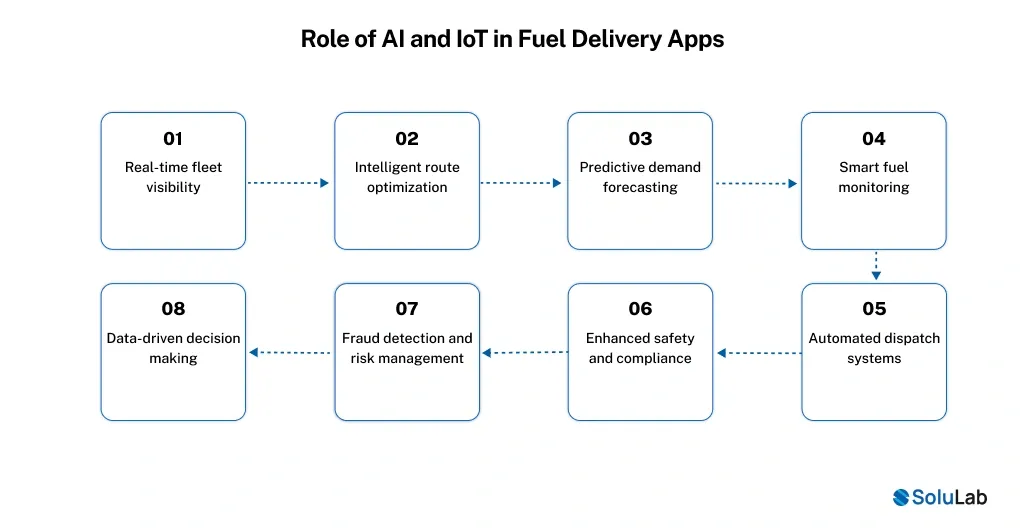
AI and IoT are reshaping fuel delivery by making operations smarter, faster, and safer. They enable real-time tracking, predictive analytics, and seamless logistics across modern fuel distribution systems.
- Real-time fleet visibility: AI and IoT enable continuous tracking of delivery vehicles, helping businesses monitor routes, delays, and fuel levels instantly, improving operational control and customer transparency across On-Demand Fuel Delivery Apps Development platforms.
- Intelligent route optimization: AI algorithms analyze traffic, demand patterns, and delivery constraints to recommend the most efficient routes, reducing fuel consumption, delivery time, and operational costs.
- Predictive demand forecasting: AI models use historical and behavioral data to predict fuel demand across locations, allowing companies to optimize inventory, prevent shortages, and plan deliveries proactively.
- Smart fuel monitoring: IoT sensors installed in tankers track fuel levels, temperature, and pressure in real time, ensuring accuracy, preventing leaks, and enhancing safety standards in IoT in Fuel Delivery App Development ecosystems.
- Automated dispatch systems: AI-driven dispatching assigns delivery tasks based on proximity, availability, and urgency, reducing manual intervention while improving efficiency and response times.
- Enhanced safety and compliance: IoT devices monitor hazardous conditions like leaks or abnormal pressure, while AI systems trigger alerts and compliance checks, ensuring adherence to strict fuel transportation regulations.
- Fraud detection and risk management: AI identifies unusual transaction patterns or delivery inconsistencies, helping prevent fuel theft, billing fraud, and operational risks that can impact business credibility.
- Data-driven decision making: Combined AI and IoT systems generate actionable insights from real-time and historical data, enabling businesses to continuously optimize logistics, pricing strategies, and customer experience.
How to Build an AI-Powered Fuel Delivery App?
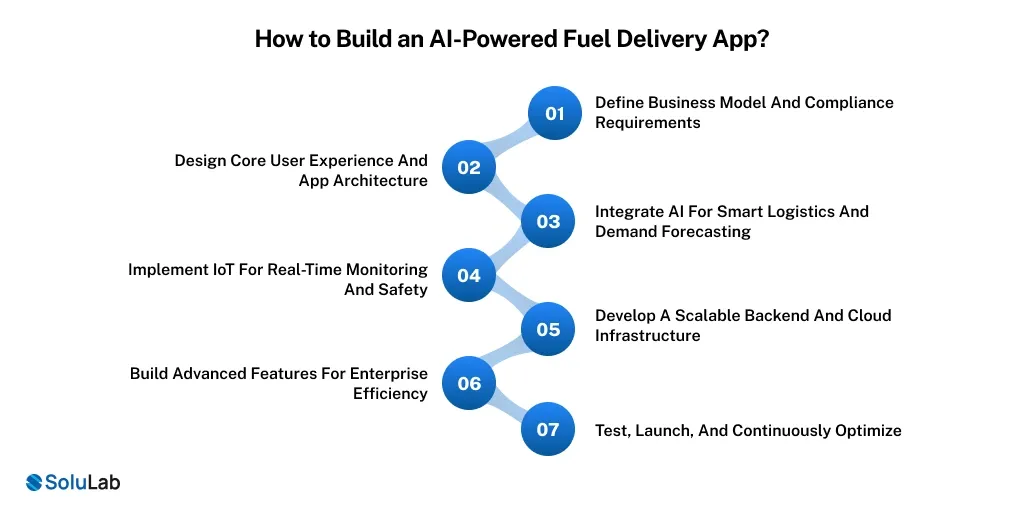
Building an AI-powered super app goes beyond basic logistics. It blends intelligence, automation, and real-time tracking to create faster, safer, and more scalable fuel distribution systems for modern businesses.
Step 1. Define Business Model and Compliance Requirements
Start by identifying your target market, whether B2C, B2B, or fleet-based delivery. Fuel is a regulated commodity, so align with local laws, safety standards, and licensing requirements early to avoid operational or legal setbacks later.
Step 2. Design Core User Experience and App Architecture
Focus on intuitive user flows like booking, tracking, and payments. Build separate interfaces for users, admins, and delivery agents. Keep the design clean but functional, ensuring minimal friction while handling complex backend operations seamlessly.
Step 3. Integrate AI for Smart Logistics and Demand Forecasting
Use AI to optimize delivery routes, predict demand patterns, and reduce idle time. Over time, the system learns behavior patterns, helping improve delivery efficiency, reduce costs, and enhance overall customer satisfaction without manual intervention.

Step 4. Implement IoT for Real-Time Monitoring and Safety
Leverage IoT in Fuel Delivery App Development to track fuel levels, tanker movement, and environmental conditions. Sensors provide real-time insights, ensuring safe transportation while helping operators monitor leakage risks and maintain compliance standards.
Step 5. Develop a Scalable Backend and Cloud Infrastructure
Choose a robust backend using technologies like Node.js or Python. Deploy on scalable cloud platforms to handle fluctuating demand. Ensure APIs are optimized for real-time communication between AI engines, IoT devices, and mobile applications.
Step 6. Build Advanced Features for Enterprise Efficiency
Offer dashboards with analytics, automated billing, fleet tracking, and smart scheduling. Strong Fuel Delivery App Development Solutions for Enterprises focus on operational visibility, enabling decision-makers to manage logistics, pricing, and performance from a single control layer.
Step 7. Test, Launch, and Continuously Optimize
Run rigorous testing for safety, performance, and real-time accuracy. After launch, monitor user behavior and system performance closely. Keep refining AI models and IoT integrations to improve efficiency, reliability, and long-term scalability.
Benefits Of Integrating AI in Fuel Delivery Applications
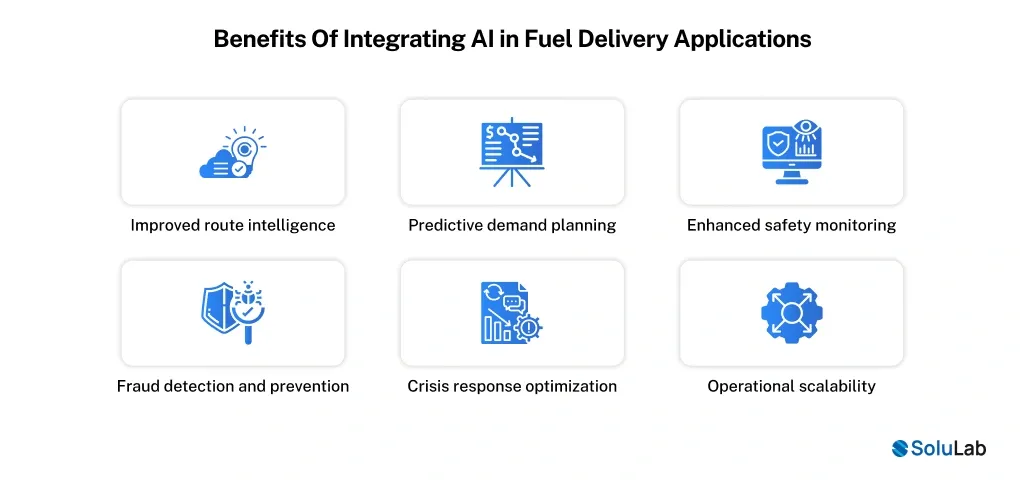
AI integration is changing how fuel delivery apps operate, making them faster, smarter, and safer. From logistics to crisis response, intelligent systems are unlocking efficiency that traditional models simply cannot match today.
- Improved route intelligence: AI-driven algorithms analyze traffic, demand clusters, and delivery constraints in real time, enabling faster dispatch decisions and significantly reducing fuel wastage and operational inefficiencies.
- Predictive demand planning: By leveraging historical trends and behavioral data, AI-powered fuel delivery solutions can anticipate demand spikes, helping businesses optimize inventory and avoid last-minute supply shortages.
- Enhanced safety monitoring: AI systems continuously track anomalies in fuel handling, delivery patterns, and storage conditions, reducing risks of leaks, theft, and operational hazards across the supply chain.
- Fraud detection and prevention: Machine learning models identify unusual transaction patterns or delivery inconsistencies, helping prevent fraud, unauthorized usage, and revenue leakage in fuel distribution systems.
- Crisis response optimization: With AI in Fuel and LPG Crisis Management, companies can predict shortages, reroute supplies, and ensure uninterrupted delivery during emergencies or high-demand scenarios.
- Operational scalability: AI enables businesses to scale rapidly without proportional increases in manual effort, automating workflows and ensuring consistent performance even during high-volume delivery periods.
How Much Does It Cost To Develop an AI-Powered Fuel Delivery App?
Building an AI-powered fuel delivery app involves multiple components working together. Costs depend on features, integrations, and scalability, but even a solid MVP requires a structured investment approach.
| Component / Feature | Estimated Cost Range | Description |
| Basic App Development | $15,000 – $25,000 | User app, delivery app, and admin panel with core booking, tracking, and payment features. |
| UI/UX Design | $3,000 – $7,000 | Clean, intuitive design for smooth navigation and better user experience. |
| Backend Development | $8,000 – $18,000 | APIs, servers, and database setup for scalability and real-time operations. |
| AI Integration | $10,000 – $30,000 | Enables automation, predictions, and core AI-powered fuel delivery solutions features. |
| IoT Integration | $7,000 – $20,000 | Real-time tracking and monitoring using connected devices and sensors. |
| Payment Integration | $2,000 – $5,000 | Secure payment gateway with multiple transaction options. |
| Testing & QA | $3,000 – $8,000 | Ensures performance, security, and bug-free functionality. |
| Compliance & Security | $5,000 – $12,000 | Covers safety regulations, data protection, and legal requirements. |
| Maintenance & Updates | $5,000 – $15,000/year | Ongoing updates, monitoring, and performance improvements. |
Future of Fuel Delivery Apps
Fuel delivery apps are moving beyond convenience toward intelligent, automated ecosystems where technology handles logistics, safety, and efficiency with minimal human intervention, reshaping how fuel reaches consumers in fast-changing urban environments.
- Autonomous delivery vehicles: Self-driving fuel tankers use AI, sensors, and real-time mapping to deliver fuel with minimal human input, reducing operational costs while improving delivery speed, route efficiency, and overall safety standards.
- Drone-based fuel delivery: Experimental drone systems aim to deliver small quantities of fuel in remote or high-demand areas, enabling rapid response scenarios where traditional delivery methods struggle with accessibility or time constraints.
- Smart cities integration: Fuel delivery apps integrate with urban infrastructure, using IoT data from traffic systems, energy grids, and connected vehicles to optimize delivery routes, predict demand, and reduce congestion across cities.
How SoluLab Supports AI Integration and App Development?
SoluLab follows an AI-native approach to improve energy supply chains, enabling real-time intelligence, predictive decision-making, and resilient fuel and LPG distribution systems during disruptions.
- Predictive demand forecasting models
- Real-time supply chain monitoring systems
- AI-powered route and distribution optimization
- IoT and data integration frameworks
- Crisis simulation and risk analytics engines
- Custom AI model development and deployment
For example, SoluLab partnered with Locus to deploy AI-driven logistics solutions, enabling real-time route optimization, predictive demand forecasting, and automated decision-making.
The implementation improved delivery efficiency by 20%, boosted customer satisfaction by 25%, and reduced operational workload, creating a scalable, intelligent supply chain ecosystem. Connect with us to discuss AI-powered fuel delivery app solutions.

Conclusion
AI and IoT are changing how fuel delivery apps operate, shifting them from simple logistics tools to intelligent, data-driven platforms. From predictive demand planning to tracking and safety monitoring, these technologies improve efficiency, reduce risks, and enhance user experience.
Businesses that adopt this approach early gain a clear competitive edge. As the industry moves toward automation and smart infrastructure, investing in the right technology stack becomes critical.
SoluLab, an AI app development company, can help your business design, build, and scale advanced fuel delivery solutions tailored to your operational needs.
FAQs
Neha is a curious content writer with a knack for breaking down complex technologies into meaningful, reader-friendly insights. With experience in blockchain, digital assets, and enterprise tech, she focuses on creating content that informs, connects, and supports strategic decision-making.