Key Takeaways
- Marketing assistants and clinical assistants are different products. A marketing assistant sits before the care pathway and should never diagnose. Conflating the two is what creates compliance exposure.
- Design so PHI is never needed. A top-of-funnel assistant can do its whole job on name, contact preference and appointment intent. Anything more expands your risk surface for no marketing gain.
- Format follows budget and surface. A text chatbot is fastest and cheapest. An animated avatar is the most engaging and the most expensive to produce and run.
- Build the clinical handoff before launch. The moment a conversation turns to symptoms, medication or diagnosis, it goes to a human. That boundary is a design requirement, not a disclaimer.
- Measure bookings, not chat volume. A busy assistant that produces no appointments is a cost. Engagement rate, qualified leads, booking conversion, deflection and cost per acquired patient.
- Wire attribution before you launch. Conversation and conversion events into GA4 and the CRM, with a baseline captured first. Without it you see activity but not impact.
- Grounding beats scripting. A generative model grounded on your approved content handles phrasing you never scripted and switches language on the same surface. A decision tree cannot.
An AI virtual medical assistant used for marketing is an animated avatar or voice agent that engages patients on your public surfaces: your website, ads and portals. It answers common questions instantly, personalises outreach, books appointments and educates patients, all while staying inside privacy limits. Used this way it lifts patient acquisition and retention without adding front-desk load.
SoluLab builds these assistants for healthcare marketers as part of our AI development company services, pairing generative AI with the compliance guardrails a patient-facing tool needs. This guide is written for a marketing team rather than an IT department: what these assistants do, which format fits your goal, how to keep them safe, and how to measure whether one earns its keep.
On this page: what a marketing assistant is and how it differs from a clinical one, the highest-value use cases, text versus voice versus avatar, HIPAA-safe design, the metrics that prove impact, how one is built, and where generative AI adds the most.
What Is an AI Virtual Medical Assistant in Healthcare Marketing?
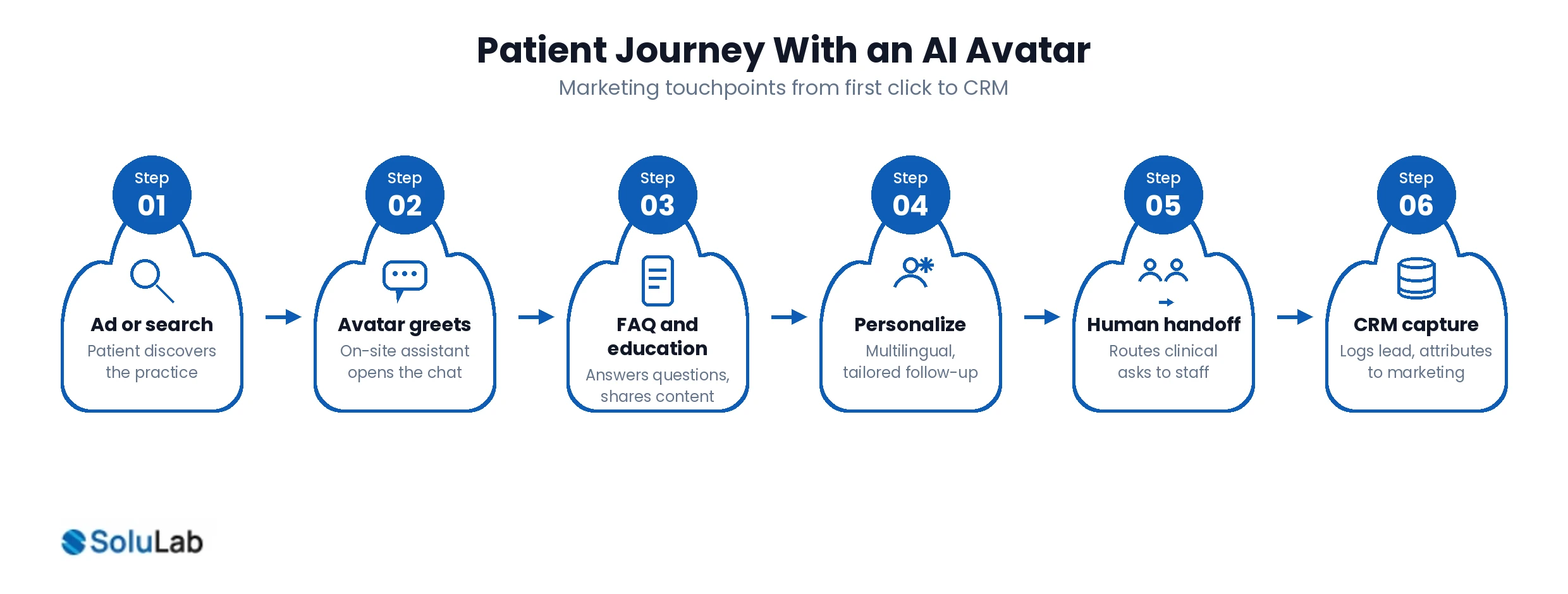
An AI virtual medical assistant in a marketing context is a patient-facing conversational agent — text, voice or animated avatar — that lives on your marketing surfaces and handles engagement rather than clinical care. It greets a visitor, answers service and location questions, nudges an appointment, and hands off to a human when a query turns clinical.
This is a different job from a clinical virtual health assistant. A clinical tool sits inside the care pathway: remote patient monitoring, symptom triage, medication reminders tied to a treatment plan. A marketing assistant sits before the care pathway, at the top and middle of the funnel, where a prospective patient is still deciding whether to book. The line matters for both compliance and content: a marketing bot should not diagnose, and it should not need protected health information to do its job well.
Definition. A marketing AI virtual medical assistant is a top-of-funnel conversational agent that acquires, educates and engages patients on public surfaces, with no clinical decision-making and minimal or zero PHI in scope.
How Does an AI Virtual Medical Assistant Support Healthcare Marketing?
It supports marketing by taking on the repetitive, always-on engagement work a human team cannot cover at scale. The core jobs break down cleanly.
FAQ handling. Answers hours, insurance accepted, service-line details, preparation instructions and directions, instantly and around the clock.
Appointment nudges. Prompts a visitor to book, offers the next available slot through your scheduling system, and reduces drop-off between interest and appointment.
Patient education. Explains a procedure or service line in plain language, which shortens the consideration period.
Personalised follow-up. Re-engages past inquiries with relevant content or reminders based on what they asked about.
The measurable result is fewer missed inquiries, faster response times, and more qualified bookings from the same traffic. The front desk keeps its time for in-person patients while the assistant absorbs after-hours and overflow volume.
What Are the Top Use Cases for Medical Practices and Health Systems?
The highest-value use cases sit across the patient lifecycle, from first click to return visit. Prioritise the ones tied to a revenue line or a known bottleneck.
Patient acquisition. Capture and qualify website and ad traffic, answer pre-booking questions, and route ready patients to scheduling.
Onboarding. Walk a new patient through intake steps, forms, insurance and what to bring, reducing no-shows.
Re-engagement. Reach lapsed patients with reminders for annual visits, screenings or seasonal services.
Service-line promotion. Explain and promote a specific offering: a new clinic, a cosmetic service, a specialist programme.
Multilingual access. Serve patient populations in their preferred language on the same surface, widening reach without a second team.
A single-specialty clinic might start with acquisition and FAQ handling. A multi-site health system usually needs service-line promotion and multilingual support on top.
Which Format Fits Your Goal: Text Chatbot, Voice Assistant or Animated Avatar?
Pick the format by where patients meet you and how much production budget you have. A text chatbot is the fastest and cheapest to launch; an animated avatar is the most engaging and the most expensive to produce and run.
| Format | Best use case | Patient experience | Cost drivers | Compliance load |
| Text chatbot | Website FAQ, lead capture, scheduling | Familiar, fast, works on any device | LLM usage, integrations, maintenance | Lower: text logs, easy consent capture |
| Voice assistant | Phone lines, hands-free, accessibility | Natural for callers, good for low-literacy or low-vision use | Speech-to-text and text-to-speech, telephony, latency tuning | Higher: call recording consent, voice data handling |
| Animated avatar | Campaign pages, service-line promotion, kiosks | Most engaging, human-like, brand-forward | Avatar rendering, voice, motion, LLM, higher build cost | Higher: video and voice data, likeness and consent |
Many teams run a text chatbot as the default surface and add an animated avatar for a flagship campaign or a specific service line where the engagement lift justifies production cost. Per-format build and run costs should be confirmed against a scoped estimate, since they vary considerably with traffic, integrations and avatar quality.
How Do You Keep a Healthcare Marketing Assistant HIPAA-Safe?
Keep it safe by designing it so it never needs PHI in the first place, then adding consent and human handoff for anything sensitive. HIPAA governs how covered entities and their business associates handle protected health information, and its rules on marketing communications are specific about when patient authorisation is required (U.S. Department of Health and Human Services). A marketing assistant that stays at the top of the funnel can sidestep most PHI exposure by design.
Practical guardrails.
Minimise PHI. A marketing bot should collect only what it needs to book or follow up: name and contact preference, not medical history.
Capture consent explicitly. Get clear opt-in before storing contact data or sending follow-ups, and log it.
Hand off clinical queries. The moment a conversation turns to symptoms, medication or diagnosis, route to a human.
Use a compliant stack. If any PHI can enter the flow, the vendor and hosting must operate under a Business Associate Agreement.
Watch tracking and data-sharing. Consumer-facing health data and online tracking on health sites draw regulatory attention, so review what your analytics and ad pixels capture alongside the assistant.
Confirm the specific HIPAA marketing authorisation triggers and any state-level rules with your compliance counsel before launch, and avoid overstating HIPAA coverage in patient-facing copy.
How Do You Measure Whether It Is Working?
Measure it against marketing outcomes, not chat volume. A busy bot that produces no bookings is a cost, not an asset. Track a short set of metrics that ladder up to acquisition and retention.
Engagement rate: share of visitors who start and complete a conversation.
Qualified leads: conversations that produce a booking request or a contactable, consented inquiry.
Booking conversion: qualified conversations that turn into scheduled appointments.
Deflection: FAQ and routine questions resolved without a human, which frees front-desk time.
Cost per acquired patient: blended cost of the assistant against patients it helped acquire.
Wire attribution end to end. Pass conversation and conversion events into GA4 and your CRM so an inquiry from the avatar is traceable to a booked appointment and, where your system allows, to revenue. Without that plumbing you will see activity but not impact. Set a baseline before launch so the lift is measurable rather than assumed.
How Is a Healthcare Marketing Avatar Built, and What Does It Cost to Run?
It is built in a few clear stages, and the running cost is driven by conversation volume, the avatar and voice layer, and integrations rather than a single licence fee.
Intent design. Map the conversations you actually want: FAQ, booking, service-line education. Define what the assistant will not do.
LLM choice. Pick the model for quality, cost and data terms. Ground it on your own approved content rather than letting it improvise.
Avatar and voice layer. Add the animated avatar and text-to-speech only if the format calls for it. This is where production cost concentrates.
Integration. Connect scheduling, CRM and analytics so conversations turn into bookings and tracked events.
Compliance review and launch. Review data flows, consent and handoff with counsel, then launch against a measured baseline.
Running costs come from LLM and speech usage per conversation, avatar rendering if used, hosting, and maintenance. Build and monthly run-cost ranges should be confirmed against a scoped estimate rather than published as a flat figure.
Where Does Generative AI Add the Most Value?
Generative AI adds the most value in personalised education, multilingual reach and natural conversation: the three things scripted bots do badly. Instead of a fixed decision tree, a generative model can explain a service line in plain language tailored to the question asked, answer phrasing it was never explicitly scripted for, and switch languages on the same surface.
For a marketing team that means one assistant can educate a first-time visitor, reassure a nervous prospective patient and re-engage a lapsed one, each in their own words. Grounding the model on your approved content keeps it accurate. This is the same foundation SoluLab applies across projects; see our generative AI development company work and our AI chatbot development company builds.
Where Does SoluLab Fit?
SoluLab builds patient-facing assistants as marketing tools, starting from your acquisition and engagement goals rather than a clinical system spec. Founded in 2014 and headquartered in Los Angeles, California, we pair generative AI engineering with the consent, handoff and attribution design a healthcare marketing surface needs.
Our approach: scope the conversations and the PHI boundary first, ground the model on your approved content, add the format that fits the campaign, and wire GA4 and CRM attribution so you can prove the lift. For strategy and conversation design, our conversational AI consulting services team defines the intents, guardrails and measurement before a line of production code. Where the build needs to reach into clinical systems, healthcare software development covers the integration side.
Frequently Asked Questions
Shipra Garg is a tech-focused content strategist and copywriter specializing in Web3, blockchain, and artificial intelligence. She has worked with startups and enterprise teams to craft high-conversion content that bridges deep tech with business impact. Her work translates complex innovations into clear, credible, and engaging narratives that drive growth and build trust in emerging tech markets.