Key Takeaways
- Fleet asset tokenization turns trucks, vans, EVs, and other commercial vehicles into blockchain tokens that represent ownership, full or fractional.
- Operators can raise working capital against vehicles they already own, without handing over day-to-day control of the fleet.
- Investors get access to fractional stakes in commercial fleets, a category that used to be reserved for banks and leasing firms.
- Smart contracts can route mileage, lease, or usage revenue straight to token holders, no manual reconciliation required.
- Getting a platform live takes legal structuring, custody arrangements, KYC/AML controls, and a real telematics data feed. Skip any one of these and the token isn’t worth much.
Fleet financing hasn’t changed much in decades. Banks, leasing companies, and private lenders still underwrite one vehicle, or one small batch, at a time.
It’s slow, and it locks out smaller operators who don’t have the balance sheet to play. Tokenization offers a different path: a truck, a van, or an entire EV fleet becomes a digital asset that can be split, financed, and traded like a security.
The tokenized real-world assets market was worth about USD 297.71 billion in 2024. Market research firms project it could reach USD 9.43 trillion by 2030.
As RWA tokenization moves past real estate and private credit, fleets are shaping up to be one of the more obvious next steps, cash-generating, data-rich assets that fit an on-chain ownership model better than most.
What Is Fleet Tokenization?
Fleet tokenization converts ownership rights, or a claim on a fleet’s revenue, into digital tokens recorded on a blockchain. A token might represent full ownership of one vehicle, a fractional slice of a pool of vehicles, or simply a right to a cut of whatever revenue the fleet brings in.
The underlying vehicle doesn’t move. What changes is who holds the paper, and how easily that paper can change hands.
How Does Fleet Tokenization Work?
The process runs from legal setup through to token distribution, and each step depends on the one before it.
- Asset selection and valuation—The fleet owner picks which vehicles or vehicle groups go into the pool and gets them independently appraised.
- Legal wrapper creation – A special purpose vehicle (SPV) or trust is set up to legally hold the fleet and issue tokens against it. This step alone can take weeks depending on jurisdiction.
- Token issuance – Tokens are minted on-chain, each carrying a defined ownership or revenue claim.
- Smart contract deployment – Contracts encode payout rules, transfer restrictions, and compliance checks.
- Investor onboarding – Investors complete KYC/AML and buy tokens through a compliant issuance or trading platform.
- Revenue and data flow – Telematics and payment data feed the platform, which triggers automated payouts based on how the fleet actually performs.
Which Fleets Can Be Tokenized?
Not every vehicle category fits. The ones that work best already produce predictable, trackable cash flow, which is what makes fleet asset tokenization worth the legal and technical overhead in the first place.
- Commercial trucks, long-haul and regional
- Delivery vans tied to logistics contracts
- Taxi and rideshare fleets with app-based usage data
- Buses running fixed routes
- Construction equipment leased per project
- Agricultural machinery with seasonal rental cycles
- EV fleets with battery and charging telemetry
- Rental vehicles with daily usage records
- Specialized industrial vehicles like forklifts and cranes
How to Build a Fleet Tokenization Platform?
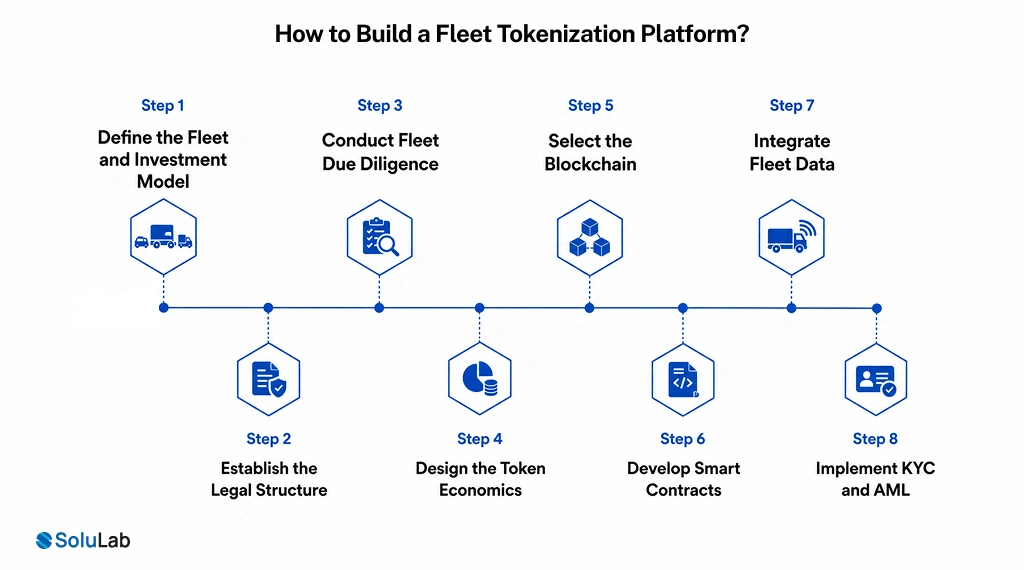
Building a compliant tokenization platform means legal, technical, and operational work, and the order matters. Skip a step or do it out of sequence, and you’ll likely have to redo it later, often at a worse time.
Step 1: Define the Fleet and Investment Model
Decide which vehicles get tokenized and how ownership will be structured before any code gets written.
- Select the fleet segment
- Choose fractional or full-token model
- Define target investor type
Step 2: Establish the Legal Structure
Set up the entity that will legally hold the fleet and issue tokens against it.
- Form the SPV or trust
- Confirm securities classification
- Draft token holder agreements
Step 3: Conduct Fleet Due Diligence
Verify vehicle condition, value, and revenue history before any of it backs a token.
- Independent vehicle appraisal
- Title and lien verification
- Historical revenue audit
Step 4: Design the Token Economics
Set the rules for pricing, distribution, and how holders actually get paid.
- Set token supply and pricing
- Define payout frequency
- Model investor returns
Step 5: Select the Blockchain
Pick infrastructure that fits your compliance needs, not just the one that’s trending.
- Compare public vs permissioned chains
- Evaluate transaction costs
- Check regulatory alignment
Step 6: Develop Smart Contracts
Build and test the smart contracts that handle issuance and payouts. This is not a step to rush.
- Code issuance logic
- Build payout automation
- Commission a security audit
Step 7: Integrate Fleet Data
Connect real vehicle data to the platform so token performance actually reflects what the fleet is doing.
- Connect telematics APIs
- Automate revenue reporting
- Set data verification checks
Step 8: Implement KYC and AML
Add the compliance layer that has to be in place before a single token gets sold.
- Deploy identity verification
- Screen for sanctioned parties
- Log compliance for audits

What Are the Benefits of Tokenizing Fleet Assets?
Tokenizing a fleet reshapes how ownership, financing, and revenue get structured. Some of the upside is obvious. Some of it only shows up once a platform is actually running.
1. Fractional Investment Opportunities
Fractional fleet ownership means an investor can buy a stake in one truck, or a whole fleet, without covering the full purchase price. That lowers the entry point into commercial vehicle financing, a category that until recently was mostly closed to anyone outside institutional lending.
2. Alternative Capital for Fleet Operators
Operators can raise money against vehicles they already own instead of going back to a bank or leasing company every time. Call it tokenized vehicle fleet financing, a parallel track that runs alongside, not instead of, traditional credit lines.
3. Automated Revenue Distribution
Smart contracts calculate and distribute mileage fees, lease payments, or usage revenue to token holders on their own. No spreadsheet reconciliation, no waiting on a monthly statement from an accounting team.
4. Improved Asset Transparency
Ownership, maintenance history, and revenue performance all live on a blockchain record that’s hard to alter after the fact. Paper-based fleet records don’t offer that, and neither do most legacy fleet management systems.
5. Potential Secondary Market Liquidity
Tokens can list on compliant secondary marketplaces. That gives investors an exit path in an asset class that, historically, locked up capital the moment you committed it.
6. Portfolio Diversification
Tokenized transportation assets behave differently from stocks, bonds, or real estate, since their returns track logistics and mobility revenue rather than broader market cycles. For an investor building a diversified book, that’s a distinct risk profile worth having.
What Are the Use Cases for Fleet Tokenization?
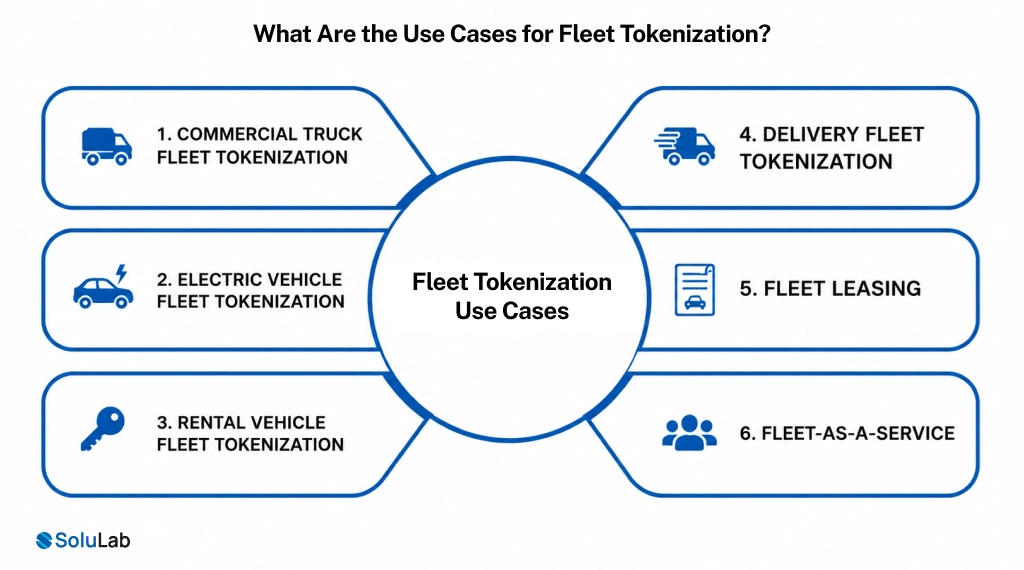
How an AI-led tokenization platform gets applied depends heavily on the type of fleet and where its revenue actually comes from.
1. Commercial Truck Fleet Tokenization
Freight operators tokenize part of their truck fleet to raise growth capital while keeping the trucks on the road. Token holders earn a share of freight contract revenue as it comes in.
2. Electric Vehicle Fleet Tokenization
EV fleet owners pair blockchain fleet management with battery and charging data, so tokens are backed by verifiable performance metrics instead of a static lease agreement that assumes every vehicle performs the same.
3. Rental Vehicle Fleet Tokenization
Rental companies tokenize a slice of their fleet to fund vehicle refresh cycles, with daily rental income flowing to token holders through automated payouts.
4. Delivery Fleet Tokenization
Last-mile operators tokenize vans and micro-mobility fleets tied to long-term logistics contracts. Token payouts track contracted delivery volumes rather than one-off vehicle sales.
5. Fleet Leasing
Fleet leasing tokenization turns existing lease receivables into tradable tokens. Leasing companies offload risk this way and free up balance sheet room for new originations, which matters more in a higher-rate environment.
6. Fleet-as-a-Service
Operators running subscription-based vehicle access tokenize the underlying fleet, giving investors a claim on recurring subscription revenue instead of a one-time sale.
What Is Driving the Growth of Fleet Tokenization?
A handful of trends are pushing fleets toward tokenized ownership faster than most people expected even two years back.
1. Growth of RWA Tokenization
The broader RWA market has moved quickly. One market research estimate puts the global tokenized real-world assets market at USD 297.71 billion in 2024, projected to reach USD 9.43 trillion by 2030 at a 72.8% compound annual growth rate.
Deloitte’s Center for Financial Services, looking specifically at real estate, forecasts tokenized real estate could reach USD 4 trillion by 2035, up from under USD 300 billion today, a 27% compound annual rate. Fleets aren’t at that scale yet. But the underlying mechanics, fractional ownership, automated payouts, verifiable asset data- transfer directly.
2. Demand for Alternative Fleet Financing
The commercial vehicle leasing market itself sat somewhere between USD 84.8 billion and USD 109.5 billion in 2025, depending on which research firm’s methodology you use, with steady mid-single-digit growth expected through 2030 as e-commerce and last-mile delivery volumes climb. That growth is putting pressure on financing models that move faster than a bank’s underwriting desk, and that’s exactly the gap tokenized logistics assets are built to fill.
3. Institutional Interest in Tokenized Assets
Gartner has forecast blockchain adding more than USD 176 billion in business value by 2025, climbing past USD 3.1 trillion by 2030. That’s not a fleet-specific number, but it signals enterprise blockchain infrastructure is maturing to a point where asset-heavy industries, fleets included, can build production platforms on it rather than pilots.
4. Growth of Electric and Shared Mobility
EV fleets are more expensive upfront than combustion equivalents, and battery costs alone can shift the math on a lease. Tokenized structures give operators a financing path that doesn’t depend entirely on a small pool of traditional auto lenders who may still be pricing in EV residual-value risk.
5. Better Fleet Data Infrastructure
Telematics, GPS tracking, and usage-based reporting are close to standard now in commercial fleets. That data is what makes fleet asset backed tokens credible in the first place, since a token’s performance can be checked against real, live activity instead of a once-a-year appraisal.
6. Increasing Regulatory Clarity
A number of jurisdictions have tightened up frameworks for security token offerings and digital asset custody over the past couple of years. That’s cut down the legal ambiguity for anyone structuring asset-backed tokens, and it’s given institutional investors more reason to actually participate rather than watch from the sidelines.

Conclusion
Fleets sit at a genuinely practical intersection of the RWA trend. They generate steady revenue, throw off rich telematics data, and have long been financed through slow, capital-heavy channels that leave a lot of operators underserved.
Tokenized real estate and private credit have already shown the model works at scale. Applying the same structure to trucks, EVs, delivery vans, and leasing portfolios is the logical next move, but it only works if the legal structure, smart contracts, and data pipeline are built right from the start.
SoluLab, an asset tokenization development company, helps businesses design and build compliant fleet tokenization platforms, from legal structuring and smart contract development to telematics integration and KYC/AML. Book a free discovery workshop with SoluLab’s tokenization team to scope your platform.
FAQs
Neha is a curious content writer with a knack for breaking down complex technologies into meaningful, reader-friendly insights. With experience in blockchain, digital assets, and enterprise tech, she focuses on creating content that informs, connects, and supports strategic decision-making.