Key Takeaways
- AI tokenization platforms are transforming static assets into intelligent, liquid, and compliance-ready investment ecosystems for global enterprises.
- AI-powered asset ownership enables real-time valuation, automated compliance monitoring, and faster cross-border settlement infrastructure across industries.
- Public blockchain ecosystems like Solana, Base, and XRP Ledger are improving liquidity access for enterprise asset tokenization platforms.
By combining machine learning, predictive analytics, and blockchain asset tokenization, enterprises can create programmable assets that continuously adapt to market conditions. These platforms are enabling faster settlements, fractional access to high-value assets, and entirely new models of digital asset ownership across real estate, private credit, commodities, and AI-native economies.
Global institutions like BlackRock, J.P. Morgan, Franklin Templeton, Siemens, and BMW are already deploying AI-powered asset ownership frameworks. These can automate treasury movement, optimize liquidity, and enable real-time compliance monitoring. These AI tokenization platforms are helping to change how businesses, startups, and enterprises access, value, and monetize assets.
What Are AI Tokenization Platforms?
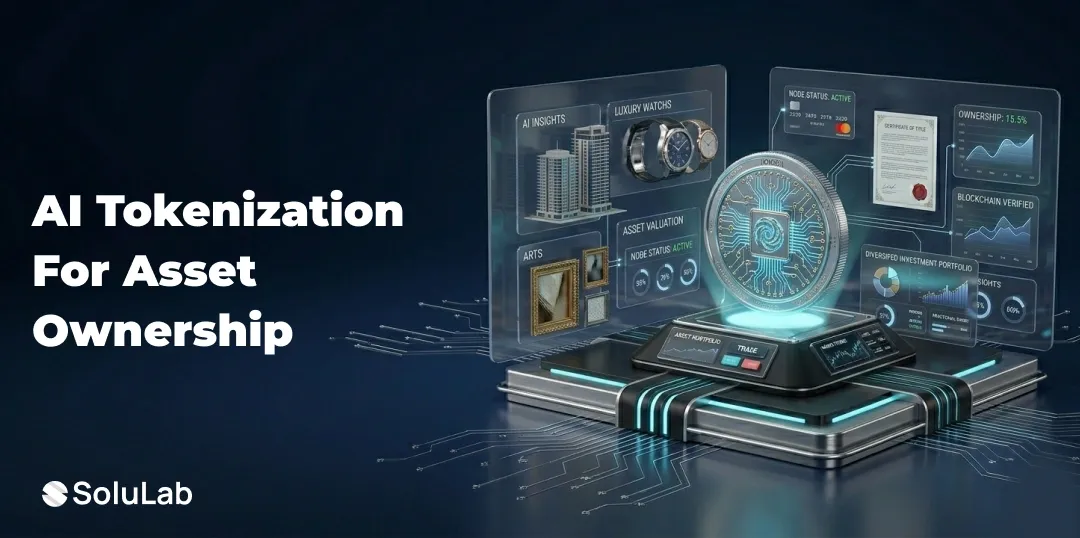
AI tokenization platforms integrate artificial intelligence with blockchain architecture to convert real-world or digital assets into on-chain tokens. These assets can then be fractionalised, traded, and managed with far greater agility than the traditional route. Here’s a breakdown:
- Fractional ownership: The platform divides an asset into digital tokens, each representing a share of the whole. That means smaller investors or business units can participate, not just large institutions.
- AI-driven valuation and monitoring: AI algorithms analyse data, market trends, and historical performance to value assets, monitor risk, and run compliance checks, rather than relying solely on manual processes.
In 2026, predictive NAV (Net Asset Value) engines are becoming a core differentiator for enterprise AI tokenization solutions, allowing assets to update valuations dynamically every few minutes instead of every few months.
- Blockchain registration and trading: Once tokenised, the blockchain asset ownership and transactions are recorded on a blockchain, which provides immutability and transparency.
- Smart contract automation: Ownership transfers, royalty payouts, or usage rights can be governed by smart contracts, resulting in fewer intermediaries and faster execution.
- AI-powered compliance and risk controls: By embedding AI-based asset tokenization rules (e.g., KYC/AML checks) and blockchain audit trails, these platforms aim to meet regulatory standards while simplifying operations.
Modern platforms now use “Regulatory-as-Code” frameworks where AI continuously monitors MiCA regulations in Europe, SEC frameworks in the US, and jurisdictional compliance rules across Asia and the Middle East.
This is helping enterprises create secure token ownership systems without depending heavily on manual legal review cycles.
How Market Trends Shaping AI Tokenization in 2026
The growth of tokenization, and by extension, AI-powered tokenized ownership, has been notable. For decision-makers in finance, tech, and startups, the numbers indicate rising opportunity.
The market for tokenized real-world assets (RWA) has reached nearly $24 billion, establishing blockchain asset tokenization as a foundational layer for modern capital markets.
1. Global Market Momentum
- The total value of tokenized RWAs on public blockchains has surged to $23.6 billion in Q2 2026, reflecting a 66% growth since the beginning of the year.
- Analysts project the broader asset tokenization ecosystem could move toward $9.4 trillion by 2030, driven by institutional adoption and AI-powered liquidity systems.
- The security tokenization software market alone has crossed $4.7 billion, supported by growing demand for enterprise AI tokenization solutions.
2. Regional Regulatory Breakthroughs
2.1 South Korea (The “STO Leader”):
- Legal Breakthrough: On January 15, 2026, the National Assembly passed amendments to the Electronic Securities Act, fully legalizing Security Token Offerings (STOs).
- Government Innovation: The Ministry of Economy and Finance is piloting tokenized deposits in Sejong City to manage state expenditure, replacing traditional credit cards with programmable, AI-monitored funds to prevent budget misuse.
2.2 USA (Regulatory Clarity):
- FIT21/Clarity Act: The Financial Innovation and Technology for the 21st Century Act has moved into full implementation, providing the SEC and CFTC with a clear “Security vs. Commodity” framework.
- Institutional Scale: BlackRock’s BUIDL fund now utilizes AI-driven RFQ (Request for Quote) systems to maintain 24/7 liquidity in secondary markets, bridging the gap between private credit and retail-ready tokens.
2.3 Singapore & Hong Kong (The Innovation Hubs):
- Singapore (Project Guardian): MAS has scaled its institutional pilot. In 2026, AI agents will be used to automate portfolio rebalancing for tokenized wealth management funds, handling trillions in potential alternative assets.
- Hong Kong (Project Ensemble): The HKMA is focusing on W-CBDC (Wholesale CBDC) to settle tokenized RWA transactions. Major banks here are embedding AI to provide real-time Net Asset Value (NAV) for tokenized green bonds.
2.4 UK & UAE (The Sandbox Pioneers):
- UK Digital Securities Sandbox (DSS): Now in its second year, the DSS has allowed firms to settle trades in minutes rather than days.
- UAE (VARA/ADGM): The UAE has seen a 266% growth in tokenized RWAs, reaching over $24 billion by early 2026. AI is being used here specifically for automated property valuation in the booming fractional real estate market.
3. Infrastructure & Sector Growth
- Government bonds now dominate digital asset ownership markets with $11.1 billion in tokenized value.
- Commodities account for $6.5 billion, while private credit is emerging as the fastest-growing AI-powered asset ownership segment.
- Hybrid and public chains like Solana, Base, and XRP Ledger are replacing isolated private networks to improve liquidity access and cross-border interoperability.
These trends indicate that AI tokenization is becoming a business tool. For startups and enterprises thinking of tokenization development, the window is open.
To build a strong foundation for AI tokenization, several technical and operational components must align seamlessly. Let’s check what and how they work in enhancing the tokenization of assets.
Read more – Private Equity Tokenization
Key Components Behind Effective AI Tokenization
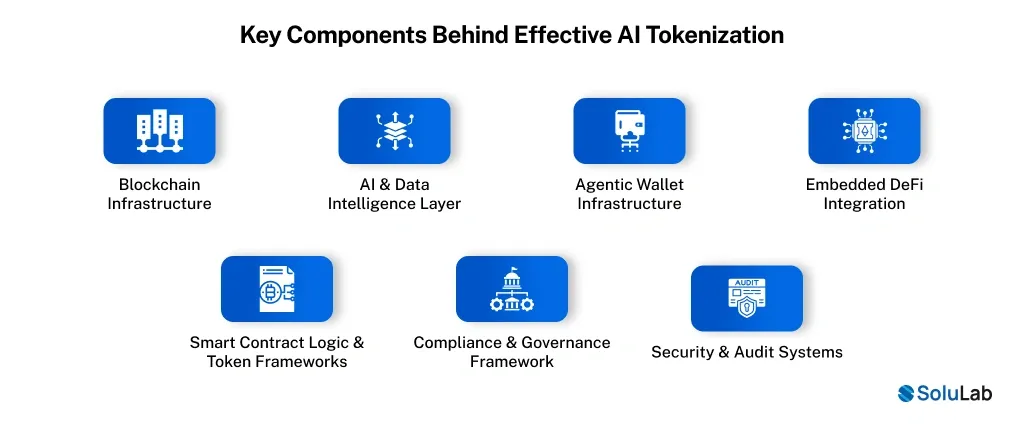
For enterprises exploring AI tokenization platform development, understanding the technical architecture is critical.
1. Blockchain Infrastructure
Every successful tokenized asset platform development strategy starts with blockchain selection.
Ethereum, Polygon, Solana, Avalanche, Base, and permissioned enterprise chains all offer different advantages in scalability, interoperability, cost efficiency, and security.
In 2026, interoperability has become a major enterprise requirement, as institutions increasingly demand cross-chain liquidity instead of isolated blockchain ecosystems.
2. AI & Data Intelligence Layer
This is the core intelligence engine behind modern AI-driven tokenization platforms.
The AI layer handles:
- Predictive pricing
- Risk modeling
- Fraud detection
- Market forecasting
- Automated compliance scoring
- Investor behavior analysis
Machine learning models continuously evaluate both internal and external market signals to optimize real asset ownership operations.
3. Agentic Wallet Infrastructure
One of the biggest 2026 trends is the rise of agentic wallets, in which AI agents autonomously manage treasury movement, liquidity allocation, and portfolio balancing.
These wallets can:
- Rebalance tokenized portfolios
- Optimize yield
- Execute settlements
- Manage cross-border treasury operations
- Trigger compliance workflows automatically
This evolution is pushing AI-powered asset management into autonomous operational finance.
4. Embedded DeFi Integration
Tokenized assets are increasingly being integrated into:
- Lending systems
- Insurance protocols
- Treasury management
- Cross-border settlement infrastructure
DeFi services are strengthening the bridge between traditional finance and decentralized ecosystems.
5. Smart Contract Logic & Token Frameworks
Smart contracts define ownership rules, transfer permissions, payout structures, governance rights, and token issuance logic.
Modern AI token development services increasingly focus on:
- ERC-3643 security token standards
- Permissioned transfer logic
- Automated dividend distribution
- Institutional-grade settlement systems
6. Compliance & Governance Framework
AI agents now continuously monitor user behavior, wallet activity, KYC validity, sanctions lists, and regulatory updates before transactions are finalized.
This makes asset tokenization for enterprises significantly more scalable than legacy compliance-heavy financial systems.
7. Security & Audit Systems
As enterprise capital enters tokenized ecosystems, security expectations have risen dramatically.
Modern AI tokenization platform development requires:
- Zero-trust architecture
- Multi-signature authorization
- ZK-proof privacy systems
- AI-driven anomaly detection
- Real-time audit logging
- Smart contract penetration testing
Benefits Of Asset Fractionalization Through AI Platforms For Startups
Picking the right benefits to highlight for startups and smaller enterprises can make adoption decisions easier.
- Access to High-Value Assets
For a startup that cannot afford to buy entire properties or large-scale art or venture-fund shares, fractional ownership via tokenization opens doors. With AI tokenized platforms, parts of expensive assets become accessible.
- Increased Market Liquidity
Traditionally illiquid assets (like real estate or fine art) meant long lock-in periods. Tokenizing those assets enables trading in smaller units, provides secondary market options, and hence gives startups more flexibility.
- Transparency and Trust
Blockchain records provide tamper-resistant logs of who owns what, and AI systems help ensure the process remains compliant and tracked. For startups working with investors, this builds credibility.
- Lower Transaction Costs
By automating valuations, transfers, compliance checks, and smart contract enforcement, many intermediaries (brokers, custodians, and manual compliance teams) are reduced. That means startups spend less time and money per transaction.
- Portfolio Diversification and Innovation
Startups can experiment with multiple assets or tokenized datasets via tokenization in AI models. This provides flexibility and innovation potential.
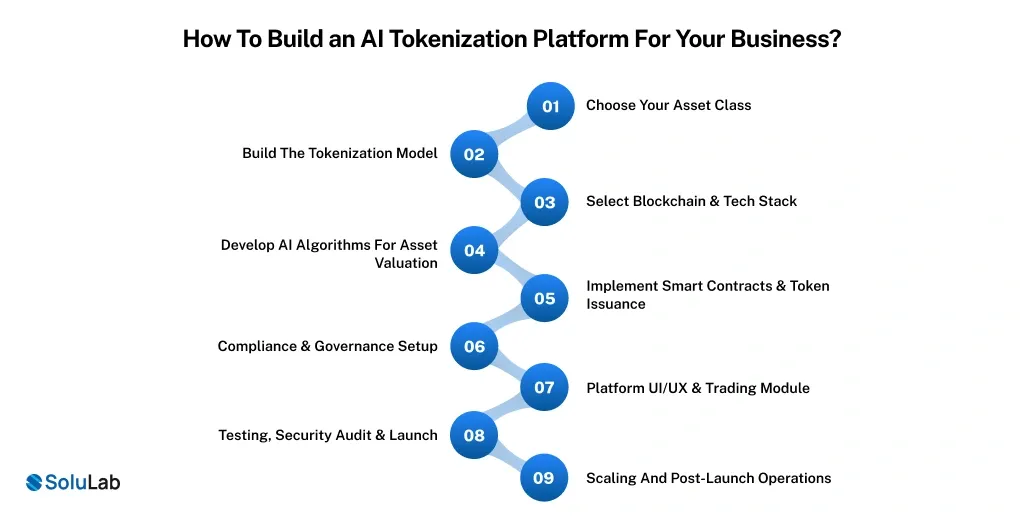
How To Build an AI Tokenization Platform For Your Business?
Here is a rough roadmap with different tiers, basic, MVP, and advanced, with realistic timeframes and approximate cost ranges (depending on geography and vendor rates) for AI tokenization platform development.
- Choose Your Asset Class
Decide whether you’ll tokenize real estate, art, commodities, financial instruments, or even AI models/data. The choice influences legal, valuation, and technical approach.
- Build the Tokenization Model
After deciding on your vision/goal, build the AI tokenization model. You can partner with any AI tokenization development company that suits your budget and requirements.
- Select Blockchain & Tech Stack
Pick your underlying AI and blockchain tokenization framework, smart-contract language, wallet integrations, and token standards (e.g., ERC-20/ERC-3643 for security tokens).
- Develop AI Algorithms for Asset Valuation
Gather data, build or integrate ML models that can value assets, monitor risk, detect fraud, and make compliance recommendations. Train models, validate them, and ensure accuracy.
- Implement Smart Contracts & Token Issuance
Set up contract logic, token minting/burning, ownership tracking, and transfer conditions. Ensure compatibility with wallets and exchanges if trading is planned.
- Compliance & Governance Setup
Integrate KYC/AML modules; set roles (issuer, investor, custodian); design governance rules for token holders; work with legal counsel to ensure regulatory adherence in your target jurisdictions.
- Platform UI/UX & Trading Module
Create dashboards for issuers and investors, build marketplace/trading logic, wallets, transaction history, and analytics. Focus on simplicity and clarity so business users can adopt without heavy training.
- Testing, Security Audit & Launch
Run user-testing, stress test smart contracts, and perform security audits (cryptography, smart contract vulnerabilities, penetration testing). Prepare for live launch.
- Scaling and Post-Launch Operations
Monitor performance, user feedback, legal/regulatory changes; iterate with improvements. For advanced platforms, this includes launching new asset classes and expanding globally.
Future Trends Shaping AI Tokenization And Fractionalization Markets
Looking ahead, several trends will influence how AI tokenization evolves in the upcoming years.
- Interoperable tokenized asset ecosystems: Platforms will increasingly support cross-chain and cross-platform token trading so tokenized assets can flow between networks.
- AI-driven tokenization markets: AI will power market-maker bots, pricing algorithms, portfolio management of tokenised assets, enabling dynamic liquidity and AI-optimised trading.
- Tokenized AI models and data as assets: Beyond physical assets, AI models and datasets themselves will become tokenized, and businesses may invest in fractions of a model or dataset instead of buying outright.
- Privacy-Preserving Ownership Models: Zero-knowledge proofs and confidential computing are becoming critical for institutions seeking privacy while maintaining transparency.
- Embedded finance and real-world asset integration into DeFi/Web3: Tokenized assets will be used as collateral in DeFi, integrated into lending, leasing, and insurance use-cases, making the bridge between traditional finance and decentralized platforms stronger.
Conclusion
AI is always growing and driving towards innovations and integrations. To stay updated with the ongoing technology development, you need an AI and tokenization development partner. This also helps you to keep your platforms and technology compliance up to date. To help you with all these, SoluLab is here.
We, at SoluLab, the top asset tokenization platform development company, offer cutting-edge asset tokenization with AI integration services. Our tokenization solutions aid you in growing above market volatility. Our expert is always at your service to help you with the process and enhance your goals.
If you are ready with your ideas and vision, contact us today!
FAQs
Deepika is a content writer who blends storytelling with strategic thinking. She explores topics across digital innovation, emerging tech, and the evolving blockchain industry. She enjoys breaking down complex ideas into simple, engaging narratives in the growing global markets.