Key Takeaways
- A tokenized stock isn’t the same thing as owning a share. What you actually hold depends entirely on how the issuer structured the token’s legal rights.
- Not every stock is a good tokenization candidate. Liquidity, custody availability, and regulatory eligibility rule several out before development even starts.
- The build process runs ten distinct stages, from business model through launch monitoring, and skipping the legal and custody stages is where most projects actually fail.
- A working platform typically costs anywhere from the low six figures for an MVP to well over a million for a fully compliant, multi-jurisdiction build.
Tokenized stocks went from a niche experiment to a market moving billions of dollars a month in about eighteen months, part of a much broader shift toward real-world asset tokenization that’s pulling in institutional capital across nearly every asset class.
Robinhood’s Stock Tokens, BlackRock and Franklin Templeton’s tokenized funds, and a growing list of fintech platforms have all proven the model works at real scale.
What most coverage skips is the harder question: what does it actually take to build one of these platforms properly, from the legal structure through the smart contract layer to the custody arrangement holding the real shares underneath it all?
This guide walks through why enterprises are investing here, how to pick which stocks to tokenize, the full ten-stage build process, what it costs, and where a platform like this can go wrong if the groundwork gets skipped.
Why Enterprises Are Investing in Tokenized Stocks Development?
The appeal isn’t abstract. It shows up in what the model actually unlocks that traditional brokerage infrastructure can’t. Tokenized stocks crossed roughly $1 billion in circulating value with more than 185,000 holders by March 2026, and CoinDesk Data clocked $11.3 billion in monthly tokenized-equity trading volume by July.
- Fractional investment lets someone buy a sliver of a $500 share instead of needing the full amount, opening equity markets to investors who were priced out before.
- Global distribution follows naturally: a token can reach an investor in a country with zero direct access to US brokerages. Something a traditional account simply can’t touch.
- Then there’s 24/7 onchain infrastructure and faster settlement, which together mean markets that don’t close at 4 pm and don’t take two days to settle a trade the way traditional equities still do.
- Automated compliance and programmable assets change how the back office actually works, not just how it’s marketed. Smart contracts enforce eligibility rules and transfer restrictions right at the token level, cutting manual compliance overhead that traditional brokerages still carry as dead weight.
- DeFi composability brings something genuinely new to the table too: a tokenized share can serve as collateral or plug into other on-chain protocols, something a paper certificate was never built to do.
- Transparent transaction records close the loop, giving auditors a shared, tamper-resistant ledger instead of reconciling numbers across intermediaries who don’t always agree with each other.
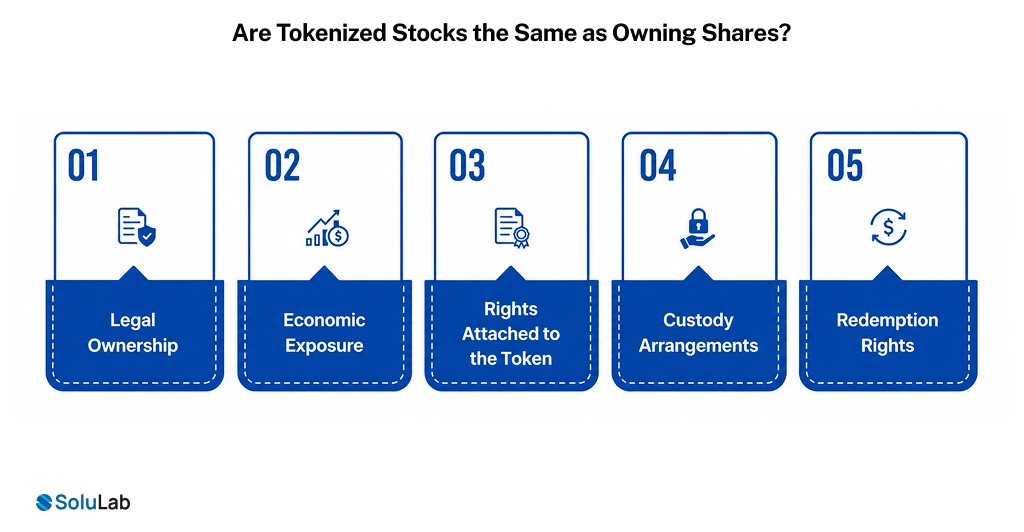
Are Tokenized Stocks the Same as Owning Shares?
Usually not. And the gap between “exposure” and “ownership” matters more than most marketing copy ever admits. Deloitte’s CFO survey found 23% of North American CFOs expect their treasury teams to hold or transact in crypto within two years, climbing to 39% among firms over $10 billion in revenue.
1. Legal Ownership
Here’s the thing most buyers miss: most tokenized stocks are structured as debt securities or derivative instruments, not equity. The token tracks a share’s price. It doesn’t hand you the legal ownership a traditional brokerage account would.
2. Economic Exposure
What you’re actually getting is economic exposure. The token’s value rises and falls with the stock, sure, but the legal claim sitting underneath that price movement looks nothing like holding the share itself.
3. Rights Attached to the Token
Voting rights, dividends, the usual shareholder privileges? Depends entirely on how the issuer built the offering, and a lot of tokenized stock products just don’t pass those rights through at all.
4. Custody Arrangements
Someone, somewhere, has to actually hold the real shares backing the tokens. Skip transparency on that arrangement and the whole “backed 1:1” pitch is a promise with nothing behind it.
5. Redemption Rights
Can the token be redeemed for cash? For the actual share? Not at all? That’s set entirely by the offering’s terms, and it’s exactly the fine print most investors never bother reading.

How to Choose Stocks for Tokenization?
Not every stock or ETF makes sense to tokenize. Pick wrong here, and it usually doesn’t show up as a failure until months after launch, once adoption stays flat and nobody can quite explain why.
1. Liquidity
Highly liquid, actively traded stocks tokenize more cleanly. Pricing stays tight, and the underlying market can absorb hedging activity without much slippage getting in the way.
2. Investor Demand
Great technology built around a stock nobody actually wants exposure to still fails. Demand has to come first, every time, no exceptions.
3. Regulatory Eligibility
Some securities carry transfer restrictions or ownership structures that make tokenization legally messy, or flatly unavailable, depending on the jurisdiction.
4. Custody Availability
You need a custodian willing and able to hold the stock in question. Not every custodian covers every asset, or every jurisdiction, and finding out mid-project is a bad time to learn that.
5. Market Data Availability
Accurate on-chain pricing needs a reliable, real-time feed for the underlying stock. Thin coverage or a delisted security turns that oracle problem into a genuinely hard one to solve well.
6. Corporate Action Requirements
Splits, mergers, dividend events- all of it has to reflect accurately on-chain. Building that logic for a low-volume, rarely-adjusted stock usually isn’t worth the engineering cost.
7. Geographic Availability
Where a token can legally be sold shapes which stocks make sense to tokenize first. A platform chasing international investors needs securities it can actually distribute in those specific markets, not just anywhere.
Step-by-Step Tokenized Stock Platform Development Process
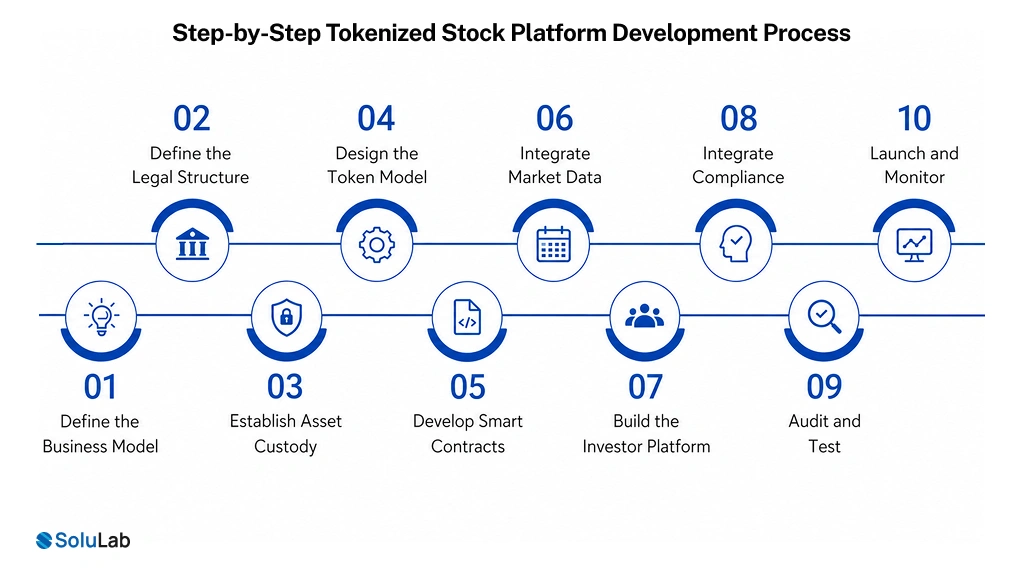
Building this right runs through ten distinct stages, and treating any of them as optional is usually how a promising platform stalls out before launch.
1. Define the Business Model
Everything downstream depends on getting this right first. Retail access, institutional infrastructure, and white-label licensing are three genuinely different businesses that all happen to wear the same “tokenized stocks” label.
- Choose the target investor segment
- Decide direct-to-consumer or B2B
- Define revenue and fee structure
2. Define the Legal Structure
Get this wrong and nothing downstream matters, full stop. Most platforms lean on an SPV or similar wrapper to hold the shares and issue tokens against them.
- Establish SPV or issuing entity
- Draft token holder rights documentation
3. Establish Asset Custody
Someone has to actually hold the shares backing every token in circulation. Verifiably, and on an ongoing basis, not just at launch.
- Select a licensed custody provider
- Set up auditable reserve reporting
- Define reconciliation frequency and process
4. Design the Token Model
This is the step where the legal wrapper turns into an actual technical spec.
- Choose token standard and chain
- Define 1:1 backing enforcement logic
- Specify transfer and eligibility restrictions
5. Develop Smart Contracts
Contract code has to enforce the backing claim and compliance rules automatically. Not through manual oversight after the fact; that defeats half the point. Teams without deep in-house Solidity expertise often bring in a specialized asset tokenization development partner here rather than learning the edge cases the hard way, mid-build.
- Write core issuance and burn logic
- Add jurisdiction-based transfer rules
- Test extensively before any deployment
6. Integrate Market Data
Pricing needs to track the real market closely enough that nobody can arbitrage the gap between token and underlying stock.
- Integrate a reliable price oracle
- Build fallback logic for outages
7. Build the Investor Platform
Ironically, this is where most users actually judge the whole product, no matter how solid the backend is underneath.
- Design onboarding and KYC flows
- Build portfolio and transaction dashboards
- Ensure mobile and desktop parity
8. Integrate Compliance
KYC, AML, jurisdiction-specific eligibility- all of it needs to run at onboarding and, this part gets missed a lot, at the transfer level too.
- Automate KYC and AML checks
- Enforce jurisdiction-based transfer restrictions
- Build audit-ready compliance reporting
9. Audit and Test
Independent security review isn’t a nice-to-have line item. It’s what stands between a functioning platform and a very public, very expensive failure.
- Commission an independent smart contract audit
- Fix every flagged issue before launch
10. Launch and Monitor
Roll out to a limited investor base first. It surfaces problems while the blast radius is still small enough to fix quietly.
- Launch with a limited investor cohort
- Monitor liquidity and platform performance
- Scale distribution once metrics hold up
Tokenized Stocks vs Traditional Stocks
The two models diverge on access, speed, and structure more than most comparisons let on. Here’s how they actually stack up.
| Factor | Tokenized Stocks | Traditional Stocks |
| Minimum investment | Often fractional, sub-$100 | Full share price, or fractional via broker |
| Settlement time | Near-instant on-chain, where permitted | T+1 or T+2 |
| Trading hours | 24/7 on supported venues | Standard exchange hours |
| Ownership type | Usually economic exposure, not direct equity | Direct legal ownership |
| Global access | Broader, subject to securities rules | Often geographically restricted |
| Voting and dividend rights | Depends on token structure, often absent | Standard shareholder rights |
| Regulatory maturity | Evolving, jurisdiction-dependent | Well established |
How Much Does It Cost to Build a Tokenized Stock Platform?
Tokenization Cost depends heavily on scope, jurisdiction count, and whether you’re building fully custom or working with a partner who already has reusable infrastructure.
| Platform Tier | Scope | Estimated Cost |
| MVP / Pilot | Single-jurisdiction, basic custody integration, limited compliance | $40,000 – $50,000 |
| Mid-Market Platform | Multi-stock support, full compliance stack, one custody partner | $50,000 – $60,000 |
| Institutional-Grade Platform | Multi-jurisdiction, multiple custody and market data integrations | $60,000+ |
| Ongoing Maintenance | Security monitoring, compliance updates, infrastructure support | 15–20% of build cost annually |
These figures are directional, not quotes, and they move quickly depending on how many jurisdictions and custody integrations the compliance layer ends up requiring.
How SoluLab Helps Build Tokenized Stock Platforms
Enterprise-grade tokenized stock platforms need more than a smart contract, and that’s usually where in-house teams hit a wall.
1. Platform Architecture and Custody Integration
SoluLab builds the full technical stack, from custody integration through the token issuance layer, working as an asset tokenization services partner rather than handing off a template and walking away.
2. Compliance and Regulatory Strategy
From KYC/AML automation to jurisdiction-specific transfer restrictions, compliance gets built into the architecture from day one instead of retrofitted after a regulator asks questions.
3. Smart Contract Development and Audit Coordination
SoluLab develops and coordinates independent audits for the smart contracts enforcing token backing and compliance logic, treating security review as a build requirement, not an afterthought.
If you’re evaluating asset tokenization platforms already on the market versus building custom, that comparison is usually worth doing before committing to either path.
Conclusion
Building a tokenized stock platform is technically achievable with today’s tooling, but the code was never really the hard part. Legal structure, custody, and compliance decisions made early determine whether a platform survives regulatory scrutiny or stalls out after launch.
The market’s growing fast enough, past $11 billion in monthly trading volume by mid-2026, that waiting on the sidelines has its own cost.
SoluLab, a tokenization platform development company, can help your business determine exactly what a compliant platform build needs for your specific asset class and target markets.
Talk to a SoluLab blockchain architect about custody and compliance strategy.
FAQs
Neha is a curious content writer with a knack for breaking down complex technologies into meaningful, reader-friendly insights. With experience in blockchain, digital assets, and enterprise tech, she focuses on creating content that informs, connects, and supports strategic decision-making.