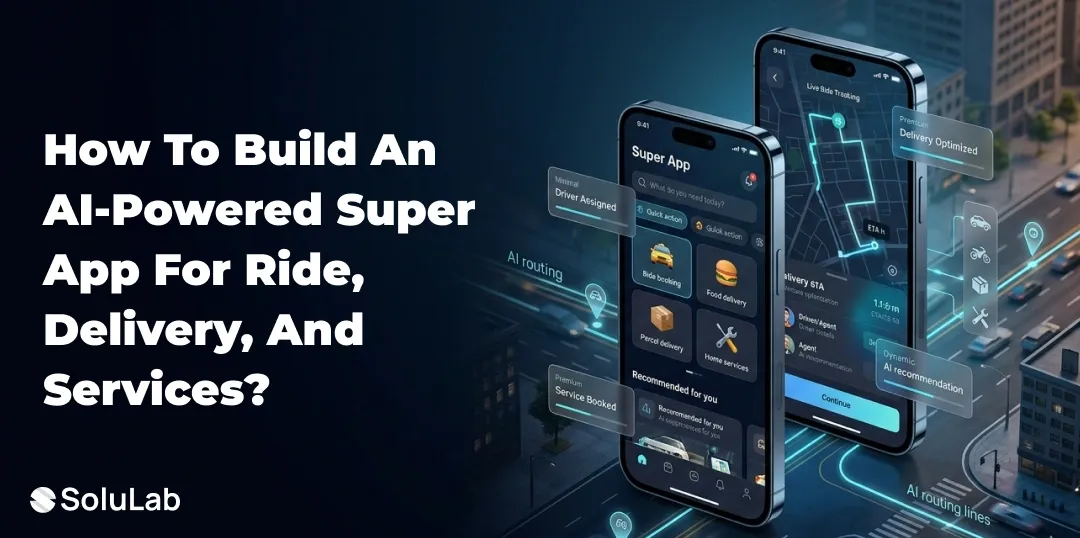
The market has clearly changed. Now the user wants all convenience at one place rather than juggling it for multiple applications.. Whether it is rides, food, parcels, or home services, they want one intelligent ecosystem that does it all. For businesses, this is not just a UX trend. It is a clear signal of where digital demand is moving.
A well-planned AI-powered app development strategy gives companies the ability to meet that demand while building a more scalable and profitable superapp for operations. From smarter dispatch and faster deliveries to personalized offers and reduced operational drag, AI turns a multi-service app into a growth engine.
This guide sheds light on how to build an AI-powered super application for delivery, ride and other services!
Key Takeaways
- Why super apps are becoming the next major growth model for service-based businesses
- How AI helps businesses improve speed, efficiency, retention, and platform-wide user experience
- The essential building blocks of a scalable app for ride-hailing, delivery, and services
- The smartest way to launch, expand, and optimize a multi-service platform
- The business models, technology choices, and execution priorities that drive sustainable growth
Why Are Businesses Moving Toward an AI-Powered Super App?
A standard single-service app solves one problem. A super app creates an ecosystem. That difference matters.
A ride app can bring daily traffic. Delivery can increase order frequency. Home services can improve lifetime value. Wallets, rewards, subscriptions, and memberships can tie everything together. When artificial intelligence powers that system, the app becomes smarter with every booking, route, customer interaction, and transaction.
That is why demand for AI super app development is growing. Businesses want one digital platform that can:
- Manage multiple services from one app
- Reduce customer acquisition costs
- Improve repeat usage
- Increase cross-selling opportunities
- Automate decisions at scale
- Support faster expansion into new markets
In short, a super app for ride and delivery services can become the operating system of a local or regional service economy.

What Makes an AI-Powered Ride-Sharing App Different from a Normal App?
While normal applications connect the user with their required services, integrating AI makes it smarter.
With artificial intelligence in ride-sharing apps, the user is able to predict the rider demand for cost before booking, it connects the drivers more efficiently, reduces wait time, and shares optimized pricing based on traffic, demand, and weather. In AI for delivery apps, AI can assign drivers, group orders, optimize routes, estimate delivery times, and identify failed delivery risks before they happen.
That same intelligence can extend into home services, too. The app can recommend the right service professionals, estimate service time, predict no-shows, and surface the best upsell at the right moment. AI in super apps connects data from many services and turns it into better decisions.
Read More: Create Quora Like App With AI
Must-Have Services In The AI-Driven Super App Include
The most effective super apps do not try to launch everything at once. They start with high-frequency services and expand in phases. A strong launch model often includes:
1. Ride Services
The ride services in application involve daily commute, airport transfers, taxi or bike services, intercity or intra-city rides, rental services, and business travels. AI in ride sharing improves driver allocation, ride batching, ETA accuracy, and demand forecasting.
2. Delivery Services
This can include food delivery, grocery delivery, medicine delivery, parcel delivery, and same-day local logistics. AI in delivery apps helps businesses improve order assignment and last-mile efficiency.
3. On-Demand Home Services
The on-demand services involve salon and beauty services, cleaning services, repair work, handyman bookings, and home services. Smart recommendations and provider ranking in AI powered supper app can improve the allocation and recommendations.
4. In-App Wallet and Rewards
The integration of features like in-app payments, referral, rewards, and cashback increases user engagement. These tools support stronger monetization and better retention.
5. Admin and Partner Dashboards
A super app needs central control. Businesses need visibility into operations, users, service providers, surge zones, failed orders, and customer complaints.
Read Also: AI Iot Gasoline Delivery App Development/
What Core Features AI-Powered Super Apps Must Have?
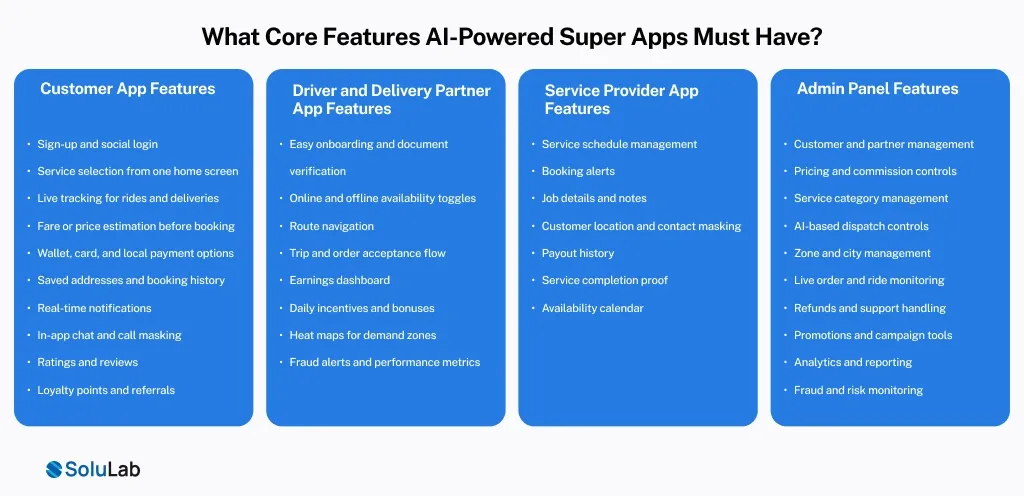
Any business planning to build an AI-powered super app for ride and delivery operations needs a strong feature set across user roles.
Customer App Features
Customers expect a clean, fast, and predictable experience. The app should include:
- Sign-up and social login
- Service selection from one home screen
- Live tracking for rides and deliveries
- Fare or price estimation before booking
- Wallet, card, and local payment options
- Saved addresses and booking history
- Real-time notifications
- In-app chat and call masking
- Ratings and reviews
- Loyalty points and referrals
Driver and Delivery Partner App Features
The service network depends on partner efficiency. The app should support:
- Easy onboarding and document verification
- Online and offline availability toggles
- Route navigation
- Trip and order acceptance flow
- Earnings dashboard
- Daily incentives and bonuses
- Heat maps for demand zones
- Fraud alerts and performance metrics
Service Provider App Features
For home and personal services, providers need:
- Service schedule management
- Booking alerts
- Job details and notes
- Customer location and contact masking
- Payout history
- Service completion proof
- Availability calendar
Admin Panel Features
The business needs full control over the ecosystem. Essential modules include:
- Customer and partner management
- Pricing and commission controls
- Service category management
- AI-based dispatch controls
- Zone and city management
- Live order and ride monitoring
- Refunds and support handling
- Promotions and campaign tools
- Analytics and reporting
- Fraud and risk monitoring
Read More: AI-Powered Intelligent Document Processing (IDP) Services
Where AI Creates the Biggest Business Impact?
Many businesses ask how to build an AI-powered super app, but focus only on frontend features. That is a mistake. The real business value comes from AI models working behind the product.
Smart Dispatch and Matching
This is one of the strongest use cases in AI in transportation apps. The system can assign the best driver or agent based on distance, traffic, order size, service type, ratings, and current workload. Better dispatch reduces idle time and improves response speed.
Demand Forecasting
AI can predict high-demand zones by time of day, day of week, weather, local events, and historical order patterns. This helps move drivers and delivery partners before demand spikes.
Route Optimization
This is central to AI in logistics apps. AI can reduce distance, fuel use, and delay by selecting faster or more profitable routes. In delivery, route logic can support multi-stop fulfillment and batch delivery.
Dynamic Pricing
An AI-Powered Ride Sharing App can adjust prices in real time based on demand, driver supply, weather, traffic, and market conditions. Delivery pricing can also reflect urgency, distance, and order size.
ETA Prediction
Accurate ETAs build trust. Poor ETAs drive cancellations. AI improves ETA calculations by using real traffic, route conditions, partner movement patterns, and service-stage data.
Fraud Detection
AI can flag fake accounts, suspicious bookings, payment abuse, coupon misuse, collusion, and false delivery completion. This protects margins.
Personalized Recommendations
A super app can recommend rides, meal deals, subscriptions, service bundles, and repeat bookings based on user behavior. That supports stronger conversion and retention.
Customer Support Automation
AI chat assistants can handle order status, booking changes, refund updates, and common support issues. Human agents then focus on high-risk cases.

The Right Development Approach for AI Super App Development
Businesses often fail because they try to build every service in the first release. A better path is a phased rollout.
Phase 1: Start with a High-Frequency Core
Most businesses begin with ride-hailing or delivery because those services create regular usage. That traffic later supports cross-selling into home services or local commerce.
Phase 2: Add a Second High-Need Service
Once the first service reaches operational stability, the second service can enter. A ride platform may add parcel delivery. A delivery platform may add grocery or home services.
Phase 3: Connect Payments, Loyalty, and Membership
The super app model becomes stronger when customers stay inside the ecosystem. Wallets, subscriptions, and offers create that loop.
Phase 4: Use AI to Improve Margin and Scale
This is where AI-driven super app solutions deliver commercial value. AI should improve dispatch, route planning, retention, fraud control, and dynamic pricing.
This staged approach lowers product risk and speeds up market validation.
How to Design the User Experience for Higher Retention?
A super app wins or fails on usability. If the experience feels crowded, users leave. If the journey feels simple, they stay.
The interface should show only the most relevant services first. Repeat behavior should shape the home screen. Frequent users should see quick actions, reorder options, saved trips, and contextual promotions. Clear status updates are essential. In rides, users want certainty about pickup time. In delivery, they want visibility. In services, they want trust.
That is where AI in ride-sharing and delivery UX creates value. AI can reorder menus, recommend faster booking options, surface preferred providers, and reduce steps based on past behavior.
Good UI/UX design is not decoration. It directly affects retention, conversion, and revenue.
Monetization Models That Make a Super App Profitable
A strong AI-powered super app development plan needs a business model from day one. Revenue should not depend on one stream alone. The most common monetization channels include:
Commission on Transactions
The platform earns from each ride, order, or service booking.
Surge and Priority Fees
Dynamic pricing and faster delivery slots can increase margin during peak demand.
Subscription Plans
Users may pay for free delivery, discounted rides, premium support, or exclusive offers.
Partner Promotions
Restaurants, stores, and service providers can pay for better visibility.
Wallet Float and Financial Services
Stored balance, cashback ecosystems, and adjacent financial products can increase revenue over time.
Enterprise Services
Corporate ride management, business delivery accounts, and employee transport programs can create stable high-value contracts.
The strongest super apps combine transaction revenue with retention-driven monetization.
Common Mistakes Businesses Must Avoid
Many businesses enter this market with ambition but weak execution. Several mistakes appear again and again.
Building Too Many Services Too Early
More services do not guarantee more revenue. Early complexity usually slows operations and weakens product quality.
Ignoring Operations
A ride and delivery platform is not only a tech product. It is an operational business. Dispatch logic, partner onboarding, support flow, and payout systems matter as much as the app itself.
Treating AI as a Feature Tag
Some teams add chatbot layers and call the product intelligent. Real AI in delivery apps and mobility products must improve measurable outcomes like ETA, fulfillment rate, cost per order, and retention.
Weak Partner Experience
Drivers, couriers, and service professionals keep the platform alive. Poor onboarding, low transparency, and delayed payouts create partner churn.
No Unified Data Strategy
A super app creates data across services. Without a clean analytics structure, the business cannot improve targeting, pricing, or service expansion.
Security, Compliance, and Trust Requirements
Any app that handles rides, delivery, payments, and personal services must build trust into the product. This is essential for long-term growth. The platform should include:
- Secure authentication
- Encrypted payment data
- Document verification for drivers and providers
- Masked calling and messaging
- Location-sharing controls
- Audit logs
- Cancellation and refund rules
- Role-based admin access
- Fraud detection and abuse monitoring
Trust also depends on product transparency. Users need clear pricing. Partners need clear earnings. Providers need fair visibility. That is how strong AI native strategy for platforms builds reputation and repeat usage.
How Long It Takes to Launch an AI-Powered Super App?
To launch an AI-powered super app, businesses need to identify certain factors beforehand. This includes the service scope, geography, AI depth, and custom features. However, businesses can launch the phased product much faster.
If the app scope is clear, launching an MVP with ride or delivery as the first core service takes just a few months, whereas a multi-featured AI-powered supper app can take a long time. What matters more than speed is launch discipline. A business should launch with:
- One strong core service
- Stable partner flows
- Reliable payments
- Real-time tracking
- Basic AI-based dispatch
- Analytics for iteration
How To Launch an AI-Powered Super Application Successfully?
The launch should focus on one city, one operating model, and one high-demand category first. A controlled rollout creates cleaner data and better operational learning. The smartest launch playbook usually includes:
- Concentrated geographic coverage
- Partner onboarding before customer acquisition
- Demand seeding through local offers
- Referral loops for users and partners
- Live monitoring for service failures
- Quick iteration based on support and behavior data
This is the difference between building an AI app and building a working market system. The app alone does not create growth. Execution does.
Why Custom Development Beats Template-Based Clones?
Clone apps may look attractive at first because they reduce initial cost. But most clone-based products break when businesses need differentiation, new services, stronger AI, or regional workflow customization. Custom AI development solutions allow businesses to:
- Define their own service logic
- Build flexible commission models
- Connect multiple service lines
- Train AI models on platform-specific data
- Create stronger user and partner experiences
- Scale without structural limitations

Conclusion
A successful AI-powered super app does more than combine rides, delivery, and services in one place. It creates a connected system that improves convenience for users and efficiency for the business.
With the right rollout strategy, intelligent automation, strong partner tools, and a scalable architecture, the platform can unlock higher retention, larger order volume, and better margins. Businesses that move early and build with focus can create a defensible market advantage.
The opportunity is no longer limited to large global brands. With the right execution partner, this model is now practical, scalable, and commercially strong.
Build Your Future Ready AI-Powered Supper App With Solulab!
Solulab helps businesses turn ambitious mobility and on-demand ideas into market-ready digital products. From AI software development and product strategy to UI/UX, backend architecture, partner modules, and smart automation, Solulab builds platforms designed for scale. Its team understands the operational depth behind ride, delivery, and service ecosystems, not just the app screens. That matters when speed, retention, and performance shape business outcomes.
For companies planning to launch or expand a super app for ride and delivery services, Solulab, top AI development company in USA, offers the technical depth and product thinking needed to build with confidence and compete with strength.
FAQs
Shipra Garg is a tech-focused content strategist and copywriter specializing in Web3, blockchain, and artificial intelligence. She has worked with startups and enterprise teams to craft high-conversion content that bridges deep tech with business impact. Her work translates complex innovations into clear, credible, and engaging narratives that drive growth and build trust in emerging tech markets.