Key Takeaways
- An AI automation consultant finds which of your processes should be automated, designs how, and proves it works before you commit engineering budget. The output is a decision, not a demo.
- The job is 70% process work and 30% model work. Anyone who opens with a model recommendation before they have seen your process documentation and volume data is selling, not consulting.
- You cannot measure a saving without a baseline. Time per task, volume per month, error rate and exception rate get measured before anything is automated. Teams that skip this can never prove the return afterwards.
- Exception rate decides the economics, not accuracy. A workflow automated to 80% still needs a human path for the other 20%, and that path is where the cost quietly goes.
- AI automation is not RPA with a language model bolted on. RPA follows fixed rules on structured data. AI automation handles unstructured input and ambiguity, which is more capable and much harder to govern.
- Compliance is now part of the design. EU AI Act transparency duties applied from 2 August 2026 to any system a person interacts with, and automations touching hiring, credit or essential services carry heavier obligations from December 2027.
- Most engagements should start with a paid assessment, not a build. Two to four weeks of process discovery costs a fraction of a failed implementation and often kills the wrong project early, which is the point.
An AI automation consultant identifies which business processes are worth automating with AI, designs how the automation should work, and validates it against real data before full engineering investment. In practice, the deliverables are a prioritized process map, a technical approach, a cost and risk assessment, and a working proof of concept. In fact, selecting the model is a small part of the job.
Here is the uncomfortable version. In fact, most organizations that struggle with AI automation do not have an AI problem. Instead, they have processes that were never documented and exception paths that live in someone’s head. They also have no baseline measurement to prove any change worked. A good consultant spends the first two weeks on that, not on model selection. If that sounds unglamorous, it is. But it is also the difference between a pilot that ships and one that quietly stops being mentioned.
On this page: what the role covers and what the engagement produces. Then how it differs from RPA and general AI consulting, and which processes are worth automating. Finally, how engagements are priced, the 2026 compliance obligations, where projects stall, and the ten questions to ask before you sign.
What Is an AI Automation Consultant?
An AI automation consultant is a specialist who assesses business processes for AI automation potential, designs the solution, and proves feasibility before large-scale build. In other words, the role sits between strategy consulting and engineering delivery. A strategy consultant tells you AI matters. An engineer, by contrast, builds what you specify. An AI automation consultant, however, works out what should be built and whether it will pay for itself.
Five things a competent one produces:
- A process inventory with real numbers. Volume, handling time, error rate, exception rate, cost per transaction. Measured, not estimated.
- A prioritized automation map. Which processes to automate, in what order, with the reasoning made explicit so you can disagree with it.
- A technical approach. Where rules are enough, where a model is needed, where a human stays in the loop, and what data has to be in place first.
- A proof of concept on your actual data. In other words, not a vendor demo on clean sample inputs.
- A measurement plan. How you will know it worked, agreed before the build starts rather than negotiated after it.
However, the last one gets skipped most often and causes the most trouble later.
AI Automation Consultant vs RPA vs AI Consultant: What’s the Difference?
These titles get used interchangeably and they should not be. As a result, buying the wrong one is a common and expensive mistake.
| Role | What they optimize for | Handles unstructured input | Best fit | Where it falls short |
| RPA consultant | Rule-based task automation across existing UIs | No | High-volume, stable, structured processes | Breaks when the input varies or the underlying screen changes |
| AI automation consultant | Process outcomes using models plus rules plus human review | Yes | Processes with documents, language or judgement in them | Needs governance and monitoring that rules-based work does not |
| AI strategy consultant | Portfolio and roadmap decisions across the organization | Not applicable | Board-level prioritization and operating model | Rarely delivers working software |
| Systems integrator | Connecting platforms and rolling out vendor products | Depends on the product | Large enterprise platform programmes | Optimizes for the platform they resell |
| AI development agency | Building what you specify | Yes | You already know what to build | Will build the wrong thing efficiently if the process work was skipped |
The practical test. If your process runs on clean structured data with fixed rules, you probably want robotic process automation (RPA), and it will be cheaper. However, if it involves documents, free text, images or human judgement, you need AI automation. If you are not sure which you have, that uncertainty is itself the reason to start with an assessment rather than a build.
Most real programmes end up mixing all three layers. They use rules where rules work and models where they do not. Then they keep a human in the loop where the cost of a wrong answer is high. Designing that blend is the core job of an AI automation consultant, and it is what AI consulting engagements are for.
Which Processes Are Actually Worth Automating?
Score candidate processes on volume, repeatability, data availability, exception rate and cost of error, then automate the highest scorers first. Most organizations pick the most visible process instead of the highest-scoring one. That is why so many programmes produce an impressive pilot and no measurable saving. Our AI workflow automation guide shows how a scored process becomes a working workflow.
| Criterion | What to look for | Why it matters |
| Volume | High transaction count per month | Fixed build cost only amortizes across volume |
| Repeatability | Same steps every time | Variation multiplies edge cases and cost |
| Data availability | Inputs exist digitally and are accessible | No data access, no automation, regardless of budget |
| Exception rate | What share needs human judgement | Sets the true economics more than accuracy does |
| Cost of error | What a wrong output actually causes | Decides how much human review you must keep |
| Process stability | Not being redesigned this quarter | Automating a process about to change wastes the build |
Two points, in particular, are worth dwelling on.
Exception rate is the number that decides the business case. A workflow automated to 80% still needs a person handling the remaining 20%, plus a queue, a routing rule and someone accountable for it. Moreover, that path is real work and real salary cost, and it is almost never in the original estimate. That is why automating 60% of a process cleanly usually beats automating 90% messily.
Accuracy targets should come from the cost of error, not from a benchmark. Misrouting an internal support ticket is cheap. Misclassifying a credit application, however, is not. The acceptable threshold and the amount of human review follow from that, and they are business decisions rather than technical ones.
How Are AI Automation Consulting Engagements Priced?
AI automation consultant engagements come in four common shapes, and picking the wrong one is how budgets get burned before anything ships.
| Model | What you get | Best when |
| Fixed-scope assessment | Two to four weeks of discovery, a scored process map, a technical approach and a cost estimate | You do not yet know what to build. This is the right starting point for most teams |
| Proof of concept | A working prototype on your real data against an agreed success metric | The use case is clear but feasibility is genuinely uncertain |
| Fixed-scope build | An agreed deliverable for an agreed price | Requirements are settled and the process is stable |
| Time and materials or retainer | An embedded team billed by the month | Scope will evolve, or you need ongoing tuning and monitoring after launch |
The pattern that works: pay for a short assessment, expect it to kill at least one candidate process, then build only what survives. In short, an assessment that never says no is a sales document.
In addition, three things move the price more than headcount does. Data readiness, since inaccessible or inconsistent data adds an engineering phase before any automation work starts. Integration surface, because every additional system multiplies the work. Finally, governance requirements, which are far heavier in regulated processes.
For smaller teams, AI automation costs for small businesses breaks down the budget drivers in more detail.
A short AI proof of concept usually answers the feasibility question faster and cheaper than a longer strategy exercise, and an AI readiness assessment covers whether the data and process groundwork is in place at all.
What Compliance Obligations Come With AI Automation?
Automation that interacts with people or makes consequential decisions now carries legal obligations in the EU. So a consultant who cannot classify your use case is a liability. This is the part of the role that changed most in the last year.
- Transparency duties applied from 2 August 2026. Under Article 50 of the EU AI Act, people have to be told when they are interacting with an AI system, and AI-generated synthetic content has to be marked and detectable. These duties apply based on what the system does, not on its risk tier, so they catch ordinary customer-facing automation, per the EU AI Act Article 50 guidance. However, systems already on the market before that date have until 2 December 2026 for machine-readable marking.
- High-risk obligations were deferred, not cancelled. The Digital Omnibus on AI, Regulation (EU) 2026/1744, entered into force on 27 July 2026. It moved the Annex III high-risk obligations to 2 December 2027, and high-risk AI embedded in already-regulated products to 2 August 2028, as this Digital Omnibus briefing summarises. In particular, Annex III covers hiring and candidate screening, credit scoring, education, essential services and critical infrastructure. So if your automation touches any of those, conformity assessment, risk management, logging and human oversight are coming.
- Meanwhile, prohibited practices and general-purpose model duties are already live, from February 2025 and August 2025, respectively.
- Outside the EU, the NIST AI Risk Management Framework is the common reference for structuring risk controls without a legal mandate.
As a result, the practical consequence for a buyer is simple. Ask a prospective AI automation consultant to classify your use case against these categories in the first meeting. If they cannot, then they are not going to build you something that survives an audit.
Where Do AI Automation Projects Stall?
There are five failure modes. However, none of them is a model problem.
- No baseline. Nobody measured the process before automating it, so the savings can never be proven and the programme loses its budget at the next review.
- The exception path was an afterthought. As a result, the automation handles the happy path beautifully but dumps everything else into an unowned queue.
- Data access was assumed. For example, the system of record has no API, the export is manual, or security sign-off takes three months nobody planned for.
- No human owner after launch. Automation drifts. So prompts, thresholds and routing rules need someone accountable, and “the vendor” is not an answer.
- Change management skipped entirely. The people whose work changed were told after the fact and route around it. In fact, this kills more automation than any technical failure.
Keeping automation working after launch is an operations discipline, covered in AI deployment services and, where models are in production, MLOps consulting.
How Do You Evaluate an AI Automation Consultant?
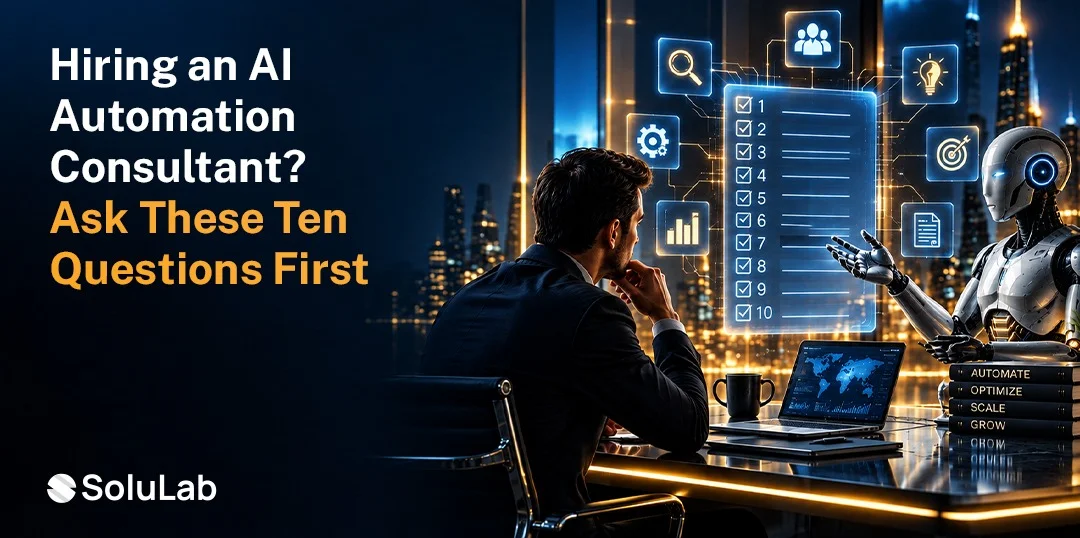
Ten questions. In short, the answers separate a real AI automation consultant from a vendor quickly.
- What do you need from us before you can give an opinion? A good answer names process documentation, volumes and data access.
- How do you baseline a process, and what do you measure?
- Show me a case where you recommended not automating something. What was the reasoning?
- What is your position on human-in-the-loop design, and when do you insist on it?
- How do you handle exceptions, and who owns that queue after launch?
- Which parts of this should be rules rather than a model?
- How would you classify our use case under the EU AI Act, and what does that change?
- Who owns the prompts, the evaluation sets, the fine-tuned weights and the pipeline code?
- What does monitoring look like after go-live, and what are we paying for it?
- Are you tied to a platform or a model vendor?
Also watch for four red flags. A model recommendation before any process discovery. No mention of a baseline. An accuracy figure with no exception-rate figure next to it. And a scope that goes straight to production build with no assessment stage, which usually means the sales cycle is driving the engineering plan.
In addition, a broader vendor-selection checklist sits in the guide to choosing an AI development partner.
Where Does SoluLab Fit?
As an AI automation consultant, SoluLab is a consulting-led engineering partner, not a platform reseller, and it is model-agnostic by default. The work spans the assessment and the build: AI consulting for the process and feasibility question, AI development and generative AI development for the build, AI agent development where the automation needs to plan and act across systems rather than follow a fixed path, and AI integration for connecting it to the systems the work already runs in. Similarly, where custom models are in scope, that is machine learning development; at organization scale it becomes enterprise AI development. Teams needing capacity rather than a full engagement can hire AI developers, and delivered work sits in the SoluLab case studies library.
Frequently Asked Questions
Shipra Garg is a tech-focused content strategist and copywriter specializing in Web3, blockchain, and artificial intelligence. She has worked with startups and enterprise teams to craft high-conversion content that bridges deep tech with business impact. Her work translates complex innovations into clear, credible, and engaging narratives that drive growth and build trust in emerging tech markets.