Key Takeaways
- Agentic AI is the shift from passive, prompt-based models to autonomous, goal-driven AI systems that can reason, plan, act, and self-correct across enterprise workflows.
- By 2026, Gartner projects that up to 40% of enterprise applications will embed task-specific AI agents, making agentic AI a core pillar of enterprise automation strategy.
- The global agentic AI market is expected to grow from roughly $7–8B in 2025/2026 to $45–52B by 2030, driven by multi-agent orchestration and domain-specific agentic AI solutions.
- Deloitte’s 2026 State of AI in the enterprise shows 74% of companies plan to deploy agentic AI within two years, yet only 21% report mature governance for autonomous agents.
- The World Economic Forum estimates that AI agents and agentic AI could unlock trillions in productivity gains and help create 170M new roles vs. 92M displaced by 2030, making governance and reskilling non‑negotiable.
- Agentic AI delivers its strongest ROI in IT operations, customer service, knowledge management, financial operations, and supply chains, where multi-step, cross-system processes dominate.
- Successful enterprise Agentic AI implementation requires modular architectures, orchestration layers, observability, KYA (Know Your Agent) governance, and human‑in‑the‑loop oversight.
- SoluLab combines agentic AI frameworks, multi-agent architectures, and enterprise‑grade engineering to help organizations design, build, and scale production‑grade agentic AI systems securely and cost-effectively.
Most conversations about agentic AI start in the wrong place, with the technology, not the business problem. Leaders get shown a demo of an agent booking meetings, closing tickets, or updating a CRM, and the question that actually matters gets skipped: Where in your business is a person currently doing repetitive, multi-step work that follows a pattern? That’s the starting point, not the AI.
Here’s why the timing matters. Use of AI development solutions in general is no longer in question; most organizations have already adopted it in at least one function. What’s still being figured out is the harder part: which of those workflows are safe and valuable enough to hand off to a system that acts on its own, not just one that answers when asked.
That’s the shift agentic AI represents, and it’s why the gap between companies experimenting with agents and companies actually running them in production is still wide. Getting that transition right is less about the model underneath and more about scoping the right task, setting the right guardrails, and building in a way that survives contact with real operations, which is exactly what the rest of this guide walks through.
What is Agentic AI?
Agentic AI is agentic artificial intelligence that moves beyond generating content to autonomously pursuing goals, making decisions, orchestrating tools, and acting in complex enterprise environments.
Unlike traditional AI agents that respond to events or prompts, Agentic AI systems interpret objectives, break them into sub-tasks, select and invoke tools or APIs, adapt based on feedback, and maintain persistent context over time.
In practical terms, when leaders ask “what is Agentic AI?” they are referring to AI agents that operate like digital team members: they understand business goals, coordinate with other systems, and proactively drive outcomes rather than waiting for human instructions.
Key Characteristics of Agentic AI
- Goal‑driven behavior (objective → plan → action → feedback → refinement).
- Autonomous reasoning and decision‑making across multi-step workflows.
- Multi-agent collaboration where specialized agents coordinate under an orchestrator.
- Deep integration into enterprise stacks via APIs, databases, and existing SaaS platforms.
- Persistent memory and context across sessions, projects, and users.
- Governance-first design with clear authorization, auditability, and human oversight.
How Agentic AI Works?
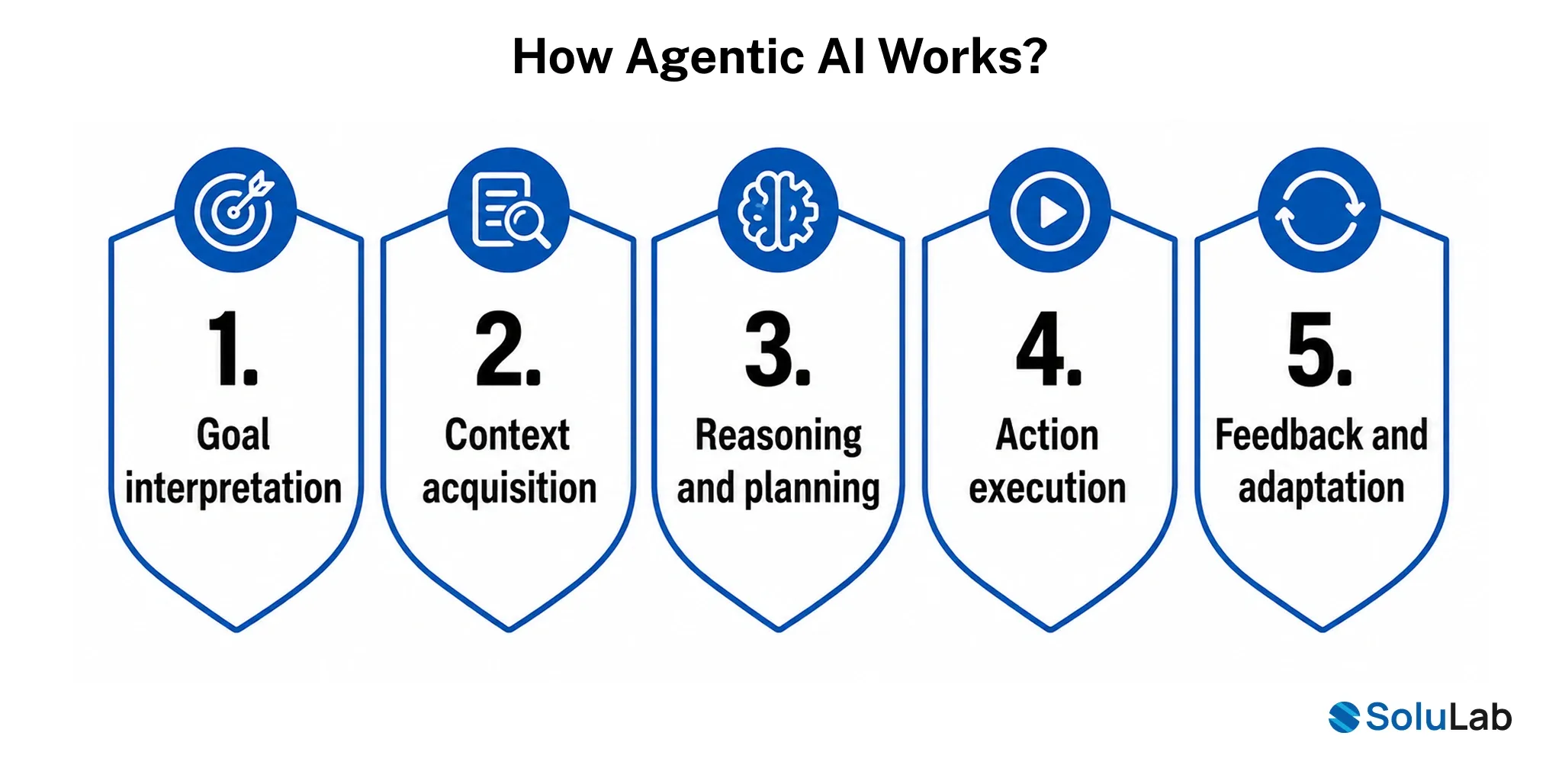
Agentic AI works through a continuous perception–reasoning–planning–action loop, anchored in a clear objective and constrained by enterprise policies.
At a high level, how Agentic AI works can be explained in five steps:
- Goal interpretation – The agent receives a goal (e.g., “reduce invoice cycle time by 20%”) and clarifies constraints.
- Context acquisition – It gathers relevant data from CRMs, ERPs, knowledge bases, and external APIs.
- Reasoning and planning – It decomposes the goal into tasks, designs a plan, and selects tools or collaborating agents.
- Action execution – It performs actions (sending emails, updating records, triggering workflows) through integrated systems.
- Feedback and adaptation – It monitors outcomes, logs events, and adjusts strategies, escalating to humans when needed.
Typical Agentic AI loop
- Perception: ingest real-time signals from logs, events, and user inputs.
- Cognition: use LLMs + domain-specific models for reasoning.
- Planning: generate and evaluate candidate plans with constraints.
- Tool use: call APIs, trigger workflows, query databases, or invoke other AI agents.
- Act: perform changes in systems of record and initiate external communications.
- Learn: update memory, policies, and guardrails based on outcomes and reviews.
From an implementation standpoint, this is where Agentic AI architecture, Agentic AI framework, and Agentic AI lifecycle become critical to ensure reliability, safety, and observability.
Agentic AI vs Generative AI vs Traditional AI Agents
Agentic AI is often confused with generative AI or classic AI agents, but they play different roles in enterprise automation.
Generative AI focuses on producing content (text, code, images, and recommendations) in response to prompts, while Agentic AI focuses on achieving goals via autonomous decisions and actions.
Traditional rule‑based or event‑driven AI agents follow predefined scripts and triggers, whereas agentic AI agents operate with dynamic plans, multi-step workflows, and learning-based adaptation.
Agentic AI vs Generative AI vs AI agents
| Aspect | Agentic AI | Generative AI | Traditional AI agents |
| Primary focus | Goal pursuit & autonomous action | Content & recommendation generation | Rule-based task execution |
| Behavior | Proactive, planning, self‑correcting | Reactive to prompts | Reactive to events |
| Workflow scope | Multi-step, cross-system | Single response or short chain | Single system or narrow script |
| Tool orchestration | Extensive API & multi-agent use | Limited tools (plugins) | Fixed integrations |
| Memory & context | Long-lived, project‑level | Session-level | Minimal state |
| Governance need | High (KYA, authorization, audit) | Medium | Medium |
For enterprises, Agentic AI vs Generative AI vs AI agents is not an either/or choice; it is a layered stack where generative models provide cognition, traditional agents handle deterministic automations, and agentic AI orchestrates them toward business outcomes.
Agentic AI Architecture
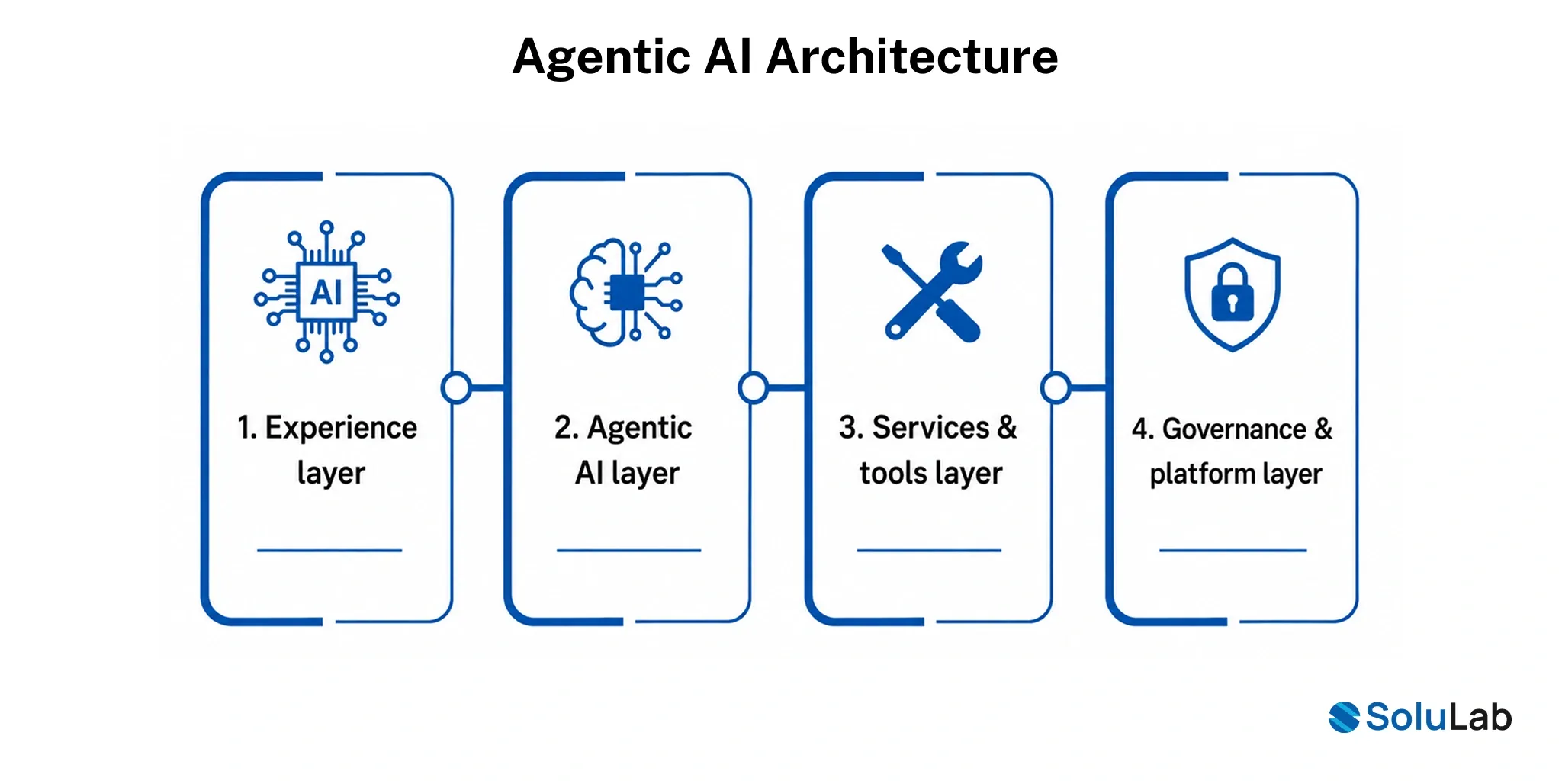
Agentic AI architecture is typically modular, orchestrated, and API‑centric, designed to scale across business units while maintaining strong guardrails.
A well‑designed Agentic AI architecture usually includes:
- A multi-agent layer with specialized agents (e.g., IT ops, finance, CX) that can collaborate.
- An orchestration layer that coordinates workflows, handles routing, and enforces policies.
- A tooling and integration fabric connecting agents to CRMs, ERPs, ticketing tools, data warehouses, and external APIs.
- A governance and observability layer for logging, monitoring, policy enforcement, and incident management.
- A data and knowledge layer providing domain-specific context, semantic search, and enterprise memory.
SoluLab’s Agentic AI development services leverage this kind of architecture to ensure scalability and maintainability, aligning with Gartner and Deloitte’s recommendations for modular, governed AI platforms.
What are the main components of an Agentic AI system?
The main components of an Agentic AI system are the agents themselves, the orchestration layer, the integration fabric, the data and memory subsystem, and the governance stack.
In simple terms, if you’re asking “What are the main components of an Agentic AI system?”, you can think of them as the brain, nervous system, memory, and immune system of your enterprise AI.
Core components
- Autonomous AI agents—Each agent encapsulates capabilities (reasoning, planning, tool use) for a specific domain or workflow.
- Orchestrator agent/orchestration engine – Coordinates multiple agents, resolves conflicts, and manages escalations.
- Tool & API connectors—Secure integrations with internal systems (CRM, ERP, ITSM) and external services (payments, logistics, analytics).
- Memory and knowledge base – Long‑term storage of events, decisions, documents, and domain knowledge, often via vector databases and knowledge graphs.
- Policy & governance engine – Enforcement of authorization profiles, KYA rules, role‑based access, and ethical constraints.
- Observability & logging – Telemetry for every agent decision, outcome, and tool call, feeding dashboards and alerts.
- Human oversight interfaces—Consoles for “agent bosses” to review actions, override decisions, and tune policies.
Agentic AI Development Stages
The Agentic AI lifecycle is a structured process that takes organizations from ideation to production and continuous improvement.
- Strategy & discovery
- Identify high‑value processes and pain points.
- Align Agentic AI initiatives with enterprise automation goals.
- Use case selection & scoping
- Select contained, low‑risk workflows (e.g., IT tickets, procurement).
- Define KPIs: cycle time, error rate, SLA compliance.
- Architecture & framework design
- Choose underlying LLMs, orchestration frameworks, and cloud platforms.
- Design governance (KYA, audit, access control) upfront.
- Prototype and pilots
- Build initial agents and orchestrators for scoped processes.
- Deploy to limited users or departments with strong monitoring.
- Evaluation & governance hardening
- Measure impact and refine policies, roles, and escalation rules.
- Validate compliance with legal, ethical, and security standards.
- Scaling & integration
- Extend agentic AI to adjacent workflows and business units.
- Integrate with broader automation strategy and data platform.
- Continuous optimization & innovation
- Iterate on agent skills, memory, and orchestration logic.
- Incorporate new models, tools, and industry‑specific agents.
SoluLab’s Agentic AI development guide is structured around this lifecycle, with dedicated phases for discovery, design, development, deployment, and optimization tailored to each client.
Which Industries Benefit Most From Agentic AI?
Industries with complex, multi-step, cross-system workflows benefit most from Agentic AI for enterprises, particularly manufacturing, financial services, healthcare, retail, logistics, and technology.
Reports from Deloitte, Gartner, and the World Economic Forum show that agentic AI is driving measurable performance gains in sectors like manufacturing, supply chains, and energy, where automation and data are abundant but workflows remain fragmented.
| Industry | Agentic AI benefits & applications |
| Manufacturing & industrial | Smart operations, predictive maintenance, quality assurance, supply chain orchestration. |
| Financial services | Autonomous transaction reconciliation, risk monitoring, compliance workflows, personalized advisory. |
| Retail & eCommerce [ | Dynamic pricing, inventory optimization, CX agents, fraud detection. |
| Healthcare & life sciences | Clinical workflows, scheduling, claims processing, data harmonization. |
| Technology & SaaS | DevOps automation, customer onboarding, support triage, analytics orchestration. |
| Logistics & supply chain | Shipment tracking, route optimization, vendor coordination, exception handling. |
Specific Agentic AI use cases by industry
- Manufacturing – Agentic AI agents coordinate production schedules, machine maintenance, and supplier orders to minimize downtime and stockouts.
- Finance – Autonomous agents manage invoice matching, reconciliation, credit reviews, and anomaly detection, reducing cycle times by up to 50%.
- Customer service – Multi-agent systems provide contextual support, escalate complex issues, and preempt churn with proactive outreach.
- IT operations – Agents monitor infrastructure, diagnose incidents, and trigger remediation workflows, aligning with Gartner’s prediction that AI agents will reshape infrastructure and ops.
SoluLab’s Agentic AI development company practice focuses heavily on these industries, helping clients operationalize Agentic AI use cases with production-grade architecture and governance.
How Do Businesses Implement Agentic AI?
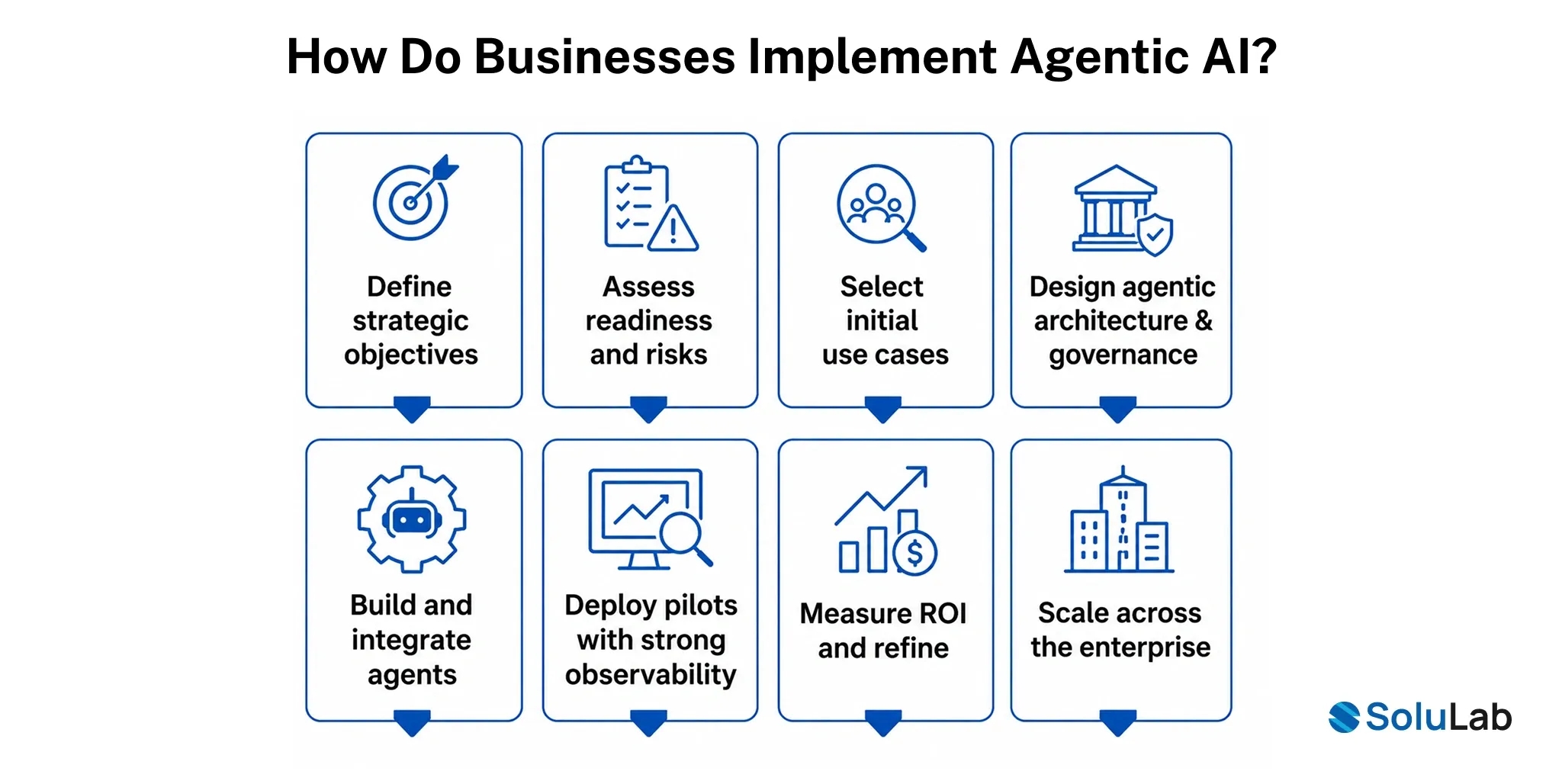
Businesses implement Agentic AI through a structured, governance-first approach: start with focused pilots, embed agentic systems into existing workflows, and iterate toward enterprise-wide orchestration.
Analysts and frameworks from Gartner, Deloitte, WEF, and Forbes consistently highlight the need for strategy alignment, modular architectures, and strong oversight models when deploying Agentic AI for businesses.
- Define strategic objectives
- Tie Agentic AI to specific business outcomes: e.g., “reduce support backlog by 30%,” “cut invoice cycle time by 40%.”
- Assess readiness and risks
- Evaluate data quality, integration maturity, and regulatory constraints.
- Identify high-risk domains (compliance, safety) requiring stronger guardrails.
- Select initial use cases
- Start with contained pilots: IT service desk, procurement, internal knowledge management.
- Design agentic architecture & governance
- Choose an Agentic AI framework and define orchestrator vs. specialized agents.
- Implement KYA (Know Your Agent) policies: identity, authorization, accountability, and continuous monitoring.
- Build and integrate agents
- Integrate with CRMs, ERPs, ticketing systems, and data platforms via secure APIs.
- Use multi-agent patterns where different agents handle subtasks and coordinate via an orchestrator.
- Deploy pilots with strong observability
- Track every agent decision, action, and outcome via telemetry and logs.
- Keep humans in the loop for high-stakes decisions and exceptions.
- Measure ROI and refine
- Monitor KPIs: cycle time reduction, error rate, CSAT, productivity gains.
- Iterate on agent prompts, skills, memory, and escalation logic.
- Scale across the enterprise
- Extend agentic AI to additional departments and processes once governance and observability are proven.
- Move toward an “agentic enterprise” model where every workflow can be augmented or orchestrated by AI agents.
SoluLab’s Implementation Methodology
SoluLab typically follows a 5-phase Agentic AI implementation model:
- Assess (strategy, readiness, risk)
- Design (architecture, governance, frameworks)
- Build (agents, orchestrators, integrations)
- Deploy (pilots, MLOps, observability)
- Scale (multi‑domain expansion, optimization, COE)
This methodology is aligned with leading guidance from Deloitte’s Tech Trends 2026 and WEF’s AI performance playbooks on embedding AI into enterprise strategy and redesigning work for human‑AI collaboration.
What Frameworks Are Used To Build Agentic AI?
Organizations use a mix of agent orchestration frameworks, LLM platforms, and cloud-native tools to build Agentic AI systems in 2026.
Frameworks for how to build Agentic AI often combine open-source libraries, hyperscaler platforms, and enterprise-focused orchestration tools.
- LLM & reasoning frameworks
Tools that provide prompt management, reasoning chains, and tool-calling capabilities.
- Agent orchestration platforms
Platforms specializing in multi-agent coordination, workflow design, and policy enforcement.
- Workflow & automation engines
Systems that integrate agentic AI into BPM, RPA, and microservices architectures.
- Governance & observability frameworks
Tools designed to implement KYA, auditing, monitoring, and policy management for agents.
What makes a good Agentic AI framework?
A credible Agentic AI framework should:
- Support multi-agent orchestration with role definitions and messaging.
- Provide native tools for API integration, database queries, and external service calls.
- Include policy and permission systems tied to organizational roles and compliance rules.
- Offer built-in observability for tracing agent decisions and tool invocations.
SoluLab evaluates and combines these frameworks into a coherent AI development tech stack, tuned to each client’s cloud, data, and security environment.
Real-World Agentic AI Use Cases and Examples
Real-world Agentic AI use cases are now live across industries, with many moving beyond pilots to scaled deployments in 2026.
Analyst and case study data show that while thousands of vendors claim “AI agents,” only a fraction deliver genuinely agentic AI with autonomous reasoning, tool orchestration, and persistent context.
High-impact Agentic AI examples
- IT service desk automation
- Agents triage tickets, enrich context, propose fixes, and trigger remediation scripts, increasing resolution speed and reducing backlog.
- Sales and lead management
- McKinsey‑referenced deployments have seen 40% increases in order intake and doubled prospecting efforts via agentic sales operations.
- Contract workflow optimization
- Agentic systems have cut contract cycle times by up to 50% by automating document analysis, routing, and follow‑ups.
- Supply chain orchestration
- Agents coordinate orders, track shipments, and proactively reroute logistics based on disruptions, aligning with Forbes’ view of agentic AI as a key driver of supply chain optimization.
- Knowledge management and reporting
- Agentic AI synthesizes information across documents and systems, producing tailored reports and maintaining organizational memory.
Enterprise Traction
Industry reports indicate:
- Eight in ten organizations believe AI agents have already delivered measurable ROI.
- Nearly three in four (74%) plan to deploy agentic AI within two years, yet governance maturity lags behind adoption.
- Gartner is tracking a 1,445% surge in multi-agent system inquiries between 2024 and 2025, signaling strong enterprise interest in multi-agent architectures.
SoluLab helps clients turn these Agentic AI examples into tailored, production-grade solutions that fit their domain, data, and regulatory landscape.
Is Agentic AI The Future Of Enterprise Automation?
Agentic AI is emerging as the next major stage of enterprise automation, moving organizations from static, rule-based workflows to dynamic, goal-driven systems.
For 2026 and beyond, Gartner, Deloitte, WEF, and Forbes converge on a clear message: autonomous AI agents and agentic architectures will be central to how enterprises design, run, and optimize operations.
Signals that Agentic AI is the future
- Gartner predicts up to 40% of enterprise apps will embed task-specific agents by 2026.
- Deloitte reports that AI is restructuring tech organizations to be leaner and more strategic, with agentic AI driving impact over experimentation.
- World Economic Forum estimates trillions in productivity gains and highlights AI agents as a core lever for performance in over 20 industries.
- Forbes calls 2026 “the year of agentic AI in enterprise automation,” citing benefits in operational complexity, supply chains, and cybersecurity.
Practical perspective
Agentic AI will not replace all other automation or AI; instead, it will become the AI orchestration layer that:
- Directs generative AI models to produce content, code, and analysis at the right moment.
- Coordinates RPA, BPM, and microservices to achieve higher-level business objectives.
- Embeds governance, ethics, and oversight into autonomous decision-making.
For enterprises in 2026, the question is less “Is Agentic AI the future of enterprise automation?” and more “How quickly can we build agentic AI capabilities safely and effectively?”
How Much Does It Cost To Build An Agentic AI Solution?
The cost of building an Agentic AI solution in 2026 ranges widely, depending on scope, complexity, integration depth, and governance requirements.
Most enterprise AI initiatives fall into three tiers:
- Pilot / limited-scope implementations—lower cost but constrained reach.
- Department-level production systems—mid-range investment with measurable impact.
- Enterprise-wide agentic platforms—significant investment but transformative potential.
Key cost drivers
While precise dollar amounts vary by geography and vendor, the main cost factors are consistent:
- Scope and number of use cases—How many workflows and departments are involved.
- Integration complexity—Number and type of systems, APIs, and legacy platforms.
- Model and infrastructure choices—Cloud provider, LLM licensing, compute requirements.
- Governance and compliance needs—level of KYA, auditability, and regulatory adherence.
- Change management and reskilling—Training employees to work with and supervise agents.
| Cost category | Description |
| Discovery & strategy | Workshops, process mapping, ROI modeling. |
| Architecture & design | Agentic AI architecture, governance blueprint. |
| Development & integration | Building agents, orchestrators, API connectors. |
| Infrastructure & licenses | Cloud, models, observability tools. |
| Security & compliance | Policy engines, audit frameworks, risk reviews. |
| Change management | Training, documentation, CX and ops adaptation. |
Deloitte and other advisors emphasize that organizations should treat agentic AI investments as platform bets, not one-off projects, and evaluate ROI in terms of long-term productivity and resilience rather than only cost savings.
SoluLab typically structures AI integration services around transparent pricing models mapped to this cost structure, ensuring CFOs and CIOs can link investment to expected gains.
How to Get Started with Agentic AI Development?
To get started with Agentic AI development, enterprises should begin with a focused strategy, a high‑value pilot, and a partner experienced in both AI engineering and enterprise transformation.
The fastest path combines clear business goals, modern Agentic AI frameworks, and a trusted Agentic AI development company like SoluLab.
- 1. Identify a single strategic process
- Examples: IT incident management, invoice processing, onboarding, support triage.
- 2. Define success metrics
- Cycle time, SLA compliance, CSAT, error rate, employee time saved.
- 3. Engage an Agentic AI development partner
- Work with experts who understand Agentic AI architecture, frameworks, and governance.
- 4. Co-design an agentic AI solution
- Map workflows, roles, data sources, and escalation paths.
- Select orchestrator, tools, and integration points.
- 5. Pilot, measure, and iterate
- Deploy to a controlled group, monitor behavior, refine agents, and expand scope.
Why SoluLab for Agentic AI development?
As a leading Agentic AI development company, SoluLab offers:
- End-to-end Agentic AI development services—from strategy and architecture to implementation and ongoing optimization.
- Expertise in multi-agent architectures—including orchestrator patterns, domain-specific agents, and robust integration fabrics.
- Governance-first approach—aligning solutions with WEF’s KYA concepts and Deloitte’s AI governance recommendations.
- Industry-tailored solutions—for manufacturing, finance, SaaS, logistics, and more, leveraging real-world Agentic AI applications and examples.
Contact Solulab for expert Agentic AI development services if you’re ready to translate agentic AI from theory into measurable business performance.

Conclusion
Agentic AI in 2026 represents a pivotal evolution in enterprise automation, combining autonomous reasoning, multi-agent orchestration, and governance-first design to unlock new levels of efficiency, resilience, and innovation.
Analysts from Gartner, Deloitte, the World Economic Forum, and Forbes all signal the same direction: Agentic AI for enterprises is rapidly moving from experimentation to impact, and organizations that invest now will be better positioned for the next decade of competition.
SoluLab, as a trusted AI development company in USA, helps businesses design robust Agentic AI architecture, implement production-grade agentic AI systems, and orchestrate AI agents that deliver measurable outcomes across operations, finance, CX, and beyond.
If you’re ready to explore Agentic AI development, clarify your use cases, and build an implementation roadmap aligned with your 2026 strategy:
Contact SoluLab for expert Agentic AI development services and start building your agentic enterprise today.
FAQ
Shipra Garg is a tech-focused content strategist and copywriter specializing in Web3, blockchain, and artificial intelligence. She has worked with startups and enterprise teams to craft high-conversion content that bridges deep tech with business impact. Her work translates complex innovations into clear, credible, and engaging narratives that drive growth and build trust in emerging tech markets.