Key Takeaways
- AI-powered intelligent document processing (IDP) turns unstructured documents into usable data.
- Traditional document processing fails due to manual work and rigid templates.
- Modern AI document processing solutions use OCR, NLP, and AI models for context-aware extraction.
- IDP systems follow five layers: ingestion, pre-processing, extraction, validation, and integration.
- AI document workflow automation connects data directly to enterprise systems.
- Intelligent document processing for government agencies improves speed and transparency.
- IDP systems must ensure accuracy, compliance, and data security (e.g., GDPR).
- SoluLab leads the charts with its flawless AI native strategy execution for all kinds of Web3 and AI development solutions.
The Hidden Bottleneck in Enterprise AI Adoption
Most enterprises today don’t struggle with a lack of AI ambition; they struggle with unstructured chaos.
Invoices, contracts, KYC forms, claims, reports, and emails aren’t just documents.
They are fragmented data systems disguised as paperwork. And despite heavy investments in AI development solutions, a large portion of enterprise workflows still depend on manual document handling.
This creates a structural gap:
- AI systems are data-hungry
- Enterprises are document-heavy
- But documents remain unstructured, inconsistent, and context-dependent
This is where AI-powered intelligent document processing (IDP) enters not as another automation layer, but as a foundational capability that converts documents into structured, usable intelligence.
Without solving document complexity, enterprise AI remains incomplete.
What Is AI-Powered Intelligent Document Processing (IDP)?
At a surface level, intelligent document processing (IDP) is often explained as OCR + AI. That’s outdated.
Modern AI-powered intelligent document processing goes far beyond text extraction. It operates as a multi-layered system that understands, contextualizes, and routes information across enterprise workflows.
Core Capabilities of IDP Systems
1. Document Understanding (Not Just Reading)
- Identifies document type (invoice, contract, ID, etc.)
- Understands layout, structure, and semantic meaning
2. Contextual Data Extraction
- Extracts fields based on context—not just position
- Handles variability (different formats, languages, templates)
3. Validation & Decision Logic
- Cross-checks extracted data with business rules
- Flags anomalies, missing data, or compliance issues
4. Workflow Automation
- Routes documents across systems (ERP, CRM, compliance tools)
- Triggers downstream actions automatically
| Capability | Traditional Automation | AI Document Processing Solutions |
| Data Extraction | Template-based | Context-aware |
| Flexibility | Low | High |
| Learning Ability | Static | Continuous learning |
| Error Handling | Manual | Automated validation |
| Workflow Integration | Limited | End-to-end automation |
Why Enterprises Are Moving Toward IDP?
- Explosion of unstructured enterprise data
- Need for real-time decision-making
- Regulatory pressure for auditability and accuracy
- Demand for scalable AI document workflow automation
In essence, AI workflow automation is no longer about saving time—it’s about making enterprise data usable at scale.
Where Traditional Document Processing Breaks Down?
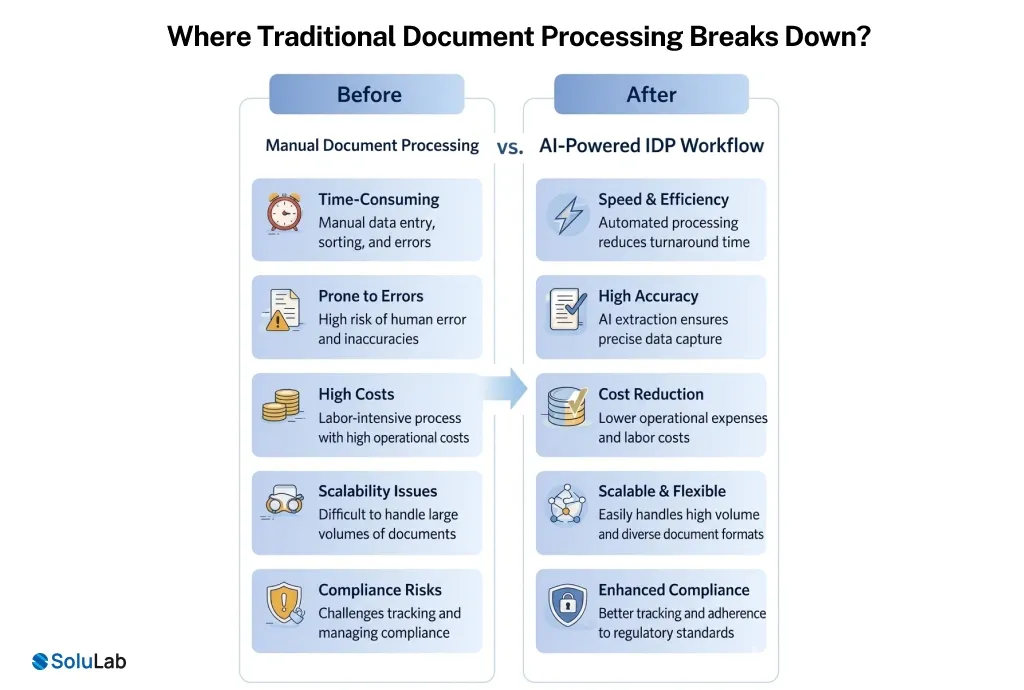
Before understanding the value of AI document processing solutions, it’s important to examine why legacy systems fail.
1. Template Dependency
Traditional systems rely on fixed templates:
- Same invoice format → works
- Slight variation → breaks
This becomes unmanageable in:
- Multi-vendor ecosystems
- Cross-border documentation
- Government forms with frequent updates
2. High Manual Intervention
Even “automated” systems often require:
- Human verification
- Manual corrections
- Exception handling
This leads to:
- Increased operational costs
- Slower turnaround times
- Higher error rates
3. Lack of Contextual Understanding
Legacy systems can extract:
- “Invoice number: 12345”
But they can’t answer:
- Is this invoice valid?
- Does it match purchase orders?
- Is it compliant with tax regulations?
This is where AI document data extraction services create a step-change—by adding reasoning, not just recognition.
4. Fragmented Workflow Integration
Documents don’t exist in isolation. They move across:
- Finance systems
- Compliance layers
- Customer onboarding flows
Traditional tools fail to integrate seamlessly, creating silos.
5. Scalability Challenges
As document volume grows:
- Manual validation becomes a bottleneck
- Error rates increase
- Processing time spikes
This directly impacts:
- Customer experience
- Compliance timelines
- Revenue cycles

The Real Cost of Inefficiency
Enterprises often underestimate the cost of poor document processing:
- Delayed onboarding → lost customers
- Compliance errors → regulatory penalties
- Manual ops → reduced margins
This is why automated document processing using AI technology is now seen as a strategic capability, not just an operational upgrade.
Transition: From Extraction to Intelligence
The shift from traditional systems to AI-powered IDP for enterprise workflows is not incremental; it’s architectural.
It requires:
- Rethinking document pipelines
- Embedding intelligence into workflows
- Treating documents as data infrastructure
Read more: AI-Powered Data Extraction in Regulated Industries
Architecture of AI-Powered Intelligent Document Processing Systems
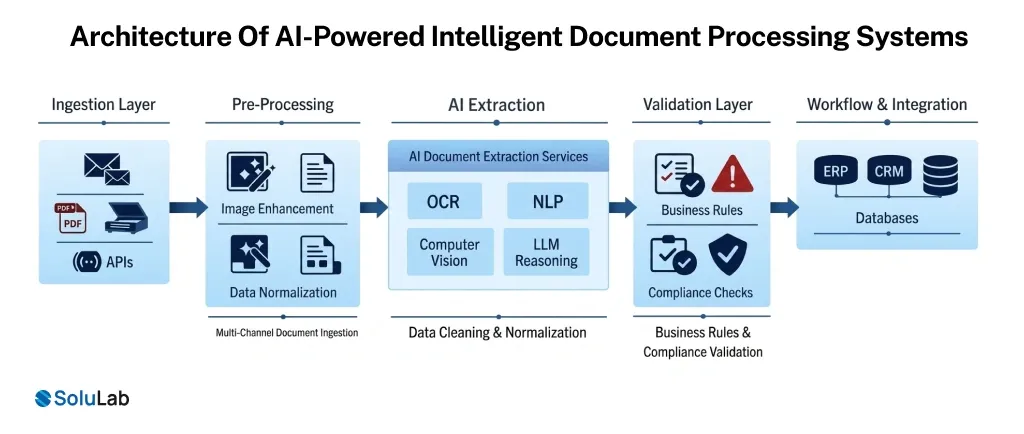
To understand the real value of AI-powered intelligent document processing (IDP), you have to look beyond features and into architecture.
Because IDP is not a tool. It’s a system embedded across enterprise data flows.
A Layered View of IDP Architecture
A production-grade AI document processing solution typically operates across five layers:
1. Ingestion Layer: Multi-Channel Document Capture
Documents enter the system through multiple sources:
- Email attachments
- Scanned files (PDFs, images)
- APIs from partner systems
- Mobile uploads
- Legacy archives
Key requirement:
Handle high variability in formats, quality, and structure.
2. Pre-Processing Layer: Cleaning & Normalization
Before AI models can interpret documents, they must be standardized:
- Image enhancement (denoising, skew correction)
- Format normalization
- Language detection
This step significantly improves extraction accuracy.
3. AI Extraction Layer: The Core Intelligence Engine
This is where AI document extraction services operate.
Technologies involved:
- OCR (for text recognition)
- NLP (for semantic understanding)
- Computer vision (for layout detection)
- Large language models (for contextual reasoning)
What happens here:
- Document classification
- Field extraction
- Context mapping (e.g., linking totals, dates, entities)
4. Validation & Business Logic Layer
Extraction alone is not enough. Enterprises need trustworthy data.
This layer applies:
- Rule-based validation (e.g., tax calculations)
- Cross-document matching (invoice vs PO)
- Anomaly detection
This is critical for:
- Compliance
- Fraud detection
- Financial accuracy
5. Workflow & Integration Layer
The final step: making data actionable.
- Integration with ERP, CRM, and compliance tools
- Triggering approvals or workflows
- Updating databases in real time
This is where AI document workflow automation transforms operations end-to-end.
Why Architecture Matters?
Many organizations fail with IDP because they treat it as:
- A standalone OCR tool
- A point solution
But enterprise AI development services require:
- Modular design
- Scalable pipelines
- Continuous learning loops
This is where working with an experienced AI development company becomes critical because the real challenge is not extraction, but system orchestration.
High-Impact Use Cases Across Industries
The adoption of intelligent document processing services is not uniform – it’s driven by industries where document complexity meets operational pressure. Some of the popular AI use cases for IDP are:
1. Banking & Financial Services
Use Cases:
- KYC document verification
- Loan processing
- Trade finance documentation
- Invoice reconciliation
Impact:
- Faster onboarding
- Reduced fraud
- Improved compliance
2. Insurance
Use Cases:
- Claims processing
- Policy document analysis
- Medical report extraction
Impact:
- Faster claim settlements
- Reduced manual review
- Better customer experience
3. Government & Public Sector
Where IDP Becomes Mission-Critical
Intelligent document processing for government agencies is particularly transformative due to:
- Massive document volumes
- Legacy systems
- Compliance-heavy workflows
Applications:
- Tax filing automation
- Citizen record digitization
- Permit and license processing
Impact:
- Reduced administrative burden
- Faster public service delivery
- Increased transparency
4. Healthcare
Use Cases:
- Patient record digitization
- Prescription extraction
- Insurance claim processing
Impact:
- Improved data accessibility
- Reduced errors
- Faster treatment workflows
5. Logistics & Supply Chain
Use Cases:
- Bill of lading processing
- Shipment documentation
- Vendor invoices
Impact:
- Faster shipment cycles
- Reduced disputes
- Better visibility
Pattern Across All Industries
The common thread:
Wherever documents are high-volume, variable, and compliance-sensitive,
AI-powered IDP for enterprise workflows becomes essential. To get a clear picture of the use case ideation process, it’s good to connect with an expert AI consulting company for the best results.
Risk, Compliance, and Governance in IDP Systems
As organizations adopt automated document processing using AI, a critical question emerges:
Can you trust the system?
Because in regulated environments, accuracy is not enough; auditability and accountability matter just as much.
1. Data Accuracy & Validation Risk
Even advanced AI document data extraction services are probabilistic.
Risks include:
- Incorrect field extraction
- Misclassification of documents
- Context misinterpretation
Mitigation strategies:
- Confidence scoring
- Human-in-the-loop validation
- Continuous model retraining
2. Regulatory Compliance Requirements
Industries like banking, insurance, and government require:
- Audit trails
- Data lineage tracking
- Explainability of decisions
This means IDP systems must:
- Log every extraction and transformation
- Maintain versioned data flows
- Provide traceability for regulators
3. Data Privacy & Security
Documents often contain:
- Personally identifiable information (PII)
- Financial data
- Health records
Key requirements:
- Encryption (at rest and in transit)
- Access control mechanisms
- Compliance with GDPR, HIPAA, etc.
4. Bias & Model Risk
AI systems can introduce:
- Bias in document classification
- Errors in multilingual or regional formats
Solution:
- Diverse training datasets
- Regular audits
- Model performance monitoring
5. Build vs Buy vs Partner Decision
Enterprises must decide:
| Approach | Pros | Cons |
| Build In-House | Full control | High cost, slow |
| Buy Off-the-Shelf | Quick deployment | Limited flexibility |
| Partner with AI Application Development Company | Balanced | Requires alignment |
For complex workflows, many organizations lean toward partnering with an AI app development company that can customize systems to their regulatory and operational needs.
Strategic Insight
IDP is not just a technical implementation; it’s a governance system.
Organizations that succeed treat it as:
- A compliance enabler
- A data infrastructure layer
- A long-term AI capability
Operating Model: How to Implement IDP at Enterprise Scale?
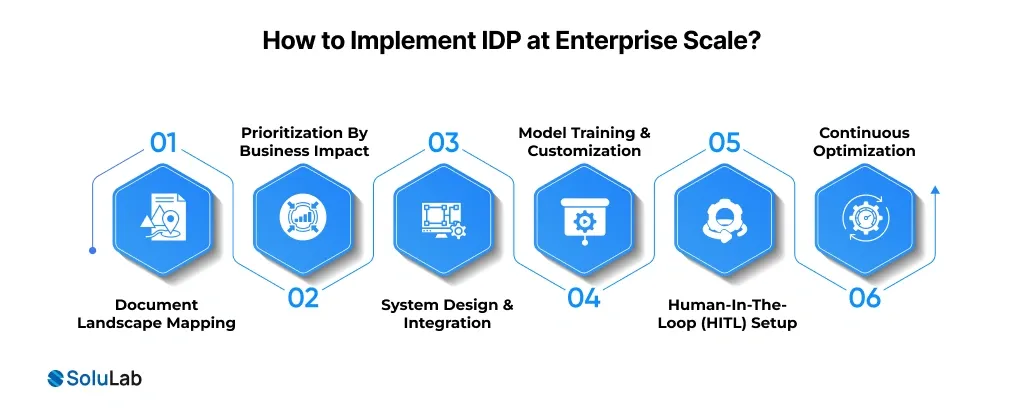
The biggest mistake enterprises make with AI-powered intelligent document processing is treating it like a plug-and-play tool.
It’s not.
IDP implementation is an operating model shift that touches data pipelines, compliance frameworks, and business workflows simultaneously.
Phase 1: Document Landscape Mapping
Before selecting any intelligent document processing services, enterprises must understand:
- What document types exist? (invoices, contracts, IDs, etc.)
- What is the volume and variability?
- Where do bottlenecks occur?
- Which workflows are document-dependent?
This step often reveals a key insight:
Most inefficiencies are not in extraction—but in handoffs between systems.
Phase 2: Prioritization by Business Impact
Not all document workflows should be automated at once.
Focus on:
- High-volume processes
- Compliance-heavy workflows
- Revenue-linked operations (e.g., onboarding, billing)
This ensures that AI document automation delivers measurable ROI early.
Phase 3: System Design & Integration
At this stage, enterprises define:
- Data flow architecture
- Integration points (ERP, CRM, compliance systems)
- Validation rules and exception handling
This is where enterprise AI development services play a crucial role, ensuring that IDP is not isolated but embedded across systems.
Phase 4: Model Training & Customization
Every enterprise has:
- Unique document formats
- Industry-specific requirements
- Regulatory constraints
So, AI document processing solutions must be trained on:
- Domain-specific datasets
- Historical documents
- Edge cases and anomalies
Phase 5: Human-in-the-Loop (HITL) Setup
Contrary to popular belief, IDP is not fully autonomous, especially in the early stages.
Human validation is required for:
- Low-confidence outputs
- Exceptions
- Compliance-sensitive decisions
Over time, this feedback loop improves system accuracy.
Phase 6: Continuous Optimization
Once deployed, IDP systems must evolve:
- Retrain models with new data
- Refine validation rules
- Monitor performance metrics
This transforms document processing automation into a self-improving system.
Where SoluLab Fits in This Journey?
In complex implementations, organizations often require a partner that understands both:
- AI system architecture
- Enterprise workflow realities
SoluLab, as an experienced AI software development company, works at this intersection, helping enterprises design IDP systems that are not just accurate but operationally aligned and compliance-ready.
Decision Framework – Choosing the Right IDP Approach
With multiple vendors and approaches available, selecting the right AI-powered IDP for enterprise workflows can be overwhelming.
Here’s a structured way to evaluate.
1. Complexity of Your Document Ecosystem
Ask:
- Are your documents standardized or highly variable?
- Do you operate across regions/languages?
High complexity → Custom AI document extraction services required
2. Compliance Requirements
Industries like:
- Banking
- Insurance
- Government
Require:
- Auditability
- Data traceability
- Regulatory alignment
If compliance is critical, prioritize:
- Explainable AI models
- Strong validation layers
- Secure architectures
3. Integration Depth
Evaluate:
- How many systems need to be connected?
- Are workflows linear or multi-step?
The more complex your ecosystem, the more you need:
- Robust APIs
- Workflow orchestration capabilities
4. Scalability Needs
Consider:
- Current vs future document volumes
- Peak load scenarios
Choose solutions that:
- Scale horizontally
- Maintain accuracy at volume
5. Build vs Buy vs Partner (Revisited)
A refined perspective:
- Buy → Best for simple, standardized workflows
- Build → Suitable for highly specialized needs (but resource-heavy)
- Partner → Ideal for enterprises seeking speed + customization
This is why many organizations engage an AI development company in the USA to balance flexibility with speed.
6. Total Cost of Ownership (TCO)
Beyond licensing costs, consider:
- Implementation effort
- Maintenance
- Model retraining
- Compliance overhead
Sometimes, a cheaper tool leads to higher long-term costs due to inefficiencies.
Strategic Takeaway
Choosing the right intelligent document processing (IDP) approach is less about tools and more about alignment with:
- Business workflows
- Compliance requirements
- Long-term AI strategy

Conclusion: From Documents to Decision Intelligence
Enterprises don’t lack data.
They lack usable data.
Documents have long been the blind spot rich in information, but locked in unstructured formats.
AI-led development solutions change that equation.
It transforms:
- Static documents → dynamic data
- Manual workflows → automated systems
- Operational tasks → intelligent decision pipelines
But the real shift is deeper.
IDP is not just about efficiency; it’s about building an enterprise where information flows without friction.
Final Perspective
Organizations that treat AI document workflow automation as a tactical upgrade will see incremental gains.
Those who treat it as data infrastructure will unlock:
- Faster decision-making
- Stronger compliance
- Scalable AI adoption
A More Meaningful Next Step!
If your organization is still navigating fragmented document workflows, the real question isn’t whether to adopt IDP – it’s how to architect it correctly from day one.
SoluLab works with enterprises to design AI systems that don’t just process documents but turn them into reliable, auditable, and decision-ready data pipelines.
Book a discovery call to get started!
FAQs
Shipra Garg is a tech-focused content strategist and copywriter specializing in Web3, blockchain, and artificial intelligence. She has worked with startups and enterprise teams to craft high-conversion content that bridges deep tech with business impact. Her work translates complex innovations into clear, credible, and engaging narratives that drive growth and build trust in emerging tech markets.