Start with the money. The global artificial intelligence market sat at roughly USD 196.63 billion in 2023, and forecasts put its growth at a 36.6% CAGR from 2024 through 2030. That pace isn’t coming from nowhere. Tech companies keep shipping research, and automotive, healthcare, retail, finance, and manufacturing firms keep picking it up.
One example from December 2023: Google LLC released “Gemini,” a large language AI model that comes in three sizes, Gemini Nano, Gemini Pro, and Gemini Ultra. What set it apart from rivals? It was built multimodal from the start, not bolted on later.
What Is AI?
AI is less one thing than a bundle of technologies that let machines do work we used to think needed a human brain. Under the hood it’s algorithms, data, and a lot of compute, arranged to imitate how people reason. Feed these systems enough examples and they get better on their own. They spot patterns across huge datasets and draw connections a person scanning the same numbers would probably miss.
The Benefits of AI-Integrated Business Solutions
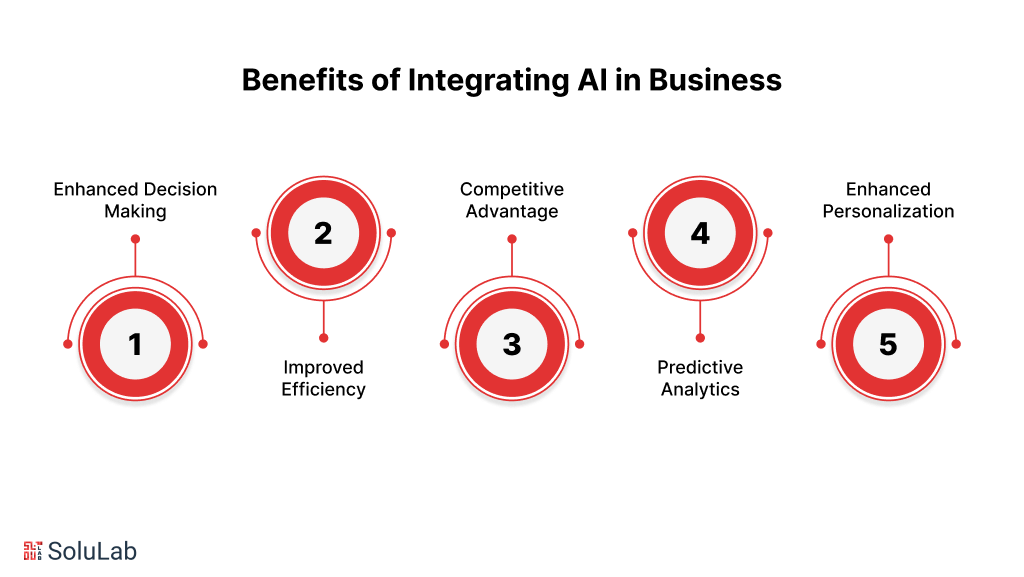
So what do you actually get when AI goes into your business systems? Usually three things: more output per person, lower costs, and happier customers. Here’s where the growth tends to come from:
1. Enhanced Decision Making: AI can chew through mountains of data, find the patterns, and make predictions, which means your decisions rest on more than a hunch. Think customer behavior, market trends, financial records. Some of those insights are hard for people to find. Some are close to impossible. AI also helps you size up risk, tune pricing, and decide where hiring money and resources should go. The better you understand how the technology works, the more of that value you’ll actually capture.
2. Improved Efficiency: Nobody joined your company to retype invoices. Automation built on AI takes over the repetitive, clock-eating work so people can spend their hours on things that matter more. Data entry, routine customer service questions, and inventory tracking are the usual first candidates. It also cuts mistakes in error-prone jobs like transcription and financial calculations. Add those gains up and overall productivity moves.
3. Competitive Advantage: Used well, AI gives you a way to stand apart and stay a step ahead of rivals. You can build new products and services with it, sharpen the customer experience, and tighten operations. Picture personalized shopping recommendations, chatbots answering support questions around the clock, or smarter supply chain logistics. That ability to adapt is what keeps a company’s edge from wearing down.
4. Predictive Analytics: Look backward to see forward. AI studies historical data, picks out trends, and gives you a read on market shifts, changing customer preferences, and trouble before it shows up. That’s a real head start. You can forecast inventory, plan supply chains, and shape personalized marketing around those predictions instead of reacting after the fact.
5. Enhanced Personalization: Because AI can process so much data, it lets you treat each customer a little more like an individual. The system watches behavior, preferences, and past interactions, then suggests products and services that fit. Customers notice. Satisfaction goes up, loyalty grows, and the relationship lasts longer.
How Software Companies Can Empower Your Business with AI?
2023 was the year generative AI stepped onto the main stage. It was a turning point. And as the technology keeps moving, more businesses are seeing what it could do for productivity and for launching new products and services.
But getting the full value takes thought. There are ethical and technical traps to work around, AI bias and hallucinations being the two you’ll hear about most, and you want the upside without the damage. A few recommendations for adopting AI responsibly and well:
- Input Error Reduction
People make mistakes. That’s not a criticism, it’s just how we’re built, and repetitive data handling is where it shows most. Attention drifts over a long shift, and an error you’d have caught at 9 a.m. slips through at 4 p.m. AI systems don’t get tired in that way. They keep error rates low across every process, critical ones included, and handle data the same way every time. This use of AI in business shows how different kinds of AI can lift operational efficiency. As you plan where AI fits in your company’s future, error reduction is one of the most practical places to start, and the productivity payoff can be large.
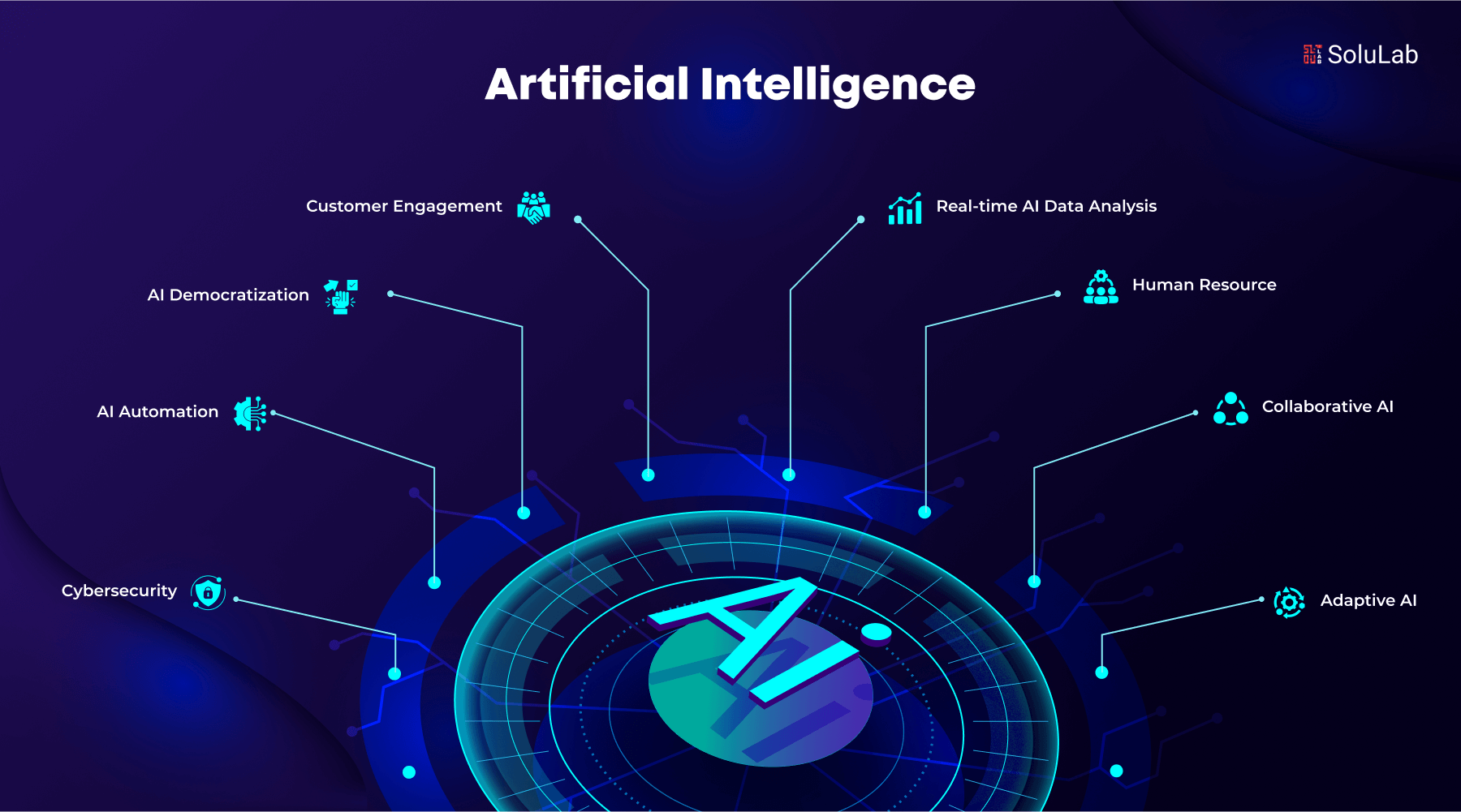
- Cybersecurity
Security teams use AI to watch system activity and flag weak spots, which lets them stop attacks before they land. AI has spread so widely through IT that it earned its own name: AIOps. It automates tasks, tidies up data, and guards infrastructure. Forget the 90s movies where the computer turns on everyone. In the tech industry, AI is mostly a very useful colleague. The same thing is happening elsewhere, the way artificial intelligence in healthcare is changing patient care through a range of AI applications. Security is just one field where the technology makes work faster and more effective. There are plenty of others.
Check our Blog Post: Business Guide to Edge AI Development
- Human Performance
AI is excellent at some jobs. Speed-sensitive work, juggling many tasks at once, processing enormous volumes of data: it wins there. Ask it for intuition, empathy, or creativity, though, and it struggles. Leadership and conflict resolution are the same story. Those skills are deeply human and hard to copy. So don’t treat AI as a replacement for your people. Treat it as something that makes them sharper. Put the strengths of both together and the results can be striking. A marketing company, for instance, can use AI’s analytics and NLP applications to predict what consumers will want with real accuracy. AI as a service also lets businesses plug in advanced technology without building a large in-house team first. Still, a campaign that moves people emotionally comes from people. Doctors are a similar case. They can lean on AI to keep up with new research and treatment options. But the treatment plan, the one that weighs a patient’s emotional and physical well-being together, is still the human doctor’s call.
- Customer Engagement
AI tailors content for each customer, new or returning, which makes the experience better and lets you get ahead of problems. Satisfaction and loyalty both rise. These systems never clock out. Advanced algorithms and natural language processing (NLP) keep support running 24 hours a day, so replies come right away and nobody sits in a queue. Behind that, the system is reading a lot of customer data and learning individual habits and preferences. That understanding is what powers AI as a service recommendations and fixes problems before the customer has to ask.
- AI System
AI doesn’t improve itself in a vacuum. People are the ones who catch its blind spots, bias and hallucinations especially, by keeping an eye on output and flagging the bad cases. Research from the University of California, Irvine, backed up a hybrid approach: when humans and AI both analyzed a varied set of images, accuracy went up. The lesson for businesses is simple. Train your staff to work alongside AI so the algorithms keep getting better. That heads off bad outcomes now and later, teaches the system to account for ethics, and stops old mistakes from repeating. You can also bring Generative AI CRM into your processes to strengthen customer relationships, and use AI in finance to sharpen financial operations and decisions.
DO YOU KNOW?
“Brazil is expected to register the highest CAGR in the artificial intelligence market from 2024 to 2030.”
- AI Automation
One of AI’s quieter wins is that it makes the software you already own work harder. Hand off repetitive chores like data entry and content generation, and AI automation frees your team to spend its energy on the problems that actually need them. Productivity goes up. Decisions get better. Growth tends to follow. AI tools also speed up problem-solving by suggesting fixes automatically, so issues get closed faster. Adaptive AI matters a lot here, because it adjusts on the fly as real-time data comes in. And if you work with a leading AI development companies, you can push these gains further with solutions shaped around what your business specifically needs.
Read Blog: AI in the Retail Industry in Australia
- Real-time AI
AI only reaches its potential when it works on live data, data in motion. Data is what AI eats. It feeds the algorithms and trains the large language models. A system is only as good as how accurate and how fresh its data is. Build an AI application on wrong or stale information and it’s worse than useless: it can spread social biases or push false information further. That’s why real-time AI matters so much. These systems take in data as it streams and respond straight away. Imagine an AI agent chatting with a shopper. It had better know when the last unit of the product they want has just sold. In an emergency, real-time AI can cut response times, and that can save lives. For banks, it changes fraud detection completely, scanning transactions the instant they happen and catching suspicious patterns at speeds no team could match. This is a big shift, and it’s worth working out how to bring it into your own business. Do that, and you get the right information, in the right context, at the moment you need it.
- Data Analysis
Every successful business runs on data. Full stop. But data at scale needs a serious system to make sense of it, and AI offers an ethical way to do that, analyzing current and historical records at remarkable speed. Now imagine a company where each decision traces back to evidence. That’s the real promise behind the question of what artificial intelligence is. Guesswork and speculation fall away, and a clear grasp of the artificial intelligence definition gives your team the confidence to decide on facts. Once you understand what AI artificial intelligence actually is, you can start getting the most out of it.
- LLMs Usage
“Two brains are better than one” applies to AI too. Several brains are better still. Large Language Models (LLMs) are the backbone of generative AI, and businesses should use a few of them instead of betting everything on one. Combining LLMs makes AI systems more accurate and more dependable. If one model stumbles on a certain type of text, another can pick up the slack. Specialization helps too. One model writes; another retrieves information. Cheap models handle the simple stuff, and the pricier ones take on hard analysis. There’s a second point, and it’s about security: favor private LLMs over public ones. Public models are trained on public data, and with a clever enough prompt they can leak sensitive information, which opens the door to fraud or theft. Private LLMs reduce that risk because they draw only on an organization’s own data and only authorized people can reach them. Getting clear on AI artificial intelligence helps explain how artificial intelligence works and what the definition of artificial intelligence really covers. The artificial intelligence meaning gets sharper once you see the different types of AI and the future of AI.
The Future of AI: Trends to Watch
New advances keep arriving, and several of them look set to reshape whole industries over the next few years. Keep track of them and you’ll get far more out of AI. These are the trends worth watching:
1. AI Democratization: AI platforms and tools are getting easier to reach for businesses of every size, so even a company without deep technical skills can put AI to work. Much of this happens through AI as a Service (AIaaS), where ready-made models can be plugged into day-to-day operations.
2. Generative AI’s Growth: Models that create things, text, images, even code, are picking up speed. Tools such as Generative AI CRM are strengthening customer relationships by writing personalized replies automatically and surfacing predictive insights about customers.
3. AI and Ethics: The deeper AI gets into decision-making, the more bias, fairness, and accountability matter. Attention to responsible AI development will push businesses toward frameworks that keep AI in line with what society values.
4. Adaptive AI: Systems are getting better at adjusting to new data as it arrives, so companies can react quickly when conditions change. Adaptive AI applications is especially useful in fast-moving sectors like finance, healthcare, and e-commerce.
5. AI in Hyper-Automation: Companies are pairing AI with robotic process automation (RPA) to reach hyper-automation, using AI-driven processes to automate tasks that used to be too complex to hand off. Expect this to lift efficiency further and trim costs.
6. Collaborative AI: Expect more people and AI agents working side by side. The agents take the repetitive work. The people take the creative and strategic work. Teams end up working smarter, and faster.
How SoluLab Can Help For Businesses Using AI?
Look at what artificial intelligence is and what it can do for operations, and one thing stands out: AI artificial intelligence has room to change a lot of industries. Once businesses understand the artificial intelligence definition and how artificial intelligence works, they can put AI in Business to use and see real gains in efficiency and decision-making. And the artificial intelligence meaning goes well past automation. It covers applications of AI such as AI in healthcare, AI in FinTech, and Generative AI CRM.
Here’s one we built. Digital Quest, a travel business, wanted better user engagement and customer service, so we developed an AI-powered chatbot for them. The chatbot runs on Generative AI. It gives travelers personalized recommendations and speeds up bookings by pulling the relevant data straight from Digital Quest’s website.
Most companies don’t want to figure all this out alone, which is where software firms that specialize in AI development come in. SoluLab brings hands-on expertise in AI agents and AI as a service, and we work with companies that want AI running inside their day-to-day operations. Partner with AI development Company like SoluLab, and you can put AI artificial intelligence to work on growth, sharper processes, and the strategic goals you’ve already set.
FAQs
1. What is artificial intelligence?
Artificial intelligence (AI) is the branch of computer science that builds systems able to handle tasks that normally need human intelligence. Learning, reasoning, solving problems, and understanding natural language all fall under it.
2. What is AI artificial intelligence?
“AI artificial intelligence” is a phrase that puts the focus on using AI technologies to copy or extend human abilities across different applications. It covers the tools and methods people use to build intelligent systems.
3. What is the definition of artificial intelligence?
Put simply, artificial intelligence is the study and building of computer systems that can do tasks calling for human-like intelligence. That means recognizing patterns, learning from data, and making decisions based on what they’ve learned.
4. How does artificial intelligence work?
AI systems take in large amounts of data, find the patterns in it, and use them to predict or decide. Algorithms and machine learning models do the analysis, and performance keeps improving as the system sees more data.
5. What are the different types of AI?
There are several, including NLP applications, Generative AI CRM, and Adaptive AI. They run from basic rule-based systems all the way to complex models that learn and adapt from experience.
Shipra Garg is a tech-focused content strategist and copywriter specializing in Web3, blockchain, and artificial intelligence. She has worked with startups and enterprise teams to craft high-conversion content that bridges deep tech with business impact. Her work translates complex innovations into clear, credible, and engaging narratives that drive growth and build trust in emerging tech markets.