Key Takeaways
- Autonomous AI agent cost is a formula, not a price. Tokens per step, times steps per task, times tasks per month, times the live rate.
- Per-task cost matters more than per-call cost. One task can become ten billed model calls, because the agent plans, acts, reads and retries.
- Output tokens usually cost more than input tokens. As a result, capping verbosity has an outsized effect on the bill.
- Tokens are the largest line, but never the only one. Orchestration, vector storage, hosting, monitoring and human review all recur monthly.
- Model routing has the highest ceiling of any lever. Send easy steps to a small model, then reserve GPT-4 for genuine reasoning.
- Start with step limits and output caps. They are fast, safe and they bound your worst case immediately.
- Year-one TCO is not twelve times the monthly bill. Add amortised build cost and ongoing maintenance, because models and data both change.
Autonomous AI agent cost per month comes mostly from GPT-4 API token spend. You calculate it as tokens per task, times tasks per month, times the API rate, plus infrastructure. Therefore the figure is an output of your own usage, not a fixed price. The worked model below shows you how to get your own number.
Teams pricing an agent usually want a figure they can put in a budget. However, most guides give a range instead. If you are close to that decision, SoluLab’s AI agent development team builds and instruments agents so the monthly bill stays predictable before you ship.
On this page: the run-cost formula, where to find live GPT-4 API pricing, a worked three-tier example, the five costs beyond tokens, why agents cost more per task, six levers that cut the bill, and year-one total cost of ownership.
What Does an Autonomous AI Agent Cost to Run per Month?
The monthly autonomous AI agent cost is GPT-4 API inference spend plus supporting opex. That opex covers orchestration runtime, a vector or memory store, hosting, monitoring and any human review. Inference is usually the largest single line, so start there.
Published breakdowns from agencies and vendors span a wide band, and one such breakdown puts a GPT-4 or Claude agent at $3,200 to $13,000 per month covering LLM API calls, vector database hosting and infrastructure. However, confirm any figure against your own usage before you budget against it.
That range is too wide to plan with, which is rather the point. The number is not a price tag. Instead, it is an output of your usage. Change the tokens per task or the tasks per month, and the figure moves with it.
How Is Autonomous AI Agent Cost Calculated?
The core method is one multiplication. Work it left to right.
Monthly inference cost = (prompt tokens + completion tokens) per step × steps per task × tasks per month × the GPT-4 API rate.
1. Tokens per step. Add the input tokens the model reads and the output tokens it writes for a single model call.
2. Steps per task. In practice, an autonomous agent rarely answers in one call. It plans, calls tools, reads results, then re-reasons.
3. Tasks per month. In other words, how many times the agent runs. For a support agent, that means tickets handled.
4. Rate per token. Input and output tokens are priced separately, and in addition the rate differs by model variant.
Do this once and you have a repeatable model. Furthermore, if you swap in real token counts from a few sample runs, the estimate tightens considerably.
What GPT-4 API Pricing Do You Plug In?
GPT-4 API pricing has two separate rates. One covers input tokens the model reads. The other, higher rate covers output tokens it generates. Consequently, verbose agents pay a premium.
Because these numbers move, treat any dollar figure in a blog as stale. Use the official OpenAI API pricing page as your source of truth, and Azure OpenAI pricing if you run through Azure.
Meanwhile, two practical rules apply when you read the pricing table.
Match the exact model string your agent calls. For example, a mini or flash variant can cost a fraction of the flagship rate.
Check for cached-input pricing. Repeated context, such as a fixed system prompt, may bill at a discounted rate on some models.
What Does a Worked Example Look Like?
Below is a three-tier worked example. The token counts and task volumes are illustrative inputs you replace with your own. Similarly, the dollar outputs stay blank on purpose, because they depend on the live rate you plug in.
| Usage tier | Tokens per task (in + out) | Tasks per month | Total tokens / month | Monthly inference cost |
| Low volume (internal tool) | ~8,000 across ~4 steps | 2,000 | ~16 million | 16M × your blended rate |
| Medium volume (customer support) | ~15,000 across ~6 steps | 10,000 | ~150 million | 150M × your blended rate |
| High volume (product feature) | ~25,000 across ~10 steps | 50,000 | ~1.25 billion | 1.25B × your blended rate |
Read the table as a method rather than a quote. Notice that the jump from low to high is not linear in tasks alone. Heavier tasks also use more tokens per step, so cost climbs on two axes at once. Blend your input and output rates according to your own token split before you multiply.
What Else Adds to Autonomous AI Agent Cost?
GPT-4 tokens are the biggest line for most agents. Nevertheless, they are not the whole bill. A realistic monthly opex stack has six parts.
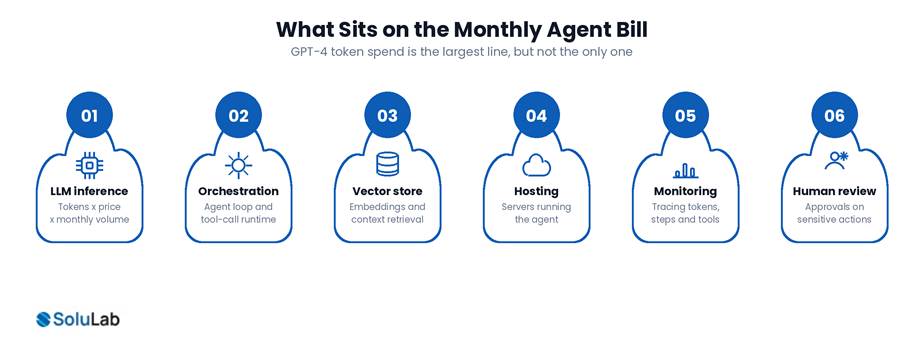
LLM inference. The token spend from the model above. Typically the largest item by a distance.
Orchestration runtime. The framework and compute that runs the agent loop, plans steps and calls tools.
Vector database or memory store. If the agent retrieves from your data, you pay for a managed vector store or self-hosted infrastructure.
Hosting and compute. The API endpoints, queues and background workers that keep the agent available.
Logging and monitoring. Tracing every step, token and tool call, so you can debug and control spend.
Human-in-the-loop review. For example, on sensitive actions a person approves or corrects the agent. That labour recurs.
Ignore the last five and your budget will be wrong. The token bill is what people quote. Meanwhile, the opex stack is what actually shows up on the invoice.
Why Do Agents Cost More per Task Than a Single API Call?
An autonomous agent makes many model calls to finish one job, and each call re-sends context. By contrast, a single chatbot reply is one input plus one output. An agent plans, acts, reads a tool result, re-reasons and often retries. Four multipliers push the bill up.
Reasoning loops. In short, multi-step planning means several model calls per task instead of one.
Tool-call retries. Whenever a tool fails, the agent calls the model again to recover.
Long system prompts. Agents carry detailed instructions and tool definitions in every call, and you pay for those input tokens each time.
Context re-injection. Moreover, running state, prior steps and retrieved documents get re-sent on each step.
This is the autonomous premium. A task that looks like one question can quietly become ten billed calls. For that reason, per-task cost is the number that matters, not per-call cost.

How Do You Lower Autonomous AI Agent Cost?
You lower autonomous AI agent cost by cutting tokens and routing work to cheaper models, without breaking task quality. Six levers do most of the work.
Model routing. In other words, send easy steps to a small, cheap model and reserve GPT-4 for hard reasoning.
Prompt and context compression. Trim system prompts, summarise prior steps and drop stale context, so each call carries less weight.
Caching. Similarly, reuse results for repeated queries, and use cached-input pricing for stable prompt chunks.
Output token caps. Set a maximum output length. Because output usually costs more than input, capping verbosity pays off quickly.
Step limits. Additionally, cap how many reasoning loops a task may run. This bounds your worst case and stops runaway loops.
Batching. Alternatively, group non-urgent work so you pay for fewer, larger calls where the API supports it.
The order matters. First, apply output caps and step limits, since both are fast and safe. Next, test model routing, which has the highest ceiling. Finally, add compression and caching for steady structural savings.
What Is the Full Year-One Total Cost of Ownership?
Total cost of ownership over a year is monthly opex times twelve, plus amortised build cost, plus ongoing maintenance. Monthly run cost answers what it costs to keep the agent on. TCO answers what the agent costs the business this year.
Amortised build. This is the one-time cost to design, develop and deploy the agent, spread across the year.
Twelve months of opex. The monthly stack above, multiplied out and adjusted for growth in task volume.
Maintenance. Prompt updates, model migrations when a variant is deprecated, monitoring upkeep and re-tuning.
Budget owners who track only the monthly API bill get surprised by maintenance. Therefore, plan a recurring annual slice of the build cost to keep the agent working as models and data change.
When Is GPT-4 the Wrong Choice on Cost?
GPT-4 is the wrong choice when a task is simple, high-volume and repetitive, because a smaller or open-weight model handles it at a fraction of the token cost. After all, not every step needs frontier reasoning. Classifying an intent, extracting a field or formatting a response are all jobs a mini model often does well.
Three signals suggest GPT-4 is overkill on a given step.
The step is structured and narrow. Fixed input, predictable output, little open-ended reasoning.
Volume is high. Indeed, at millions of calls even a small per-token gap becomes a large monthly number.
Latency and privacy matter more than peak quality. A self-hosted open-weight model keeps data in your environment.
The honest answer is a mix. Use GPT-4 for the reasoning that justifies it, then route everything else down. A page that tells you to run GPT-4 on every step is selling tokens rather than solving your cost problem.
Where Does SoluLab Fit?
SoluLab builds autonomous agents with cost control designed in from the start, rather than bolted on after the first invoice. In practice, our engineers meter token spend per step in production, so you can see which reasoning loops and tools drive the bill. That instrumentation turns the formula above into a live dashboard instead of a monthly surprise.
If you are scoping an agent and need a predictable monthly number, our AI agent development company team models your token usage and builds with routing, caching and step limits already in place. For the deployment and observability side, our AI deployment services cover monitoring and cost visibility once the agent is live. We also build across the wider stack through our AI development company practice.
Frequently Asked Questions
Shipra Garg is a tech-focused content strategist and copywriter specializing in Web3, blockchain, and artificial intelligence. She has worked with startups and enterprise teams to craft high-conversion content that bridges deep tech with business impact. Her work translates complex innovations into clear, credible, and engaging narratives that drive growth and build trust in emerging tech markets.